

12 Best Ways To Use Deli Meat Beyond A Sandwich Or Charcuterie Board
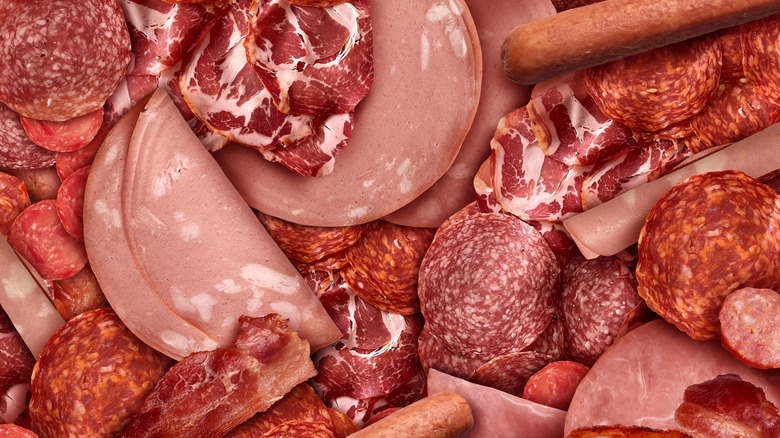
For many of us, when we think of deli meat, we think of one thing: sandwich. And when we think of cured meat like salami or prosciutto, we often automatically envision charcuterie. And who can blame us? Those two things are freaking awesome. But many other things can be done with these cold cuts and cured meats — and we're not just talking about a Lady Gaga meat dress (though it's probably best not to use mortadella for such a purpose). There are actual alternative methods to eating these delicatessen delights.
You may be going keto or keeping to a gluten-free diet. You may not have the time nor inclination to construct a charcuterie spread. You may just be over the idea of sandwiches (tough to imagine that one). Whatever the case, there are plenty of great options for our paper-packed, plastic-wrapped pounds of sliced turkey and cured, cased logs of capocollo.
To get some advice and fresh ideas, The Takeout spoke with Sarri Harper, CEO of Carnegie Deli. Yes, that Carnegie Deli — the legendary, erstwhile NYC eatery that lives on as an all-purpose retailer, wholesaler, restaurant collaborator, and select seasonal vendor. Harper is the granddaughter of former co-owner Milton Parker, who helped steward the famous pastrami house through its halcyon days of the 1970s and beyond. She knows meat, and she knows its many possibilities. Here are 12 of those possibilities that go beyond sandwiches and charcuterie. Warning: We're not responsible for any resulting salivation puddles.
1. Hash
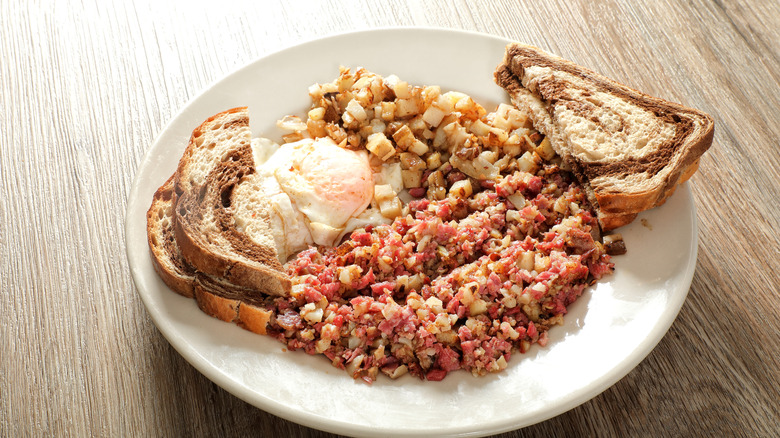
Corned beef has a funny name. To the uninitiated, what does "corned" even mean? What do you picture? You might picture corn, understandably — but you'd be wrong, and how dare you picture it? You should instead know that "corns" was the ancient nickname for large grains of salt. It's safe to say, the epithet has carried over, albeit in this one niche — this one, delicious niche.
Obviously, corned beef — a deli meat, after all — is famously used in a hash. Any diner worth its salt (pardon the expression) can deliver you a decent plate of it. But hash doesn't have to be only a corned beef thing. "Pastrami or corned beef works really well in a hash with crispy potatoes and eggs," says Sarri Harper, pointing to how the meats can be used interchangeably. The two never seem to be far from one another, and certainly weren't at Carnegie Deli, though there are big differences between pastrami and corned beef.
Really, if you're making crispy potatoes and some runny eggs, you can probably throw almost any deli meat in with it and get a favorable result. South Carolina hash uses pork butt, so we don't see a reason why sliced ham can't be a part of the hash party, too. (No, not that kind of hash party.)
2. Pot pie
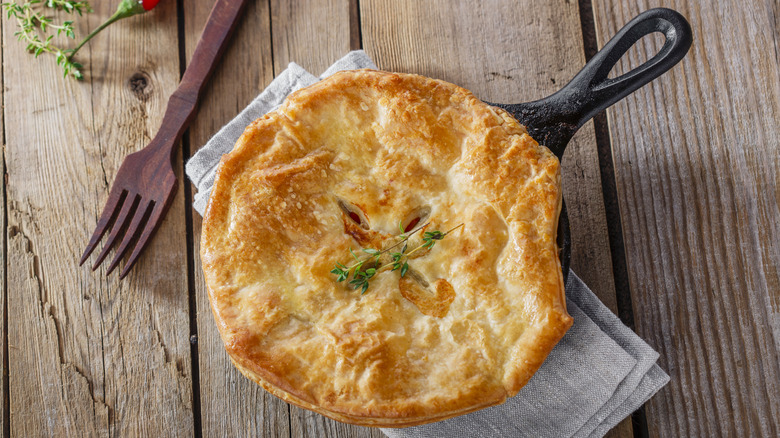
Pot pies, or at least pastry shells filled with meat and other ingredients, date back to Ancient Rome. They found their more modern footing in the England of the 1500s, and meat pies are still a big part of British cuisine. Of course, they also made their way over to the U.S. in due time — with one version becoming more popular than all others. That would be the classic, cozy chicken pot pie.
Chicken pot pie has its American origins with the Pennsylvania Dutch, who actually first made it with noodles before properly pie-ing it. In the 1950s, when Swanson introduced the first frozen chicken pot pie as a comfort-food TV dinner, it made the meal a staple in many homes. As familiar a dish as it is, though, it can be tinkered with. Instead of chicken, you can easily incorporate turkey into a pot pie, utilizing the latter meat's very incorporate-able characteristics.
"Lighter and more neutral, almost like a blank canvas," is how Harper describes the flesh of the gobbler. "It works in a wider range of combinations." Pot pie is just one example of a composed dish that is a perfect showcase for turkey. The mild meat works well with other common pot pie ingredients such as celery, carrots, peas, and onions.
3. Mac and cheese
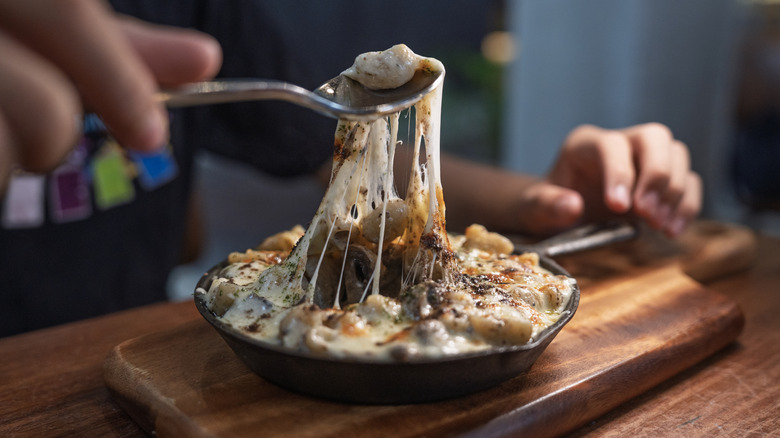
Thomas Jefferson has been given credit for a lot of things foundational to the U.S. This includes popularizing mac and cheese stateside (although the kudos should really go to one of his enslaved workers, the chef James Hemmings). One of the brilliant things about the imported and adapted pasta dish is that there is endless room for enhancement. This is part of the great versatility that baked mac and cheese has to offer.
By enhancement, we mean meat. "Ham can be baked into mac and cheese," Harper posits, getting straight to the point. (And why not? Why take any detours whatsoever when ham is the destination?) Harper says that ham "adds salt and depth to dishes like mac and cheese". But while nobody would blame you for doing so, you don't have to stop with ham.
Pastrami is an equally great addition to the dish (because why wouldn't it be?) but corned beef, and even bologna, shouldn't be crossed off as possibilities, either. "The key is using deli meats that are already seasoned and structured so they can stand on their own in a composed dish," Harper declares. It'd be interesting to know what Thomas Jefferson (or Mr. Hemmings, rather) would think of these meaty modifications.
4. Pasta salad
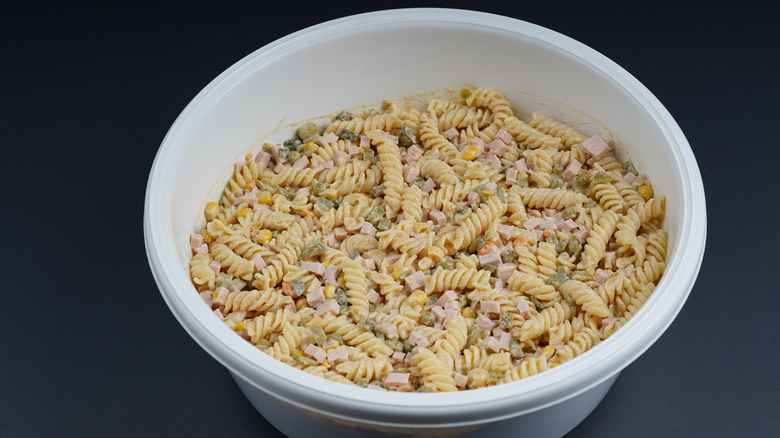
Although cold pasta salads go back hundreds of years in Mediterranean cuisine, and are essentially spinoffs of Italian antipasto dishes, they are somehow hella American. Just think of the cookouts, picnics, and backyard summer parties that wouldn't be complete without pasta salad. It's the perfect concoction in which to put very little (or a lot of) thought into, as it can be thrown together quickly or constructed very carefully. And it's a canvas for a wide range of ingredients — including proteins.
"Think of deli meats as ready-to-use proteins," Harper advises. "You're building a full dish, not just stacking a sandwich." With that in mind, it's easy to see how almost any deli meat can be used in a pasta salad. Since cold cuts are, well, cold, or at least not hot, they can literally be tossed into any kind of pasta mix at your whims, whether those be modest homemaker whims or mad kitchen scientist whims.
"Turkey works really well in salads because it's lighter and more neutral — it takes on whatever dressing or ingredients you're pairing it with without overpowering the dish," says Harper before reminding us that roast beef is also quite versatile. Also don't sleep on salami or ham, as long as they're not over-infused. They "add more salt and richness, so a little goes a long way."
5. Quesadilla
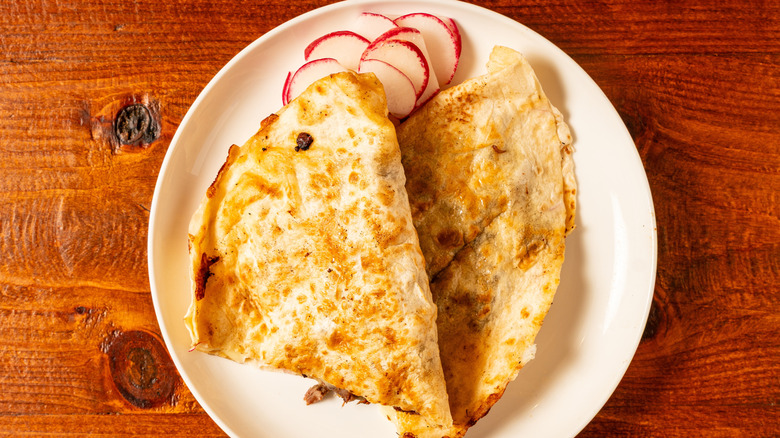
The quesadilla is both deeply authentic and endlessly adapted. Its authenticity comes from the fact that it was born out of (most likely) colonial Mexican and Spanish influences. Its adaptations in the U.S., meanwhile, have gone well beyond Tex-Mex to make the quesadilla a staple in many American eating arenas. Today, you'll find quesadillas in fast-casual restaurants, sit-down chains, Irish pubs, diners, corner delis, everywhere. Everywhere means everything, as far as potential ingredients go. And the last time we checked, "everything" includes deli meats.
It should come as no shock that a warm carb like a tortilla double-padding melted cheese would be an ideal abode for cold cuts. "Roast beef is great in a flatbread or quesadilla with cheese and something acidic like balsamic," Harper says, giving us one delicious idea. The balsamic would work well to kick the flavor up a notch and balance out the understated flavor of the roast beef.
Sure, this may not be your abuela's quesadilla — or Hernán Cortés', for that matter — but a deli meat is sure to make the eating experience more enjoyable. Choose your favorite to make it all your own, like seemingly everyone else has done. No matter which meat you use, though, keep in mind our tips for making the perfect quesadilla.
6. Scrambled eggs
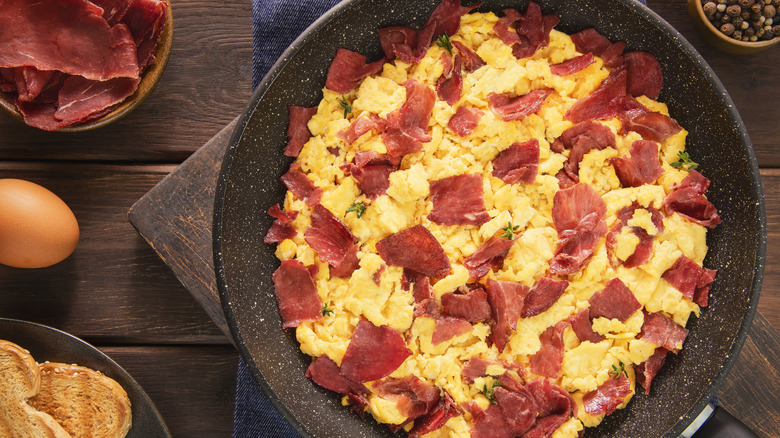
"Salami or soppressata can be chopped into eggs," proclaims Harper. It's certainly tough to argue that, especially if you've ever had a salami, egg, and cheese sandwich from a Dominican bodega in Washington Heights. There's a bite to the meat that beautifully complements the plushness of eggs. It's like mixing a crocodile with a sheep. Actually, that's a horrifying image; scratch that.
Misguided analogy aside, you don't need to make an egg sandwich to apply a protein. Rich and fluffy scrambled eggs (there are plenty of tricks to make the fluffiest scrambled eggs) are just begging for a deli meat that has a robust, savory flavor. There's no need to limit yourself to just salami or ham. Bologna can certainly partner with eggs, especially when you remember Harper's tip that "bologna is best when it's seared until crispy and used almost like bacon."
We shouldn't leave pastrami out, either. In fact, according to Harper, it should never be left out of any equation: "Pastrami is always number one — it's packed with flavor and works across a range of dishes." We think that's well said, and a welcome replacement for the sheep-odile image in our heads.
7. Pizza
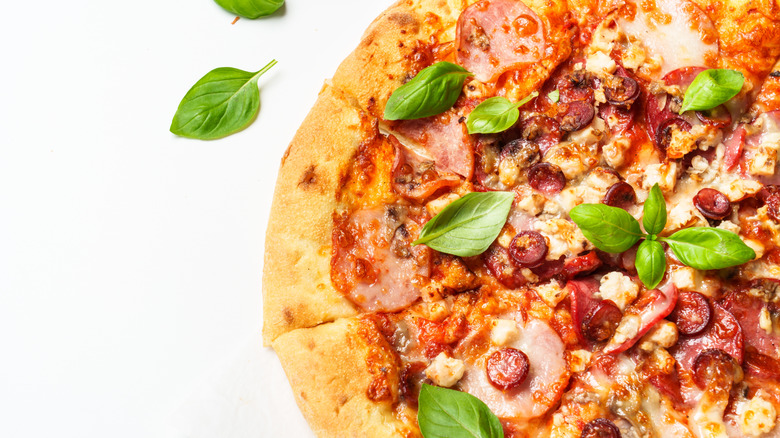
For this entry, we ask that you take off your pizza-ingredient-snob hat. (Also, that must be an interesting-looking hat.) Yes, to those who place an emphasis on some idea of authenticity, there are only about four ingredients that should go on a pizza. These don't include the featured toppings of the Canadian-born Hawaiian pizza, with its deli meat of ham paired with pineapple (to say nothing about the brave pizzaiola selling a meat-free pineapple pizza in Naples).
Pizza can be anything you want it to be, and deli meat as a topping should not only be suggested, but encouraged. Aside from the aforementioned ham, and obvious ones like salami (of which pepperoni is one type), don't be afraid to use something like mortadella, which Harper says "works well in warm dishes where the fat can melt slightly," or bologna. You don't even need to restrict yourself to crisped-up bologna, which can approximate a sausage topping. Also try uncooked bologna in the way that you would use prosciutto (yet another deli meat) on a pizza, or fuse the best of Italian and Jewish eats by getting crazy with pastrami as a topping. And by crazy we mean crazy good, because that's what it is.
8. Beans
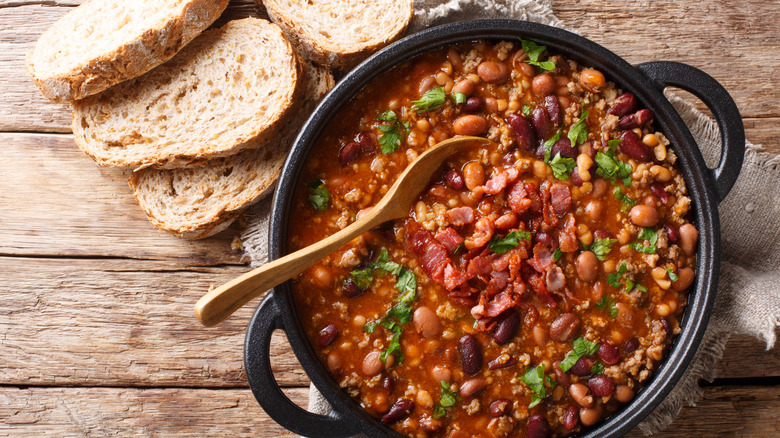
Let's talk about capocollo (sometimes spelled as capicola) for a moment. It's a cured deli meat that, despite its appearance, is different from salami. Whereas salami is made from ground, seasoned meat that's then cased, capocollo is meat from the pig's neck and shoulder that's cured and aged as a whole piece. Think of the two as Italian cousins who'll give each other a kiss on the cheek before sharing an espresso and Sambuca.
Although the salumi is a great feature in many sandwiches, including the Italian subs you need to try before you die, there's another, more legume-y way of utilizing it. Harper tells us that "capocollo is great added to beans," and there is no shortage of recipes that back up this claim. Various combinations of capocollo and beans have been added to pasta, used in a stuffing, and just enjoyed together as is. Cappy's cousin salami also goes well with beans, giving a similar flavor experience.
Of course, you don't have to get delicate or highfalutin with this combination. Ham and white beans is a classic, rustic, Southern comfort dish. And although it's generally made with chunks of leftover dinner ham, the cold cut variety can easily be incorporated in its stead.
9. Vegetable mix
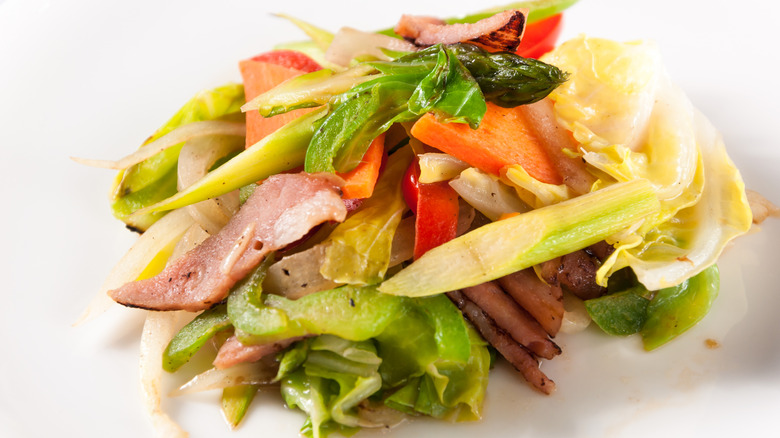
There you are, looking at bunch of vegetables in your crisper. You're going to sauté some onions, chop up the veggies, throw them in a pan, and season them up a bit. Alternatively, you could decide to roast them on a baking sheet. Either way, you've got yourself a healthy, satisfactory dish. It could use just a little something else in there, something for the soul to balance out the nutritiousness. But what?
That's when you go into your other crisper and unwrap some sliced deli meat to add to your dish. Capocollo — if you have it on hand — is fantastic for this purpose, according to Harper. She also likes to go with "already seasoned and structured" corned beef for all kinds of cooking. However, more budget-friendly cold cuts can do the job just as well. If you're pan-frying veggies, try adding some bologna or ham (though maybe avoid using less salt). If you're roasting, give turkey a go. Follow our simple steps to get restaurant-quality cooked vegetables, and you'll be all set and well satiated.
10. Risotto
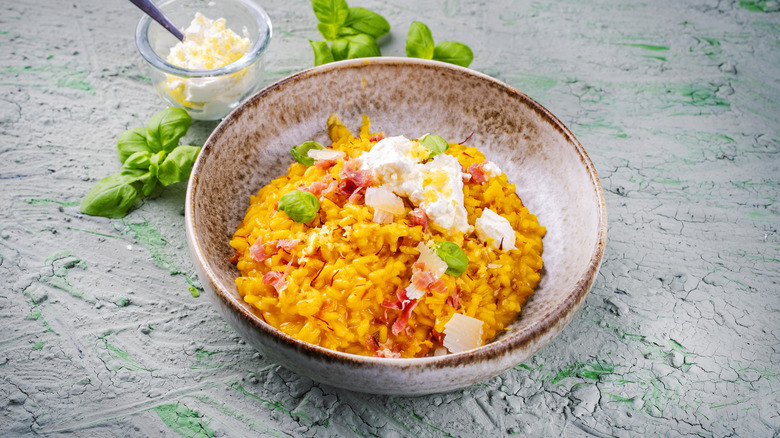
The exact origins of risotto are rather murky. In order for the dish to be created in northern Italy, rice had to be brought by the Arabs to the Italian peninsula via Sicily during the 1300s. It made its way up through the valleys of the River Po. Eventually, the risotto we recognize today was first seen in a cookbook around 500 years later, in the 1820s.
It's safe to say that first risotto recipe did not include deli meat. But fear not, present-day person. Risotto is a great vehicle for deli meat, especially mortadella. Its meltable fat — the same one that Harper rhapsodizes about — can work its way into the dish, with delicious results. Just remember not to rinse the rice; that's a trick to making a creamy risotto that pairs well with your delicatessen fare.
For an absolute delight of a dinner, combine two low-brow beauties into your risotto: beer and deli meat. This is where mortadella can shine, as it will mingle gorgeously with the brewski component. Ham and risotto, meanwhile, makes for a classic take, especially when peas get involved. The same goes for turkey, especially when it teams up with mushrooms.
11. Grain bowls
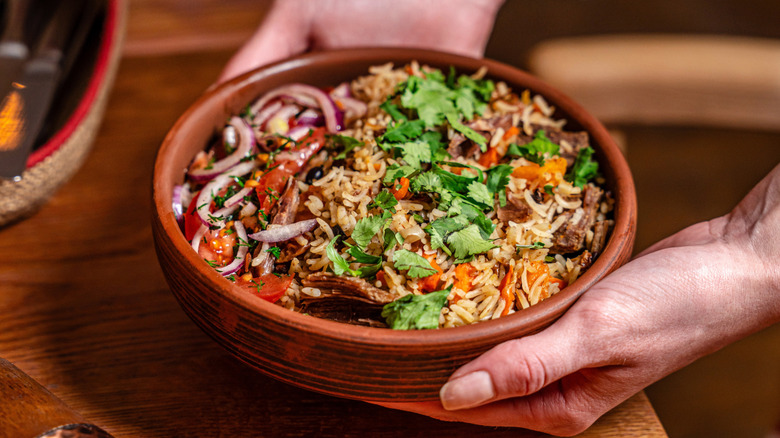
Bowls are clutch. The concave vessels can be filled with an endless array of comestibles, ingredients, and foodstuffs — hot, cold, or in between. One method of designing a meal for the bulbous dinnerware is to create a grain bowl, and one way of augmenting a grain bowl is to add deli meat.
Which deli meat you add is up to you. Harper says a go-to pick for her is turkey, but that's not the only deli meat to reach for when thinking of ways to spice up a bland grain bowl. "Pastrami can work especially well in a warm salad, like a potato or grain-based dish, where the flavor can hold up," she explains.
No matter what you're tossing in with your grains and veggies, it's best to use the highest-quality deli meats. How can you tell the good from the bad? Harper breaks it down: "High-quality deli meat should look and taste like real meat — you want to see texture and grain, not something overly smooth or processed. The color should be natural, the seasoning should be visible, and it should smell fresh. If it looks slick or wet, overly uniform, or has an off smell, those are signs of lower quality."
12. Crispy fried bologna
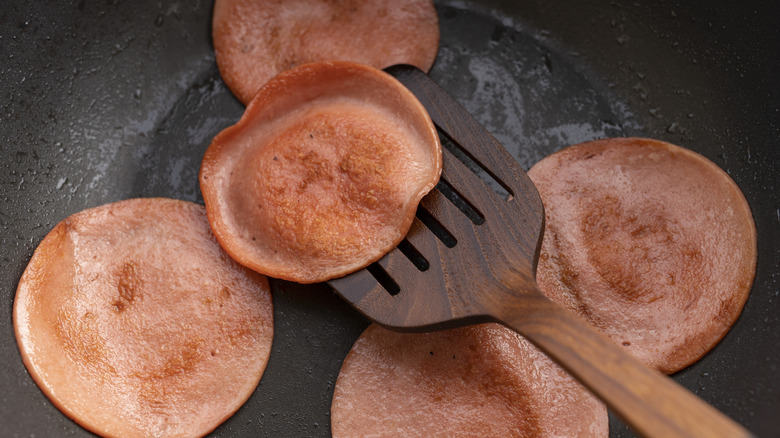
When asked about bologna, Harper proclaims, "Frying bologna is a classic!" And we fully support this level of enthusiasm. Charred, crispy bologna is indeed an exclamatory yum-fest. Plus, frying it does away with some of the mystery-meat vibe of the cold cut — which is honestly a bit of an unfair perception.
Bologna, after all, is just a spinoff of mortadella — and yes, the Oscar Mayer-ized deli meat's ancestral home is indeed the city of Bologna. The names share the same letters but have two very different pronunciations, probably due to the food being brought by Bolognese immigrants into melting pots like New York City, thus traveling like culinary and dialectic pinball.
The processed sausage slices have gone on to become as American as a catcher's mitt. Even Snoop Doog has a favorite fried bologna sandwich. But fried bologna is a dish — yes, a dish — that can be eaten all on its own, or at least as a centerpiece, sans sandwich bread. It can be enjoyed with cheese and crackers, curled up into cups that can be filled with scrambled eggs, or made musubi-style. (Hell, if you can do it with Spam, why not bologna?)