

What Everyday Essentials Really Cost At Walmart, Aldi, Target, And Costco In 2026
Paying for groceries has become a major source of anxiety for the average American. According to LendingTree, the vast majority of shoppers have altered their buying habits due to cost, since about 60% regularly worry about how much they spend at the supermarket. One of the approaches being adopted by strained consumers has been to quit buying splurge items in order to afford the essentials and everyday food needs.
But, what is the current state of the everyday essential? How much can even these set you back, especially at the biggest, most commonplace grocery retailers around? Four of them — Walmart, Aldi, Target, and Costco — make up close to 40 percent of their industry's market share (with Walmart admittedly leading the way by a large margin, at 20%, on its own). Many of us are getting our basic necessities from one of these giant chains.
We've done a bit of research, and, although prices will vary in different markets around the country (and can always fluctuate), these seem to be the going rates at said quartet of stores, in and around the New York City area, for staple items like eggs, rice, bananas, butter, yogurt, and more. Some may surprise you. Some may depress you. Some may give you hope. Some may send you off the grid.
Milk
Americans consume somewhere around 40 billion pounds of milk per year. Which is crazy when you think that the human adult wasn't lactose tolerant for its first few million years of existence. It even feels like the refrigerator was actually made for milk, over and above everything else that now gets placed in there. It's innate to mammals, and a staple on our shopping lists. So, what's the going rate?
We've gone with whole milk here, and it has nothing to do with promoting the new dietary guidelines proposed by the USDA and the Department of Health and Human Services. Target is selling its gallon of whole milk for $4.39. That's steep in comparison to Costco's $2.71 gallon. Aldi and Walmart are closer to the Target range, albeit a bit lower, at $3.13 and $4.06, respectively, for the Friendly Farms and Good & Gather versions.
This is where it pays to have a membership, as you're talking well over a dollar cheaper for Costco's milk when compared to the others. And, Costco does sell it by the single gallon, so you don't have to worry about hiring furniture movers to lug a multi-pack out of the store.
Coffee beans
According to recent statistics, the two-thirds of Americans drink coffee daily to the tune of roughly three cups per day. And, Voltaire, the famed French philosopher and writer, would drink approximately 40 cups each day. (Granted, he did this about 300 years before scientists would recommend keeping coffee consumption to the morning time only). Point is, coffee is an indelible part of many of our lives. Which begs the question: Can we even afford it these days?
Examining the cost of whole beans (and for Target we focused on the Lavazza brand, since Good & Gather doesn't seem to have a whole bean offering), it takes a bit of micro-math. When it comes to total cost, a 10-ounce bag of Walmart's Great Value Colombian Medium Dark Roast is going for $7.74. Costco's Kirkland House Blend is $17.99 (for 2.5 pounds), while Aldi's Simply Nature Organic Honduran is selling a bit higher than Walmart's: $7.99, but for 12 ounces. Target is sitting last here, selling its aforementioned Lavazza Dolcevita Classico for $10.39 per 12-ounce bag.
So, who's got the best bang for your bean then? When broken down by ounce it is Costco at 45 cents per, followed by Aldi at 67 cents, Walmart at 77 cents, and Target's Lavazza at 87 cents.
Eggs
"Eggflation" was a scary time. The industry wide price surge made it starkly obvious that the vast majority of us make eggs a regular part of our lives. We often don't think twice about scrambling some up, hard-boiling them, painting them for Easter, throwing them on Halloween, imitating a "Rocky" breakfast for Instagram, etc. Eggs are just always there. And, when we reach into the fridge unthinkingly, only to find they are gone, we're at a brief loss. But, how much do we have to spend now for this ovaloid staple?
All four retailers offer a basic carton of eggs through in-house brands. Walmart's dozen of large eggs, via Great Value, is selling for $1.67. Aldi's Goldhen large eggs are priced at the exact same amount, and Good & Gather at Target has a $1.89 12-count carton of ovum.
Costco famously sells its eggs in huge, wholesale amounts. But, for a measly two-dozen Kirkland large eggs, you'll be set back $4.30 — still higher per dozen than either of the other three. Guess Costco is human after all.
Salt
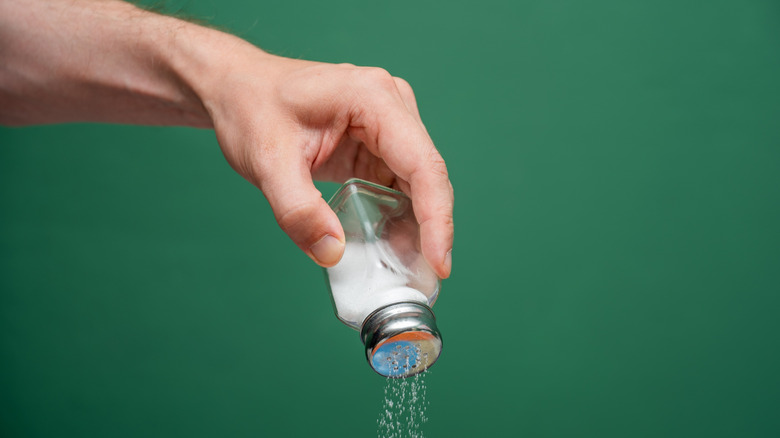
Salt is vital to us. For the many millennia prior to modern refrigeration, salt ensured survival by preserving our food. The mineral's impact is evident in metaphors like "salt of the earth," "salt on a wound," and "taken with a grain of salt." Somebody that's "worth their salt" has value, yet if they're "salty" then they're nobody you want to be around. All this to say that salt is important to people on a deeper level than the spice rack. However, we still have to go out and buy it.
Which one of the Big Four has the best deal? Walmart, Aldi, and Target all sell a 26-ounce container of plain table salt. The Great Value version is selling for $0.82, the Stonemill-labeled one from Aldi is only $0.67, and Good & Gather is as high as $0.99.
Costco's Kirkland brand only has sea salt, which is usually a tad higher than the plain iodized variety. It shows here as a 30-ounce container is $3.99, equaling a whopping 13 cents per ounce. Compare that to Walmart's 3.2 cents per ounce, Aldi's three cents, and Target's four cents, and that is a significant difference. Granted, again, it's sea salt versus plain salt here, but if you just need some salt, any salt in your kitchen, you might be best off going to Aldi.
Sliced bread
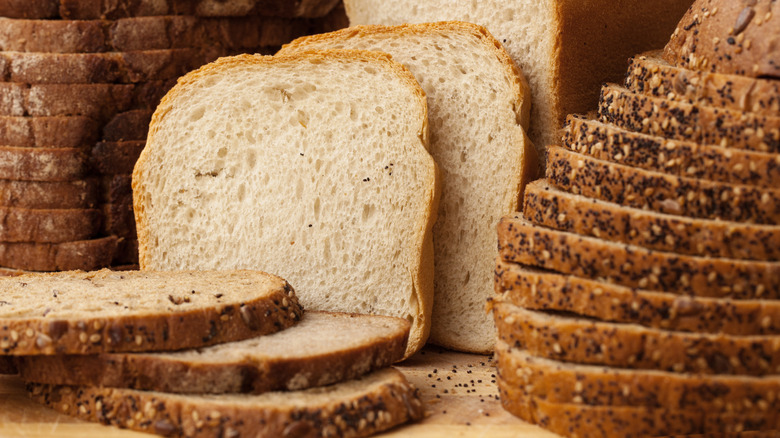
Sliced bread, at least sold as such, was a pretty good invention. The best since itself, by all accounts. That innovation happened in 1928, and sliced bread has since been a part of the furniture of grocery shopping lists. Although, in fairness, it does seem like an unnecessary luxury at times. What's it really take to slice into a soft loaf yourself and eliminate the middle man? Don't we all own knives anyway? And, is going after sliced bread the wisest move? Probably not.
On to the price stickers then. Aldi, Target, and Walmart all have house brands for plain, white sliced bread, in the form of L'oven ($1.25 for a loaf), Market Pantry ($1.59), and Great Value ($1.48). Neither of them are ideal for making a tuna melt, according to Andrew Zimmern, but they'll do the job if you need cold-cut sandwich cappers or PB & J lunches.
Costco does not seem to have a Kirkland version of white bread. Instead we looked at its going rate for Wonder Bread, which is $5.66 for a two-pack. This is where private labels pay off, since that works out to right around a dollar more per loaf than the other three.
Rice
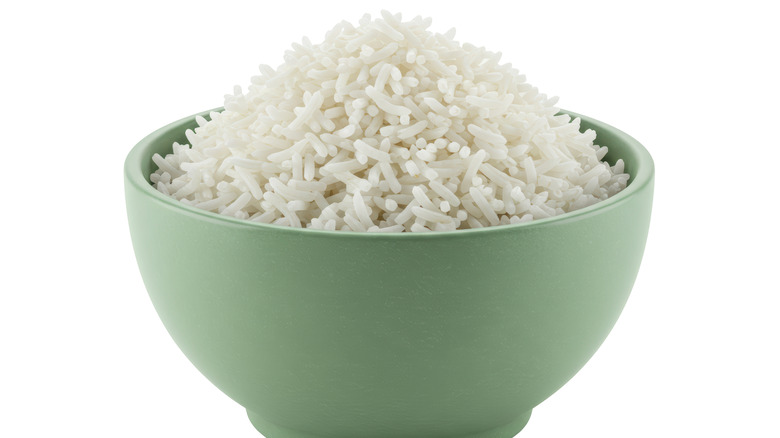
Rice is the most eaten food in the world. It alone makes up about 20 percent of the human population's calorie intake. Whether it's white rice, brown rice, wild rice, basmati, jasmine, bomba, or whatever, we need it around. It can be bought in huge bulk at Costco and other warehouses, but you can also stock up significantly at a lower-scale retailer, like Target. But, which of these, along with Walmart and Aldi, is actually giving you the best deal at this moment in time (which will be different than your moment in time when reading this)?
They don't make it easy, as each of them sell your basic long-grain rice in different quantities. Walmart offers a Great Value iteration that's $3.37 for a 5-pound bag. Costco's leviathan-sized 25-pound bag goes for $14.74. Aldi's Earthly Grains has a 3-pounder for $2.09. Target prices its 2-pound bag of Good & Gather long-grain for $2.39.
What does this boil down to, pound for pound? Walmart's is about 67 cents per pound of rice, Costco is 59 cents, Aldi is 70 cents, and Target is $1.19. Actually, what we said about stocking up on rice at Target: Probably not your best move.
Onions
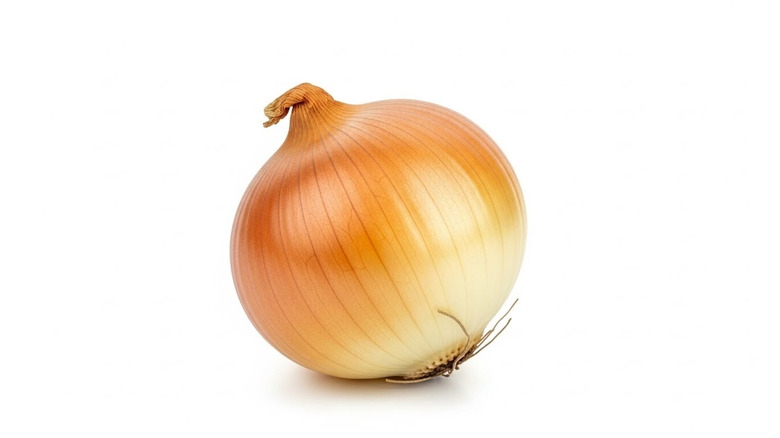
No matter the difference between red, white, and yellow onions, some or all of those iterations of the pungent orb are usually in our grocery orders. The average American eats almost nineteen pounds of the stuff each year, making it one of the top selling vegetables. Some retailers on this list — we're not going to name names, Aldi — seem to insist on selling them only in bulk, never individually. Which seems a tough ask of the workaday consumer. But, maybe that's the most cost-effective way?
To even the playing field, we examined the prices from all four places for 3-pound bags of yellow onions, except for Costco which has 5-pound denominations. Walmart has them for $3.24, Aldi for $1.79, and Target for $3.89. The prices vary wildly, which is probably indicative of how each retailer gets its produce supplied. Costco's 5-pound bag is going for $5.66, equaling about $3.40 for three pounds of onions. Not everyone is a fan of how Aldi handles its onion inventory, but you have to admit that's a substantial price gap.
Lemons
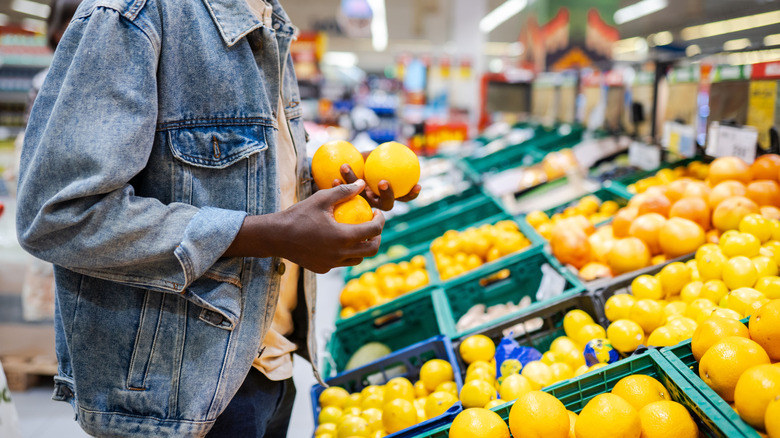
We can thank South Asia for a great deal of contributions to the world, both the environment and the culture. But, lemons have to be at the top of that region's shared bounty. What is a world without lemons? It's a Broadway musical without a single song, a peacock without its feathers. Lemons are healthy, delicious, versatile, and beautiful-looking. No wonder we always need some by our side – over a trillion pounds of them are produced for Americans on any given year.
How much are they, then, at our leading grocers? Once again, Walmart, Target, and Aldi all have uniform sizes of lemon bags for a straightforward comp (two pounds). Walmart's is $3.92, Aldi's is $2.89, and Target's is significantly higher at $5.49 for the same amount. Better be some good-ass lemons, Target.
Meanwhile, Costco is hawking its 5-pound bag of lemons for $9.07. What's that equivalent if it was just a two-pound bag? About $3.63. The Germans win this one too, and it's actually kind of a blowout.
Olive oil
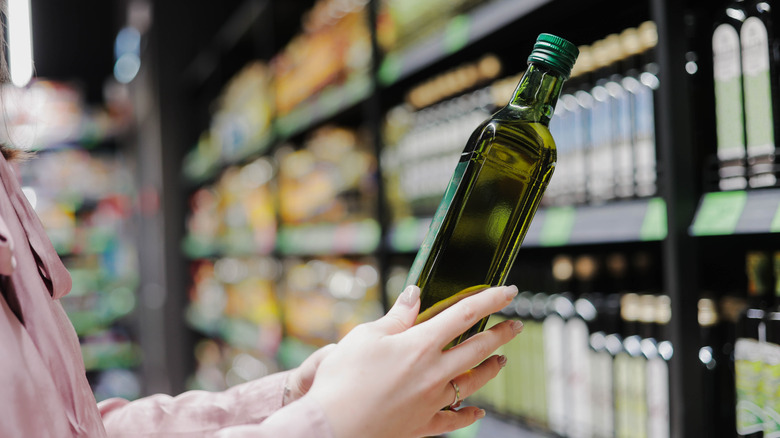
Although the United States lags far behind Greece, Italy, and Spain regarding the use of olive oil per capita (and really, that's no seismic revelation), it still consumes around ten percent of the world's olive oil, placing it third. Whether it's dressed in our salads, used in our cooking, or just standing there in the kitchen like a green sentry (but not for too long, since, no, olive oil does not age well like wine), it's a regular buy for a good deal of grocery shoppers.
We're going to have to figure out a per-ounce comparison here (for basic olive oil, not extra virgin), since there is another size difference throughout the four stores' private-label versions. For a 17-ounce Great Value bottle at Walmart, it's $5.94. Same quantity for Aldi's Carlini brand, and that one goes for $5.65.
Target's 25.5-ounce bottle of Good & Gather is $9.59. Costco's Kirkland is priced at $22.49 for three liters (about 101 fluid ounces). This makes Costco the best deal, far and away, at 22 cents per ounce of olive oil. Second is Aldi at 33 cents, third Walmart at 35, and Target, with a still-respectable 38 cents an ounce, comes in last.
Butter
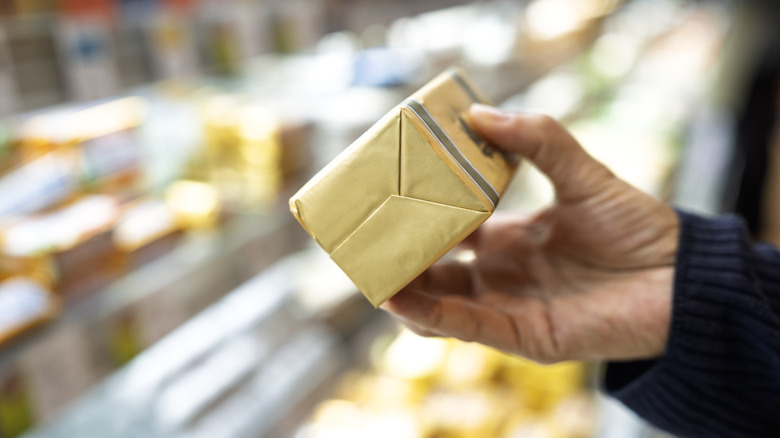
In 2024, butter intake in America reached an all-time high at nearly seven pounds per person. The fact that we consume the size of a small house cat in butter per year means that we like to have the spread on hand. Costco is known for its bulk butter offerings — the Kirkland grass-fed brand is rivaling the much-loved Kerrygold in some eyes — but does it mean it's the best spend?
You can get 16 sticks of butter at Costco for $12.47, working out to about 77 cents per stick. Walmart is $1.94 for two sticks of Great Value butter. Aldi and Target both have 4-stick packs — the former through the Countryside Creamery brand, the latter through Good & Gather — priced at $2.99 and $3.59, respectively.
How does it all shake out? Aldi wins again at 75 cents per stick, with Costco close behind at 77 apiece. Target comes in at 90 cents per stick, putting it in third place. Walmart is the least cost-effective, at 97 cents per stick.
Bananas
Bananas are always at or near the top of the list when it comes to the most-bought fruits in the U.S. Whether people buy them green as Irish grass, a firm yellow, or spotted with a ripening black, a banana bunch is tossed into many a shopping cart come time for the weekly grocery trip. The pouches of potassium can be enjoyed by both the health-conscious and those just looking for something sweet and starchy to munch on.
And, it seems like Target is offering the best banana deal here. Don't call it a comeback. Good & Gather bananas go for 39 cents a pound. Compare that to Walmart and Aldi, which are 50 and 55 cents per pound, respectively.
Even mighty Costco, with it's $2.26 price for three pounds of bananas still breaks down to significantly more than all the others, at 75 cents per pound. That's right around double what Target charges. You may be getting more at Costco but you're also paying more — defeating the purpose of getting more.
Apples
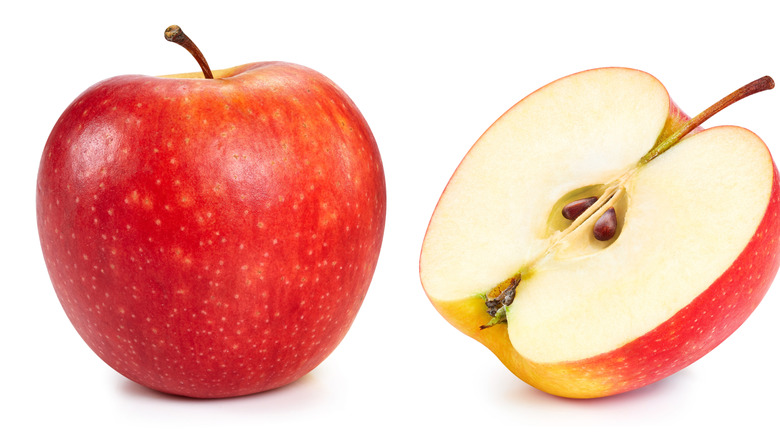
Apples and bananas are not only great partners for a children's vowel song, they are usually alternating the number-one spot for American produce preferences. By some measurements apples are the champ; by others, bananas. But, what can't be denied is that we eat a hell of a lot of apples.
And, unlike bananas, there is a huge variety to choose from. Some are ideal for on-the-go snacks; some are best for making apple pie; some are better for placing on someone's head and shooting with an arrow; some are better for discovering gravity. For this non-Newtonian comparison we stuck with the generally inexpensive, readily available gala variety.
At the time of looking, Costco only had organic gala apples available, driving the relative price up to $2.27 a pound. Meanwhile, Walmart was selling non-organic galas for 72 cents a pound, Aldi 76 cents, and Target $1.06. It seems Target's top ranking when it comes to everyday essential deals was short-lived. Hey, they say it's harder to keep the crown than it is to win it.
Plain yogurt

What once was an afterthought in the dairy aisle for many Americans, plain yogurt has found a firm place in many U.S. homes and tummies (thanks to its probiotic benefits). According to the New York Times, in 2025 Americans ate an average of 14 pounds of plain, or Greek, yogurt per person. Even those who need a little something sweet to counteract the sour of plain yogurt, have found ways to incorporate this ancient dairy product (which seemed to originate, not in Greece, but in the Middle East).
So, how much are the Big Four currently asking for a bit of 'gurt? We'll start with Target here. It's Good & Gather plain yogurt, 32 ounces of it, which sets you back $2.99. Friendly Farms from Aldi has a same-size offering for lower: $2.45; which is also less than Walmart's Great Value brand at $2.64.
A uniform price for Costco's Kirkland plain yogurt was a bit difficult to find, with costs ranging from $6.89 to $8.49 for a 48-ounce container. For the sake of argument, we'll go with the average price: $7.69 — which works out to 16 cents per ounce, or $5.12 for 32 ounces. Hopefully if you're getting this yogurt at a Costco, it'll be on the lower end of its price spectrum come time.
Lettuce
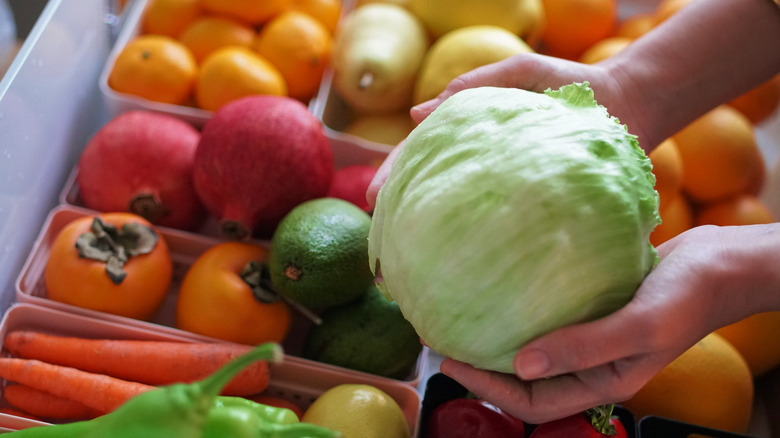
And, then there's lettuce. It feels like, if you're in between paychecks (or jobs) and you're completely broke, a head of lettuce is something you can still afford. At the very least you can have the basis for a simple salad. And, it is very reliable for many, as lettuce comprises about one-fifth of total sales for U.S. produce-growers in a given year.
This includes romaine and other leaf lettuces, but for this category we're focusing on good old-fashioned iceberg head lettuce for three of the stores. What's Aldi, Target, and Walmart offering this essential green for? Aldi is $1.95 per head, Target is $2.49, and Walmart is $1.98.
For Costco, it seemed to be just the 5-count of romaine heads of lettuce available for analysis, which was $6.80 in total. That works out to $1.36 per head. When you're looking to save money, does it really matter if you're going with romaine or iceberg? Because Costco is the way to go here.