

8 Telltale Signs Your Pork Has Gone Bad
Food safety is something you definitely never want to mess around with (especially in today's world of seemingly never-ending food recalls). As such, it can be smart to familiarize yourself with the telltale signs of a food that's gone bad. Unfortunately, though, that's not always easy.
We spoke with several experts about pork and, specifically, how to tell that it's gone bad. These experts included Dr. KatieRose McCullough, senior director of science and public health at the Meat Institute; Dr. Vanessa Coffman, alliance director at Stop Foodborne Illness; and Dr. Catherine Nettles Cutter, professor and food safety extension specialist for Penn State University's Department of Food Science. All mentioned something similar: It can be really difficult to tell if pork is truly "safe" to eat, and relying on look, smell, and taste alone can be tricky.
Sometimes, pork can appear totally normal, but still harbor foodborne pathogens — and even then, if the pork is handled appropriately, it may not pose any danger. That said, there are some signs that pork might not be of the highest quality, and you may want to avoid eating it — whether or not it is still technically "okay" to eat. So, along those lines, let's take a look at some of the best ways to avoid less-than-best pork and best practices for cooking pork safely.
Watch out for off odors
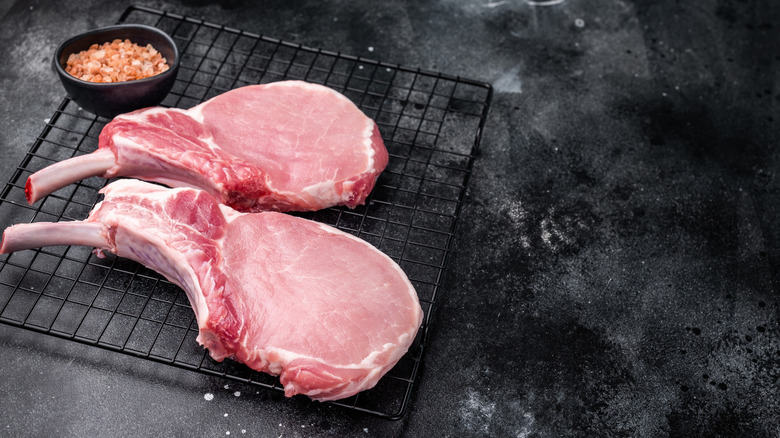
As Dr. Vanessa Coffman told us, "The bacteria and mold that can 'spoil' pork are different than those that can make you sick. Pathogens, or the microbes that cause foodborne illnesses, typically don't cause a change in the look, smell, or feel of foods, including pork." As such, don't 100% rely on your nose to tell you that a pack of pork chops either is or isn't safe to eat.
Still, if you do smell something weird, don't hesitate to toss those pork chops and order a pizza. You're not going to have a good time if you're chowing down on pork that simply smells off. Odors you should look out for include anything sour, ammonia-like, or rotten, said Dr. Catherine Nettles Cutter, as these can indicate that the pork doesn't meet consumers' food quality expectations.
Food quality and food safety, she noted, are two different matters to consider. Food safety is purely concerned with whether or not a food can make someone ill, whereas food quality looks at whether or not a food meets consumer expectations regarding appearance, flavor, texture, etc. A food can be safe but low quality, unsafe but high quality, or unsafe and low quality. For the best experience, you want both safe and high-quality pork in your kitchen. Accordingly, while you may not be able to rely on your nose to tell you a piece of pork is unsafe to eat, you may be able to rely on your nose to tell you that a piece of pork is going to be unpleasant to eat.
Look for a change in texture
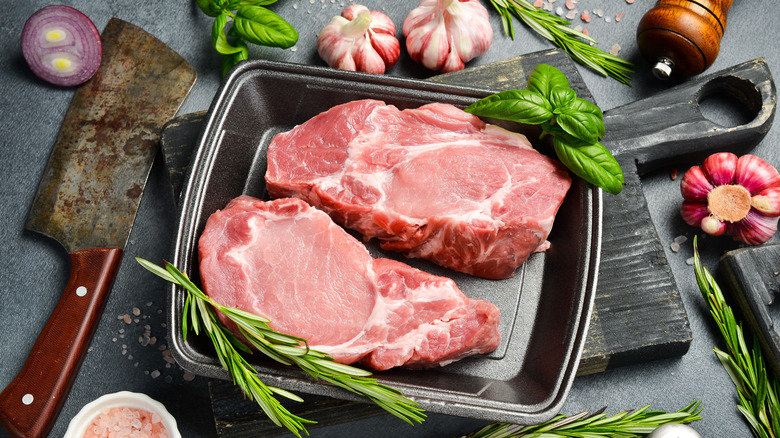
Pork's texture can also indicate that it's less than ideal to eat. If you notice that pork, whether raw and uncooked, or cooked and leftover, is slimy, tacky, or mushy, go ahead and toss it.
Yes, that's correct — your cooked and leftover pork isn't always in the clear. As Dr. Catherine Nettles Cutter said, "Cooking inhibits spoilage and pathogenic organisms, but cooked products can become re-contaminated with other microbes due to cross contamination in the kitchen, in the refrigerator, by utensils, while handling, or from the air."
When dealing with leftover pork, Dr. Vanessa Coffman recommended that you place your pork in the fridge as quickly as you can, within one to two hours of serving. Then, eat that pork over the next two days. Make sure that you reheat it to the proper temperature, too, at least 165 degrees Fahrenheit. Dr. KatieRose McCullough further reiterated that leftovers need to be kept out of what's known as the "danger zone," aka between 40 degrees Fahrenheit and 140 degrees Fahrenheit, where it's most likely for food-borne bacteria to grow.
Keep an eye on the color
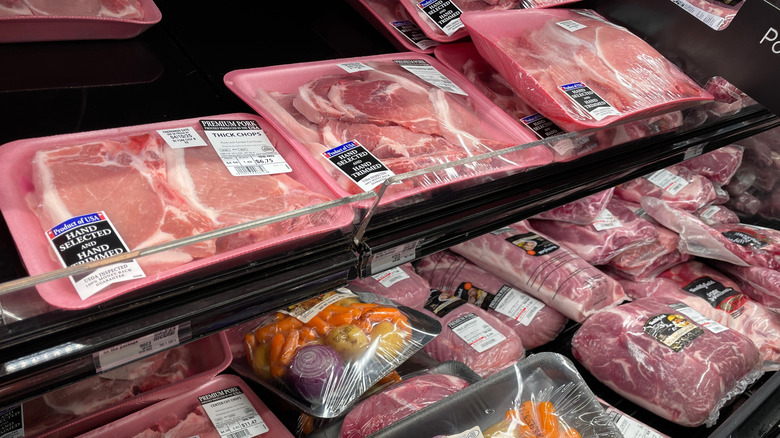
Again, while appearance isn't a guarantee of pork safety, if you do see that pork has turned off-color, you may want to go ahead and get rid of it, just in case. Even if it's still technically safe to eat, it may be less than ideal. Dr. Catherine Nettles Cutter mentioned specifically looking out for pork that may be browning, which could be a sign of poor quality.
The U.S. Department of Agriculture likewise mentions that, when buying pork, you should be looking for cuts that are gray-pink, and with a bit of marbling. Pork.org, meanwhile, recommends looking for a cut of pork that is pink-red, with either marbling or flecks of fat, as the marbling and fat contribute to a better flavor. While you're examining the color of the pork, also look at the bone (if buying a bone-in cut). You want to avoid a dark-colored bone.
Look at the meat juice
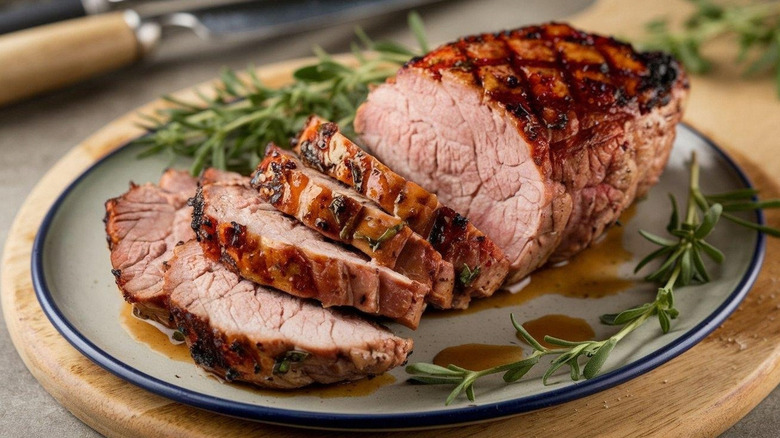
Let's say you've purchased a pack of some sort of pork cut at the grocery store and you get it home. You expect that most cuts of grocery-store-purchased meat will have some juice floating around in the package. That's just normal, right? But keep an eye on that juice just in case: It may be able to clue you in to the pork's quality. Dr. Catherine Nettles Cutter cautioned, "Discard any packaged pork products that smell odd (off odors) or exhibit cloudiness in the meat juice (purge) in the package."
Checking the meat juices is also important when checking for doneness in cooked pork, but it shouldn't be your only indicator that a piece of pork is fully cooked. While many attest that, if a piece of pork is no longer pink and the juices are clear, it's done, color isn't always a safe gauge of doneness. Instead, when confirming that a piece of pork is properly cooked and safe to consume, always confirm the temperature.
As Dr. KatieRose McCullough advised, using a calibrated food thermometer, give your dish a quick check. "Whole muscle cuts such as pork loin should be cooked to 145 degrees Fahrenheit with a three-minute rest, and ground meat and other non-intact pork products should be cooked to an internal temperature of 160 degrees Fahrenheit," she said.
Avoid problems with packaging
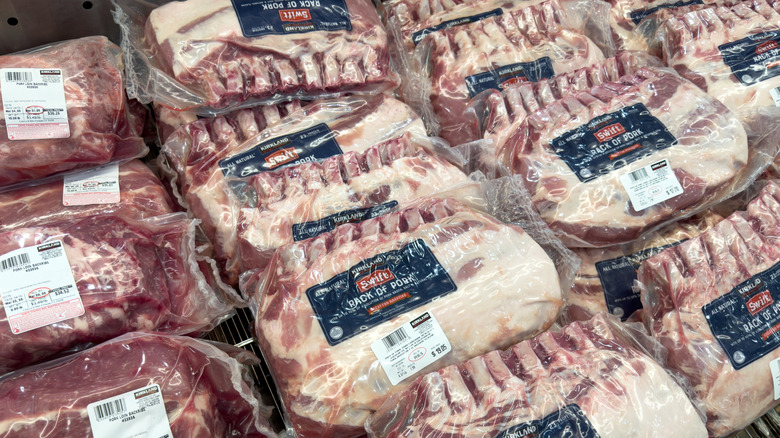
Before you even get home or cook a piece of pork, you may notice there are issues with the pork's packaging. Sometimes, that packaging is a big clue to similarly big issues with the pork's quality. Particularly, Dr. Catherine Nettles Cutter said you should throw out any packages of pork that are "bloated, swollen, or leaking."
Bloating meat packaging isn't always a sign of something gone wrong, but it can be (and why wouldn't you rather stay safe than sorry?). In some instances, bacteria forms gas that then leads to bloated packaging. In other cases, gas is actually added to the packaging in order to extend shelf life. It's difficult to tell the difference, but if you're standing in the grocery store and all of the packaged pork looks the same, more or less bloated, you're probably dealing with that deliberate manufacturing side effect. If there's only one pack of pork that's bloated, though, or you have a pack of bloated pork at home that wasn't that way when you bought it, err on the side of caution. Toss it.
Don't rely on cooking to keep you safe
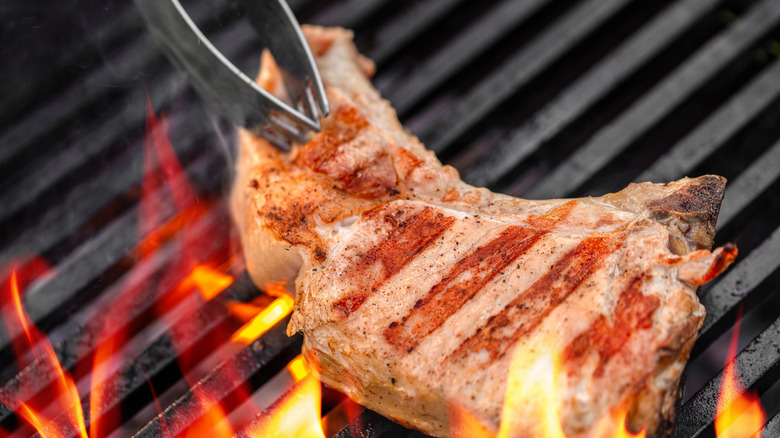
Yes, cooking is a huge part of avoiding foodborne pathogens. Dr. Vanessa Coffman said that studies have found that as many as 30% of ground pork and 9.3% of whole pork samples have shown the presence of salmonella bacteria. However, she said, "The presence of a foodborne pathogen on raw pork does not necessarily mean the meat is unsafe to eat, as thorough cooking to the proper internal temperature destroys salmonella and many other harmful bacteria."
That said, there's a caveat: The pork has to be cooked properly, and you have to handle the raw pork appropriately before and after cooking. Dr. Catherine Nettles Cutter recommended following the four "C's" of food safety: Cleaning, Cooking, Chilling, and Cross-Contamination. That means always cleaning your hands before and after touching the pork, and cleaning all countertops, cutting boards, and utensils that may come into contact with the pork. It also means cooking whole cuts of pork to 145 degrees Fahrenheit and ground pork to 160 degrees Fahrenheit, as well as chilling leftovers within two hours, in a properly cooled fridge. Prevent cross contamination by never using the same cutting boards, plates, or utensils for both raw pork and ready-to-eat foods like produce.
Examine the fat
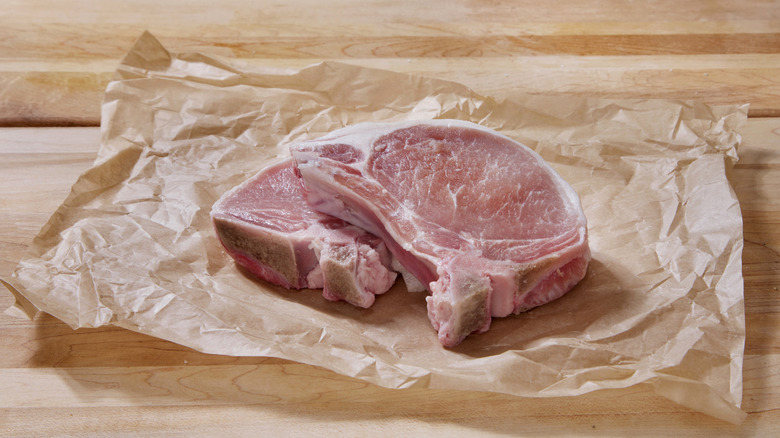
One of the warning signs of spoiled pork that Dr. Catherine Nettles Cutter said that some consumers might overlook? Changes in the pork's fat. "If it's not firm to the touch, smells rancid, or is not white in color, discard," she said.
Even if the fat is mostly white, still look out for small dark spots, as they can likewise be an indicator of declined quality. Yellow-tinged fat is also a potential red flag. Otherwise, make sure that the actual meat is pink-red, and that any bones are reddish as well. If the bone is more white than red, it could mean that the meat will be tougher, as it came from an older pig.
While we're on the topic of pork fat, don't overlook this ingredient as the potential goldmine that it is. Lard, aka rendered pork fat, is a favorite with cooks and bakers worldwide for many reasons, not least of which is its ability to produce a truly flaky, so-good-you'll-lick-your-fingers pastry crust.
Don't rely solely on best-by dates
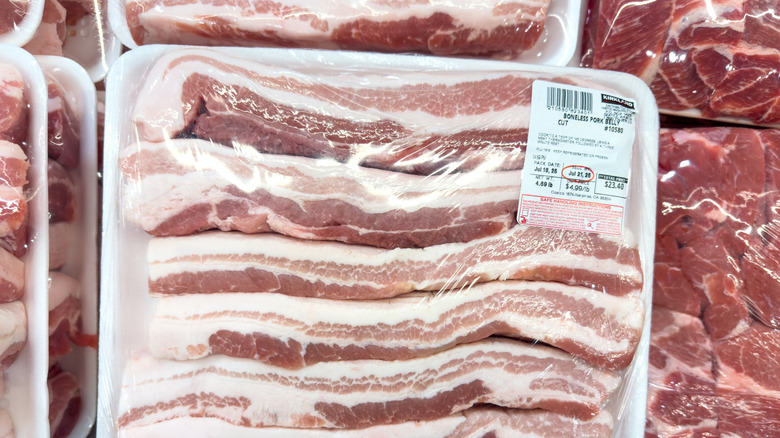
Best-by dates are important but they shouldn't be the only test of food safety that you rely on, overall. Even if you have a pack of pork in your fridge or freezer that still is technically "good" per that best-by date, you could run into some problems if you're not careful.
Dr. Catherine Nettles Cutter explained: "Consumers tend to rely on the use-by, best-by date labels for determining safety. Rather, these dates are used by processors primarily for quality attributes. Improper storage (for example, temperature abuse) during the shelf life of the product can lead to faster microbial spoilage before the use-by or best-by dates."
So what does proper storage look like? Dr. Vanessa Coffman cautioned home cooks to not allow raw pork to sit unrefrigerated for more than two hours at a time, or one hour if the temperature is above 90 degrees Fahrenheit. It's also important to note the length of time you can keep raw pork in your fridge, before freezing. Ground pork is good for just two days in the fridge, but bacon can last up to a week. Meanwhile, if you toss that same pork in the freezer, you can extend its life by quite a lot, with ground pork lasting around three months in the freezer, and bacon lasting up to a month.