

6 Brewery Red Flags That Should Have You Heading Out The Door
Hey, life is short. (Sorry to start with that reminder.) Who wants to spend their valuable, finite time on Earth at a brewery that sucks? No one. And, you may think, well, if the beer is said to be either good or bad, that's all you need to know. But, a brewery is more than that, isn't it? If it really was just about the beer, you can just pick up a six-pack to your liking and hang out in the sun on the roof of your home.
The problem is trying to figure out if a brewery is worth the visit before spending your time and money there. And, there are a few ways you can suss it out upon sight (and sometimes, unfortunately, smell). It doesn't matter if you're hitting up a brewery in NYC, Oakland, Austin, a small town, a beach town, a downtown, or wherever. There are certain characteristics that good and bad taprooms share.
Here are six red flags that are telling you you're in the wrong brewery. If you notice these and decide to stick it out, you do so at your own risk. Whether you're risking a bad time, some disappointing ales, or even your wellbeing, you deserve better. Look out for these stop signs before you order a pint (and it goes in the wrong kind of glass).
If it doesn't look, smell, or taste clean, it probably isn't clean

The signs of a brewery's cleanliness, or lack thereof, can be perceived through your senses. Sight certainly helps. You can see if the bartender is pouring out beer in a way that may contaminate it, if the floors, tables, or counters aren't sanitized, or the glassware is dirty. If you do observe these red flags, there's a good chance unseen elements, like tap lines, are also being neglected and are nasty.
You can also tell if the facilities are lacking upkeep, i.e. the bathroom, by the smell, which is another sense you should absolutely trust when measuring up a brewery. Like one Redditor who walked into a local taproom that stank like "dirty mop water" noted. While this can mean that the place is actually mopping (a good sign), it's also disgusting (a very bad sign).
If any of these portents are apparent, not only is there a good chance the beer makers aren't caring like they should, there's also a chance you might literally get sick by whatever resulting bacteria is ending up in your draft. Probably best to give a general "no, thank you," turn around, and find yourself another brewery.
Yes, the beer vessel matters. It so, so matters
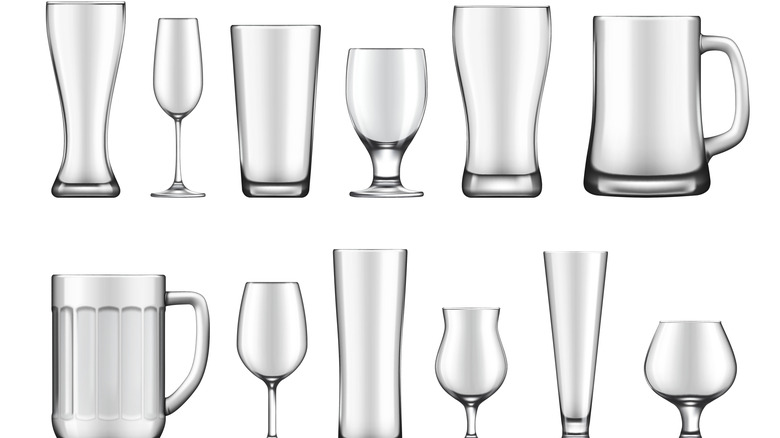
Hey, as long as your beer is put in any kind of vessel from which you can imbibe, then all is well, right? Hell, a Viking drinking horn will do. Not so fast, Odin. Certain beers should go into certain glasses. Maybe not at your local dive, but at an establishment dedicated to the literal craft of beer, this matters (along with the way you hold each beer glass). Pint glasses aren't for everything — despite a bad brewery using them for exactly that — but they are good for lighter beers, like lagers and pilsners, where strong aroma and bracing hoppy-ness aren't prioritized; same goes for those fun, bulbous Czech pilsner glasses.
Tulip glasses are ideal for strong, aromatic beers, like double IPAs. Snifters are the way to go for high-ABV brews that aren't very carbonated. Goblets, or chalices, are for luxurious beers with deep, nuanced flavors. Weizen glasses — tall, narrowed, sloping — are made for one thing: Wheat beers. If you walk in and see every beer in a brewery poured into your commonplace pint, no matter the color of the liquid, that implies a brewery doesn't want to take the time to showcase its product in the ideal way. You have to then ask, why not?
Keeping glassware in the freezer? What are you hiding, sir?
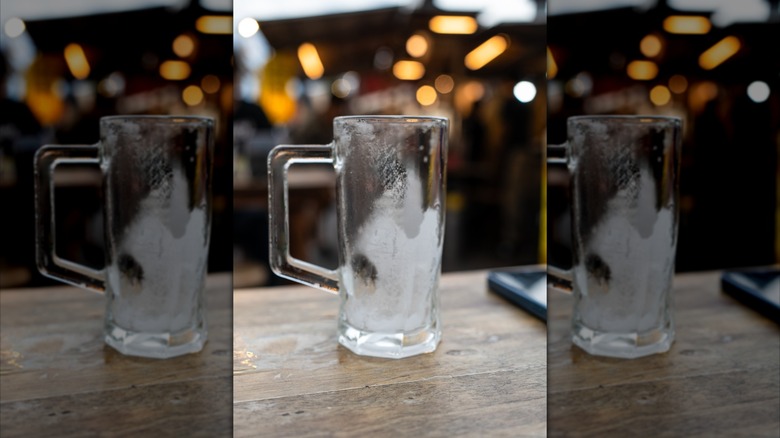
Again, there are standards for a brewery that doesn't apply to the corner pub, or dads hanging out in a garage. There are certainly times and places when you want to pour your beer into a frosty mug. It can be brisk and refreshing and the perfect antidote to a sweaty day. But, when a proper brewery is grabbing its glassware out of the freezer, that should raise an eyebrow.
And, frozen glasses being verboten isn't just some beer geek thing that's nerdy for the sake of nerdiness. A frozen glass at a brewery can mean a number of issues are being concealed. Perhaps the cooler is broken. Perhaps a keg that's been sitting in the heat has been tapped and served out. Perhaps the brewer just doesn't think the beer's taste can stand on its own, so best to numb the palates and let the condensation from the frost dilute the beer.
You might feel that this and other signs mentioned in this article are taking beer-drinking too seriously. Of course it is. What's the point of a brewery that doesn't take beer seriously? That's just doling out moribund macro-brews that are no different than a Bud or Coors Light or whatever you would use to make a refreshing michelada? Answer: There is no point.
Servers either don't know or don't care

Now, there are some who feel like a bartender at a brewery can be too knowledgeable about beer. Or, rather, that they can't shut up about the pedantry of brewing, to the point you just want to ball up in a corner and weep for your tiny, unlearned beer brain. That's fair. But, when a brewery has a server that's the opposite of this, and can't really tell you anything about the liquid they make that you're putting into your body, that can be alarming.
Perhaps there's an even more frustrating scenario that's almost a combination of the two: The bartender that doesn't give a toss about the beer, the brewery, their immediate surroundings, or the customers. You know the type: Someone who looks like they'd rather be anywhere else in the world than behind that counter talking to (gasp) you about, not just beer, but anything.
Remember, servers are the front-facing representatives of the brewery, whether they're doing any actual brewing or not. If a beer maker doesn't want to take the time to hire folks that care, what else are they neglecting about their business? There's a very good chance it's the beer itself. And, unless you carry around your own bitters to liven up mediocre beer, then your money is probably best spent elsewhere.
Houston, we have a vibes problem

And, here we come to the most inexact of all sciences (besides homeopathy): Vibes. What makes a great vibe and what makes a bad vibe? If you try too hard that won't necessarily work, if you don't try enough that might let you down as well. It's about doing enough to enable the vibe gods to smile down upon you. Yet, there's a question in all this, and one that was posed on Reddit: Do you go to a brewery for the beer or the vibes?
One commenter said, "a great vibe can balance out mid beer." Another commenter countered right back: "And great beer can balance out an ehh vibe." Fair and fair. Another chimed in with a much more decisive take: "I will absolutely choose to go to a place with not as great of beer if the vibe and employees are great way before I'm going somewhere with better beer but the place and staff suck ass."
It's a spirited debate either way, but what isn't up for debate is that vibes matter. And, you know a vibe as soon as you feel it. If you walk into a brewery that's seriously lacking in the vibe department, it could mean one of two things: The beer is so amazingly good that vibes don't matter, or the vibe gods have cursed the place, potentially because they are displeased with the mortals in charge. In that case, there's little that can be done. Except maybe for the place to cut down on having trivia night four times a week.
Yo, your tap list boilerplate
A brewery that's offering a pedestrian, token selection of beers shouldn't inspire the greatest of confidence. This isn't to say that a brewery's beer menu has to be an exotic novella of brews. And, when a beer maker is offering 12 different hazy IPAs, you might just end up being some combination of confused, overwhelmed, and dizzy — forcing you to pick one at random and hope for the best.
It almost feels like they're just checking off boxes and phoning it in (making sure to include the obligatorily high-priced double IPA). A great brewery often has an eclectic, rotating tap list, even if it's not the widest of selections. Not reading the same boilerplate offerings you see everywhere? that's a good sign you're in a solid brewery — or at least one that puts thought into its product.
Look out for seasonal offerings, experimental brews, and varied makes. Balance on a tap list is just as important, if not more so, than sheer quantity. After all, beer is for everybody (of legal drinking age), and having something for different types of palates is a sign of thoughtfulness from a brewer. And doesn't that, like a nice holiday stout, give you the warm fuzzies?