

11 Things You'll Want To Know About Starbucks' Coffee Beans
Everyone knows Starbucks, even if they don't stop by on a daily basis for their morning fix. If, though, you do stop in regularly, then you're probably pretty intimately familiar with the brand's offerings, seasonal product drops, and secret menu items — even the ones baristas wish you'd stop ordering. But while you know exactly what goes into your personal order, from a pump of this to a shot of that, do you really know all that much about the beans that are responsible for bringing the entire drink to life?
These aren't just any ol' coffee beans, because, at the end of the day, coffee beans can vary vastly. A multitude of factors are at a play when it comes to determining how a coffee bean will impact the flavor of the end beverage. Not only does geography and where the beans are grown play a role, but so do the conditions under which the beans were grown. What's the soil like? What's the altitude? How much rain was there? Then, you get into how the coffee beans were roasted, followed by how the beans were ground (or not ground) and stored.
All these factors are instruments in a broader orchestra that leads to the song in your cup — and that means that every choice Starbucks makes about its beans matters. So, settle in and get to know the chain's beans a little better. You might just find that you appreciate them more.
Starbucks keeps its beans fresh via proprietary FlavorLock technology
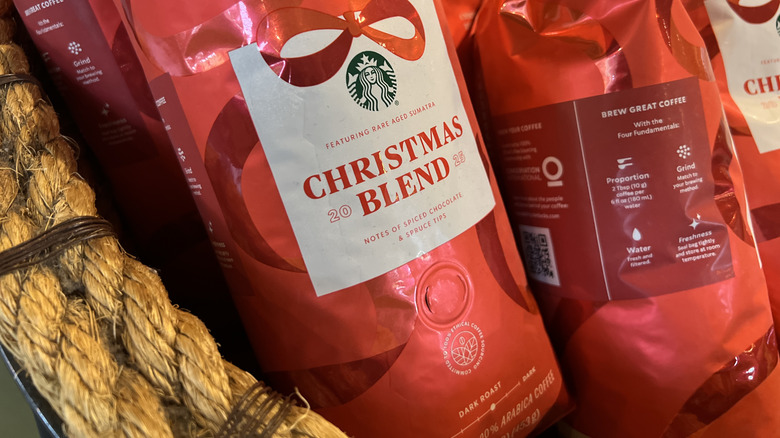
While this is no longer a problem today, decades ago, it was an issue that, if coffee beans sat around in their bags for too long, they became stale. This was such a problem that Starbucks said that it would often turn down wholesale coffee orders because, after shipping and by the time the beans actually made their way to the consumer, they were stale upon opening. Luckily, through a bit of research and development, and building off previous research being conducted by coffee roasters in Italy, Starbucks was able to overcome this issue.
Today, you'll see the modern equivalent of what Starbucks adopted in the 1980s: FlavorLock bag technology. Basically, it's that little valve you see on the front of Starbucks' bags of coffee. It allows carbon dioxide to leave the bag while preventing oxygen from entering, thus ensuring that the beans stay as fresh as possible, as long as possible — up to a few months versus just a few days, which was about what Starbucks could guarantee prior.
All Starbucks' beans are Arabica
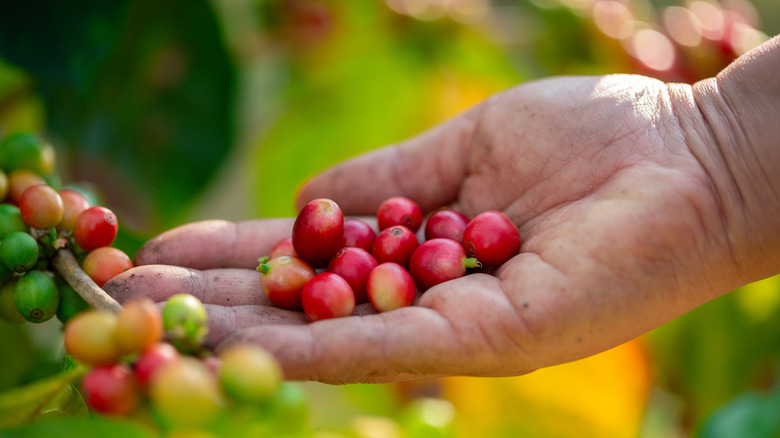
The majority of the world's coffee beans fall into two camps: Arabica or Robusta. These are the two primary species of coffee trees. So what's the difference? Arabica coffee beans have about half the caffeine as Robusta coffee beans. Arabica coffee beans are also ultimately more widely used for coffee, with nearly double the amount of Arabica beans exported globally every year as compared to Robusta beans. Arabica beans grow at higher elevations, while Robusta prefers a lower altitude. Robusta coffee trees are more affordable and easier to maintain and they actually produce more coffee overall. However, despite these potential pros, according to Starbucks, the Robusta trees produce a subpar product. In fact, Starbucks describes the taste of Robusta coffee beans as comparable to burnt rubber.
This isn't just Starbucks turning its nose up at any competitors who may use those other beans, though. This is a more broadly shared opinion. As such, Robusta isn't used all that much in high-end coffee blends, even though the top-tier Robusta coffee can be of equal quality to low-end Arabica coffee. If you do really want to try out Robusta coffee, you might look to instant coffee, which often uses Robusta. Additionally, perhaps somewhat surprisingly, espresso blends are more apt to include Robusta, as it's believed that the Robusta coffee makes for a better layer of froth atop your beverage.
There are debates as to how ethically Starbucks' beans are sourced
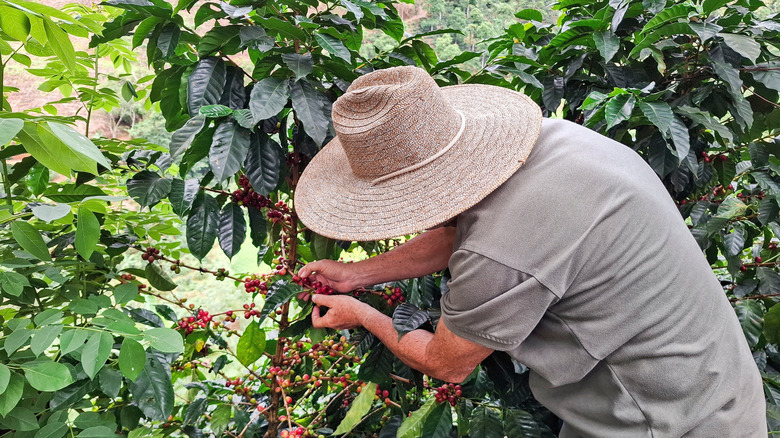
Ask Starbucks and of course the brand will say that its beans are ethically sourced. Starbucks launched its ethical sourcing standards, dubbed the Coffee and Farmer Equity (CAFE) Practices, in 2004. These standards claim to vet farms based on economic, social, and environmental factors. For example, Starbucks suppliers must show how much they pay their farmers for their coffee, down to the individual farm and farmer. The farms must provide a humane working environment and not use any child labor, and producers must not convert any natural forest to agricultural use, or use certain pesticides, among many other requirements. After suppliers prove they meet the requirements, it's up to them to maintain the standards, with new inspections occurring every several years.
However, in 2024, the National Consumers League filed a lawsuit against Starbucks, saying that, while the brand's packaging claimed 100% ethical sourcing, reports had come out that link Starbucks-associated farms with employee abuse. For example, in one case, a Brazilian coffee farm was utilizing teen labor in unsafe working environments; in another, a Starbucks-supplying tea plantation was accused of providing not only unsafe working environments, but there were also reports of employee sexual abuse. The Starbucks controversy extended onward in 2025, with Brazilian workers filing a lawsuit against Starbucks. The workers claimed they had been forced into unpaid labor on Starbucks-associated coffee farms, and that the workers were exposed to unsafe working conditions.
Starbucks' beans are packaged within two hours of roasting
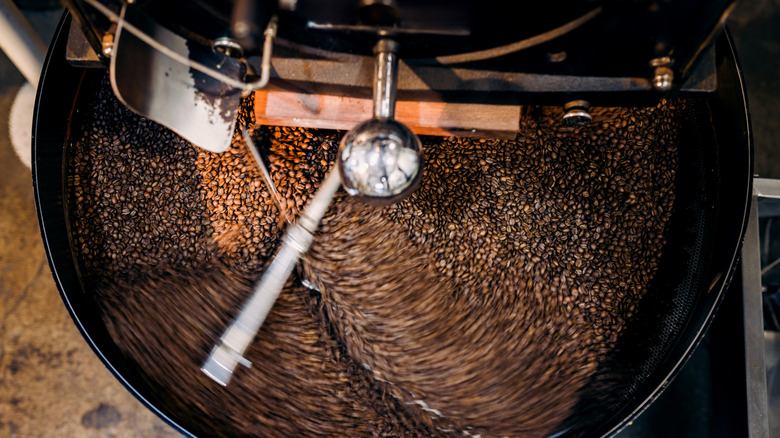
Just like Starbucks developed new packaging that would help keep oxygen away from its beans during transit and while sitting on store shelves, so does the brand think about oxygen exposure ahead of packaging. That's why it tries to limit that exposure as much as possible, by ensuring beans are packaged within just two hours of roasting. This effort, combined with the FlavorLock technology, the brand says, will ensure that coffee in an unopened bag remains fresh for up to 34 weeks.
Of course, after you actually open the bag, the coffee beans are exposed to oxygen and are therefore going to begin to deteriorate fairly quickly. For the best results, Starbucks recommends using an open bag of coffee within a week. If you've ground the beans, those home-ground beans should be used within 30 minutes, which is why you shouldn't grind coffee until you're ready to drink it.
And while you may think that popping that bag of coffee into the freezer is going to keep it fresher longer, that's actually not the case at all. If you currently have a bag of coffee sitting in either the fridge or freezer, it's one of the items you should throw out now. In the fridge or freezer, coffee loses its flavor faster, due to ambient moisture.
Starbucks' beans are sourced from the Coffee Belt
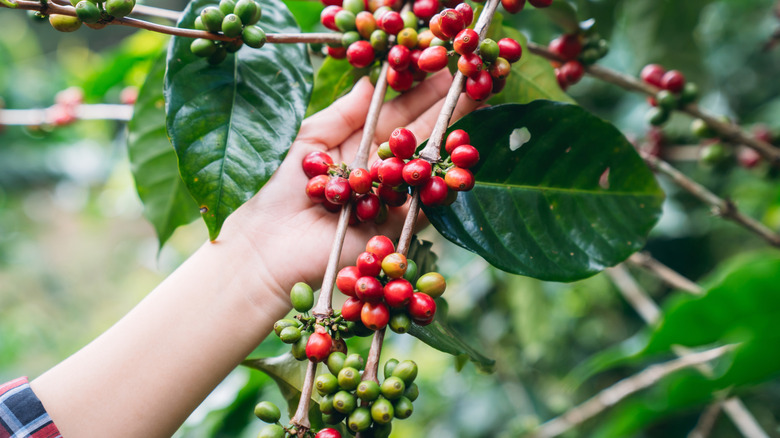
The world's Coffee Belt is literally a belt-shaped strip that stretches around the entire planet, between the Tropics of Cancer and Capricorn. If you're struggling to recall your days of elementary school geography, basically this means the band stretches from Mexico to Brazil in the Western Hemisphere, from Ethiopia to Tanzania in Africa, and from Vietnam all the way down to Australia in Asia-Pacific. The belt is divided into three sections: Latin America, Africa, and Asia-Pacific.
The majority of coffee is grown within this strip, including Starbucks' coffee beans. However, where exactly within the Coffee Belt that beans are sourced can impact how the beans taste. Just because two kinds of coffees were both grown within the Coffee Belt, that can really be where their similarities end.
Out of the three sections of the belt, Starbucks purchases most of its coffee from the Latin American section. The brand notes that this is because the region offers a greater consistency in its beans. As far as differing flavor profiles go, beans from the Latin American portion of the belt generally come with tasting notes that are subtly spicy, chocolatey, or nutty. Beans from the African portion of the belt are often somewhat fruity. Beans from the Asia-Pacific portion of the belt, on the other hand, may be more herbal.
Starbucks roasts beans three ways
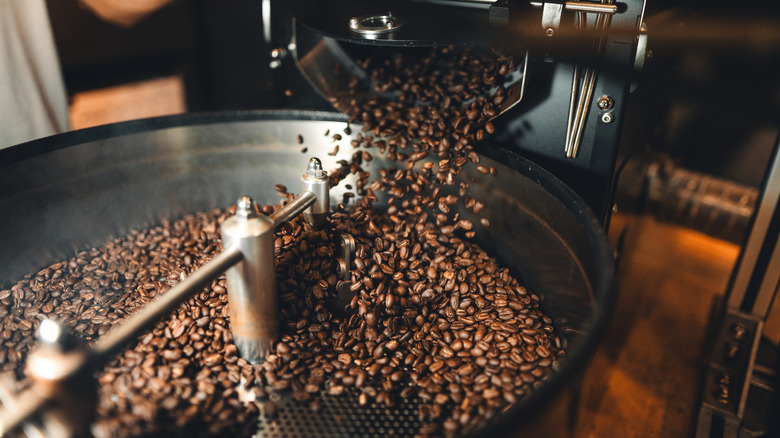
When Starbucks gets its coffee beans from its various suppliers around the globe, the beans are green and look nothing like what you probably think a coffee bean should look like. So, before Starbucks packages those beans up to send them on to you, the beans must be roasted, and Starbucks roasts beans three ways. All its coffees can be separated into blonde roasts, medium roasts, and dark roasts. As you could probably guess, the lighter the coffee, the lighter the flavor and mouthfeel.
A blonde roast is a type of light roast that's roasted over a relatively lower temperature and for a shorter amount of time. Typically, the beans are roasted at between 355 and 400 degrees Fahrenheit. Meanwhile, a medium roast coffee is roasted a little bit longer and at a higher temperature, 400 to 430 degrees Fahrenheit. A dark roast can sometimes be roasted for twice as long as a blonde roast, and the temps can get up to 450 degrees Fahrenheit. There are other roast types in the coffee world, such as a medium-dark roast and a very dark roast, but Starbucks sticks to its characteristic three.
Starbucks' Reserve beans are a step above
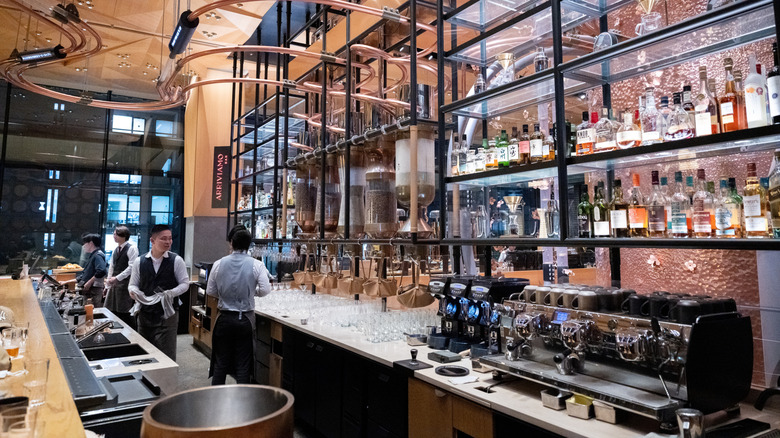
There are six Starbucks Reserve Roasteries around the world, in Chicago, Shanghai, Milano, New York City, and Tokyo (there are two in NYC). Visiting one of these roasteries isn't just a stop into a Starbucks coffee shop, it's an experience, and an upscale (and potentially overwhelming) one at that. Across the huge spaces, there are tastings and classes, and limited-edition menu items that you won't find anywhere else — and, for a time, these Starbucks Reserve Roasteries were also the only place you could find Starbucks Reserve specialty coffees. However, that's no longer the case, and you can sometimes purchase these specialty coffees in limited runs at your neighborhood location.
But is there really a difference between Starbucks and Starbucks Reserve coffee beans? Actually, yes. Sometimes, these beans are sourced from single-origin, family-run plantations. They're picked for their uniqueness and rarity and, Starbucks says, some of the beans that end up in a Reserve bag are once-in-a-decade finds. Starbucks coffee traders visit far-flung destinations to find the beans, and then require those same farms to send their beans back to an office in Switzerland, where the beans are tested further, to ensure they remain consistent. Whenever a chosen lot of beans arrives at one of the roastery locations, that lot is specifically roasted in its own unique way, so that those beans shine at their brightest. The roaster isn't just relying on the same ol' recipe that they use for any standard Starbucks beans.
Starbucks' beans are tested rigorously
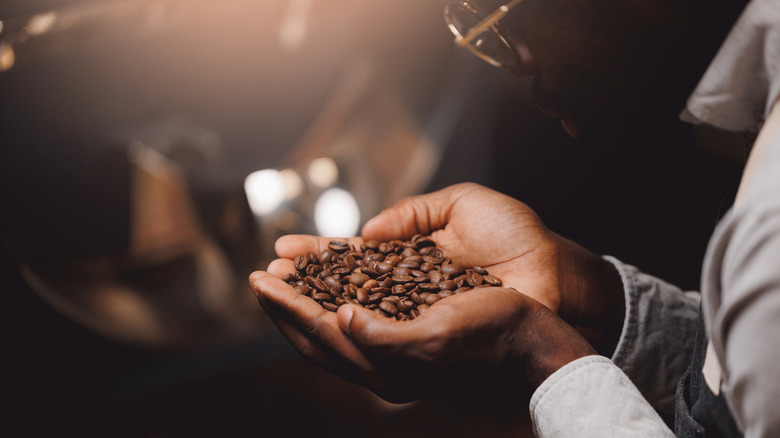
It's not just Starbucks Reserve beans that undergo some strict testing, though, at that Switzerland headquarters. All of Starbucks beans are held to the highest standards, in a setting known as the cupping lab, by employees known as cuppers. This handful of individuals evaluate millions of pounds of beans per year, and hundreds of cups of coffee per day.
First, they'll look at the raw coffee beans. They need to be consistently the quality that Starbucks expects from that particular bean and its geographic origin. Those raw beans are roasted in small batches and then coffee is brewed. Again, cuppers are looking for consistency and quality in the brewed coffee, both in aroma and flavor. Don't worry — they're not actually drinking all that coffee (can you imagine drinking hundreds of cups per day? That's definitely too much coffee). Much as is the case in settings where, say, a judge might need to taste a high volume of wine or a spirit, the cuppers spit out the coffee after giving it a good taste.
Starbucks' blonde-roast beans have more caffeine
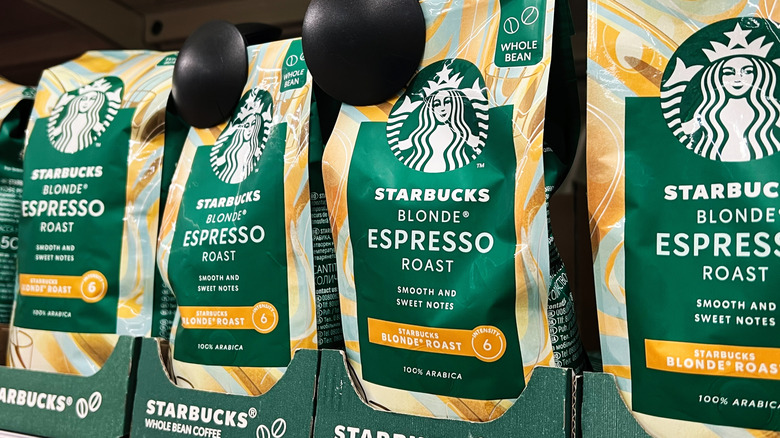
If you've made it this far, then you know that Starbucks' blonde-roast beans have a lighter, more delicate flavor profile, and that they're not roasted as long or at as high a temperature as the brand's other beans. However, you'd think that because these beans pack less of a flavor punch that they might also pack less of a caffeine punch — but that's where you'd actually be wrong. Blonde roast drinks at Starbucks have more than or the same caffeine as their darker counterparts.
However, this isn't going to be the case across the board, everywhere you go, every coffee you drink, because there's a little bit of nuance. The reason that Starbucks blonde roast drinks have the same or more coffee comes down to measurement.
See, during roasting, coffee beans lose water weight, while also increasing in size. The longer the roast, the bigger that impact, so ultimately light roasts end up denser than dark roasts. As such, when you scoop up some light-roast coffee grounds, you're getting more coffee in that scoop, so more caffeine. However, if you were to measure the coffee by weight versus volume, the density disparity would even out and you wouldn't see that greater caffeine content in the light roast.
How you grind Starbucks' beans will impact their taste
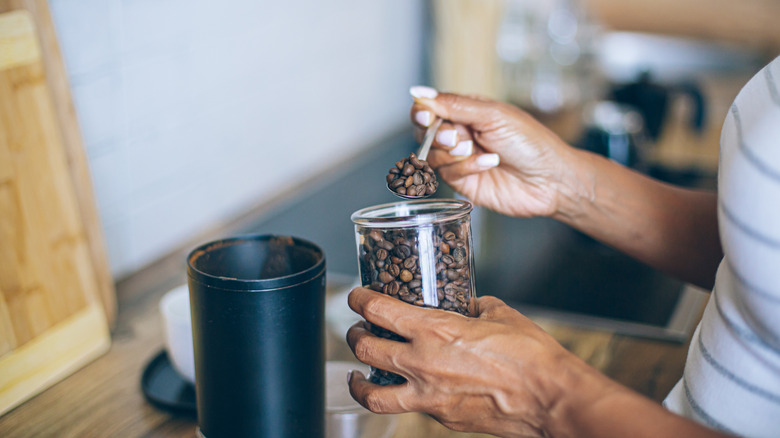
Once Starbucks' beans make their way into your waiting hands, you can't just assume that you'll get an amazing cup of coffee by popping open the bag, throwing the beans into a grinder, and then running them through your drip machine. How you grind and then brew your Starbucks' beans will impact your end cup of coffee's flavor profile.
You have to pick the correct coffee grind (the "grind" refers to coffee grounds' size and consistency) in relation to your brewing method of choice. If you don't make the right decisions here, your coffee may still taste fine, but it's not going to taste its best. This is because the finer the grounds, the greater the overall coffee surface area, which leads to faster coffee extraction.
So what's the best grind for your beans? Extra-course and coarse grinds, which are similar in texture to coarse salt, are best for cold brew and French press coffee, as well as percolators. Medium and medium-fine grinds, which are closer in consistency to fine sand, are good for your standard drip machines as well as pour-over setups. Espresso requires a fine grind, whereas Turkish coffee requires the finest grind of all. A quick way to know if your grind is too fine or too coarse? If your coffee is weak and watery, you need to grind finer than you have been. If your coffee is extra-strong and bitter, go coarser.
You can use Starbucks grounds as fertilizer
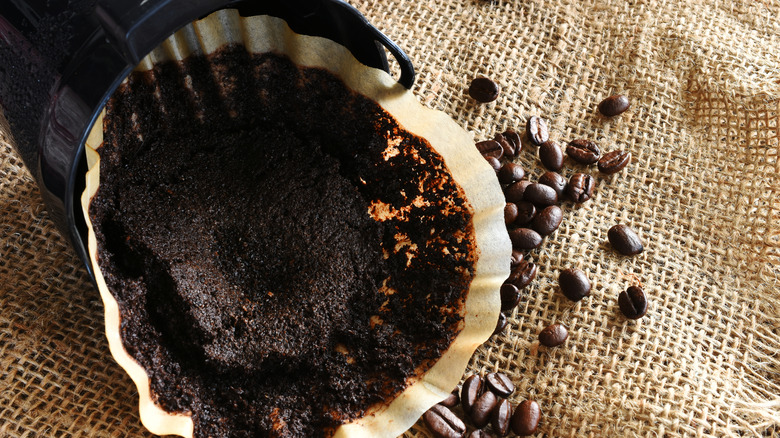
Once you've extracted all the glorious brew from those coffee grounds, don't just toss them in the trash. You can use those bean remnants for fertilizer. Coffee grounds contain plant-beneficial nutrients such as nitrogen, potassium, and phosphorus. The grounds can also improve soil structure, and act as a natural slug deterrent.
While you can apply the leftover coffee grounds directly to your soil, you'll want to do so with caution, as too much coffee can be harmful. The best way to go about it is to actually incorporate coffee grounds into a broader compost pile, though coffee grounds should only account for no more than 20% of your pile's volume.
Starbucks itself recognized the benefits of using its coffee grounds as fertilizer and, in 1995, launched a Grounds for Your Garden program. Basically, stores offer their used grounds on a first come, first served basis. After the grounds are spent, baristas just repackage the grounds in original shipping packaging, so you can pick them up and go.