

10 Prime Rib Rules You Should Never Break
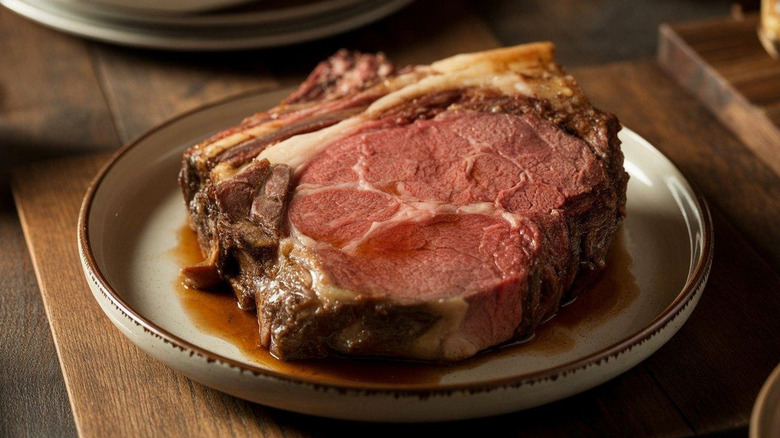
Prime rib has quite the reputation. It's the kind of cut that gets pulled out at special events and for times when you want to impress with your cooking skills. But between confusing terminology, guesswork on cooking times, and a whole lot of contradictory advice online, it's also one of the easiest roasts to get wrong (and a pricey one at that). Understanding the difference between prime rib and a rib roast is really just the starting point.
To help you master this cut at home and serve up one that could hold its own against some of the best prime rib restaurants in the country, we asked three experts to break down the rules worth following along with warning us about the ones people break most often. Mark Nicholas is Vice President of Operations at New York Butcher Shoppe, a hand-cut, Certified Angus Beef specialty market known for its neighborhood butcher shop feel; Mark Trimble is Executive Chef at Omaha Steaks, with experience in four- and five-star kitchens from Atlanta to Switzerland; and Jorge Thomas is the founder of Swaledale Butchers, a trained chef and butcher with a long-standing focus on whole-carcass butchery and cooking over fire and smoke. Together, they walk us through everything from buying the right cut to knowing exactly when to pull it from the oven so that no stage trips you up en route to serving the best dish at your table.
Know what you are actually buying
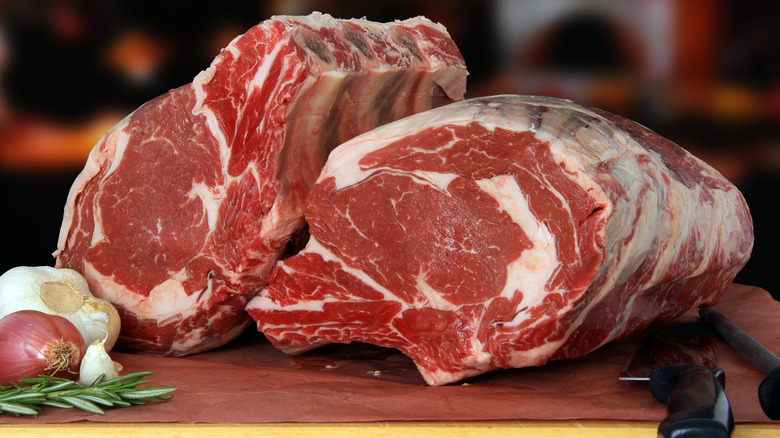
The biggest mistake regarding prime rib starts even before the cooking does. The word "prime" causes more confusion at the meat counter than almost any other term in butchery. Mark Nicholas sees this constantly play out. "Prime rib does not necessarily mean prime grade or bone-in," he explains. "'Prime rib' is a generic term for a rib roast. You then can choose from choice or prime grade, prime being the higher grade. And then decide boneless or bone-in." In other words, if you go to your butcher and ask for prime rib without specifying any further, they are not going to be clear about what exactly you need.
Mark Trimble points out that apart from terminology, you also need to have your priorities in place. "The biggest mistake is focusing only on size or price instead of understanding what you're buying," he says. "Look for good marbling, because that intramuscular fat is what gives prime rib its flavor and tenderness." For chef Trimble, the chuck end piece is the cut to ask for since that section sits closer to the shoulder and tends to carry richer marbling and fat.
Jorge Thomas agrees that size shouldn't be the only deciding factor. "I'd rather have a smaller joint from good beef with proper fat cover and marbling than a huge lean one," he says. He adds to also ask about how long the beef has been aged, too. "With a rib roast, it matters," he insists.
Let the surface chill fade
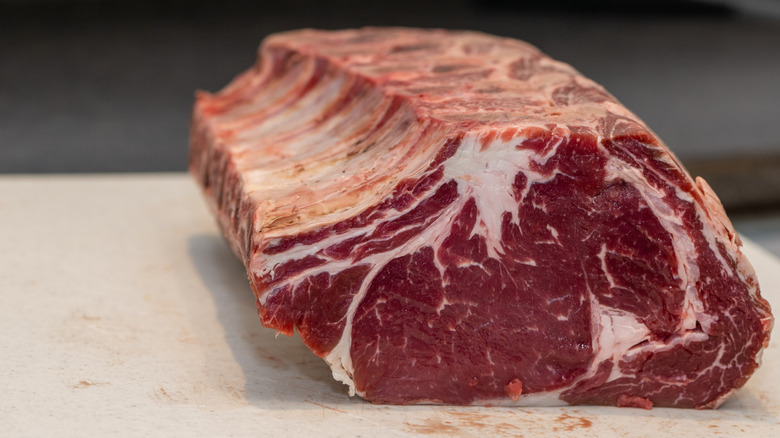
Taking a prime rib out of the fridge before cooking feels like common sense, but according to all three experts, the common advice to bring it fully to room temperature is more myth than a professional technique. "I wouldn't wait until the whole thing was at room temperature. That could take a while," says Mark Nicholas. The main goal is to take off the initial major chill from the refrigerator. "An hour or so should be plenty of time."
For chef Mark Trimble it's also a question of food safety: "I don't recommend leaving a large roast out for hours to try to bring it completely to room temperature. It's unnecessary, and from a food-safety perspective, you don't want it sitting out too long," he explains. Instead, he suggests pulling the roast out while prepping everything else, letting some of the surface chill fade naturally rather than treating it as a separate, timed step.
Jorge Thomas backs this up with a practical reality check. "A big rib of beef isn't going to reach room temperature after an hour on the kitchen side," he says. "Take the chill off it, fine, but I wouldn't leave a large joint sitting around for half the day." The takeaway across all three answers is the same: Chasing full room temperature is an unnecessary step built on a myth that doesn't hold up once you consider how large and dense this cut actually is.
Salt it early
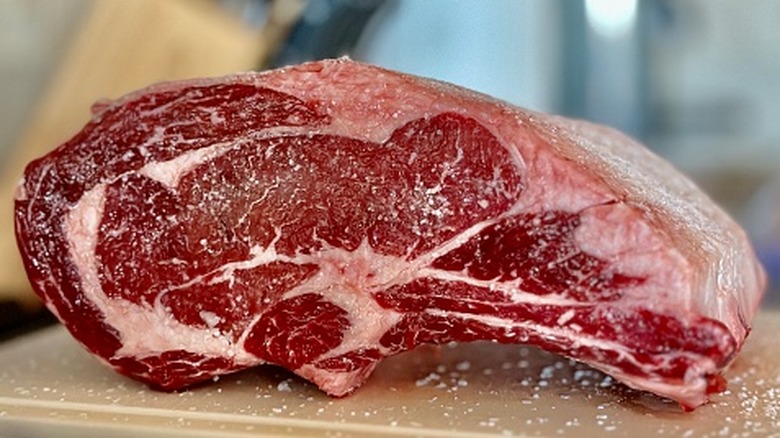
Let's get this out of the way first: A prime rib is a large cut of meat. As a result, it will probably need more salt than you are comfortable using. Jorge Thomas is adamant when it comes to salting prime rib: "Salt it properly. It's a big piece of meat and people are often far too timid with seasoning," he says. "If I can, I'll salt it the day before and leave it uncovered in the fridge. Pepper before cooking. Good beef doesn't need much else."
Executive chef Mark Trimble echoes this sentiment. "I prefer to season generously in advance, making sure to cover the sides also, pressing the seasoning firmly over the entire prime, ideally several hours or even the day before, so the salt has time to penetrate the meat and enhance the flavor throughout, not just on the surface," he says.
"Since I use a lot of salt, I don't like to go overnight. I like a few hours before it goes in the oven," says Mark Nicholas. "But since it is a big roast, it can be very forgiving if you want to season earlier." Underneath all this advice is this principle at play: Salt, given time draws moisture out and then back in, carrying flavor deeper into the meat along the way. Salting early, and salting generously, makes a real difference by the time the roast reaches the table.
Cook low and slow
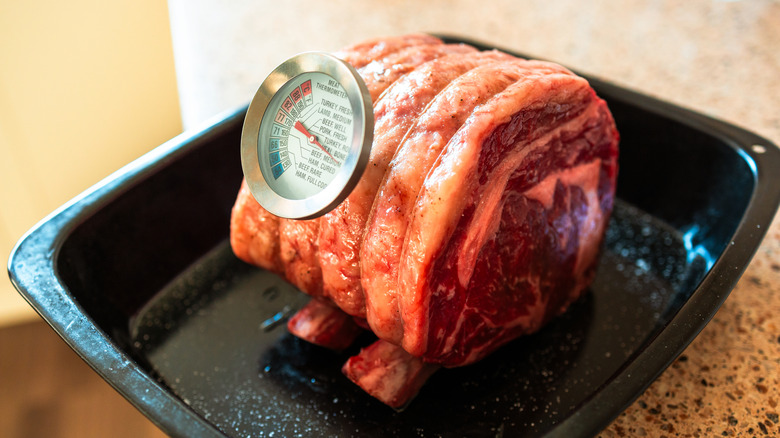
If you have ever cooked prime rib in the oven, you will know that the preferred approach is gentle. Now is the time to keep the oven low and slow rather than blasting it with high heat from the start. Mark Nicholas has built his entire method around this particular type of consistency: "I personally have always done a lower consistent heat because of socializing while I cook," he says. "I don't have to pay attention as closely. I cook at 350 [degrees Fahrenheit] for about 10 to 15 minutes per pound. I pull it at 120 degrees [Fahrenheit]. It has always worked just fine for me."
Jorge Thomas frames high heat as a genuine risk rather than just a matter of preference. "For a big rib I prefer a gentler oven, then plenty of heat for the outside," he says. "You get much more even pink meat that way. Start too hot and you can end up with a thick grey band before the middle is where you want it."
Executive chef Mark Trimble prefers "a lower-and-slower approach because it gives you more control and helps the roast cook more evenly from edge to center." That dreaded grey band is the real reason low and slow works so well here. Gentle, even heat gives a large roast the time it needs to cook through gradually, keeping more of the interior a consistent, rosy pink rather than fading to grey the closer you get to the crust.
Finish with high heat
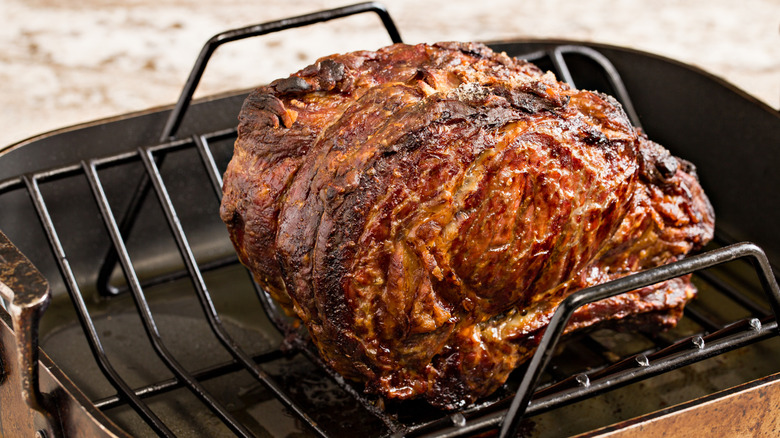
While cooking low and slow is necessary for even doneness, it doesn't build that delectable, deep brown crust that makes a prime rib look so good (and taste great as well). So, what needs to be done to achieve this? Executive chef Mark Trimble has two complementary methods that he uses. "High heat is great for developing a crust, so you can also combine the two methods: Cook gently until you're close to your desired temperature, then use high heat at the beginning or end to create that beautiful exterior," he says. What matters for chef Trimble is that the roast gets both a gentle cook for even doneness and a hot blast somewhere in the process for color and crust.
"For a big rib I prefer a gentler oven, then plenty of heat for the outside," agrees Jorge Thomas. Use low heat to cook the roast gradually and evenly and then a blast of high heat to build color and texture on the surface quickly. Be aware that high, direct heat when applied for too long or too early risks overcooking the outer layers before the center catches up. Using both in sequence and let each one do the job it's actually suited for. There is no single oven temperature to handle both jobs at once.
Never skip the rest
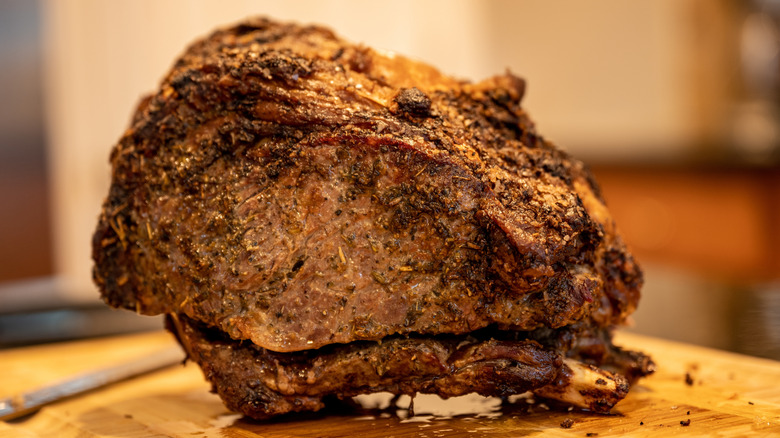
The moment finally arrives. After hours of careful cooking, it's time to carve the prime rib and dig in. However, all the experts urge you to hold on. "The meat relaxes as it rests," Mark Nicholas explains. "It will hold onto the juices much better in that relaxed state. Plus, [there's] always a little 'carry over' cook. I pull mine at 120 degrees [Fahrenheit]. While it's resting, it will continue to cook to about 130 [degrees Fahrenheit] or so. Do not rush this step. A roast that size can rest for a good 30 minutes or so." Resting gives those all-important juices time to redistribute evenly back through the meat before it's cut. Slicing through too soon sends all that moisture straight onto the cutting board instead.
Jorge Thomas also prefers a pause with some heft to it, since this stage makes such a big difference to the final result. "Depending on the size, I'd happily rest it for 30 minutes or more," he says. "Five minutes whilst you find the carving knife isn't resting a rib of beef."
"Resting is essential," Mark Trimble agrees. "It's not an optional final step — it's part of the cooking process. When the roast comes out of the oven, the juices need time to redistribute throughout the meat. If you carve immediately, those juices end up on the cutting board instead of in each slice. Depending on the size of the roast, give it at least 20 to 30 minutes before carving."
Always cook by temperature
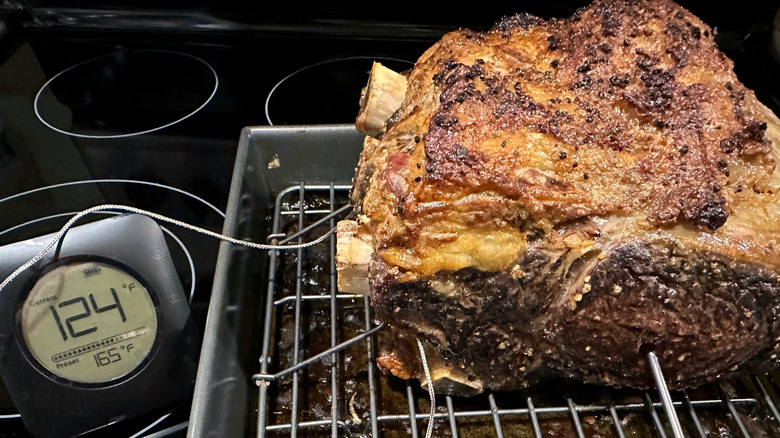
There is one kitchen tool that almost every expert recommends buying, and that's the meat thermometer. Guesswork has no place in the equation when dealing with cooking meat. Mark Nicholas can't stress this enough: "Always use a meat thermometer. It is the best way to know for sure," he says. "It's also why I cook my roasts by time and temp. The math works pretty much all the time as long as you know the weight of the roast." Jorge Thomas recommends you "check the thickest part, away from the bone, and take it out before it reaches the temperature you want to eat it at. It'll keep cooking whilst it rests."
"Prime rib is too expensive, and too special, to rely on timing alone," says Mark Trimble. "Temperature, not the clock, should determine when your prime rib is done." He also stresses pulling the roast early, since carryover cooking will continue during the resting time.
Nicholas illustrates it with real numbers, pulling his roast at 120 degrees Fahrenheit and knowing it will climb around 10 degrees higher while it rests. Skip that math, and a roast pulled at your actual target temperature will overshoot it by the time it's ready to carve. Basically what all three experts are saying is that it is always temperature, not the clock, that actually determines whether a prime rib turns out the way it's supposed to.
Carve against the grain
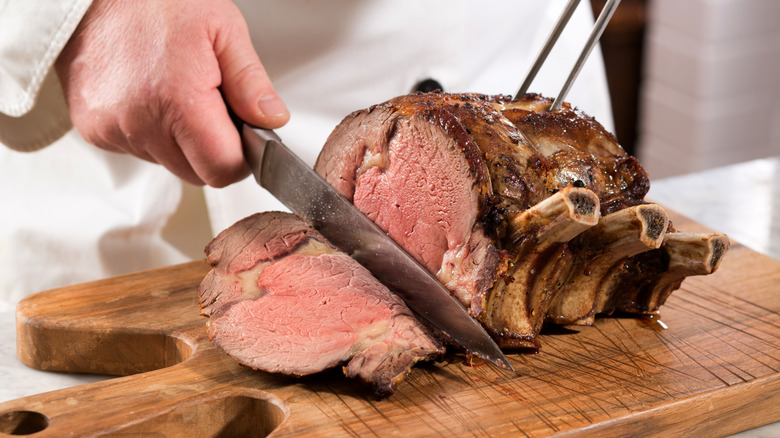
Once the roast has rested properly, how it gets carved plays its own role in how tender each slice ends up. Jorge Thomas lays out a specific method for handling the bones during carving. "Rest it first and use a properly sharp knife," he says. "If it's bone-in, I'd take the rack of bones off and then carve the beef across the grain. Much easier than fighting around the bones at the table."
It's essential that the roast is fully rested before you attempt to carve it, Mark Trimble agrees. "From there, technique is about using a sharp carving knife and slicing against the grain for the most tender bite," he says. "Don't rush it — clean, deliberate slices will make a beautifully cooked roast look just as impressive on the platter as it tastes."
For Mark Nicholas, "Timing is more important than technique. Letting it rest is key," he says. A properly rested roast forgives a lot of imperfect knife work, while a roast carved too soon won't be saved by good technique alone. "If you are worried about knife skills, then choose boneless as they are easy to carve," says Nicholas. Remember that slicing meat against the grain and across muscle fibers is what makes a slice taste tender rather than chewy. You have gone through the effort of letting the meat rest adequately — now take this final step that turns a well-cooked prime rib into slices that are actually easy to eat.
Don't throw away the bones
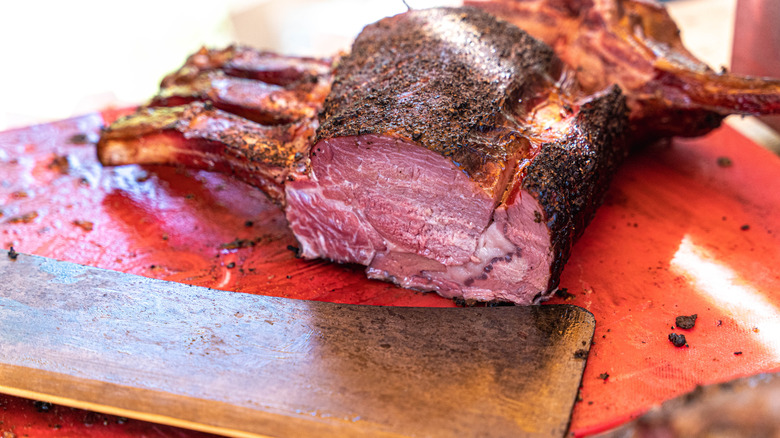
The bones in a prime rib are valuable whether you choose to cook the cut bone-in or boneless. Mark Nicholas focuses on the practical benefit of separating the bones before serving, even if they were cooked on. "Having the bones cut off and tied back on is the best solution for carving and serving," he says. "Usually this will feed several people, so having to navigate the bone for someone who has not done that very often can be frustrating." For Nicholas, this isn't about flavor, it's about making the roast easier to carve and serve at the table without guests struggling around bone structure they're not used to handling.
"One misconception is that you have to choose one approach as universally 'better'," says chef Mark Trimble. "Cooking bone-in can add flavor and help insulate the meat, while removing the bones beforehand can make carving easier. If you do remove them, don't throw them away — you can tie them back onto the roast during cooking for the benefits of bone-in roasting while making carving simpler afterward."
Jorge Thomas prefers to cook it on the bone, as they protect one side of the joint. He also adds that the bones "make a pretty good roasting rack. Take them off before carving and don't throw them away. There's plenty of good eating left around them."
Let the fat do the work
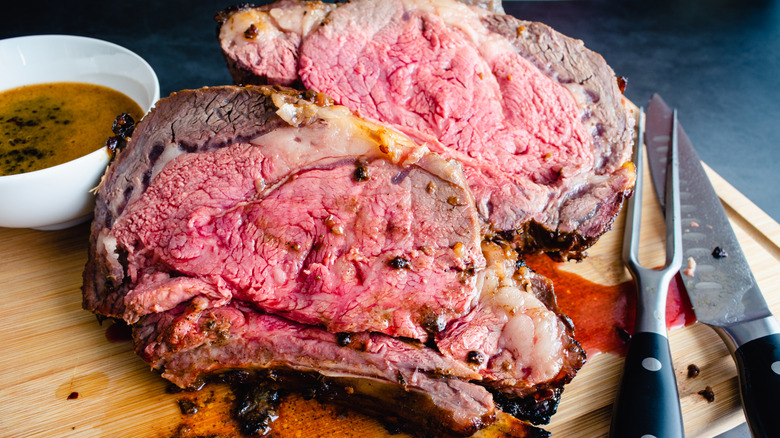
You wouldn't be alone in believing that basting is a great way of taking care of your prime rib while it cooks away. But wait up — according to our experts, it's a habit worth breaking when it comes to this cut of meat specifically.
"Prime rib already has plenty of natural richness, especially when you start with a well-marbled roast," explains chef Mark Trimble. "Constant basting isn't necessary and can actually work against you by repeatedly opening the oven and disrupting the cooking environment. I prefer to let the beef do the work. If you want to add flavor, a light coating of butter or oil with herbs can help the seasoning adhere and contribute to browning, but there's no need to continuously baste."
"If you've bought a good rib, it already has fat," says Jorge Thomas. "You can baste towards the end with butter and herbs if you want, but I wouldn't keep opening the oven and messing about with it. Leave it alone and let it roast." Mark Nicholas agrees with this attitude regarding letting the oven do its work without keep opening it and letting out the heat. However, he does do things slightly differently: "I will add whatever fat I want to use at the beginning of the preparation," he says. "I like to use duck fat. I rub it down at the very beginning. It will give me the desired crust I'm looking for."