

The 8 Best Oils For Flavorful Fried Chicken
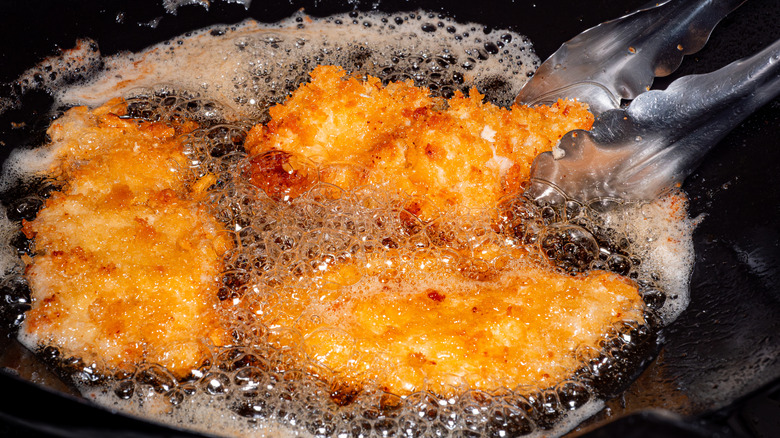
So, the explosive flavor of your first bite of freshly fried chicken has caused you to reach chicken nirvana, and now you're wondering how to achieve such perfection at home. The truth is, there are many hurdles that one has to navigate before getting it right. You could learn how to keep fried chicken from getting soggy, or Tyler Florence's secret to juicy fried chicken, but those aren't the only things you need to consider. Importantly, the type of oil used for fried chicken can truly enhance the flavor and texture.
We decided we needed some professional help to point us in the right direction, so we turned to the experts. Luckily, we found two chefs willing to give us their professional insight into what oils work best for the most flavorful fried chicken: Chef Benjamin Darling of Farm Bar in Chicago, Illinois, and Chef Mark Alba from Hartley Kitchen in Atlanta, Georgia. With their combined expertise, they provided some fried chicken pointers, the first one being about what not to use.
Darling mentions that he "would avoid very flavorful oils, like sesame oil, because the flavor will be very overwhelming." Alba agrees with the sentiment regarding flavored oils, and adds that steering clear of darker colored oils would also be wise. As for the oils that they believe work best? Go with a neutral oil. You might now be wondering, what is a neutral oil? But that's simply an oil with a mild or light flavor.
1. Canola oil
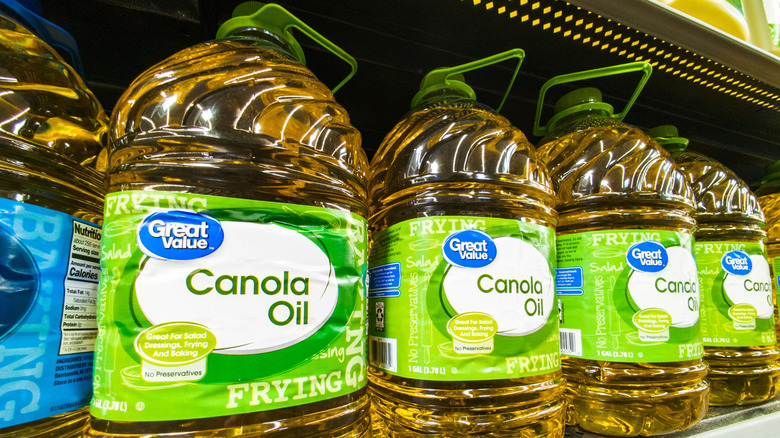
Canola oil is often mistaken for rapeseed oil due to its similar appearance, and perhaps the fact that the canola plant was spawned through human intervention from the rapeseed plant. For the sake of your fried chicken, though, don't allow yourself to fall victim to this confusion. Both rapeseed oil and the plant itself are entirely separate entities, with different chemical makeups.
Now that you know not to fall for the look-alike, let's get to why canola oil is considered a great option for your fried chicken. It certainly hasn't earned the title of Bobby Flay's favorite cooking oil for nothing. One of the main concerns when cooking with any oil is its smoke point, or the point at which the oil starts to burn. As Chef Alba puts it, "Once the oil burns, it can impart burnt and bitter flavors." The great thing about canola oil is that the smoke point is quite high, ranging from 400-475 degrees Fahrenheit, depending on the quality of the oil.
Chefs Darling and Alba agree that canola is a great oil for frying chicken, and Darling calls it "industry standard." Alba adds that non-trans fat canola oil is a safe alternative to peanut oil for those with allergies, and is an affordable option with "a neutral flavor that will let your seasoned flour mix shine."
2. Sunflower oil
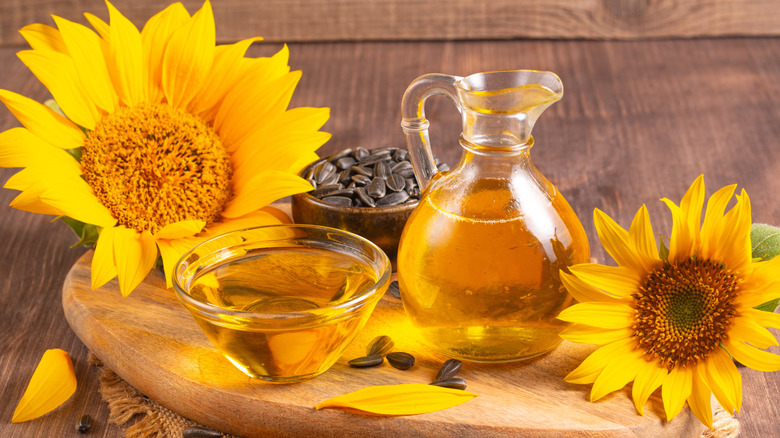
Sunflowers have notoriously short blooming seasons. If you've ever seen a withered sunflower, you'll know that once the flower has begun to droop, its petals scattered on the ground, it's a far less impressive sight than when in bloom. Sunflower oil, though, gives these wilted flowers renewed purpose, as it is at this point that the seeds are harvested, cleaned, and put through the oil extraction process.
This type of oil is, according to Chef Darling, another go-to in the industry for fried chicken, with a neutral flavor that won't taint the flavoring of your breading or poultry. As for its smoke point, this is where sunflower oil gets to be a little more complicated.
If you head over to your local grocer, you may notice that sunflower oil comes in refined and unrefined options. The difference comes into play when you consider how the oil was created. With unrefined options, the oil goes through a very simple, bare-bones process that leads to a more natural product. Refined oils, meanwhile, undergo many more steps through mechanical or chemical processes. These processes increase both the shelf life and the smoke point of the oil. The smoke point of refined sunflower oil clocks in at approximately 450 degrees Fahrenheit, while the unrefined version sits at about 320 degrees Fahrenheit. If you accidentally purchase unrefined, though, you don't need to panic. Darling says that as long as your oil is fresh each time it's used, it shouldn't cause issues.
3. Animal fat
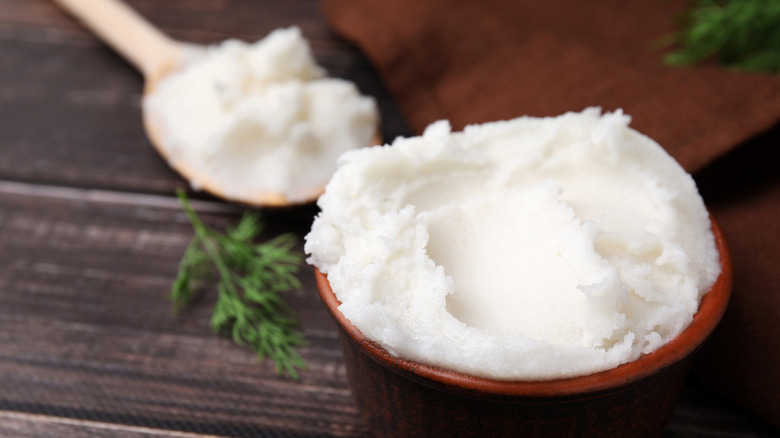
While they occasionally get a bad reputation for being heavy in calories and high in saturated fats, animal fats are still a great option for making fried chicken, especially when it comes to the flavor. There are several types of meat from which these fats may come, including pork (which produces lard) and beef (which provides tallow). The differences between lard and tallow may be unclear to some, as both have a long history of being used in the kitchen. Lard, in particular, was an important part of many recipes before vegetable oil swooped in to steal the spotlight.
While animal fat is not strictly an oil when in its solid form, our expert chefs made it clear that it deserves a mention on this list — especially when the focus is on producing a flavorful outcome. Alba admits that, while animal fat may not be the least expensive option, tallow or lard will add a "rich, savory flavor" to fried chicken. He also says that these fats have a very high smoke point, around 400 to 450 degrees Fahrenheit. If you're worried about the cost, or don't want to neglect your entire collection of cooking oils, you could seek out the fried chicken recipes that Darling says call for a mixture of vegetable oil, lard, and bacon fat.
4. Peanut oil
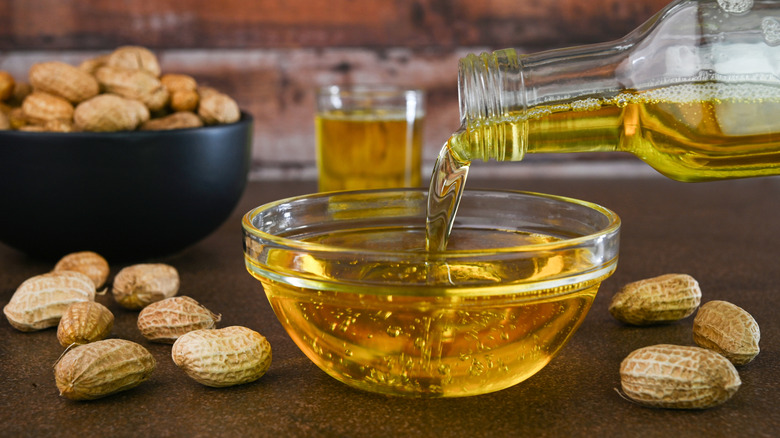
You may already know that Five Guys exclusively uses peanut oil for its fries. But even if you've never heard of peanut oil, the name is pretty self-explanatory: It's a type of oil that is extracted through either a chemical or mechanical process from crushed peanut paste. This oil is commonly available in both refined and unrefined options. Unrefined peanut oil will maintain a nuttier flavor. It's also more expensive, and it has a lower smoke point.
When frying chicken, you run the risk of affecting the flavor if the oil burns. There can also be health concerns, Alba warns. "Burnt oil can produce a compound known as acrolein that is unhealthy in high quantities, leaving your chicken with a chemical taste," he says. With all this in mind, it may be better to stick to the refined options.
If you've been dreaming of a crispy piece of traditional, Southern fried chicken, peanut oil may just be the oil for you. It's second only to canola oil for Alba, who considers peanut oil to be "the true Southern classic oil" for making fried chicken. However, a word to the wise: Beware of cooking for those with allergies, as this may not be the right choice for them. In those instances, Alba suggests opting for a non-trans fat canola oil.
5. Olive oil
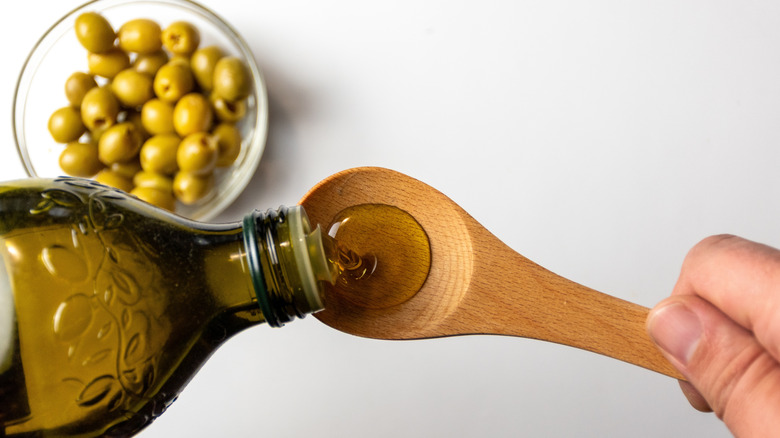
If you've ever wondered what the difference is between regular olive oil and the virgin or extra virgin variety, then you have come to the right place. Similar to the difference between refined and unrefined oil, the difference between virgin and regular olive oil is simply the production process that the olives have gone through. Extra virgin olive oil (EVOO) has gone through the simplest process possible, from olive to bottle, and is thus considered the highest quality of the three types. Regular olive oil, on the other hand, is more refined. Virgin olive oil is less common, and is often created from a mixture of ripe and unripe olives.
The smoke points for these types of olive oil differ significantly, with EVOO's typically falling between 350 and 400 degrees Fahrenheit. To compare, the smoke point for refined olive oil sits between 390 and 470 degrees Fahrenheit. If you do choose to use EVOO, just be mindful of the lower smoke point.
EVOO maintains a stronger flavor profile due to the way it is created, while regular olive oil has a more neutral flavor. As for whether or not the experts recommend olive oil for frying chicken, it all comes down to what you're looking for. Alba says he would "avoid using dark or flavored oils like olive oil", while Darling points out that Italian nonnas have been successfully frying chicken cutlets in extra virgin olive oil for many years.
6. Rice bran oil
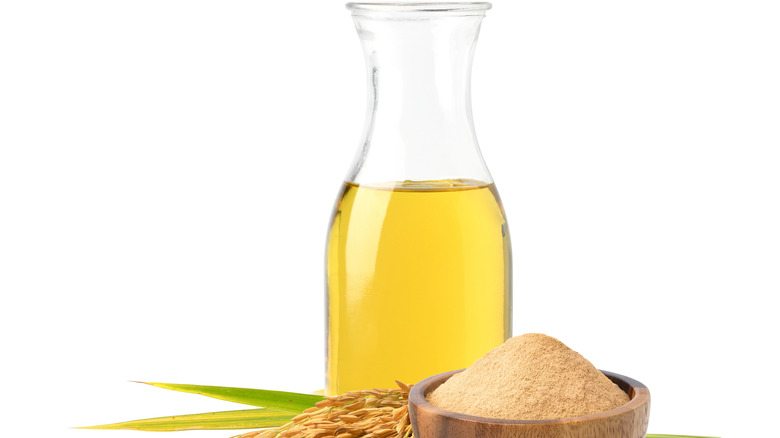
Rice bran oil is, unsurprisingly, created from rice. But what you may not be able to deduce from the name alone is that it's extracted from the outer shell of rice — a specific part of the grain called the bran. The bran is removed from the grains of rice, and instead of becoming waste, it's used to make rice bran oil.
Rice bran oil has been consistently used in Asian cuisines for many years, and it is slowly gaining more popularity in the U.S. With perks like its high smoke point, antioxidants, and omega 6 and 9 fatty acids, this oil is certainly a strong contender for fried chicken. While rice bran oil is known for having a slightly nutty flavor, the taste is mild enough that it won't overshadow your breading or meat.
While the smoke point of rice bran oil is a whopping 450 degrees Fahrenheit, that doesn't mean you should be cooking fried chicken anywhere close to that. One of our experts, Chef Alba, mentions that if thick pieces of chicken are fried between 375 and 450 degrees Fahrenheit, the outer layer may crisp up before the inside has had a chance to cook properly. He says he likes to "fry chicken closer to 325-350, as it frequently times out perfectly, with a just-right cooked interior and golden brown crust."
7. Grapeseed oil
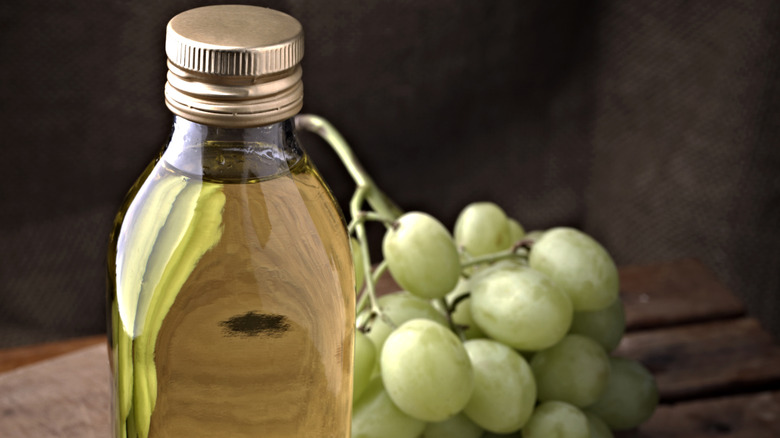
As our experts point us in the direction of using neutral oils to make flavorful fried chicken, it's clear that grapeseed oil should be included on this list. The light-colored oil is often overlooked, but just because it tends to fly under the radar, that doesn't mean it's not useful. For its neutral flavor profile and also its high smoke point, grapeseed oil is a must-have pantry item and a great choice for frying chicken.
Grapeseed oil is retrieved from pressing grape seeds — a brilliant idea for reusing a part of the grapes left over after the winemaking process. Its smoke point sits comfortably between about 420 and 450 degrees Fahrenheit, which makes it an excellent option for frying foods in general. It's a much better option than, say, using butter to make fried chicken — which, by the way, our experts advise against. Darling says the smoke point of butter is too low for this application; it's likely to "burn well before the chicken is cooked through."
While grapeseed oil is sometimes praised for its health benefits, and considered to be a potentially healthier alternative to other cooking oils, opinions differ. Some say that, yes, it has health benefits, though the difference between grapeseed oil and something like olive oil is quite minimal. Alba agrees that grapeseed oil could be the healthiest option for making fried chicken, but also says that shouldn't necessarily be a concern. "Do you really want healthy fried chicken? Go ahead and splurge!"
8. Safflower oil
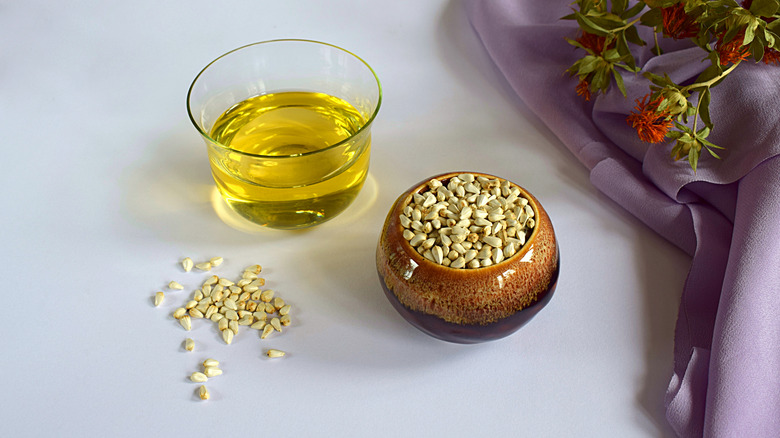
No, this is not a spelling mistake that has us confusing safflower with sunflower oil. Safflower oil is an entirely different product, from an entirely different plant — one that has been harvested for several thousands of years. When it was first introduced to the U.S. in the early 20th century, the fat content of the seeds was quite minimal, which made turning them into cooking oil an unsustainable endeavor. But over the years, and with the help of human intervention, the fat content has increased significantly. The oil output of safflower seeds now makes the production of safflower oil worthwhile. Once harvested, the seeds are cooked, dried, and then squeezed to obtain the safflower oil.
In general, this oil meets our neutral cooking oil requirements, and it also features quite a high smoke point — about 450 degrees Fahrenheit. Even with such a high smoke point, though, it's important to maintain the temperature of the cooking oil when making fried chicken. As Chef Darling reminds us, the temperature rising too high should not be our only concern. If the temperature lowers enough, it could result in a disappointing outcome as well. "If it dips too low, the water doesn't escape fast enough, resulting in soggy breading," he says. Luckily, he has also shared with us one of his tricks to making sure fried chicken ends up crispy every time: using a thermometer.