

12 Foods With More Calcium Than Milk
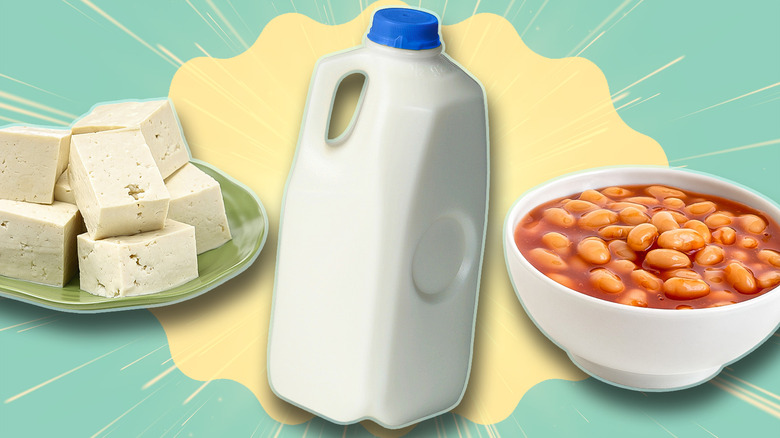
The importance of getting enough calcium has been consistently drilled into us. Parents tell young children how it will strengthen their bones, and give them superhero powers. Doctors talk to patients about the impact of calcium as part of a healthy, well-balanced diet. Let's not forget about all of the commercials that used to air, featuring people of all ages wearing milk mustaches, and huge, calcium-fueled smiles. It was for good reason, too, since calcium can improve your bones, hair, skin, nails, and overall health.
Per the U.S. Department of Health and Human Services, kids are supposed to get anywhere from 260 mg to 1300 mg of calcium per day, while for adults, that's around 1000 mg to 1200 mg. A single cup of cow's milk provides 300 mg of calcium, which is about 24% of the daily recommended amount. But while milk is probably the most well-known source of calcium, there are so many other foods that can help you to reach your recommended daily intake. Calcium does not have to come from one source.
In addition to other types of dairy that can get you to your daily calcium goal, there are many plant-based, vegan, and non-dairy options available to get the job done. Regardless of dietary restrictions or lifestyle, you'll find a large spectrum of foods with more calcium than milk.
Fatty fish

Here's a little food for thought: The next time you order a pizza, before you nix the idea of adding anchovies as a topping, you should know that they happen to deliver a huge portion of calcium. That coupled with the cheese on the slice can make your pizza not only delicious, but rich in calcium as well.
Tinned fish, or tin fish, is a food trend that has recently soared in popularity via Tik Tok. However, it's not just a timely food fad. In fact, a handful of fatty fish varieties have calcium counts that will shock you. Eating canned sardines or salmon can give you over 300 mg of calcium per serving, surpassing the amount in a glass of cow's milk. The calcium in a serving of canned jack mackerel or canned crab also punches above milk.
What is it about tinned fatty fish that makes it such a standout calcium supplier? The secret is in the bones. Many types of canned fish contain tiny, soft, edible bones. While they can go completely undetected, they are the true MVPs of the high calcium content. If you want to eat them straight from the can, go for it. If you prefer a different approach to having tin fish in your diet, that's okay, too. A quick recipe search online will unearth an abundance of delicious, and nutritious ways to incorporate fatty fish into your meals. You can include them in soups, curries, pasta sauces, and more.
Tofu
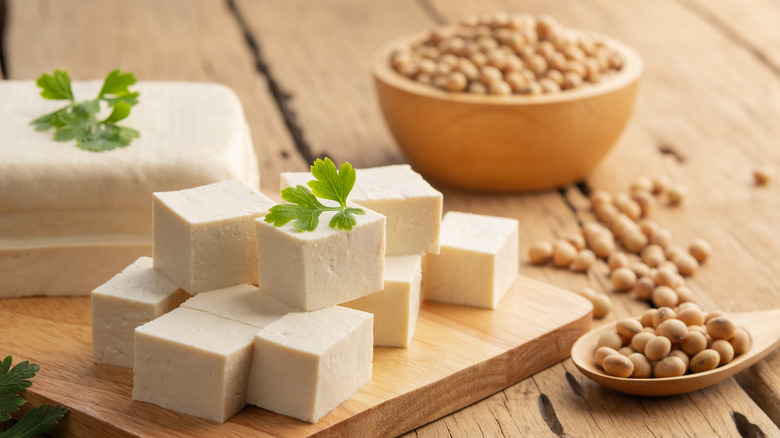
If you are vegetarian or vegan, or if you simply prefer to avoid all dairy products, you should consider adding tofu to your roster, as it is a fantastic source of calcium. Just half a cup of cubed firm tofu contains 300 mg, and some varieties can deliver up to 500 mg of calcium.
While tofu does have a bland taste, its pliable texture makes it easy to mix with a number of other ingredients, if you don't want to eat it as is. Simply drop it into the blender of your morning smoothie, and you'll automatically add more silkiness to the texture. You can also use tofu to make dips more substantial, and nutritious, or cube firm tofu to toss into salads.
If you choose to eat tofu raw, pick some of your favorite flavor profiles, and use those to inspire a marinade. Depending on how strong you prefer the flavor, let your tofu hang out in the marinade for as little or as long as you want. Tofu is great because it adapts to whatever you cook it with. Its porous texture will soak everything right up like it was made to be there. Call that girl dinner, or include it on a charcuterie board for guests. It's a great vegan choice that delivers a mild zing of flavor, a smooth finish, and a beneficial dose of calcium.
Yogurt

Your favorite plain yogurt likely has over 400 mg of calcium. Compare that to the 300 mg you get from a glass of milk. Also, note that while grocery store Greek yogurt is considered a healthy choice, it actually has less calcium than regular yogurt because of the way it is strained.
If yogurt is already a part of your day on a regular basis, good for you. Between the calcium, protein, and probiotics found in the most popular yogurt varieties, eating it is doing good things for your body, and especially your gut. If you'd like to incorporate more into your diet, finding ways to upgrade yogurt might help.
There's not one way to enjoy yogurt. It's a fantastic base for sauces, dips, marinades, and more. Scoop some into a bowl, and top it with fresh fruit, your favorite granola, honey, chia seeds, chocolate chips, and anything else you fancy to make a healthier (but still delicious) relative of the beloved ice cream sundae. A single serving of regular yogurt delivers more than 30% of your daily recommended calcium intake. Greek style yogurt still provides more than 20%, so it's certainly not a calcium fail if you choose that route.
Kefir

If you have seen something called kefir in the yogurt section of your grocery store, but were never sure what it was, here's a brief education to get you up to speed on a super nourishing food. It's technically another variation of yogurt, and it has some similarities, including the way it provides a hefty dose of calcium. Instead of digging in with a spoon, though, this fermented food is enjoyed in drinkable form. Kefir is known to be a little acidic, and to have a bit of a bite compared to regular yogurt.
One serving of kefir is brimming with more than 300 mg of calcium. But kefir isn't just calcium rich, even though that's a big win in itself. It is also packed with probiotics to foster better gut health, as well as a long list of other nutritional benefits to positively impact your overall health. Incorporating kefir into your diet has been linked to increasing your ability to fight certain cancers, and improving other areas of health. And as far as how to eat it goes, anything you can do with yogurt, you can likely do with kefir. Use it in fruit bowls, smoothies, or just chug it straight from the bottle.
Nettles

A lesser known food source packed with calcium is the nettle, also referred to as stinging nettles. You'll be awestruck by how much calcium this plant has nestled in its little leaves. One serving of nettles contains more than 400 mg of calcium per serving, and there is research showing that consuming them can help with a variety of health issues, such as heart health, prostate health, some cancers, allergies, and arthritis.
There are several ways you can incorporate nettles into your diet, just like you do with other veggies. Nettle leaves can be prepared the same way you might cook other leafy greens, like regular spinach. Sauté the greens in a pan with a protein of your choice, and gobble it up to immediately increase your calcium intake.
If you would prefer to hide the flavor of the nettles, or incorporate the leaves into other recipes, that's cool, too. The next time you bake a fresh loaf of bread, fold some nettle leaves into the dough. Throw a bunch into the hearty soup you have simmering on the stove for dinner. Add nettles to your omelet. No matter how you choose to eat nettles, you'll find that adding them to any dish levels up your calcium points.
Nuts and seeds
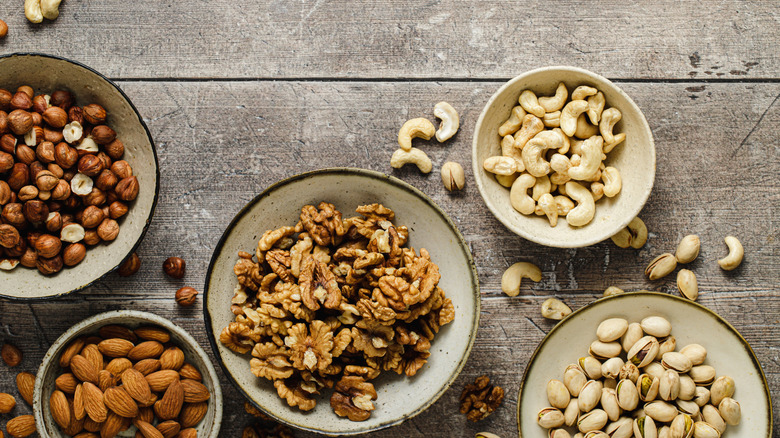
The list of seeds, and nuts that deliver an excellent dose of calcium is long, and diverse. At the top of the calcium leaderboard are sesame seeds, which have over 900 mg per serving. So, eat that sesame bagel with pride, knowing that those tiny seeds are actually good for you. Tahini, made from ground sesame seeds, is another great way to up your calcium intake. It's a delicious sauce with Middle Eastern roots, and no shortage of ways to enjoy it. Tahini is frequently found in hummus recipes, and it can be drizzled, dipped, or spread like any other condiment to enhance a meal.
Almonds are another smart snack that really bring the calcium. The same goes for chia seeds, walnuts, pistachios, poppy seeds, brazil nuts, hazelnuts, sunflower seeds and others. The whole category, in fact, offers infinite, creative ways to achieve your daily calcium without tapping into dairy. The sheer variety you can find in stores speaks to the versatility of nuts, and seeds in the kitchen. Whip up some chia pudding, or use an air fryer to make the easiest toasted nuts for salads, soups, and sauces.
Cheese

Cheese has a huge, and passionate fanbase. Some may even argue that cheese is actually a love language. How else do you explain the amount of content online showcasing dramatic cheese pulls as though they're a form of communication? People across the globe love to share how far they can stretch the gooey cheese in their mozzarella sticks, grilled cheese, and pizza. But you can, of course, also snack on it, fry it, bake it, melt it, top other foods with it, and so much more. Cheese enthusiasts can be found everywhere, and they all have their favorite ways to enjoy it. And the good news for all of them is that cheese is a solid choice as a calcium source.
The list of calcium-rich cheeses is long, with flavors to suit any cheese devotee's palate. Hard cheeses are ranked the highest, so take this as your sign to go heavy on those. Parmesan, Swiss, gouda, gruyère, and bleu cheese each have about 345 mg of calcium per serving. If those aren't your thing, don't worry, because soft cheeses still contain calcium. The more moisture in the cheese, the less calcium it contains, so mozzarella, brie, and other soft cheeses may have less per serving, but there's no need to skip them completely.
Leafy greens
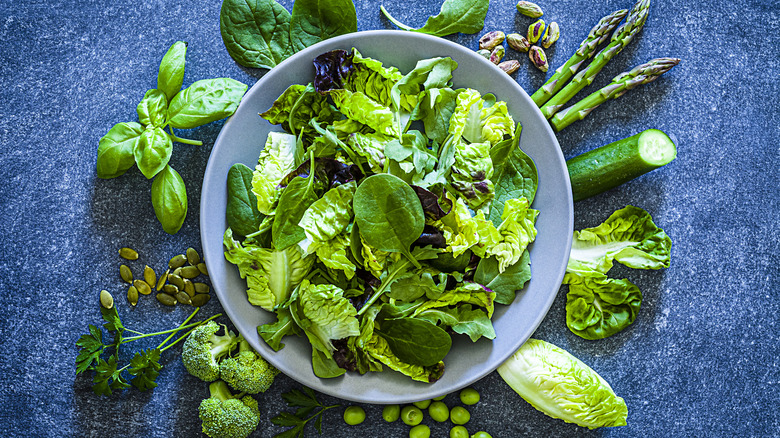
Leafy greens are calcium superstars that come in many shapes and sizes. Popular greens like broccoli, spinach, lamb's quarters, bok choy, and curly kale come equipped with a significant amount of calcium, as well as a list of additional health benefits. If you are already a green veggie lover, keep up the good work. If not, the numbers alone might just make you jump onto the bandwagon.
Greens really are great because they are adaptable to so many different foods, and dishes. Obviously, they fare well in salads, and they can be used to dress up a sandwich or wrap. If you are into dips, you can finely chop some leafy greens to add in. Smoothies and omelets also play well with many greens, as do baked casserole dishes.
If you're wondering which greens have the most calcium, let's talk about lamb's quarters. No, they are not actual lamb, but a vegetable belonging to the spinach family. One serving of lamb's quarters offers up to 464 mg of calcium. If you are doing the math in your head, that's a whopping 164 more than a cup of milk.
Alternative milk beverages

These days, there is an entire catalog of milk alternatives for those who want the goods, but don't want the dairy. Vegans, and people with a lactose intolerance, have long flocked to them, and they are now gaining more mainstream traction. Clearly, the general public is catching on, because you can't walk into a coffee shop these days without seeing a bevy of swaps to top off your drink instead of cow's milk.
There's soy milk, almond milk, oat milk, cashew milk, rice milk, and others. All are free of dairy, but not at the sacrifice of calcium. As long as they are fortified enough, they can easily top the amount of calcium provided by cow's milk. For example, almond milk that has been fortified brings 442 mg of calcium for the same serving size, which equates to 34% of your daily goal.
Oat milk and soy milk also deserve bragging rights, with each serving up over 300 mg of calcium. Drink your favorite milk alternative straight from the container, pour it over your breakfast cereal or granola, or ask for it in your latte on your next coffee run.
Orange juice

Orange juice has long been hailed as a healthy breakfast staple, as it is a vitamin C superhero. However, it's not a one trick pony. Fortified orange juice, and fortified grapefruit juice both serve as excellent sources of calcium, with the key being to look for a fortified version. A single glass of fortified orange juice can account for 30% of your daily calcium intake, proving that alternative milks are not the only beverages that can deliver more calcium than dairy.
Orange juice is a perfect addition to smoothies, and it can even be frozen into popsicles that are much healthier than anything you'd buy in a store. Along the same lines as the popsicle, why not make orange juice ice cubes for fun mocktails on a warm day? If you really enjoy orange juice, get creative, and expand how you consume it. You can use it as the liquid when baking muffins, cakes, and other confections; it will give them all a whisper of orange essence. It also works well in many marinades for whatever proteins you like to prepare. Combine with other fruits, and you have a sweet, delicious, and calcium-filled topping for french toast, waffles or pancakes.
Cereal

Cereal lovers, it's your time to shine — because, guess what? It's not just the milk in your morning bowl of cereal that increases your calcium intake. Similarly to juices, some cereals are fortified, and can surpass the amount of calcium in a single glass of milk. Special K and Total Raisin Bran cereals both have some of the highest numbers per serving — around 1000 mg of calcium, to be specific. If the fortified cereal is whole grain, that's even better. In addition to the calcium component, many cereals today offer substantial protein, fiber, and other important nutrients.
If you are not a cereal for breakfast person, it's also something easy to pack as a snack when you are on the go. You can forgo the milk altogether, and fill a container with some of your favorite dry cereal. It's also great for kids' lunch boxes, and it travels well as a road trip or plane snack.
Also note that milk isn't the only thing that pairs well with cereal. Next time you grab a yogurt from the fridge, mix in some of your favorite whole grain cereal to add another layer of texture, flavor, and calcium. Whether you eat your fortified cereal with or without milk, at your kitchen table or during your morning commute, you're putting big numbers up on that daily calcium board.
Oatmeal

Learn how to properly cook oatmeal, and give yourself calcium superpowers. A cup of dry oats delivers 400 mg of calcium, and it can be prepared with any milk you like. Just like with dry cereal, adding milk to your oatmeal skyrockets that number even further, inching you a few steps closer to your daily recommendation. Cow's milk, almond milk, soy milk, and other alternatives will help you double-down on calcium in one sitting. And, as if being a calcium powerhouse wasn't enough, oats are also great for digestion, and overall gut health.
Overnight oats are a fantastic way to turn dry oats into a hearty meal packed with amazing nutritional benefits. All you have to do is mix the oats with milk or a milk alternative, and let it sit in a closed container or mason jar in the fridge all night (hence the overnight part.) In the morning, you will have a healthy, filling, calcium-loaded foundation that can be enjoyed in so many different ways. Pick your favorite fruits, nuts, honey, cinnamon or anything else you like, and use it to top the overnight oats. It's satisfying, nutritious, and ticks more boxes than just the one for calcium.