

11 Things Not Enough People Know About Cracker Barrel
Where else can you play a wooden peg game, browse a gift shop full of rocking chairs, and warm your hands by a stone fireplace, all before your meal is served? Cracker Barrel has built a legacy on a particular mix of comfort food, tradition, and nostalgia, and the story behind it is more intriguing than most diners realize.
Think about the last time you walked through those front doors. You probably passed a row of rocking chairs, squinted at the antiques on the walls, grabbed a stick of candy, and slid into a seat with a peg game already waiting. It all feels so familiar that it seems like nothing about it surprises you anymore. But, the company that now runs more than 650 restaurants across 43 states started out as an add-on to a gas station, and that's only the first quirk on this list.
Cracker Barrel is one of those rare chains people have strong feelings about. There are families that plan road trips around visits and regulars who know their orders by heart. So, when the company changes even a small thing, the whole Internet notices in no time at all. That kind of loyalty also comes with a colorful history about the brand's name and a few determined decisions. So grab a rocking chair and get ready for a few revelations that might change how you see your next plate of its' popular chicken n' dumplings.
1. It began as a gas station add-on
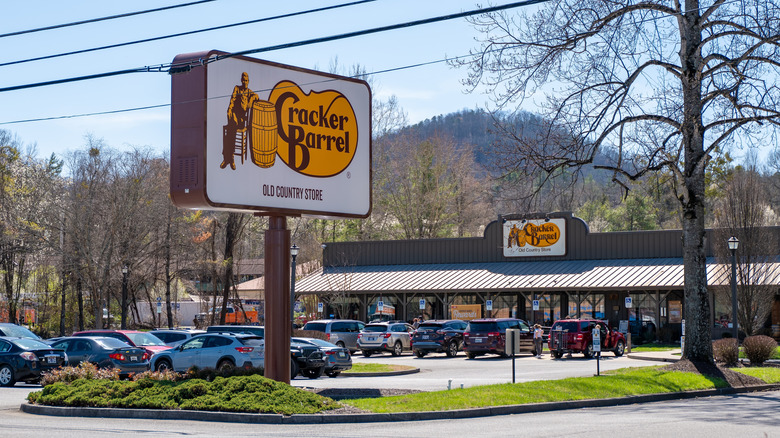
Did you know that before Cracker Barrel became the much-loved chain it is today, it started off as a plan to sell more gasoline. Let's backtrack to 1969 when founder Dan Evins was an an independent middleman who supplied fuel to a small group of Shell stations in Tennessee. These were small gas stations that were situated on back roads and were doing well enough until the new interstate kicked in. Suddenly the larger roads were pulling drivers away from stopping by smaller stops en route. To counter this loss in business, Evins decided to build his own station beside Interstate 40 outside Lebanon and he attached a restaurant and a small gift shop to it. The logic being this was that a good meal would surely lure more travelers to his pumps.
The first Cracker Barrel opened in September 1969 and turned a profit within a month. Within no time, food sales quickly outpaced the fuel. Evins decided to expand to a second location, selling half the business to a group of local investors to fund this move. When the oil crisis of the 1970s arrived, Evins had already realized that he was sitting on a food business goldmine and ended his distribution deal with Shell. Soon there were multiple Cracker Barrel stores stretching from Tennessee to Georgia and the company stepped out of the gasoline business altogether.
2. Cracker Barrel serves 210 million biscuits a year
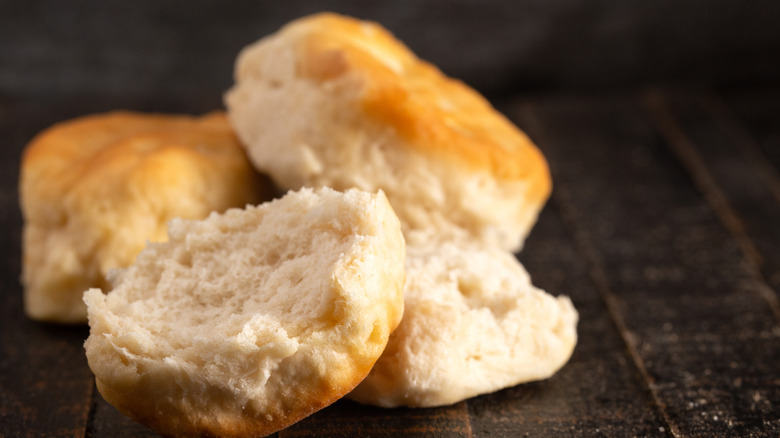
The food numbers from Cracker Barrel are truly impressive. While it's new menu items are "simplified" (their words, not ours), one item remains a classic. The best seller on the restaurant chain's menu remains its buttermilk biscuits. Cracker Barrel states that it serves more than 210 million biscuits a year, topping all its other menu items by a distinct margin.
What makes this even more impressive is the way they are made. According to the company, every restaurant bakes its biscuits from scratch in a dedicated biscuit oven. The exact rolling pins and cutters are designed by the Cracker Barrel team themselves. A quirk in today's highly automated food industry is that the biscuits are still shaped by hand so no two come out exactly alike. The official Cracker Barrel site boasts over 825,000 biscuits made each day that are served along with 7 million servings of strawberry, grape, and blackberry jellies a year. If you hanker to bake your own perfect biscuits, you can always buy the company's Biscuit and Dumplin' Mix for a treat at home.
3. The antiques are real
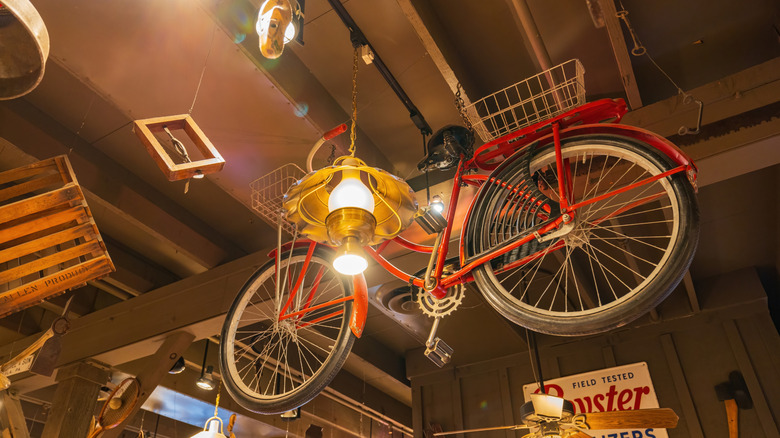
You might have mistakenly thought of all the old signs, skillets, and farm tools on the walls of your local Cracker Barrel as decorative props. But the company states that every piece is an authentic antique, and there are a lot of them. According to the official site, the company has collected over 700,000 treasures over the last 40 years. And these are on display across its restaurants. The decor warehouse in Lebanon, Tennessee holds more than 100,000 more.
The collection began in 1969, when founder Dan Evins asked local antiques dealers Don and Kathleen Singleton to furnish the first Cracker Barrel store. The couple's son Larry later became the company's chief antique picker. Today, the entire system of antique collection and distribution is organized with military precision. New arrivals are cleaned, restored, and cataloged, and each piece gets its own six-digit barcode and a category. Before a new restaurant opens, the décor team builds a mock dining room and lobby inside the warehouse to test the layout. Then it spends about a week installing the real thing on site. A visit to the warehouse also throws up gems like a portable pantry from 1860 or a vintage Coca-Cola banner dating back to the 1900s.
4. The decor is tied to each town
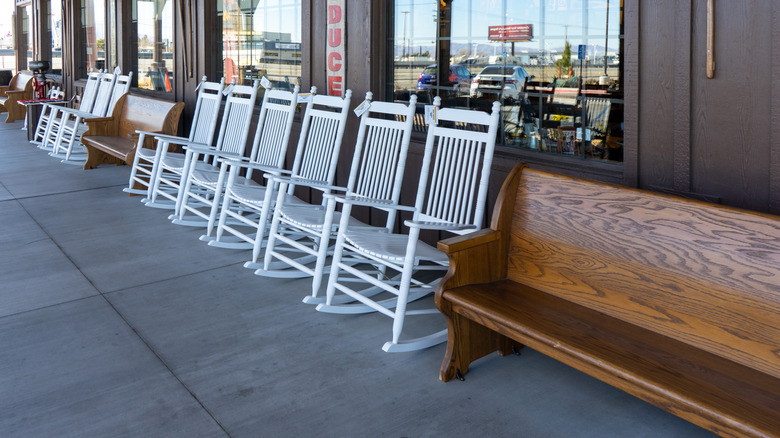
If you notice your local Cracker Barrel has a decor item that is out of the ordinary, there's a reason for that. According to the company, the décor team researches a new location's history and chooses specific pieces that echo the location's history.
Many of the 950 to 1,000 items allocated to each store are regional and location specific. The company blog points out some interesting examples: Fort Payne, Alabama, long known as "The Sock Capital of the World," has a wall of sock-themed pieces. The store in Rialto, has a fireworks sign because the town is known to be one of the world's biggest fireworks distributors. The blog also says that newer stores get one to three shadowboxes built from reclaimed wood that weave in touches from the community. For locals, this creates a sense of excitement and appreciation with every visit. However, sadly for the collectors and enthusiasts among us, a décor team member told the podcast Our American Stories that none of the décor is for sale.
5. Every store has the same few items
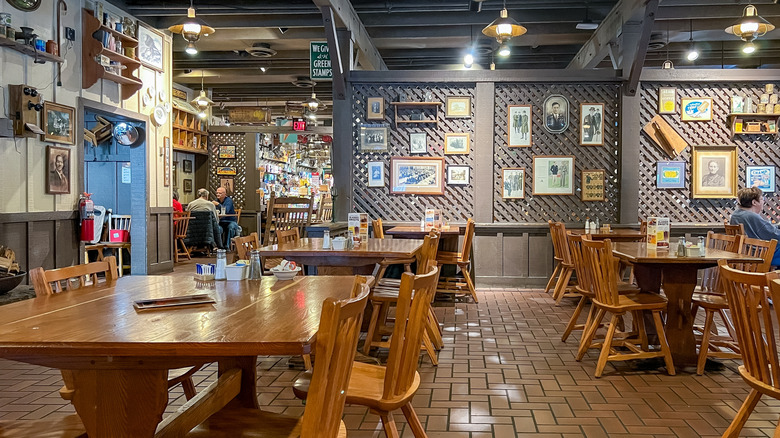
On the flip side of the local decor touches, no matter which state you're in, there will be a few things in every Cracker Barrel store that are identical. In an interview with TODAY, the company's décor manager shared some of them. He pointed out that you will always find a horseshoe over the front door, a traffic light above the restrooms, and a deer head over the mantel. A cookstove used in the shop displays has also been added to this list. Make no mistake, these are not simple decor add-ons, but each one has been chosen for a reason. The horseshoe is believed to bring luck and the traffic light imparts a humorous joke on busy restrooms.
When you understand that the chain is basically building a "home away from home" vibe, the repetition in decor and air of predictability makes a lot more sense. The uniformity is intentional and adds to the familiarity. Another interesting story is that once the décor goes up, it rarely changes. At the most a piece will be swapped if damaged or the store is being renovated.
6. The peg game has a real origin story
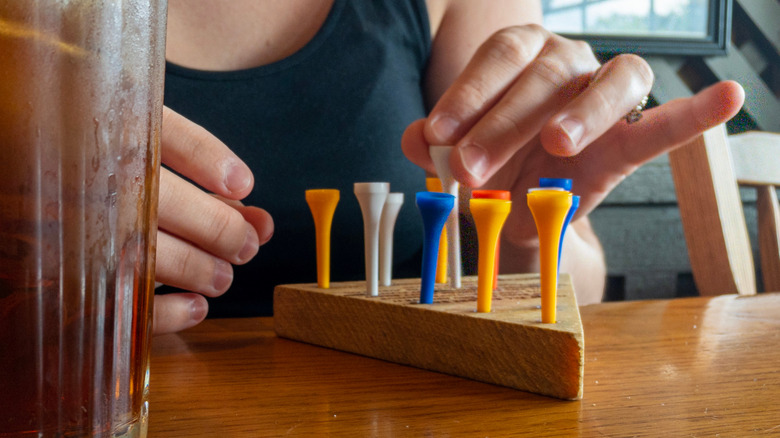
Did you know that the little wooden triangle waiting at your table at Cracker Barrel is in fact much older than the chain itself? The company traces the game, known as peg solitaire, to the court of Louis XIV. The 15-hole triangle is the version you'll find on your restaurant table, though the more common version of this game is the 33-hole cross (a fact worth knowing if you want to impress your fellow diners).
The Cracker Barrel edition has a Tennessee story of its own. As per the company blog, the first games were handmade when the original restaurant opened in 1969, with a father and son drilling each hole, stamping each board and counting every peg by hand. This was the family firm of Qualis and Son Novelties, also based in Lebanon, Tennessee — the same town as the first restaurant. Today, the restaurant chain says it sells nearly half a million of the peg games a year — proof that the game added to pass time while you waited for your food has a cult following in its own right. Over the years, another thing that has changed is the wording which has run from "genius" and "plain dumb" to a more palatable (and politically correct), "No need to be embarrassed, try again!"
7. It once owned Logan's Roadhouse
Imagine Cracker Barrel as your sweet relative — homey, welcoming, traditional. Now image the same relative with a secret rocker past. Like maybe secretly owning a roadhouse! Well, that was the reality for the Cracker Barrel company for about seven years.
Let's rewind a bit and explain. In 1991, Logan's Roadhouse opened in Lexington, Kentucky. In early 1999, Cracker Barrel's parent company, CBRL Group, bought the steakhouse (for approximately $179 million) and let it run as its own separate company. The Cracker Barrel Group, in fact, held on to the business for nearly seven years until it sold Logan's to a private equity firm in 2006. A few years later, CBRL changed its name back to Cracker Barrel Old Country Store, Inc. and revisited it's original plan of being a one-concept company i.e. biscuits, dumplings, and antique decor. Logan's, meanwhile, had a wild ride, going through bankruptcy, before being bought and sold by multiple companies. Today, it's still valiantly holding on, with more than 100 locations in 22 states.
8. Cracker Barrel Rewards come with rules you should know
For years, the little peg board game on the table was nothing more than something that kept you busy while you waited for your biscuits to arrive. But, in September 2023, Cracker Barrel turned the concept of the simple game to match it's loyalty program. Points are called Pegs, and you earn one for every dollar you spend in the restaurant, the shop, or online. Spend enough and you can trade them for anything, such as a drink or side dish or even a free entree.
Of course, like any good game, there are rules. For example, your account can hold only 500 Pegs at a time, and once you hit that ceiling, you stop earning until you cash some in. Another little known fact is that your Pegs have a shelf life of one year, so the ones you've been hoarding will quietly vanish if you wait too long. Keep in mind that factors like tips, paying with gift cards, taxes, or anything ordered through a third-party delivery app don't count toward your points at all. If you want to avoid a nasty surprise, check your balance in the app or online before you order, or just ask the cashier to check.
9. Cracker Barrel's new CEO has Outback in his past
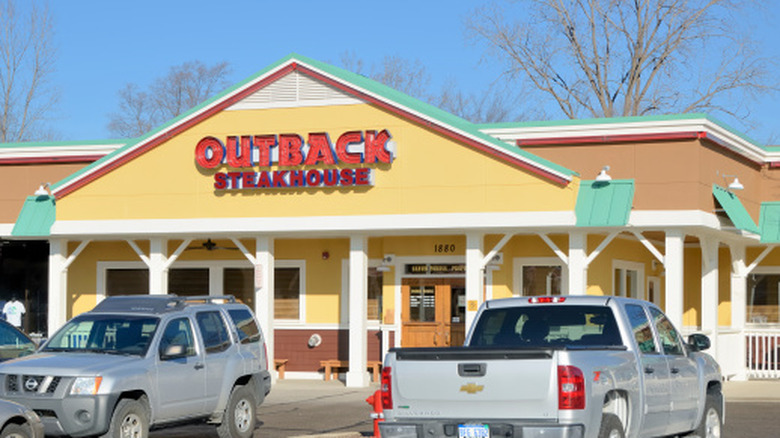
In 2026, Cracker Barrel's biggest change wasn't a new menu item or a different logo, it was the person in charge. In July, the company announced that CEO Julie Masino was stepping down. While the official reports did not state exactly why, theories abound citing the recent logo and rebranding disaster. The news caught Wall Street off guard, and the company stock slid. Her replacement comes from the the other side of casual dining. After running Bloomin' Brands, the company behind Outback Steakhouse, David Deno took over the company in August 10 this year. Deno is no stranger to casual dining and chain restaurants, as he spent years as the finance chief of Bloomin' Brands, along with stops at Best Buy and Pizza Hut before that.
All eyes are on Deno as he navigates a long to-do list. With aging customers, most of them die-hard traditionalists, and heavy debt, he has his work cut out for him. Cracker Barrel says it chose him after a comprehensive search, and now he has to prove it. Julie Masino did stay on as an advisor for awhile, so at least he had a guide to hold his hand during this transition.
10. The gift shop is nearly a fifth of the business
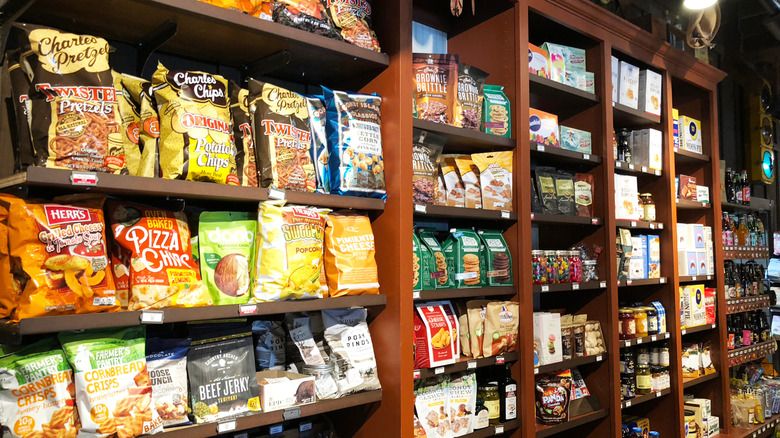
Cracker Barrel is a restaurant company with a very busy gift shop attached. According to the latest financial reports, it was reported that retail made up about 18.6% of total revenue. The in-house shops depend heavily in dining traffic (no surprise, since people have to pay for their meals after walking through the gift shop).
While the company's annual report announced retail sales as high compared with traditional retailers. the shop has not always had an easy time. A few years ago, the CEO had to fight off pressure to leave gift shops out of future stores due to struggling sales figures. But, luckily, he stood strong in his faith of the brand and sales slowly took an upturn in figures. New management reportedly plans to simplify product layouts and widen aisles to make the shopping experience even smoother and more profitable.
11. A rebranding gone wrong
In August 2025, Cracker Barrel set out to look fresher and landed in one of the most talked-about rebranding flops in years. The chain unveiled a simplified, text-only logo that dropped the Old Timer and his barrel. This was touted as a part of a radical three-year plan to transform the brand (and would cost it close to $700 million to do so). The backlash was immediate. It even became political when President Trump urged the company to return to the original logo.
Within about a week, the new logo was scrapped, but not before company stock sank as much as 12%. Reports also stated that customer traffic had fallen as a result. In September, it halted the restaurant remodels that diners had also disliked, but the damage lingered. Wharton marketing professor Americus Reed explained this phenomenon: According to him, a logo comes to stand for a whole lifestyle over time, so regulars may have read the change as a sign that the values behind the brand were disappearing, too. As was witnessed by the immediate reaction against new decor elements or Cracker Barrel's feedback program for rewards members, it's very clear that its diehards wanted more nostalgia, not less.