

Walmart Great Value Mountain Lightning Vs Mountain Dew: Which Is Better?
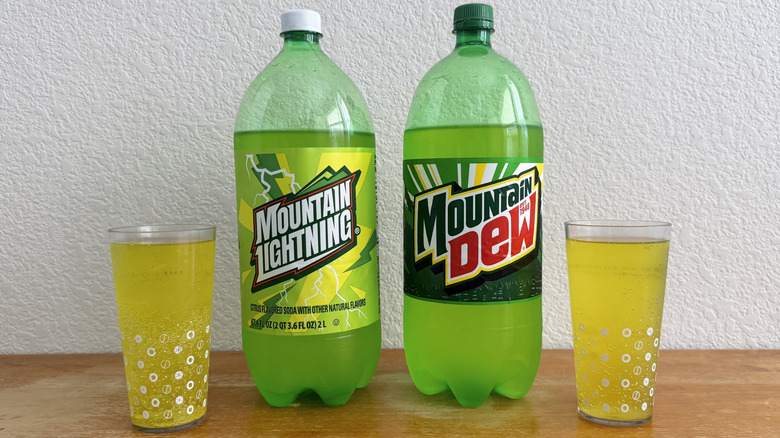
Welcome to Dupe Detective, a column where I'll be reviewing a name brand food product's competitor product to find out how well it compares to, or even beats, the original.
In 2022 there were 28 different flavors of Mountain Dew. That number is fluctuating at any given time due to an ever-shifting lineup of limited-edition releases, like 2026's Mango Pineapple Punch collab with Trolli, to give one among numerous examples. Around that flavor's debut, the Mountain Dew website listed a still-formidable 19 variants. Even amidst so much variety, original Mountain Dew still shines as particularly unique compared to many of its peers in the soda aisle. In fact, some might not know that the flavor of original Mountain Dew pairs a readily apparent lemon with a less-blatant orange juice concentrate.
For those coveting the signature citrus flavor of Mountain Dew on a tight budget, Walmart sells a blatant dupe called Mountain Lightning, approximating not only its inspiration's name but also its edgy branding. Walmart dupes have performed admirably in the past — for example, when I compared Walmart's Great Value Luncheon Meat to Spam, the Walmart product came out ahead. With that in mind, I picked up two-liter bottles of Mountain Lightning and Mountain Dew from my local Walmart Supercenter in Las Vegas and tried them both. Ahead are my thoughts on each product, before my thoughts on just how the Walmart dupe holds up against original Mountain Dew.
Taste test: Great Value Mountain Lightning
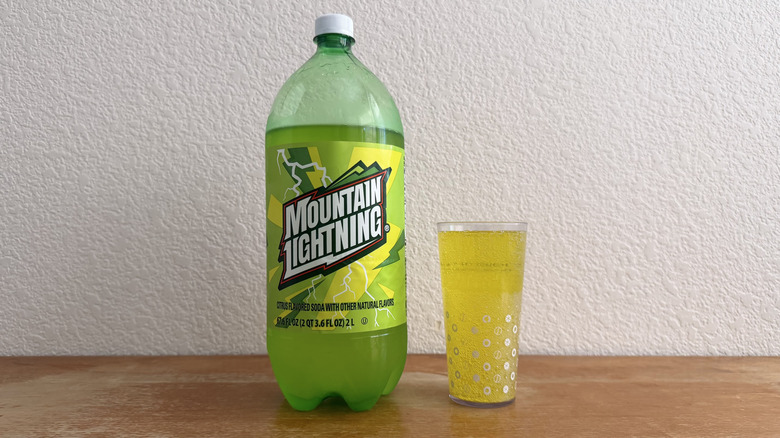
I tried Great Value Mountain Lightning before my bottle of Mountain Dew, and my initial impression of Walmart's dupe was that it tasted pretty close to my memory of its name-brand inspiration. The adjective that comes to mind when I think of original Dew is "electric," and Mountain Lightning delivered on its name — in other words, it balanced its lemon and orange flavors in a way that wasn't just citrusy, but reminiscent of Mountain Dew in particular.
While that early impression was positive, I started to notice a surprisingly prominent ginger flavor emerge over time, akin to a ginger ale, which is notably sweeter than a ginger beer. The more Mountain Lightning I drank, the more I found that ginger defined it just as much as citrus. If I had tasted Mountain Lightning blind, I very well may have guessed it was a flavored ginger ale, like Canada Dry's updated classic Ginger Ale and Lemonade. Altogether, that unexpected element resulted in something admittedly more complex, but also not as tasty as I imagine its citrus component would have been sans ginger.
Taste test: Mountain Dew
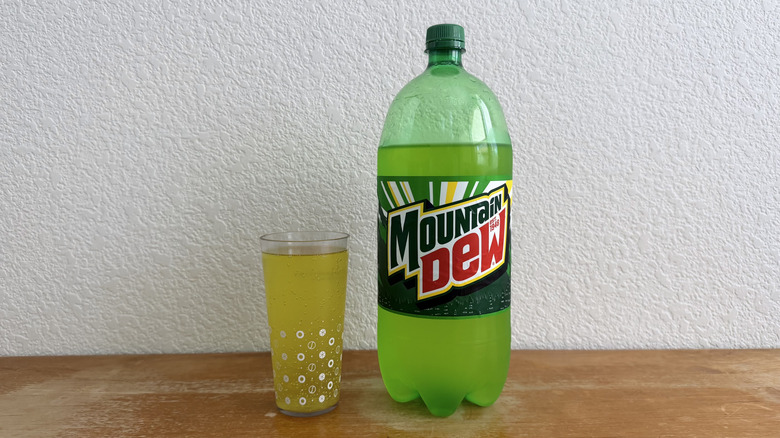
Tasting Mountain Dew after having just tried Walmart's Mountain Lightning, I found the former's flavor a little more muted than I was expecting. The citrus component of Mountain Lightning tasted so much like my memory of Mountain Dew, I actually thought the real thing was the slightest bit underwhelming. More specifically, I couldn't quite identify lemon and orange to the same extent, finding its flavor to be a nondescript citrus blend.
Even if it wasn't as citrusy as I was expecting, I ended up finding Mountain Dew more compelling to drink the more time I spent with my two sodas. That was because a balance of slightly less fizziness, less cloying sweetness, and — most importantly — a lack of the bizarre ginger flavor Walmart uses in Mountain Lightning added up to a more cohesive whole. In a strange way, I found that Mountain Dew was a little dull compared to the surprisingly experimental flavor of Mountain Lightning. However, that dullness ended up translating into reliability, meaning that as I got tired of ginger, I still wanted more Mountain Dew.
Final verdict: Mountain Dew is better than Great Value Mountain Lightning
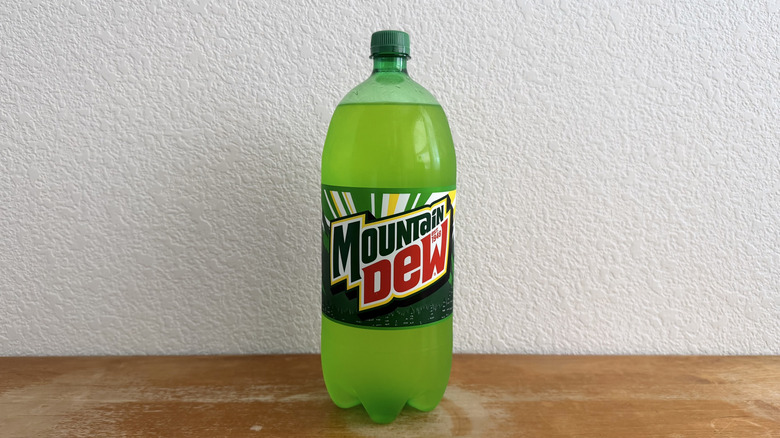
Something that should be factored into any comparison between Mountain Dew and Mountain Lightning is the fact that Walmart sells its dupe for a fraction of the cost of its name-brand inspiration. That would be especially important if, say, Mountain Lightning tasted like a slightly worse version of Mountain Dew. In fact, when I compared Walmart's orange chicken to Panda Express, price did end up benefiting Walmart. However, because Mountain Lightning's flavor is so distinct, the price difference doesn't matter as much as it theoretically could.
Simply put, Mountain Lightning tastes like a Mountain Dew-flavored ginger ale. It's hard to imagine anyone interested in a cheaper version of Mountain Dew ending up satisfied by Walmart's dupe. If a lower cost is of the utmost importance, Mountain Lightning isn't bad, but those simply coveting the flavor of Dew should stick to the real thing. Putting the notion of a cheaper alternative aside, Mountain Dew just tastes better than Mountain Lightning.
Truthfully, the best possible soda would exist in a middle ground between the two products — I did actually like the lemon-orange flavor in Mountain Lightning better, so a hypothetical soda revolving around that element without ginger might be ideal. But as things stand, I can't imagine Mountain Lightning truly satisfying anyone but big fans of gingery sodas, whereas the flavor of original Mountain Dew is better balanced and more broadly enjoyable as a result.
How do Walmart's and Mountain Dew's prices and nutritional content compare?
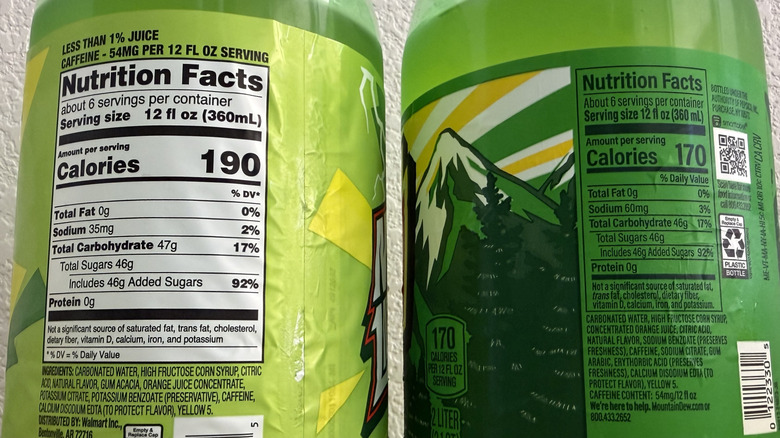
At my nearest Walmart Supercenter, located in a large shopping center near Las Vegas' Harry Reid International Airport, a two-liter bottle of Mountain Lightning costs $1.00. A 2-liter bottle of Mountain Dew is nearly three-times that price, at $2.97. In no way is Mountain Dew unfairly priced, but Walmart's Mountain Lightning offers a clear advantage in the cost department all the same.
Nutritionally, a 12-fluid-ounce serving — or, one-sixth of the bottle — of Mountain Lightning totals 190 calories, 35 milligrams of sodium, 47 grams of carbs, and 46 grams of sugar. That same quantity of Mountain Dew equals 170 calories, 50 milligrams of sodium, 46 grams of carbs, and 46 grams of sugar. Each soda offers slight nutritional advantages, then, with Walmart's dupe containing less sodium, whereas name-brand Mountain Dew has less calories. Nevertheless, the differences are so slight that the two products are nutritionally equivalent in substance.
How I compared these two products
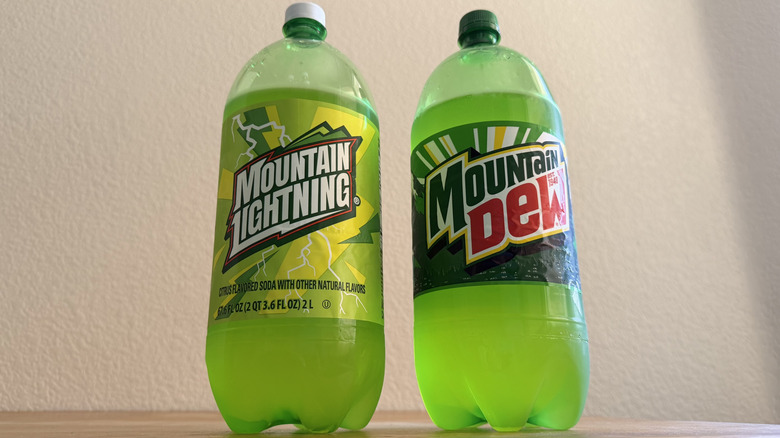
I picked up 2-liter bottles of Walmart's Great Value Mountain Lightning and Mountain Dew at the same Walmart Supercenter located close to my home in the suburbs of Las Vegas. I bought them a few days before I tried them, so they had ample time to sit in my refrigerator and cool to an ideal drinking temperature.
To taste both products, I filled medium-sized cups with each soda and no ice. I started with Mountain Lightning, having enough of it to develop a strong opinion on its flavor, before moving on to Mountain Dew. Once I had recorded my first impressions of the two sodas, I started alternating sips of each of them to more closely compare then to one another. Later that night, I ended up having more of each soda mostly for my own enjoyment, but I did have my initial impressions in the back of my mind to compare to how I felt about them later that day. All my assessments are based entirely on this experience, and not any prior thoughts I may have had about the featured brands or products.