

Walmart Great Value Luncheon Meat Vs Spam: Which Is Better?
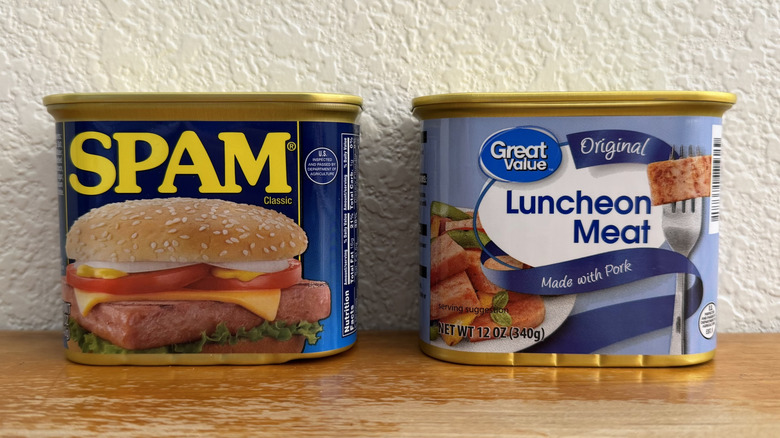
Welcome to Dupe Detective, a column where I'll be reviewing a name brand food product's competitor product to find out how well it compares to, or even beats, the original.
Practically everyone has heard of Spam, but to many of those people, key details about it remain a mystery. Among some of the Spam myths that people need to stop believing are that it's made from strange meat — it's just pork, ham, and four other ingredients — as well as various purported stories behind its iconic name, the true source of which is technically unconfirmed. More important than its ingredients or name is the fact Spam tastes pretty dang good. History isn't the only reason Spam remains so popular in Hawaii, after all.
Spam alternatives are pretty rare, given that Spam isn't just a brand but the very name by which its particular style of processed lunch meat is commonly known. In other words, it's just about impossible to describe Spam without using the word Spam. Nevertheless, Walmart produces its own generic version under its Great Value brand, simply called Luncheon Meat. I picked up the Walmart dupe in addition to a can of classic Spam and compared them both straight out of the can and lightly pan-fried. Ahead are my thoughts on each product, before my pick for whether or not Walmart's Luncheon Meat holds up against its name-brand inspiration.
Taste test: Walmart Great Value Luncheon Meat
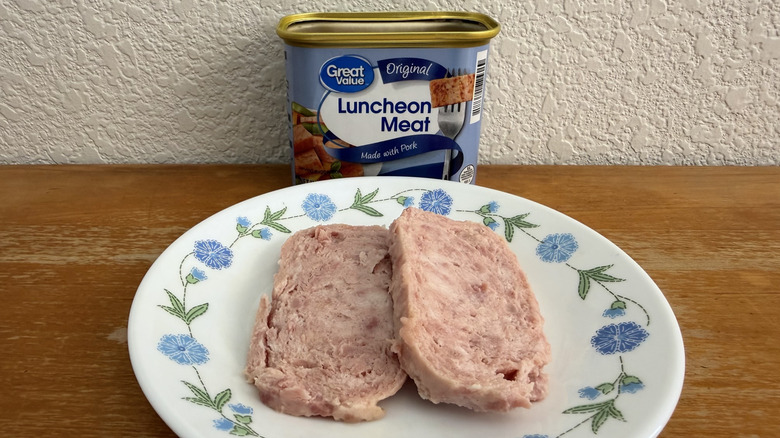
Before trying either product, it was apparent Walmart's Great Value Luncheon Meat differed from Spam based on its appearance. Whereas my name-brand Spam handily retained the shape of its container even when I sliced it, Walmart's dupe was a little chunkier, with bits of stray meat coming loose after I opened it. Describing it in those terms doesn't sound appetizing, but the fact it looked more like meat and less like a reconstituted mass was more of a strength than a weakness.
I began by trying my Great Value Luncheon Meat straight from the can, and I hadn't had any Spam yet — at that point, I thought that the Walmart dupe tasted pretty close to my memory of Spam. A gratuitous dose of salt defined its flavor first and foremost, followed by rich pork. I perceived a bit of acidity too, which could perhaps have come from one of its preservative ingredients, or more likely, the sheer extremity of its salt content. Texturally, I felt like it resembled white meat chicken, due to a level of firmness atypical for pork. Pan-fried, my Great Value Luncheon Meat truly shined, developing a satisfyingly crispy salt crust on its exterior, whereas its flavor became even richer and oilier. Before trying it, the notion of a Walmart Spam dupe didn't sound all that appetizing, so I was surprised by how much I enjoyed it in the end.
Taste test: Spam
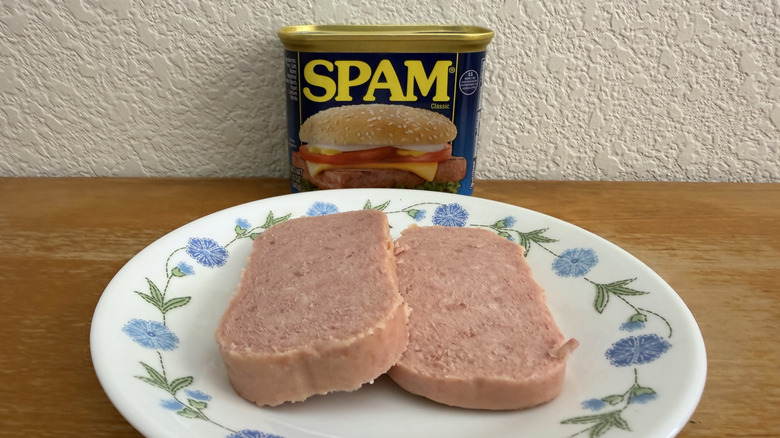
After trying Walmart's Great Value Luncheon Meat first, my Spam seemed even more artificial than usual. For what it's worth, it's only made with a handful of ingredients, and when opened, Spam will go bad when stored for longer than four or five days. So, that notion was more perception than reality. That said, its seemingly artificial character wasn't necessarily a bad thing — it just meant that, whereas the Walmart dupe resembled a mass of meat, I found name-brand Spam more like a heftier pâté. I liked the former's consistency better, but the latter's solidity was nice in its own way.
Like Walmart's Great Value Luncheon Meat, my Spam was amply meaty and extremely salty, to the point I felt like it became slightly acidic. However, both of those elements were slightly less extreme than in the Walmart product, dampened by a subtle but nevertheless discernible spongy blandness. After I pan-fried it, I thought my Spam retained much of those same characteristics, the biggest change being the mere temperature of the meat. Had I tried it first, I think I would have found my Spam plenty satisfying, but having it after the Great Value product accentuated certain ways it came up short relative to its Walmart dupe.
Final verdict: Walmart Great Value Luncheon Meat is better than Spam
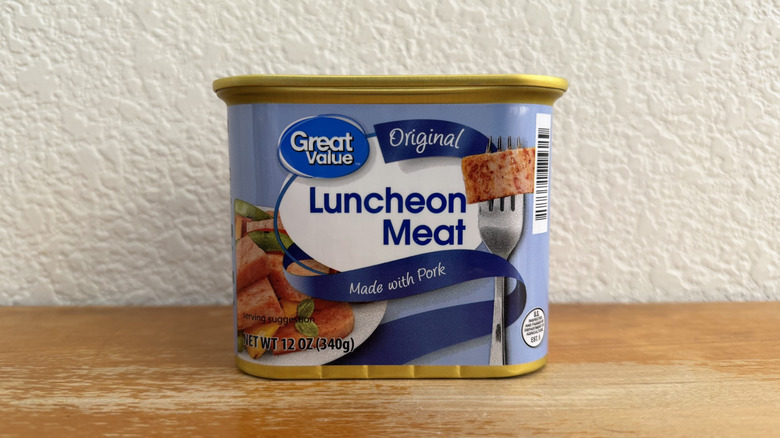
Beating the odds, I found that Walmart's Great Value Lunch Meat tasted better than the iconic Franken-meat that inspired it. That victory comes with one caveat — if I were at a restaurant ordering, say, a Spam musubi, which is a classic Hawaiian comfort food everyone should try, I would probably find the Walmart dupe a strange replacement. Even if its flavor might eventually win me over, the cleaner, smoother look of Spam is so iconic to Hawaiian Spam dishes, I expect I would feel like I didn't quite receive what I had ordered.
The conditional caveat of how it might look in a restaurant aside, I found that Walmart's Great Value Luncheon Meat beat Spam in every relevant category. Texturally, its meatier consistency was more satisfying. The fact it tasted just a bit more like heavily salted, rich pork than Spam was also a point in its favor. Finally, when pan-fried, the Walmart Luncheon Meat's flavor got a serious upgrade, whereas the process didn't alter Spam's flavor in any meaningful way. While I don't really patronize Walmart often, the superstore chain continues to surprise me, securing another upset victory after Walmart's orange chicken beat Panda Express. Anyone who enjoys Spam at home, then, should give Walmart's Great Value Luncheon Meat a try — after carefully analyzing both, I found that there's really nothing Spam does that the Walmart dupe doesn't do better.
How do Walmart's and Spam's prices and nutritional content compare?
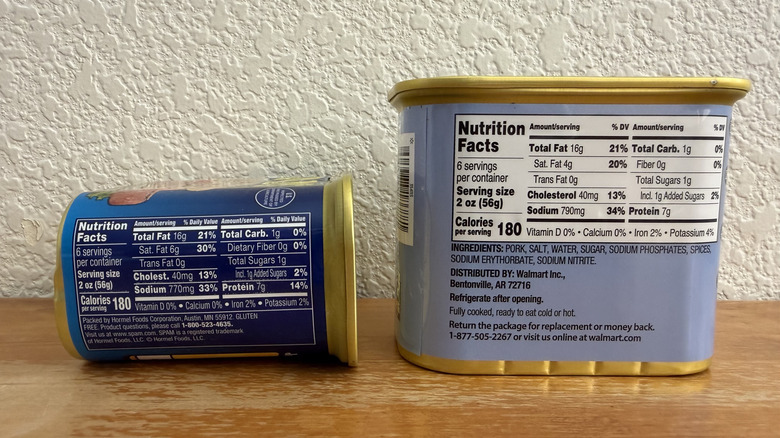
I bought both my can of Great Value Luncheon Meat and my can of Spam at the same Walmart Neighborhood Market in the suburbs of Las Vegas. The former was $2.26, whereas the latter was $3.72. While this didn't factor into my analysis, I think it's worth noting that Walmart makes Great Value alternatives to many of the most popular alternate Spam flavors like low-sodium and bacon, even covering some of the six types of Spam most people don't know about.
Nutritionally, one-sixth of a Great Value Luncheon Meat can totals 180 calories, 16 grams of fat, 4 grams of which is saturated fat, 40 milligrams of cholesterol, 790 milligrams of sodium, 1 gram of carbs, 1 gram of sugar, and 7 grams of protein. That same quantity of Spam equals 180 calories, 16 grams of fat, 6 grams of which is saturated fat, 40 milligrams of cholesterol, 770 milligrams of sodium, 1 gram of carbs, 1 gram of sugar, and 7 grams of protein. All in all, then, the two products' content is practically identical, with Spam edging out its Great Value dupe in saturated fat, while Walmart's product has the slightest bit more sodium.
How I compared these two products
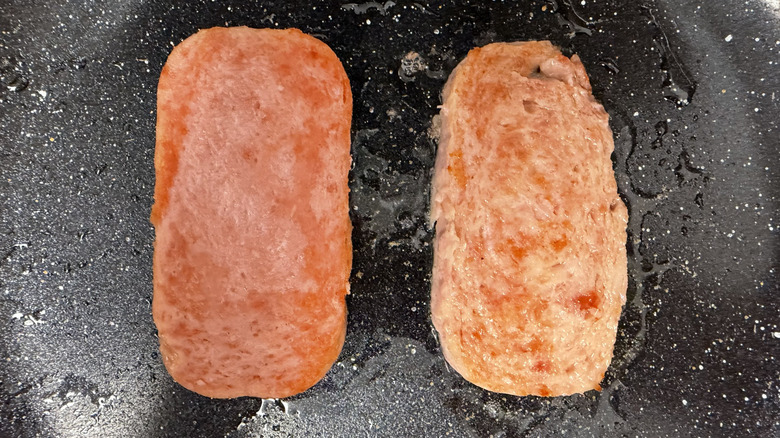
My local Walmart Neighborhood Market, located near my home in the suburbs of Las Vegas, carries an ample selection of Spam products, alongside its selection of Great Value Luncheon Meats. At home, I ate both products in one sitting.
First, I tried most of a slice of Walmart Great Value Luncheon Meat straight from the can, noting down my initial thoughts as I ate. Then I did the same for Spam. Eventually I alternated a few more bites of each product so I could compare them more directly. After that, I cooked equivalent slices of both products in a pan on a light layer of vegetable oil and ate them in the same manner. My assessments are based entirely on this experience, and not any past thoughts I may have had on the featured brands or products.