

Utz Or Snyder's Of Hanover: Which Brand Makes The Best Pretzels?
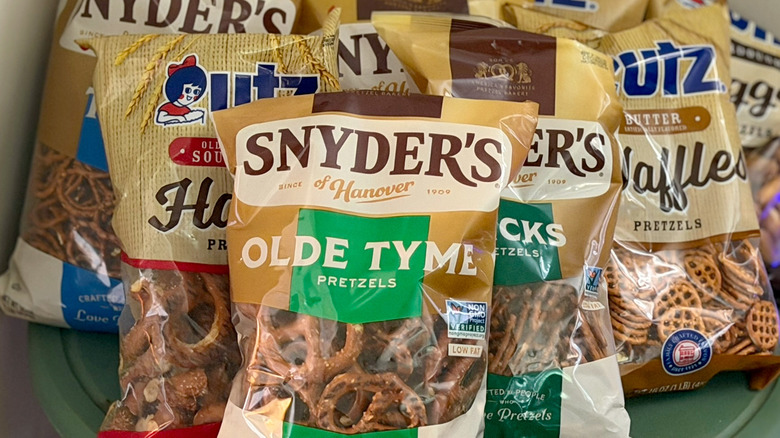
Located about 40 miles south of the state capital Harrisburg, the otherwise-sleepy Hanover, Pennsylvania, just happens to host two of the nation's largest and most important pretzel manufacturers — Utz Quality Foods and Snyder's of Hanover — leading to the borough's well-deserved nickname of the Snack Food Capital of the World. Beyond just Hanover, the state of Pennsylvania — where I reside — is clearly the epicenter of these salty treats in the U.S. For example, about 80% of pretzels made in the U.S. are manufactured here. It's even said that the average Philadelphian consumes 12 pounds of pretzels per year (via PA Eats).
Pennsylvanians' love of pretzels stems back to the influx of German immigrants to Southeastern and South Central Pennsylvania in the 1800s. In 1861, Julius Sturgis opened the country's first commercial pretzel bakery in Lititz, about 50 miles northeast of Hanover, and the snack quickly became popular across the region. In the early 1900s, Utz and Snyder's coincidentally set up shop in Hanover, where both still thrive today.
Considering these two giants and their unique attachment to a tiny little borough that most non-locals would have never heard of if not for its pretzel supremacy, I thought it would be fun to compare the two pretzel manufacturers across a variety of pretzel styles. Let's determine once and for all which brand is the deserved king of American pretzels. You can learn more about my methodology at the end.
Specials
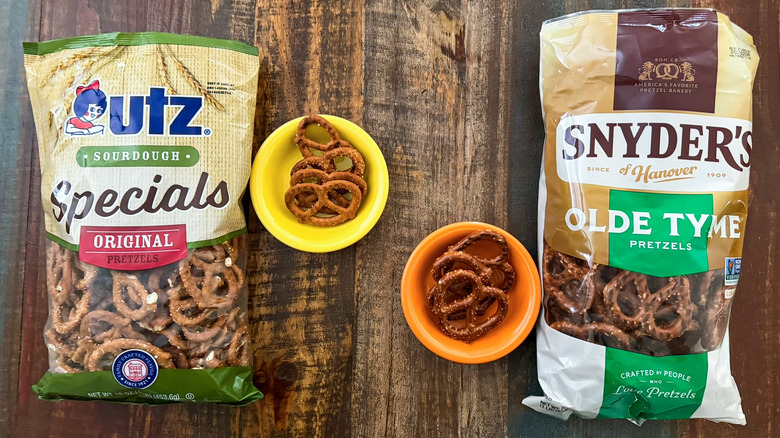
Though perhaps not as well defined as some of these other categories, what Utz calls Specials is a medium-thick, medium-hard, twisted hard pretzel. Snyder's offers a similar product known as Olde Tyme. This is actually my favorite style of hard pretzel. It's thick enough to have substantial texture, and firm but not too hard on the outside, yet lighter and pleasantly giving within.
In this category, Utz's Sourdough Specials are just about perfect. They are crunchy yet crumbly, the absolute best possible texture for a hard pretzel. They're also chock full of flavor and extremely balanced. Snyder's Olde Tyme pretzels, on the other hand, are a bit thicker but also much airier within, giving them more of a brittle texture. While they certainly aren't bad — a lesser pretzel is still a pretzel after all — they simply can't keep up with Utz in this category.
Minis
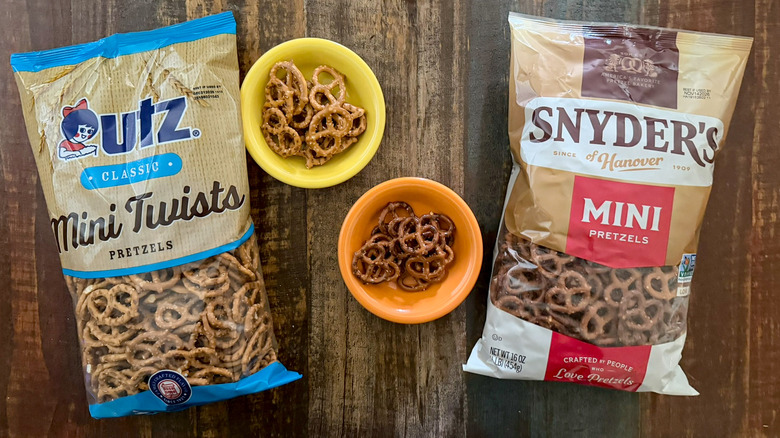
Perhaps the prototypical size and shape that one thinks of when considering hard pretzels, the mini — which Utz calls Mini Twists — is an absolute icon. But, in this case, Snyder's hits on all the aspects of a classic mini pretzel, taking an easy win here.
It's the darker color that gives away the robust, roasty flavor of these pretzels, adding a depth of flavor with which the much paler Utz cannot compete. While Snyder's uses less sodium per ounce — something I will discover is consistent across most of these styles — the little pops of salt here match perfectly with the rich flavor, and manage to crop up at just the right moment. Though they are ultimately simple, these Snyder's minis are just the perfect example of a small, hard pretzel, all in a single bite.
The Utz minis, on the other hand, not only lack flavor but come across as a bit dry and sawdusty from a textural standpoint. It's a disappointing effort from Utz here, especially in such an important category.
Thins
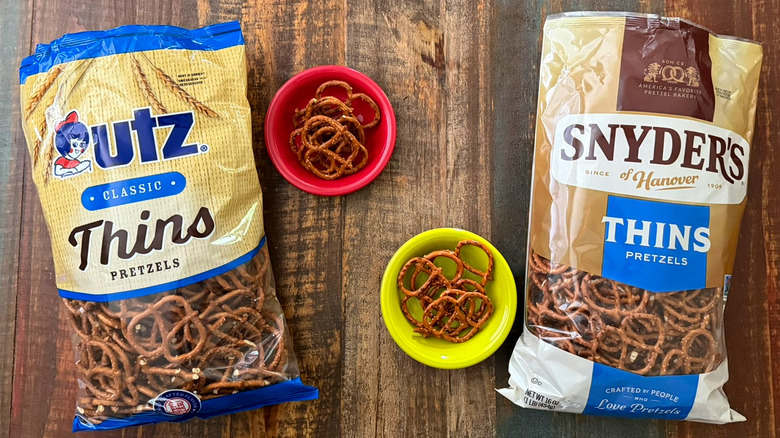
Thins are another iconic pretzel style — a bit like taking the aforementioned mini and stretching it to a larger size while also making the arms of the twist significantly thinner. The issue with thins, in my humble opinion, is that the exterior-to-interior ratio is off; with far too much exterior, they can become too salty quite quickly. (Salt fiends may feel differently.)
In this case, however, this is a negative point for Utz, which — as mentioned above — tends to use a much heavier hand with the salt. Here, it includes a whopping 420 milligrams of sodium per ounce, and without the interior crumb to balance out all that salt, the pretzels come across as dry and overly saline.
Snyder's Thins, on the other hand, offer the same robust, roasty notes mentioned in the minis, which — while not quite as successful as the more balanced crust-to-crumb of the latter — still offer a generally pleasurable experience. It's an easy win for Snyder's in this category.
Sourdough Nuggets
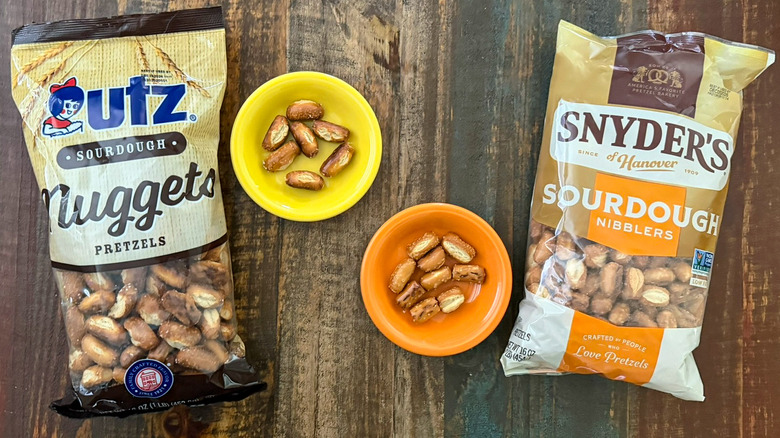
This style features a bite-sized, pellet-shaped snack which most brands (including Utz) call nuggets, yet Snyder's dubs them Nibblers. In this case, the Utz Nuggets are a bit longer, by about a centimeter and a half. Texturally, Snyder's nugget is lighter, with a crisp exterior and an airy interior. Utz, on the other hand, has a harder shell, is slightly brittle, and extra crunchy.
Though I prefer the lovely airiness of the Snyder's texture here and the ease of chewing that version, the Utz nugget does showcase a richer sourdough flavor that lingers longer after swallowing, whereas the Snyder's version leans bland. In typical Utz fashion, there's also an extra punch of sodium that doesn't appear in the Snyder's nugget — a significant 150-milligram difference per ounce — adding positively to its flavor profile. Though both are solid versions, I'm going to have to give a slight nod to Utz here.
Hards
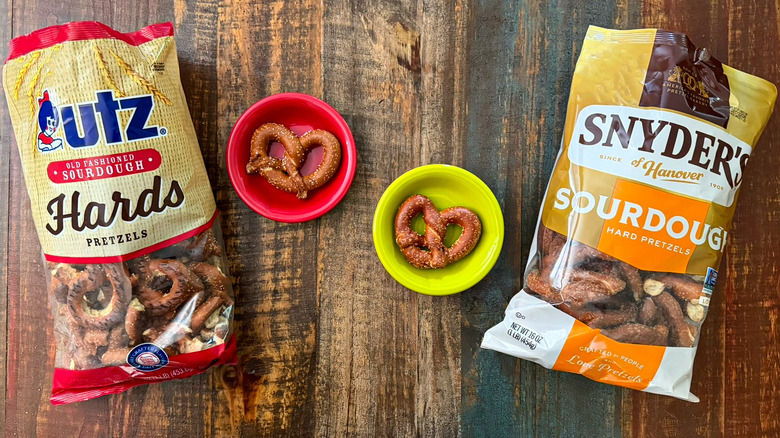
If I am being totally honest, this is probably my least favorite style of pretzel. They're just too darn, well, hard! As in, whenever I am eating one of these, I feel like an emergency dental visit is imminent. And yet, for your edification, dear reader, I soldiered on.
Utz Hards are absolutely unrelenting. Hard shell, hard interior, hard everything. The Snyder's Sourdough Hard Pretzels, on the other hand, at least have a bit of give in the interior, which helps to balance out the texture. Though I am not going to buy either again, the Snyder's can at least be managed with a bit of careful chewing.
I also tried dunking these in hot tea to see if that would help alleviate the aggressive firmness. This didn't work well, unfortunately. Firstly, the flavors didn't match; tea needs a sweet biscuit. And while the warm liquid did soften the interiors of these pretzels, it didn't actually do a whole lot to weaken the rigidity of the crusts. That being said, this dipping exercise did confirm for me that the Snyder's hards have a better overall texture, even after warming.
Sticks
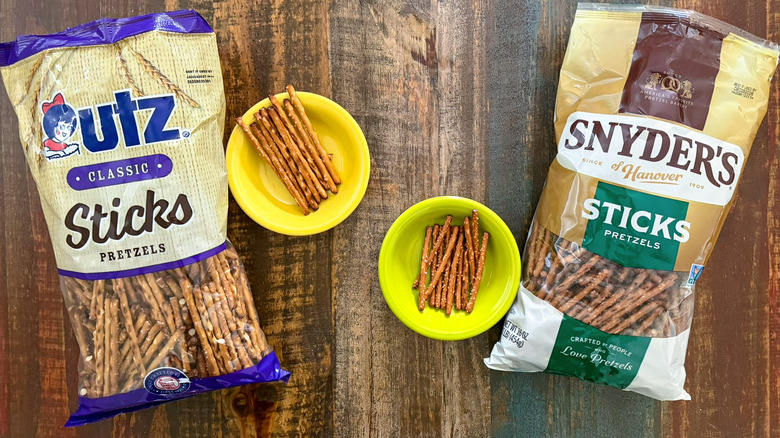
Pretzel sticks are made from 2- to 3-inch-long, straight pieces with a thickness that's similar to the individual arms on a mini, if perhaps slightly wider. It's actually the thickness that stands out here, as the Utz Sticks are both noticeably longer and girthier than the Snyder's version. As such, even though the Utz, per usual, contains noticeably more sodium, the balance between salty crust and crumb is more harmonious. This also means there's more of the soft interior texture, which further enhances enjoyment.
A slightly larger stick also improves dippability, especially with thicker foodstuffs like peanut butter or ice cream, which adds another crucial point in the Utz column. That being said, those looking for pretzel sticks specifically for dipping should probably seek out Utz Dipper Stix or Snyder's Dipping Sticks, both slightly wider versions of this style, or the much thicker pretzel rods.
Rods
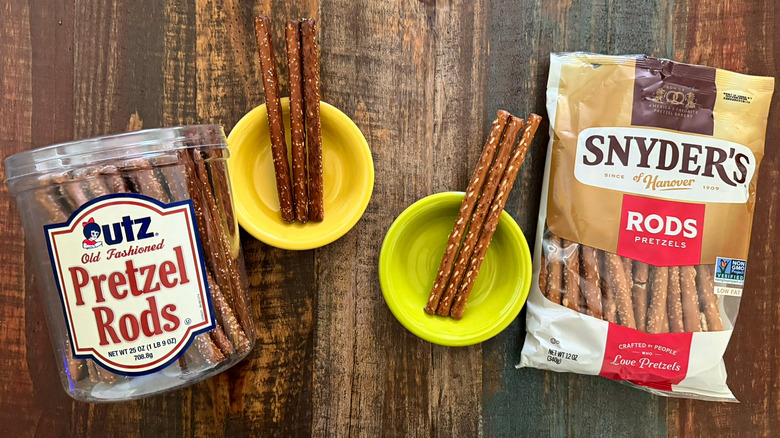
Going even further along the sticks continuum, pretzel rods are the next step up, featuring 7- to 8-inch-long staves that are significantly thicker than the aforementioned sticks or dipping sticks. They're great eaten on their own as a sturdy, portable snack, used as a dip vehicle, or covered in melted chocolate. They also often come in a fun, reusable tub, because the bagged versions — which Utz doesn't even offer — can shatter easily in transit.
This was a tricky category, because while Utz Pretzel Rods — which, in contrast to the sticks, are slightly shorter than Snyder's — display a richer flavor, highlighting deeper roasty notes than the latter, they are borderline too salty. I even scraped off the salt to try each of these unadorned, which certainly confirmed that the Utz base pretzel offers more flavor. So, even though the salt balance on the Utz is borderline excessive, I still have to give them the slight nod here.
Butter Snaps
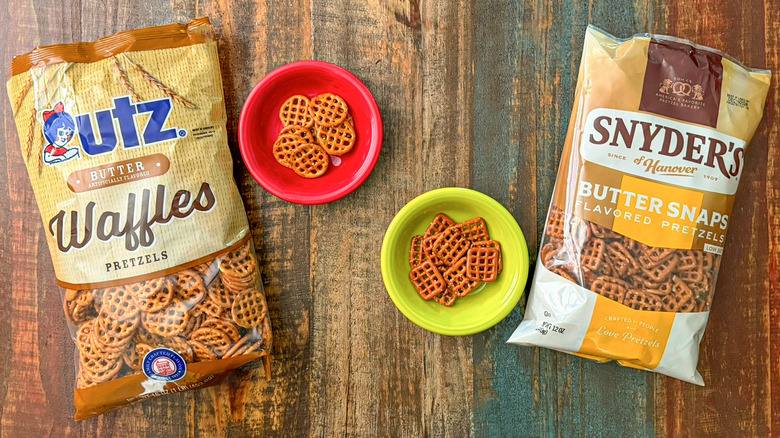
One of the goals of this exercise was to pair up similar styles from each brand. In the case of snaps — the mini pretzels with a waffle-style weave — Utz doesn't have this option other than the butter-flavored ones. At the same time, though, we've done a pretty good job covering the standard pretzel shapes and sizes, so why not also compare a style that's butter-flavored?
Utz calls its version Waffles as they are circular rather than square, but the size, weave, and texture are quite similar to a classic snap. These are a great snacking option with similar dimensions to the aforementioned minis, and their more dense structure makes them especially good for dipping.
As for the butter flavor, it's probably going to be divisive. In the Snyder's, in particular, it's quite bold, making these taste akin to movie theater popcorn. These notes are more subtle on the Utz, and while I suppose someone who doesn't like the butter flavor would prefer that, why would that person even buy butter-flavored pretzels? If you're going to do it, in other words, you might as well go big. Other dings on the Utz are that it uses artificial butter flavoring (compared to butterfat and natural milk flavor in the Snyder's) and contains significantly more sodium without really achieving a saltier taste. As with the minis, the Snyder's pretzel itself also has more depth of flavor.
Honey Wheat Braided Twists
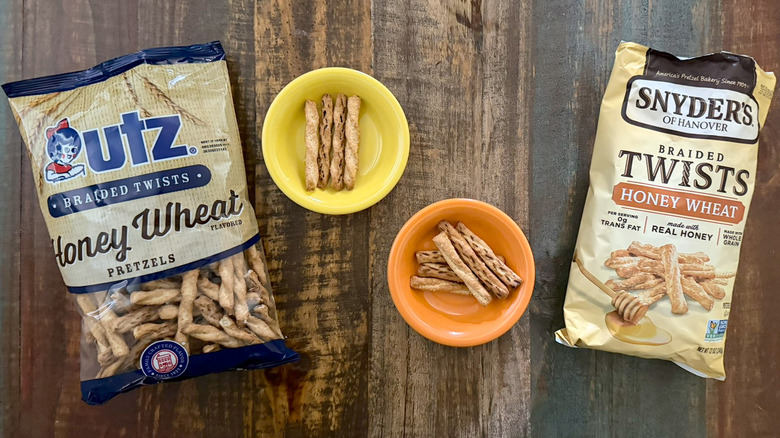
While almost all the snacks covered above are just standard pretzel flavor, and both companies do offer a wide range of flavored pretzels — including pretzel-piece snack mixes — the purpose of this exercise was more to focus on the basic pretzel shapes than to delve into the wide array of flavors. That being said, the Honey Wheat Braided Twist is an interesting option that is still mostly a basic pretzel, yet offers a slightly different flavor than standard, in this case with the addition of honey, brown sugar, and whole wheat flour (and, for some odd reason, dehydrated potatoes in the Snyder's version).
Taste-wise, both brands offer a grain-forward flavor with a delicate hint of honey in the background. Utz, however, executes this concept better, with a richer and more complex overall flavor that emphasizes the nuttiness of wheat and the floral-tinged sweetness of honey. Meanwhile, the Snyder's pretzels come across as somewhat bland and texturally a tad dry — unusual, considering this is the one category where its pretzels actually contain slightly more salt. While Snyder's Braided Twists aren't terrible, this category is an easy win for Utz.
Verdict: Which pretzel brand is better, Utz or Snyder's?
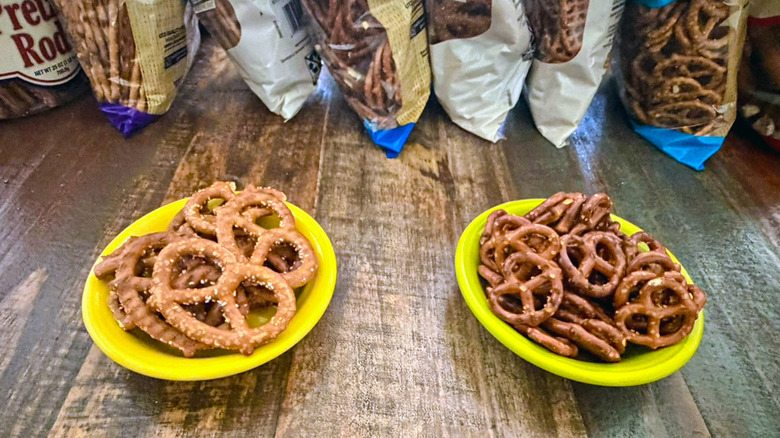
From a purely statistical standpoint, Utz ekes out a close victory here, coming out on top in five categories to Snyder's four. While that makes Utz the official champion of this taste test, the reality is not so simple. Individual categories clearly matter, as while some battles were almost too close to call, others were easy wins. Snyder's, for example, dominated the ever-important minis and thins, two types of pretzel that many people are sure to buy and enjoy. Utz, on the other hand, not only won more categories, but also makes my overall favorite pretzels on this list, its Sourdough Specials.
One other aspect of this that I didn't necessarily expect coming in, but referenced several times above, is the sodium content — an important consideration for many Americans with hypertension, heart disease, and more, or for anyone who is just concerned about eating too much salt. While every style is slightly different, it isn't uncommon for the Utz pretzels to contain 50% more sodium than their Snyder's counterpart, which is certainly a significant amount. And while Utz did win one more taste test in our little exercise, Snyder's still makes high-quality pretzels and thus remains a worthy choice for those looking to cut sodium (or who just prefer pretzels with less salt).
Methodology
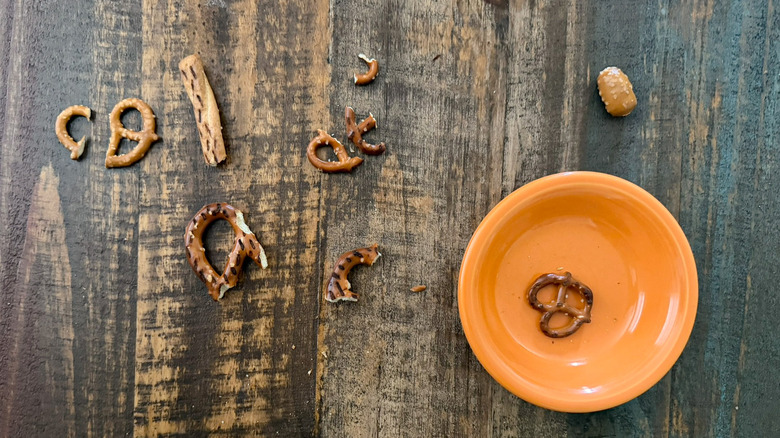
This exercise was specifically focused on hard pretzels, one of many pretzel styles. To select which hard pretzels to include, I looked for styles that both Utz and Snyder's of Hanover offer to create the fairest and best comparisons. So, for example, Utz also offers pretzel types called Wheels and Daisies, but as there doesn't seem to be an equivalent of these at Snyder's, those were skipped.
Once I had the pretzels in hand, I tasted each style against the other to determine a winner. Overall flavor, of course, was the most important factor, but I also considered texture, saltiness, and the balance between crust and crumb. If you'll excuse me, now that I'm just about all pretzeled out but remain pretzel-rich, I have some pork chops and salty cookies to make.