

14 Whole Wheat Breads, Ranked Worst To Best
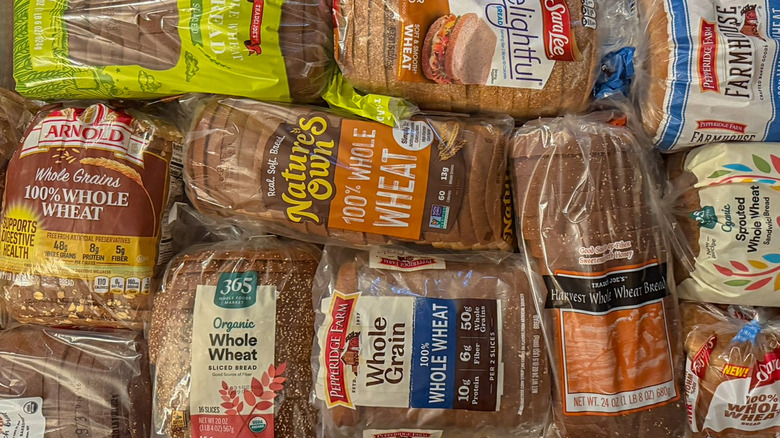
It's well known that bread made from whole wheat flour — which includes the seed's bran, germ, and endosperm — is more nutritious than bread made from white flour. That said, the labels on bread can sometimes make it confusing to know how much whole grain it actually contains. This can include using terms such as multigrain and wheat.
For those genuinely interested in incorporating more whole grains into their diets, there are several ways to navigate these labels. For one, read the specific ingredients. These are listed in descending weight order, so if the first is whole wheat flour, the bread is likely primarily whole grain. However, if the first ingredient is white flour, enriched flour, or wheat flour, that may not be the case. Two, look for the term "100% whole wheat." Unlike other terms, whole wheat bread is regulated and thus usually a trustworthy indicator. Lastly, look for the Whole Grains Council Whole Grain Stamp. Though this wheat icon isn't used by every manufacturer, its inclusion is a positive sign — though be sure to read the individual stamp's specifics.
All that said, we thought evaluating some commonly available whole wheat breads — for flavor, texture, and overall quality — would be a worthwhile endeavor. You can learn more about our exact methodology at the end. Though there are obviously more than 14 of these breads available across the country, this should serve as a good starting point, as well as a guide for managing the supermarket bread aisle.
14. Sara Lee Delightful Soft & Smooth Wheat
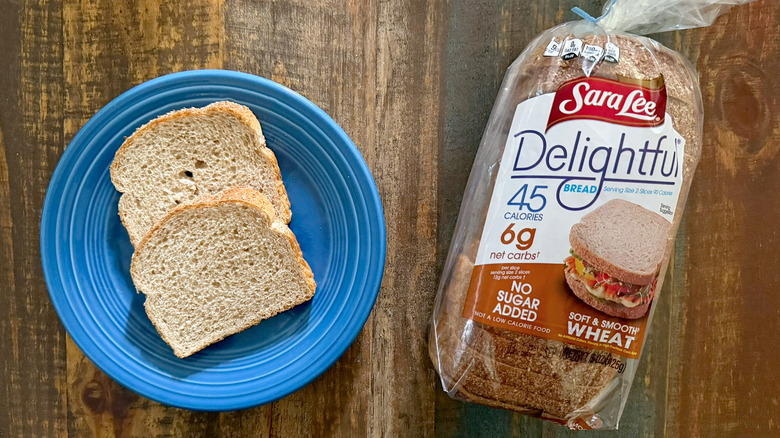
This is the one option on this list that I would not eat again, even if it were offered for free. This is because the bread features a highly artificial flavor that reminds me a lot of diet soda or other products made with artificial sweeteners. In this particular case, my best guess is that this is the result of using a sugar alcohol called maltitol in place of regular sugar. The bread conveys a strongly unnatural quality to the point that I immediately wanted to spit it out.
Sara Lee Delightful Soft & Smooth Wheat boasts just 45 calories per slice and 6 grams of net carbs, as well as the aforementioned no added sugar. Compared to the regular 100% whole wheat from Sara Lee (more on that in a moment), it's only slightly less caloric — about 2 calories per gram here versus 2.5 for the other — and the strange choice to add a sugar substitute to a food that doesn't actually need to be sugary makes this one a complete pass.
13. Sara Lee 100% Whole Wheat
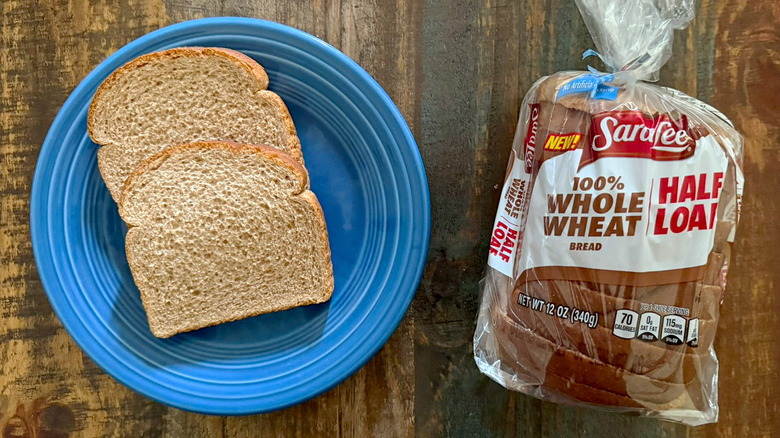
Beyond Sara Lee's Delightful sub-brand and its off-putting artificiality, the rest of these breads are edible. There are, of course, going to be better and worse elements to highlight, but none of them are truly terrible options. In some cases, I'm going to have to split hairs related to the differences between them. In this particular case, Sara Lee's other entry is its 100% whole wheat.
Similar to the one above, this is also a squishy, uniform, and light style of wheat bread. It's the chewiness of the crumb that gives away the highly processed origins here — while it is quite tender to the touch, it does not give way cleanly to a bite like a more artisanal bread would. Toasting it improves this texture a bit, though not quite enough. In addition, there is a slightly plastic sweetness in the aftertaste of this, again outing it as a bread that's probably highly processed. While sufficient in a pinch, I would not actively seek it out.
12. Nature's Own 100% Whole Wheat
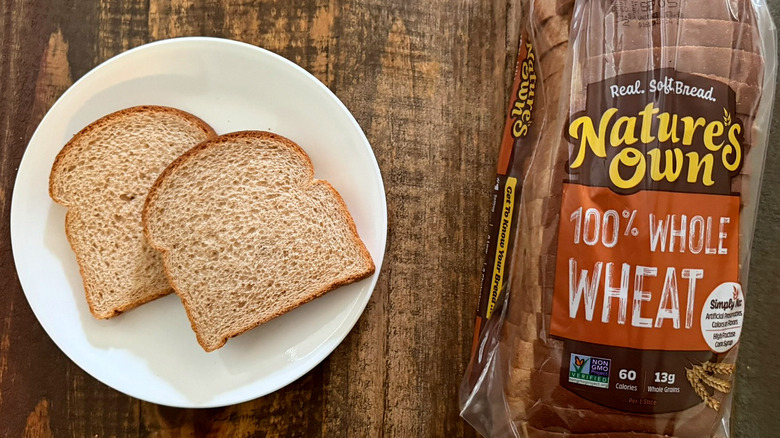
Like the previous option, this bread has a similarly soft yet tough texture that makes it seem more industrial than artisanal, and is unpleasant to bite into, especially when raw. As above, this gets a bit better after toasting, though the toughness is still somewhat evident. Unlike the last option, this one does not have that excessive sweetness on the aftertaste. In fact, somewhat amusingly — especially when comparing this to the Sara Lee Delightful — Nature's Own has less than 1 gram of added sugar per serving! As such, it does come across with a nice wheat-forward flavor, though it is relatively neutral in the grand scheme of things.
According to the brand, citing data from Circana market research, Nature's Own is the best-selling loaf bread brand in the U.S. Also, this bread contains no artificial preservatives, colors, or flavors, or any high-fructose corn syrup. These slices are relatively small in height and width compared to some of the others on this list, which may explain their relatively low number of calories per slice (60, to be specific) and their low fiber per serving at only 2 grams.
11. L'oven Fresh 100% Whole Wheat
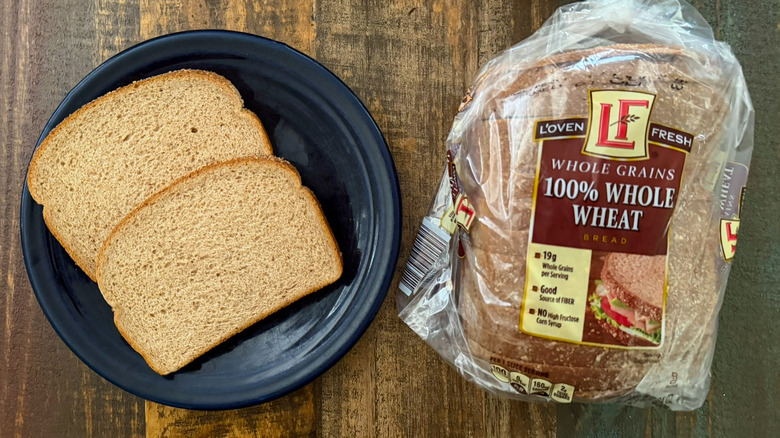
This one looks like it would be delicious. It's got a generous slice size, an inviting dusting of wheat bran across the crust, and an even, inviting tan color in the crumb. Unfortunately, however, the bite fails to deliver. In particular, the texture is doughy, creating a springy chewiness that isn't exactly pleasant. And the crumb does not yield to a bite, further emphasizing this gumminess. In other words, it's hard to chew. Flavor-wise, there's nothing wrong (or right) here, since it's rather neutral. But the texture is enough to not want to come back for more.
Incidentally, this is the L'oven Fresh brand, Aldi's equivalent to name brands like Pepperidge Farm and Nature's Own. The store's more upscale brand, Specially Selected, offers more interesting, often higher-quality breads, though it doesn't include a 100% whole wheat option. Still, when I reviewed these a few months ago, I was especially impressed with the Bistro bread line.
10. Pepperidge Farm Whole Grain 100% Whole Wheat
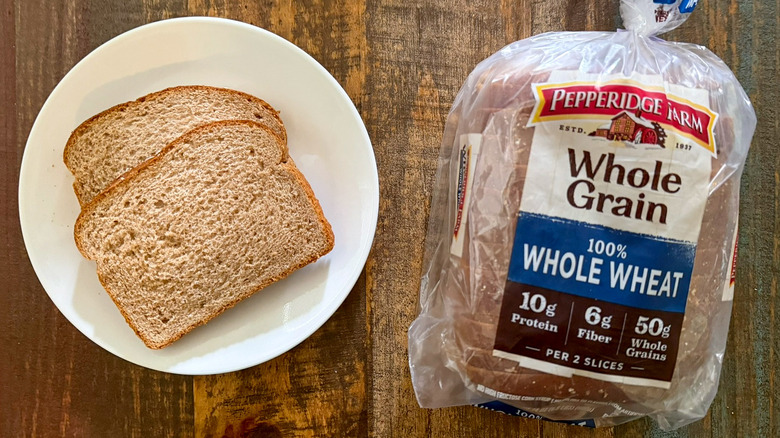
Cracked wheat — which is included in this loaf — is an interesting ingredient in the sense that when used well, it can offer texture, flavor, and even crunch to a rustic wheat bread. But when it is just mixed into a simpler sandwich bread like this Pepperidge Farm Whole Grain 100% Whole Wheat loaf, on the other hand, it can actually do more harm to the crumb than good.
These little kernels come across as firm, but in an unyielding way — so not like a crunchy seed or nut, but rather something that gets noticeably in the way. While I don't want to go so far as to suggest that it hurts to bite into this cracked wheat, it is indeed mildly uncomfortable.
Compared to some of the other breads on this list, Pepperidge Farm's breads come across as more honeyed and indeed offer a significant amount of sugar (by this list's standards, at least) at 4 grams per slice. However, this may also be related to the slice sizes. These pieces certainly will make a large sandwich, especially compared to the loaves covered above.
9. Trader Joe's Harvest Whole Wheat
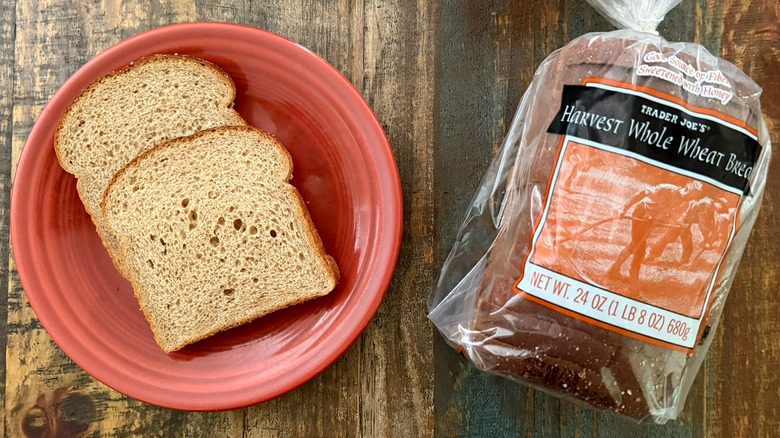
While Trader Joe's can generally be relied upon to provide high-quality products at reasonable prices, this one — its higher-end wheat bread, the Harvest version — is disappointing. In this case, compared to the simpler sliced variety (which we'll talk about soon), the only notable upgrades are that the bread is sliced slightly thicker — 43 grams compared to 35 grams — and it features a sprinkling of wheat bran on the top. Is that worth paying more for? Obviously, that's a matter of opinion. But if you're in the market for something that's a bit more artisanal, this just ain't it.
On the positive side, though this is made in a similar style as the ones mentioned above — that sort of spongy, cakey supermarket style — in practice, it's not as tough or chewy as the aforementioned Nature's Own, nor does it have any cloying notes found in the Sara Lee slices. Though relatively neutral in flavor, it's a decent execution of this mass-produced style.
8. Arnold Whole Grains 100% Whole Wheat
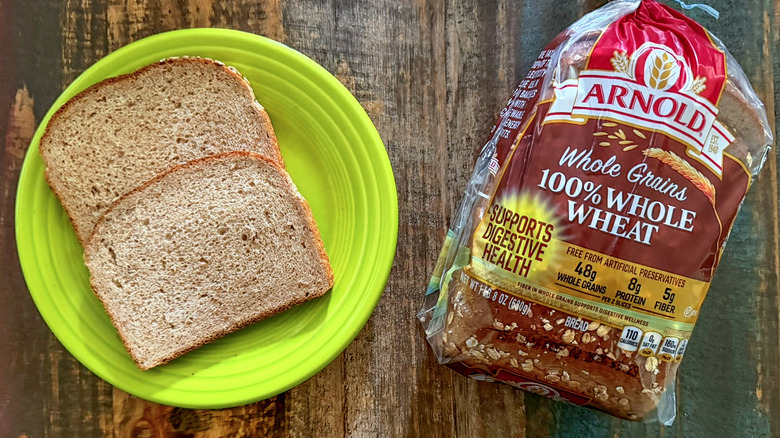
Though this bread doesn't use cracked wheat, it does include bulgur wheat, so it contains similar textural challenges found in the Pepperidge Farm Whole Grain bread, though perhaps not quite as problematic. Obviously, these little pops of fibrous pushback may be appealing to some, but for me, this element is off-putting enough that on a list like this, which contains breads with only slight differences, it pushes it down the ranks. This one isn't as aggressively sweet as the Pepperidge Farm one, meaning it offers a more savory, wheaty, and rustic flavor. It can, however, come across as a bit dry, especially eaten as toast, and it has a slightly gritty finish.
Arnold, incidentally, is owned by Bimbo Bakeries and is primarily an East Coast brand. It is known as Brownberry in the Midwest and Oroweat on the West Coast, and as far as I can tell, it is the same product with the same logo, just a different wordmark.
7. Dave's Killer Bread 100% Whole Wheat
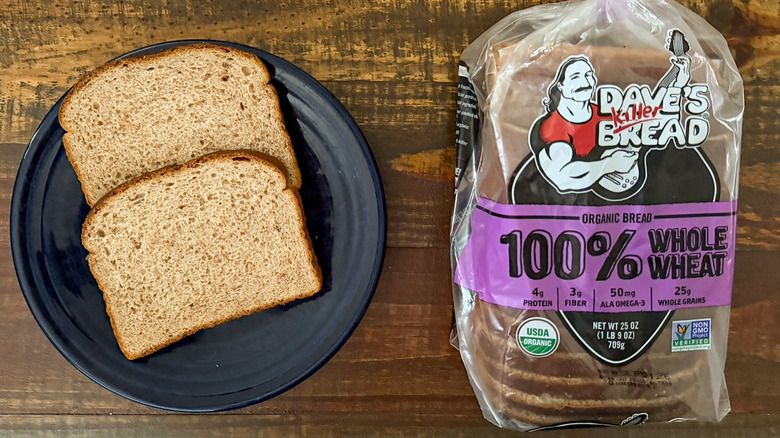
Since Dave's Killer Bread was acquired by Flowers Foods — which also owns Nature's Own, Wonder, and more — about a decade ago, I've seen people complain online about the decline in quality as the brand continues to expand. (It was the country's top-selling organic bread even before the sale.) I've noticed a bit of a drop off myself with regard to its 21 Whole Grains and Seeds variety, though perhaps this is just the power of suggestion. That being said, I'd never tried Dave's Killer Bread 100% Whole Wheat, so I tried to go in with an open mind.
The first thing I noticed was how sticky this loaf was to the touch. When I pushed into the bread with my finger, it felt almost glutinous. This sensation continued in the mouth — though it was a different type of chewiness than the L'oven bread, it was still unappealing. Looking at the ingredients, this is tied with Pepperidge Farm Whole Grain 100% Whole Wheat for the most sugar — 4 grams per 42-gram slice — of any of the products on this list, which may explain the tactile sensation. Why is there so much sugar?
On the plus side, this bread uses a bit of cracked wheat, but the way it is treated or integrated adds a pleasant textural element without becoming unyielding, as mentioned in several of the loaves above. It's also USDA-certified organic.
6. Trader Joe's Whole Wheat Sliced
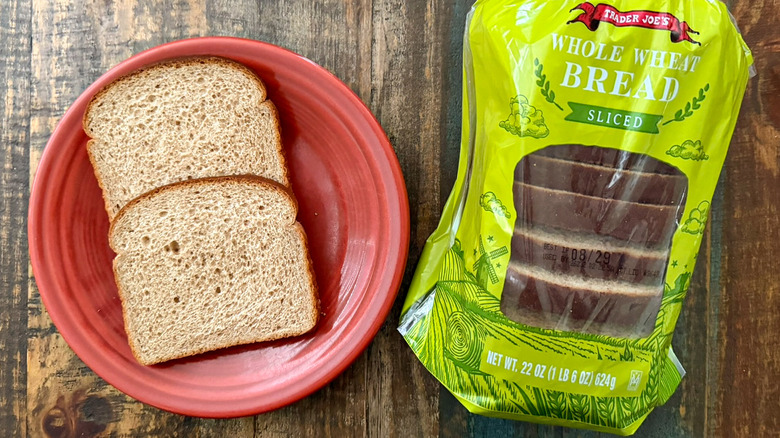
As I made my way through this taste test, I realized that there are two distinct styles of bread featured here. Though both typically use 100% whole wheat flour, the first tends to have smaller slices and a texture that's tender yet spongy, sometimes even cakey, and a taste that's more neutral from a grain perspective, and a bit sweeter as well. The second style, on the other hand, comes across as more rustic, hearty, and robust. It's less uniform in texture and tends to be toothsome and complex, often featuring nutty, malty, or earthy notes. This TJ's option is easily the best within the former group.
It's soft and mild, but gives nicely when bitten into and contains no off-putting candied or artificial notes. Though certainly not as complex as some of the breads listed below, it's a great value buy if you're looking for this type of sandwich bread. It seems absolutely perfect, for example, to support a PB&J for the kids.
5. Pepperidge Farm Farmhouse 100% Whole Wheat
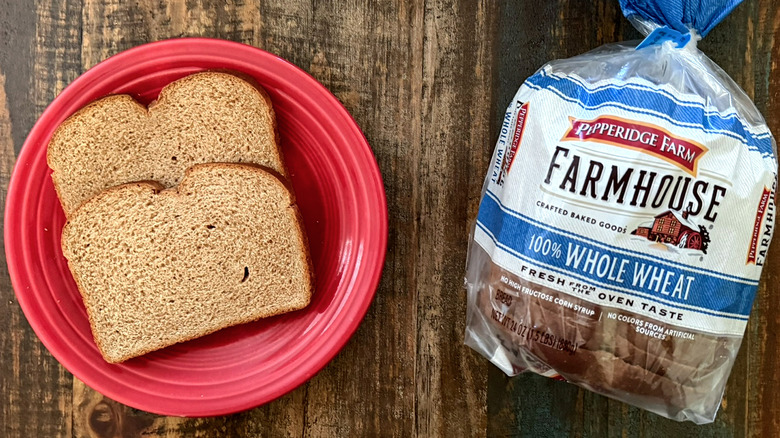
"Farmhouse" is a marketing term, so there's no standardized meaning in this context, though it seems that Pepperidge Farm is using this to represent a more crafted, artisanal style. The slices here are thick. In fact, these are the heaviest of any on the list at 49 grams per slice. They also contain 4 grams of fiber and 4 grams of added sugar per slice, both of which are on the higher end.
The brand's marketing material references a slower baking process for this bread, which is more traditional — and, in current times, often indicative of a craft approach, especially when compared to the modern, industrial baking process that has been sped up for increased efficiency (but often sacrifices quality for speed). Considering all that, it's perhaps no surprise that this bread offers a plush, pillowy texture. Though soft, it gives beautifully to a bite, and while ever-noticeable in the mouth, it is never overly tough or chewy. The crumb is uniform, meaning there are no large grains or seeds, which also contributes to the luxurious texture.
If there's a downside to this bread, other than (though perhaps related to) the higher calorie count, it's that it is too sweet, especially on the aftertaste.
4. Wegmans Organic 100% Whole Wheat Sandwich
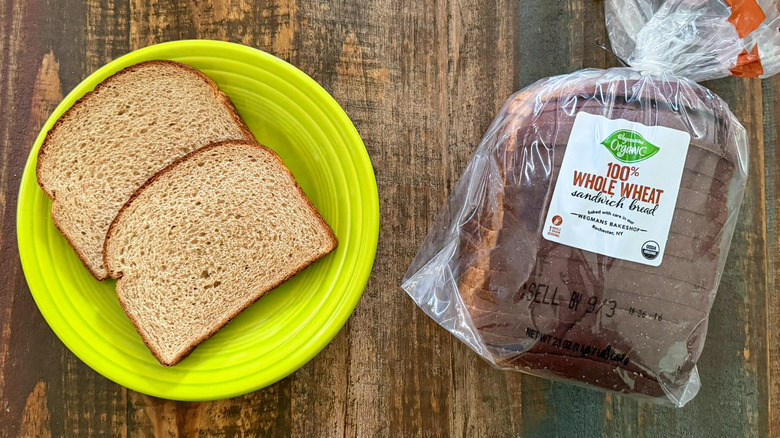
We're finally getting to the best of the best, starting with this Wegmans option (not to be confused with the store's similar but different Organic Soft 100% Whole Wheat Bread, which isn't included in this ranking). This 23-ounce loaf is simply an excellent whole wheat bread. It's well-balanced, offering a hearty wheat flavor, beautiful texture, and a simple list of ingredients. (It is also USDA-certified organic.) It's great raw, toasts up beautifully, and stands up to many sandwich preparations.
If there's a ding on this one, it's (again!) that it is ever so slightly too sweet for my taste. Not offensively so, mind you — a 36-gram slice contains 3 grams of added sugar from organic honey and organic cane sugar — but I can't help but feel it would be improved by being more judicious with the sweet stuff, which would allow the nuttiness of the wheat to better shine through. Even so, this is one I'll be buying again.
3. Wholesome Harvest 100% Stone Ground Whole Wheat
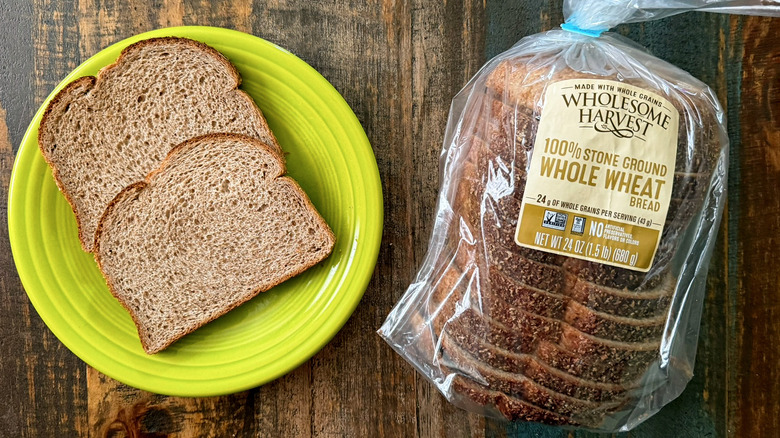
Remember what I wrote about Aldi's L'oven bread above? About how it looked the part, but failed to deliver on texture? Well, this one from Wholesome Harvest — which is part of the Bimbo Bakeries family of breads — looks quite similar to that Aldi option, yet from a taste and flavor standpoint, it is everything the Aldi loaf is not.
The strength here is achieving that — if I can borrow from Pepperidge Farm for a second — farmhouse texture, a beautifully soft, toothsome yet pleasantly yielding crumb that presents as substantial, decadent, and satisfying. From a flavor standpoint, it's pleasingly grain-forward, though remains well-balanced enough to not overpower any food it is surrounding in a sandwich. Of these top four, it's the softest, so those looking for that particular sensation will do well to start here.
2. Whole Foods Market 365 Organic Whole Wheat Sliced
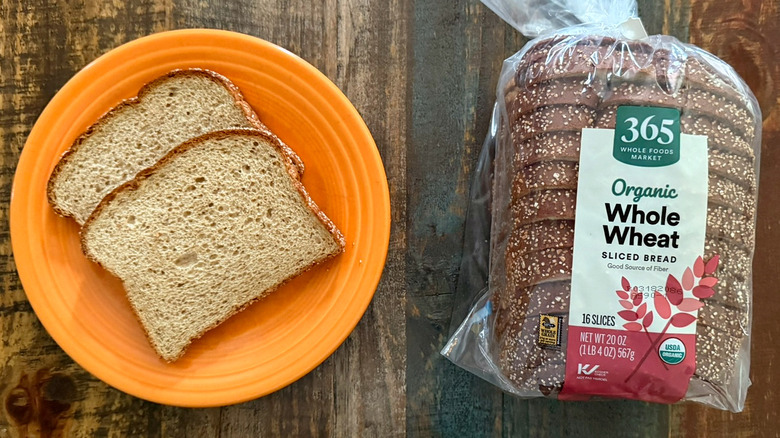
Since being acquired by Amazon, Whole Foods has received some well-deserved criticism for moving away from what made it such a popular upscale grocery store in the first place. But placing two whole wheat sandwich bread loaves in the top two here shows that it's still killing it in some aspects — in this case, with complex, bakery-style loaves, even those from its pre-bagged line.
There's a wonderful rusticity here — as if this came from an independent bakery, not a commercial one — with a varied texture that creates intrigue and interest beyond just the idea of a robust whole wheat bread. There's a bit of sugar — 2 grams per 35-gram slice — but it integrates wonderfully with the nutty notes from the wheat. Of the two Whole Foods loaves on this list, this one was slightly drier and had a more uniform texture that was less interesting. But it's still an excellent choice.
1. Whole Foods Market 365 Organic Sprouted Whole Wheat Sandwich
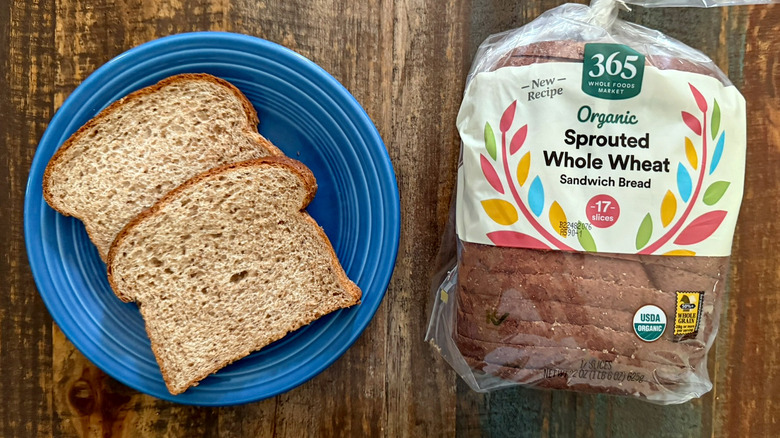
If it feels anticlimactic to put both Whole Foods loaves above everything else, what can I say? They're simply better. Another USDA-certified organic standout from Whole Foods' 365 brand, this one features all the same positives as the previous option, but with an even more fascinating crumb texture. It's craggy and rugged, seemingly tough yet somehow also soft and fluffy, offering the best of both wheat bread worlds — rustic, hearty elements alongside an easy-to-chew, tender texture.
The one thing that separates this loaf from every other bread on this list is the use of sprouted whole grain flour. This means, perhaps obviously, that the wheat used has been allowed to sprout, or to begin germination. Otherwise, it's the same old wheat. Using sprouted grains has become somewhat of a health trend because they can be easier to digest. Whether this is just another passing fad or truly a healthier option, one thing is clear: sprouted wheat makes a darn fine sandwich bread.
Methodology
To select breads for this list, I started by focusing on products with whole wheat as the lead ingredient, meaning any "multigrain" or similar options that sneak white flour into the mix were not considered. I also tried to focus on brands that are available nationwide, or at least close to it, picking each loaf up from stores including ACME, Aldi, Giant, Trader Joe's, and Wegmans in the Philadelphia suburbs in August 2026.
For each bread selected, I evaluated its quality in a variety of ways. First, I smelled the raw bread. Then, I tasted it raw. Then I toasted it and tasted it with butter. Lastly, I made a simple sandwich with it. This gave me the opportunity to understand how the bread performs in a variety of scenarios, and hopefully make the best overall assessment of their quality (or lack thereof). As for what I will now do with all this bread, at least science has helped explain its long-expected shelf life.