

12 Meats Real Cowboys Ate The Most In The Old West
Spaniards introduced horses and cattle to Mexico during colonization in the 1500s. Along with this they brought their vaquero tradition. Vaqueros were responsible for driving and herding the kept bovines, doing so while mounted on horseback and often under the employment of ranchers and landowners. Many were of mestizo, Native American, and African American descent.
It wasn't until the 1800s — when Anglophone settlers began migrating out west and the spirit of Manifest Destiny was in full swing — that the vaquero culture was adopted and the white, English-speaking cowboy became a thing. No matter the background of the individual lassoing up livestock in that era, they had to eat. And, while fancy folks in New York City were dining finely at Delmonico's, cowboys on the other side of the continent had to adapt to a very different kind of diet — chowing down on some types of meat that would make a Gilded Age matron gasp into her silk handkerchief.
What were the animals real cowboys feasted on? Here are a dozen examples of the wildlife that was raised, trapped, and hunted. They ranged from enormous, thunderous beasts to small, swift-footed fauna. Some of them are still regularly eaten today. Others, well, not so much. The Takeout spoke to a pair of experts to get insight into the bygone cowboy menu: "Cowboy" Kent Rollins, cookbook author and host of Outdoor Channel series "Cast Iron Cowboy," and author and historian Allen J. Wiener.
Beef
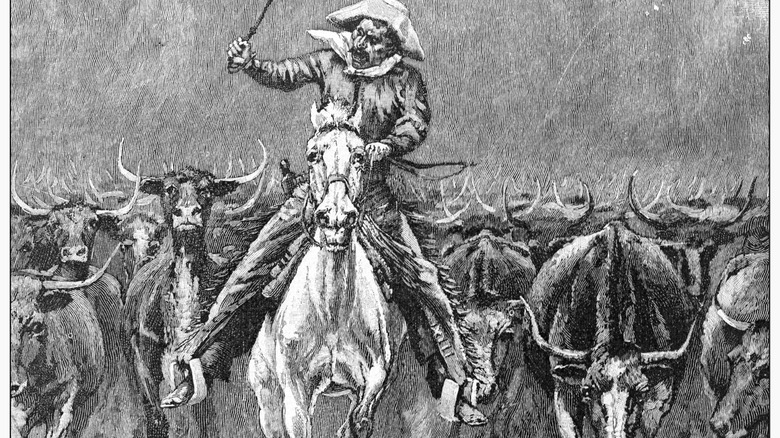
This might be the least surprising meat featured here, although it wasn't as prevalent a meal as one may think, given that there were thousands of pounds of cow flesh thumping around at any given point. As Allen J. Wiener put it: "Although cattle surrounded them, those animals were an investment and not considered a food supply. Beef was available when injured cattle could be slaughtered."
Although steak and cowboys often intersect as symbols of America, those 19th century herders weren't dining on filet mignon or New York strips out on the plains. "Cowboys in the old West ate a lot of jerky," Kent Rollins explained (which included, but was certainly not limited to, beef). "Meat was harvested and dried to preserve it."
Wiener did add that beef may have been a bit more common away from the cattle drives, especially for the privileged class. "On cattle ranches, wealthy ranch owners and their forepersons ate much better than working cowboys." They money men indulged in fresh, high-quality beef while those on the laboring end were left the cheaper cuts. Those workers would've definitely appreciated the bang for your buck you get at a modern-day Texas Roadhouse.
Bison
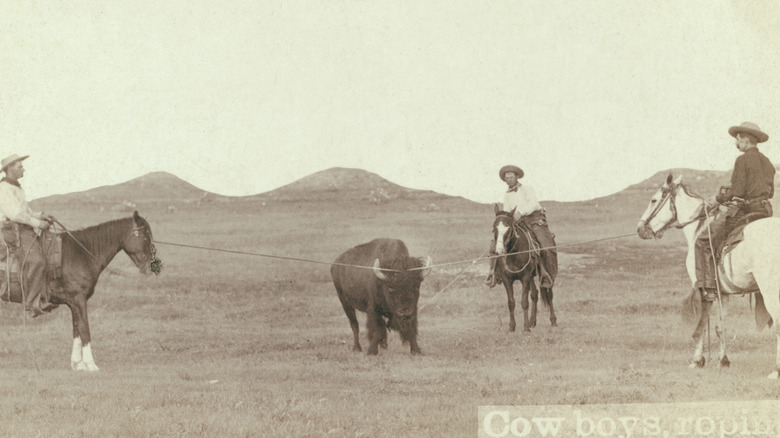
Once a dominant force in American wildlife, the mighty bison was hunted to near extinction in an alarmingly short amount of time as the west was being settled. It has since become known as "The Great Slaughter." Around 1820, it's estimated there were as many as 60 million bison in America, even after thousands of years of the animal being hunted (and made spiritually significant) by Native Americans. At the end of the 1800s, the bison population was below 1,000.
Obviously then, this was a meat that — like the Native Americans before them — cowboys ate. Probably not so much for those working on cattle drives, where, according to Allen J. Wiener, "Cowboys endured long workdays and had little time to hunt or fish, so wild game was rarely available." Although Kent Rollins believes bison jerky was commonly eaten. And bison pemmican — a Native American food "made of rendered fat mixed with dried meat," Wiener tells us — was consumed regularly on the Lewis & Clark expedition.
Once again, it was back on the ranches where cuts of meat such as bison would be enjoyed, or even at a sit-down joint in a fledgling municipality. "Once the drive reached cow towns, like Dodge City, Wichita, and Abeline," said Wiener, "cowboys were free to spend their pay on restaurant meals or buy food from grocers." In fact, buffalo (the term Native Americans had always used for bison) was a downright gourmet meal in the Old West.
Deer
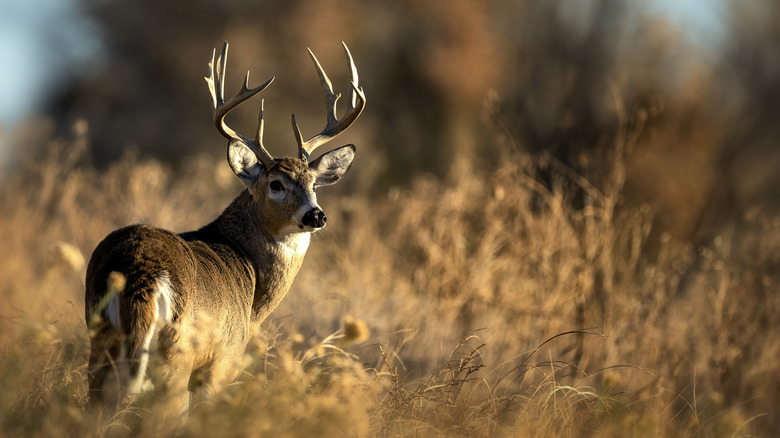
Venison was often on the menu for those living the frontier life, as it is for many game-eaters today. One of the more accessible of the non-livestock meats (although venison has its own specific seasoning demands), species of deer have been devoured by humans for untold millennia. Far be it from Old West cowboys to lay off the stuff then, especially when they were enjoying a settled meal away from the drive.
"Ranches produced a variety of vegetables and wild game, such as deer," said Allen J. Wiener. Although, again, venison was often reserved for the meals in which ranch owners and their immediate staff partook. Out on trails, cowboys were fortunate if wild game like deer was being prepared to eat in the chuck wagon — the horse-drawn mobile kitchen of the American frontier.
When the cook — aka the cookie — running the chuck wagon had the likes of deer on hand, it was often roasted over an open fire or fried in a skillet, according to Wiener. He also explained that stews were commonplace as well. "Meat was chopped and slow-cooked for hours with beans, rice, or cornmeal."
Wild turkey
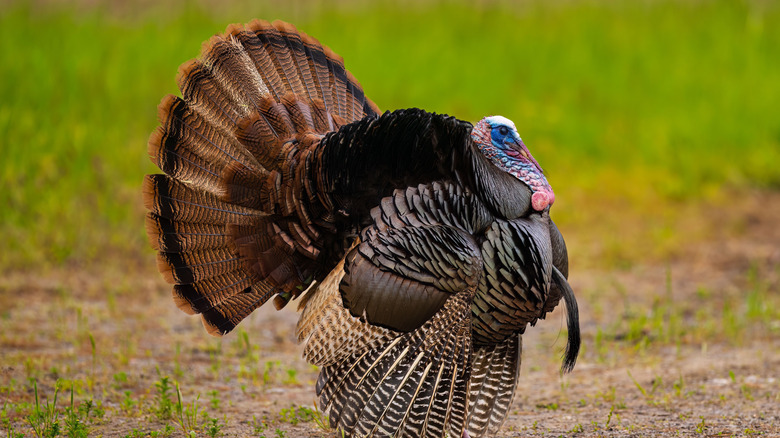
The difference between wild turkey and domesticated turkey is like the difference between a Maserati and an ice cream truck. The two variants are the same species, yes, but domestication — as it does to many animals — has stripped the turkey of its natural, untamed bravado. Wild turkeys are swarthy, sleek, and can fly as fast as a cruising car. Human-reared turkeys are pallid, weighty, and practically allergic to flight.
Though the latter may be much better for mealtime purposes (hence its domestication in the first place), it would have been the feral birds that cowboys in the old west caught and cooked. Trail cowboys sometimes supplemented their jerky with game that was freshly killed, as per Allen J. Wiener. This included wild turkey.
On the ranches there was some more time for hunting turkey, but not much. A cowhand still had a long, busy day, Wiener reminded, often with little time to chase around soaring, formidable birds. And, wild turkeys are some of the hardest game to catch, with excellent eyes and ears that can see and hear someone encroaching from a ways away.
Sage grouse
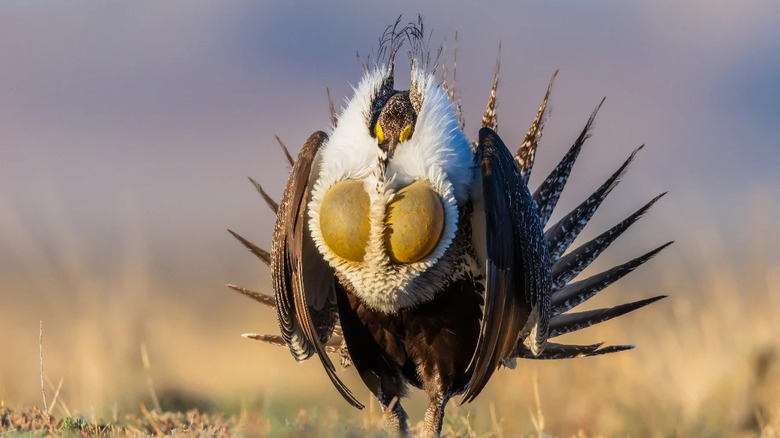
Now we're starting to get into the more obscure meats to many a modern eater. The sage grouse is a ground-dwelling bird that only inhabits the flatlands of the western U.S. and southern Canada, a region known for its preponderance of sagebrush (hence the moniker), which the birds rely on for sustenance.
These grouses are round and fatty, with tiny heads, and pointed, spired tails that almost look like a crown. The males are much larger, and they boast two, yellowish air sacs that puff out when showcasing themselves during mating season. Not only did they attract female grouses back in the Old West, they attracted hungry cowboys.
Kent Rollins explained that sage grouse, like a lot of other game on the prairie, was hunted or trapped. Although, by many accounts — including from one Meriwether Lewis of Lewis & Clark fame — it was not a favorite dish. Grouse is a dark-meat bird that can be tough, and the sage grouse is especially derided because of its total reliance on sage as a food, which in turn imbues the meat to the point of being overwhelming. Still, when out on the frontier, meat is meat, and cowboys would make it work.
Pheasant
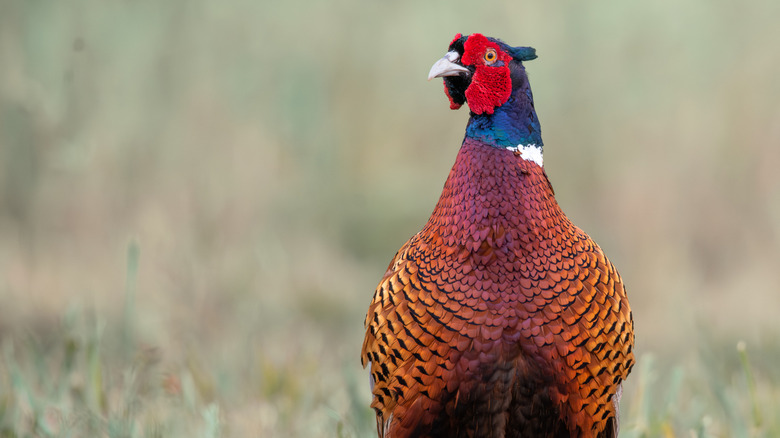
The interesting thing about the pheasant — the ring-necked pheasant, as its known — is that it's not indigenous to North America. Owen Denny, a special consul to China in the late 1800s, introduced the "delicious" fowl to these shores from their native, East Asian habitat in 1881. The birds quickly propagated and grew into the tens of thousands in just a few short years, making them a staple of the old west cowboy diet, according to Kent Rollins. Albeit a late one.
Unlike the sage grouse, the pheasant is a much more agreeable eat. Its meat has a lighter complexion and a more neutral flavor that leaves room for seasoning and creative prep from the cookie. This would have gone down well with the no-frills sides cowboys were accustomed to on the prairie. "Most of the time," Rollins explained, "they ate biscuits, coffee, and beans with the meat."
After-dinner sweets were not out of the question either, according to Rollins: "Dessert was often Spotted Pup, which was a rice-like custard, maybe even a pie if they had fruit dried or fresh." The fresh produce was an important component nutritionally if cowboys could get their hands on it, as Allen J. Wiener explained. "Relying heavily on a meat diet could cause scurvy and malnutrition from vitamin deficiencies, notably a lack of fresh fruit."
Salted pork
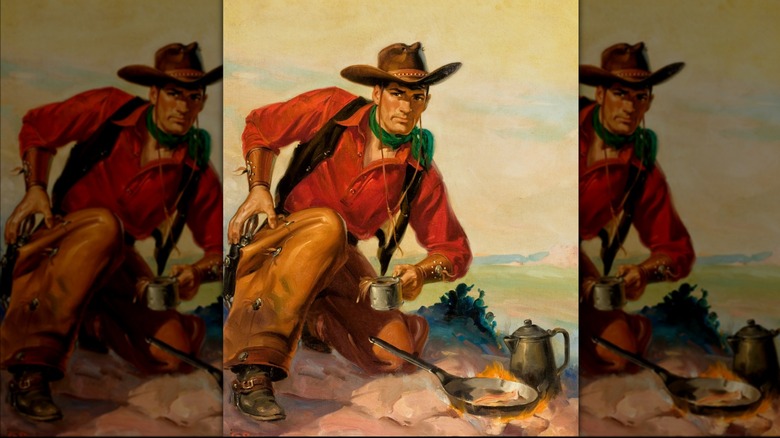
Salted pork may have been the most commonly consumed food by cattle-folk in the Old West. "There was a primary dependence on salted, preserved meats," said Allen J. Wiener, and it was usually the main component of a meal, although "cowboys on the trail could sometimes supplement salt pork with freshly killed small game."
And, as Wiener added, salted pork wasn't just eaten straight, but used as a flavor enhancer. "The cook rendered bacon or salt-pork fat to pan-fry meats or to cook small game and occasional fresh beef." The fresh beef for those cowboys on the drive — as opposed to those on the ranches — mostly came from injured cattle that were put down.
Pork that was already salted was a hugely important provision for anyone traveling to the western frontier or making a life there. Salting meat in that environment came with a lot of risks, as outlined by Wiener: "There was danger of tainted, spoiled, or improperly cooked meat due to a lack of refrigeration, warm climates, and primitive preservation methods like salting and sun-drying." He went on to add that undercooked pork could be a haven for parasites.
Rabbit
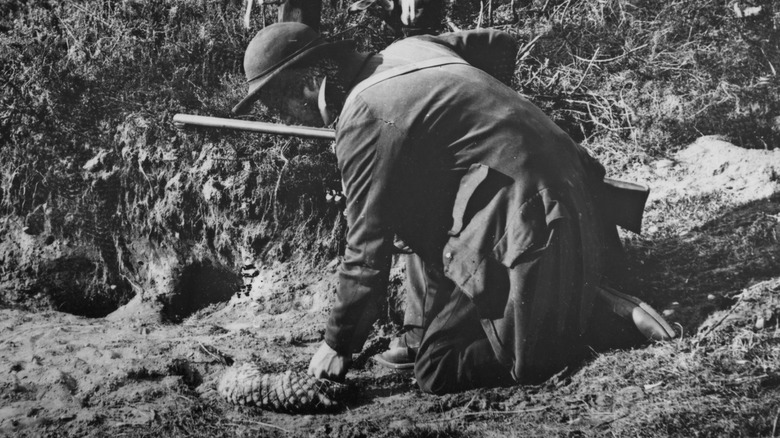
Hey, if rabbit was good enough for Dolly Parton to eat growing up, then it's no surprise it was good enough for cowboys with rumbly tummies in the old west. Rabbit, in pre-Hispanic Mexican culture, was something of a delicacy, with archaeological evidence showing that some butchers of the time specialized in purveying the long-eared hoppers. For European-descended settlers that dwelled in the American West well past the era of Spanish colonization, rabbit wasn't so much a delicacy as a divergence from the norm.
Allen J. Wiener illustrated that for long cattle drives, rabbit could be a welcome alternative meat source, and one that provided a change of pace from salted pork and "trail-slaughtered beef." Rabbit was common, trappable, versatile as fare, and amenable to seasoning. You can put rabbit in stew, fry it in a skillet, or you can cook it the same ways as other meat in the cowboy diet — which, according to Kent Rollins, was "typically prepared over open fire ... on a spit, or even directly in coals."
Prairie chicken
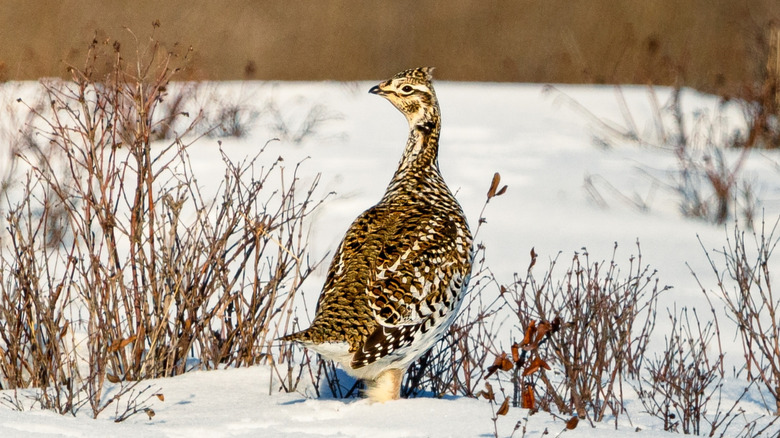
The greater prairie-chicken is actually a name for another kind of grouse that inhabits the tall grasslands of the west. Like the sage grouse, the males are stout and get very loud, yellow, and air-sac-y during mating season. Unlike their sage-obsessed cousin, however, the prairie-chicken subsists on a variety of nuts, berries, vegetation, and even insects, making the meat a bit more palatable (although still tough) and not as one-note in flavor.
Prairie-chicken was certainly a feature of the cowboy diet, as Allen J. Wiener mentioned, "when such game was readily available." Unfortunately, "readily available" is not how anyone would describe the prairie-chicken nowadays, specifically the ones that inhabit the coast of Texas. They are considered seriously endangered, mostly due to loss of habitat. This is after the east coast variety — known as the heath hen — went completely extinct in 1932.
Another reason for the decline in prairie-chicken population was actually the aforementioned pheasant. After the pheasant was brought from Asia, it began laying its eggs in the ready-made nests of the prairie-chickens. The pheasant eggs would hatch first and the oblivious prairie-chickens would raise those chicks instead, abandoning their own eggs.
Squirrel
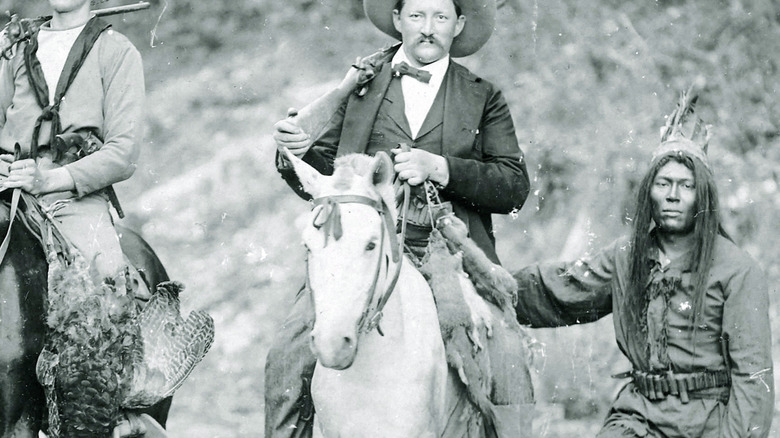
The squirrel that cowboys in the old west would tuck into were not the tree-bound urbanites many city folk are used to seeing (including pizza squirrel, Baltimore's counterpart to NYC's pizza rat). Instead, and in concert with the habitat of the plains, it was ground squirrel on the menu, of which there were a number of different species rustling around — including the gold-mantled ground squirrel, Belding's ground squirrel, and the rock squirrel.
"When they did hunt (game like squirrels)," according to Allen J. Wiener, "cowboys used rifles or pistols." Probably much easier than sneaking up on one and trying to grab it, especially when cowboys were famous for being pretty good shots.
Once they nabbed a few of these little critters, there were a few ways to cook them up. Even the ninth President of the United States, William Henry Harrison, had a recipe for squirrel stew. He also died of pneumonia a month into his tenure after he refused to wear a coat during his inaugural address, so the man's judgment could be questioned.
Calf organs
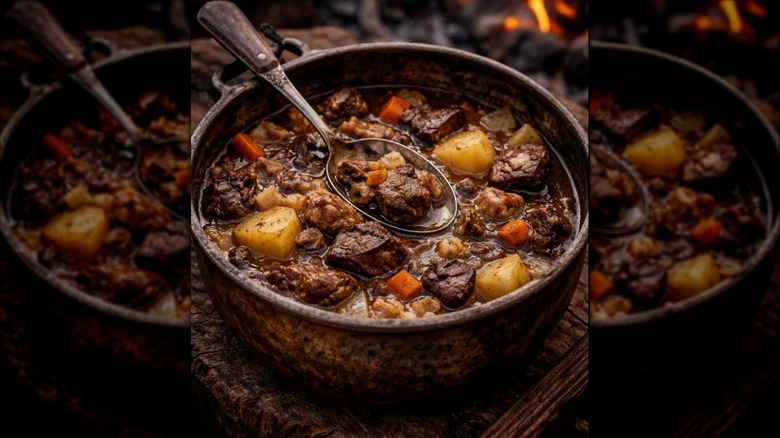
Waste not, want not, as the saying goes. And, out on the unforgiving frontier of the old west, few cowboys outside of the wealthy cattle barons and well-paid ranch staff could afford to waste potential sustenance. Thus, when a young calf would meet its maker on the trail, it wasn't just the flesh that would be turned into supper. It was a whole lot of everything else on the inside as well.
Allen J. Wiener regales us with one offal-based dish cowboys would be picking out of their teeth. "A frequent meal called 'Son-of-a-Gun Stew' combined the internal organs of a freshly slaughtered calf, including the liver, heart, sweetbreads, and tongue." He described it as a "no-waste" feed that used up as much of the animal as possible so that it wouldn't spoil. And, it should be mentioned that "Son-of-a-Gun" is the euphemistic version of the more common, profane name for the dish. Doesn't take much of an imagination to figure out the replacement word. Here's a hint: It wasn't "daughter" for "son."
Rattlesnake
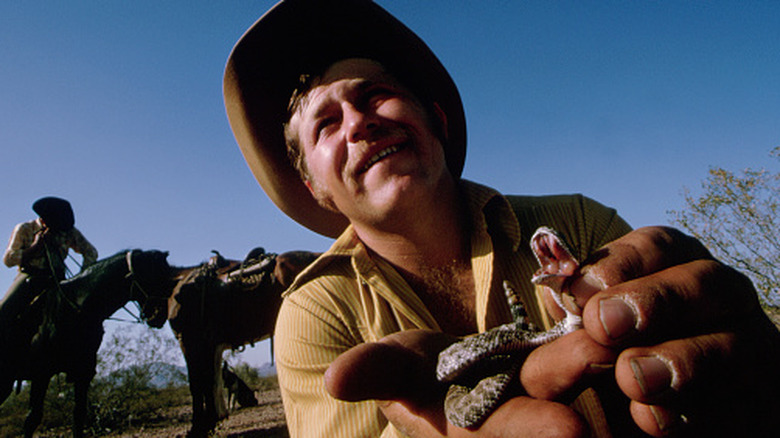
Don't let the rattlesnake bites at Texas Roadhouse fool you: There ain't no snake in those (just jalapeños and cheese). The real deal reptile, however, was certainly part of the cowboy diet in the old west. And, those rattlesnakes were just as venomous as they have always been. To most, the sound of rattling on the plains brings nothing but primal fear and an almighty sprint as far away as possible. A cookie in an 1800s chuck wagon, however, might be putting on some snake boots and following that chilling sound for the next meal.
Kent Rollins himself has an enthusiastic recipe for fried rattlesnake, and has talked about an experimental chili from back in that day made with the legless, diamond-skinned slitherer. Allen J. Wiener will tell you that rattlesnake was common fare for many on the western trails, not only cowboys.
If there's one thing that this particular meat, along with many other aspects of western frontier living, will tell you, it's that succumbing to fear might mean sacrificing survival. And, without survival, there couldn't be expansion. And, without expansion, the legacy of the American cowboy might not exist.