

I Tried And Ranked 10 Cheap Beers. This Was The Absolute Best
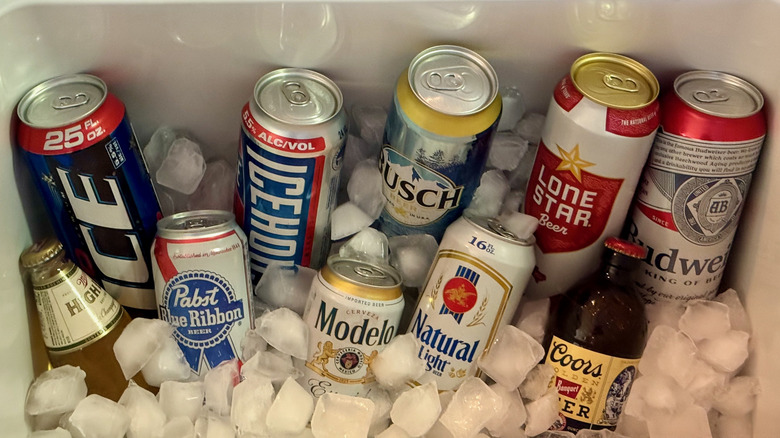
The craft brewery boom flooded the market with every type of beer, ale, and cider imaginable. Niche markets exploded, including the competition to brew the world's strongest beer. Throughout all the trends and seasonal releases, cheap beer remained a stalwart of the beer aisle. They didn't all make it (pour one out for our old friend Schlitz). But some of these beers have been sipped in saloons, taverns, and mining camps for more than 150 years.
Just because they are cheap doesn't mean they are bad beer. Even most beer snobs, the types of connoisseurs who take pride in knowing how to avoid faux pas when visiting a brewery, have at least a few mass-produced value brands they stand behind. The price point of these beers makes them a popular choice for hosting family and friends at backyard barbecues and pool parties.
This analysis guides you to the best and worst of the cheap beer section. You can find more information about our ranking in the methodology section at the end of the article, but the goal was to judge the beer solely on flavor. We started with ten of the cheapest beers we could find at gas stations, liquor stores, and grocery aisles around our home base of Austin. A team of three testers sampled each one and ranked them to crown the absolute best-tasting cheap beer.
Icehouse
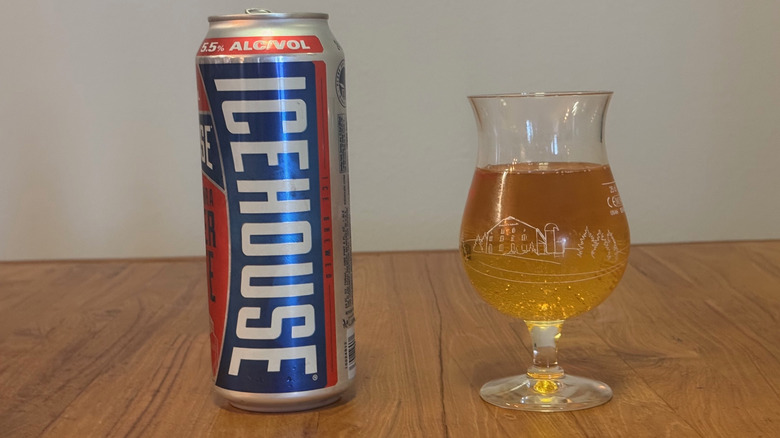
Icehouse fared the worst of all the beers we tested. It has a light amber color that is darker than many of the other beers we sampled. It frothed as it was poured into a glass, but there was almost no head retention, and the foam quickly settled to a flat surface. The dark color hinted that the beer might be more flavorful than some of the lighter ones. It was, but unfortunately, the flavor wasn't pleasant and elicited the dreaded bitter-beer face in some of our testers.
The website is scant on details about Icehouse, other than that it is ice-brewed to enhance the taste. The label on the can doesn't offer many additional details, but when we checked the ingredient list, we found that it included corn syrup. However, that's not to blame for the flavor. Corn syrup is a fairly common ingredient used during the fermentation process by many value-priced beers, including some that ranked much higher on our list.
It's not just our testers who found the beer bad. It has a score of 52 on BeerAdvocate, which equates to "awful." And not just a little awful. As of writing, it ranks behind more than 39,000 other beers on BeerAdvocate. Icehouse was one of the cheapest of the cheap beers we bought, but it wasn't worth saving pennies on. There are better cheap beer options than Icehouse.
Bud Ice
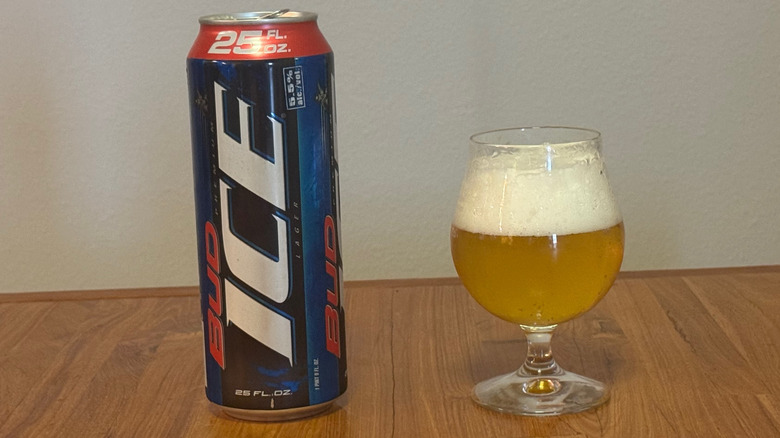
Bud Ice didn't do much better in our testing. It is also an ice-brewed beer and shares some characteristics with Icehouse, including a fairly potent alcohol content of 5.5% and the inclusion of corn syrup in the ingredients. The beer was a pale yellow color. It wasn't entirely translucent, but it wasn't dark either. Unlike Icehouse, it built a frothy head while it was poured that was fairly persistent. The flavor was more beer-forward than we expected, but the testers found it one-dimensional and syrupy.
Bud Ice is one of the many beers brewed by Anheuser-Busch. The temperature is reduced to below freezing to give the beer a smooth taste. The basic concept seems to be that water freezes at a higher temperature than alcohol. So, when it is frozen, the water begins to form ice crystals, which can then be filtered out to create a more concentrated brew.
While our tasters ranked it above Icehouse, it had an even worse rating on BeerAdvocate, where it has a measly score of 49. On the positive side of the equation, it came in a hulking 25-ounce can from the corner store, making it one of the cheapest per ounce. Even with that, we suggest reaching for a different can.
Natural Light
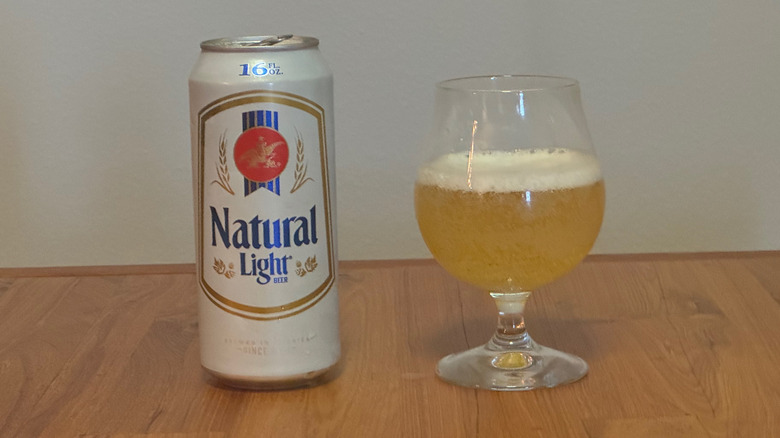
While Natural Light is near the bottom of our rankings, it's for different reasons than the two preceding it. While those had characteristics that we found unpleasant, Natural Light just didn't have much going on. It had a very pale yellow color that was nearly transparent. We were able to build a head on the beer by holding the can a foot above the glass while pouring, but it dissipated quickly. The beer had a crisp, non-offensive flavor. Or, more precisely, lack of flavor. This isn't the first time the beer has performed poorly in our testing, either. It was also dead last in a previous ranking of beers from Anheuser-Busch.
Natural Light debuted in 1977 as the first low-calorie light beer in the Anheuser-Busch lineup. The company appears to be embracing that history, and the current can is a vintage throwback to the 1970s style. Considering the consistently poor reviews, it's surprising that Natty Light has persisted long enough to be vintage, but here we are.
Natural Light is sold individually in 25-ounce cans, but in our neighborhood it was easier to find in 18-, 24-, and 30-packs. Maybe that's a reflection of Austin being a college town, or maybe it's an indication that this is a beer typically bought and consumed in large quantities. There is nothing offensive about Natural Light, but it isn't robust enough to rank any higher on this list.
Pabst Blue Ribbon
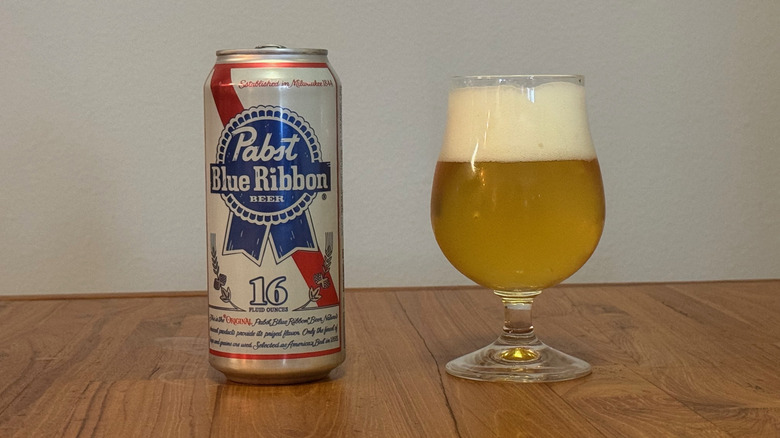
According to our testers, this is the point in the rankings where the beers transitioned from bad to varying levels of good. Pabst is an enjoyable beer for many people. It had a light amber color and built a frothy head that required us to pause several times to let it settle while filling the glass. Pabst was noticeably hoppier than the preceding beers, but the hops weren't overpowering. It tasted like a standard, no-frills, classic American beer.
The brewery started in Milwaukee in 1848 and has been a mainstay of the American beer scene since then. By 1872, it was the second-largest brewery in the nation. The Pabst Blue Ribbon name was officially adopted before the end of the 1800s. Over the years, the iconic brand has been involved in a few collaborations, including a canned chili with Campbell's and a partnership with Grillo's to produce a pickle beer.
Our testers found the beer to strike a solid middle ground. There was enough hoppiness to let you know that you were consuming beer, but it was still easy drinking. The only thing that keeps PBR from ranking higher on the list is that its flavor was on the generic side. Still, it's a quality choice for those who like flavorful beer with a subtle hoppiness.
Budweiser
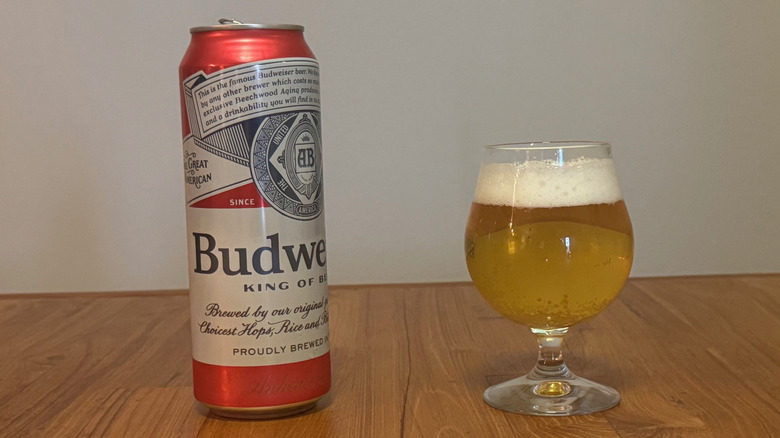
Budweiser is another classic name in the beer game. The beer was first brewed in St. Louis 150 years ago, and the recipe has slowly evolved over the decades. (Today's version of the beer is lighter-tasting than the original recipe used in 1876.) It had a pale gold color and built a frothy, persistent head as it was poured into a glass. In many ways, the flavor was similar to Pabst. Notably, Budweiser also had enough hops to taste like beer while maintaining a mellow, light character.
The self-proclaimed "King of Beers" used to dominate the market in America. Before the craft beer craze, Budweiser was the brew of choice. According to Forbes, in 1988, Budweiser accounted for 25% of all beer sales. Sales have declined since then, but Budweiser is still a ubiquitous brand nationwide.
While our testers generally had favorable opinions of Budweiser, it wasn't enough to propel it past this mid-tier level. Our definition of well-rounded is a flavor that evolves as it moves over the taste buds on the tongue. The knock against Budweiser is that it doesn't have that. It opened with a punch of maltiness with the initial sip, but there wasn't much after that. It's a decent, cheap beer, but not the most exciting one that we tested.
Lone Star
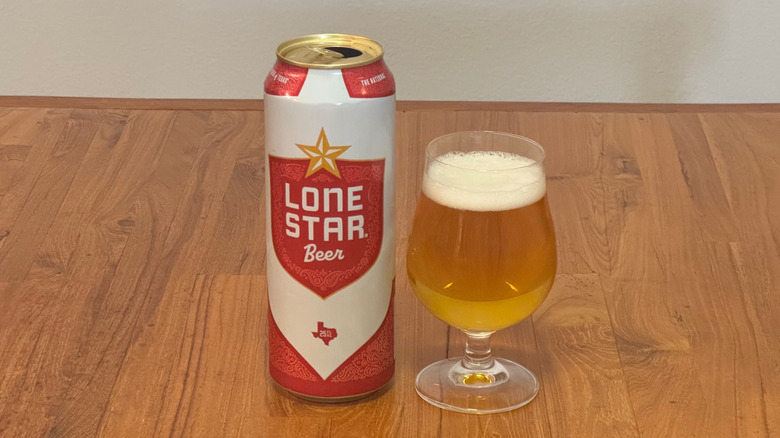
Lone Star is the first beer to crack the top half of the list. The beer was a pale amber color that was nearly, but not quite, translucent. It has a subtle, classic character that aligns with Budweiser. However, it featured a rounder flavor that hit more taste buds and was more complex. For a full-flavored beer, there was a remarkably subtle aftertaste.
This was as close as we came to testing a regional beer. We primarily focused on beers readily available across the country, and Lone Star is predominantly sold in Texas. However, the Texas region is a pretty big one, and we wanted to see how it stacked up against the giant brands.
The National Beer of Texas advertises that it has been around since 1884, but that claim should be taken with a Texas-sized grain of salt. Texas Monthly reporting revealed that Lone Star Brewing Company was founded in San Antonio in 1884, but that company went belly up in 1919 without ever brewing a beer named Lone Star. A new Lone Star Brewing Company debuted in 1940 and, after acquiring the brand name, was able to make a dubious claim to the 1884 founding date. Regardless of its origins, the regional favorite punches above its weight class when it comes to value-priced brews, but didn't have enough to claim the top spot.
Miller High Life
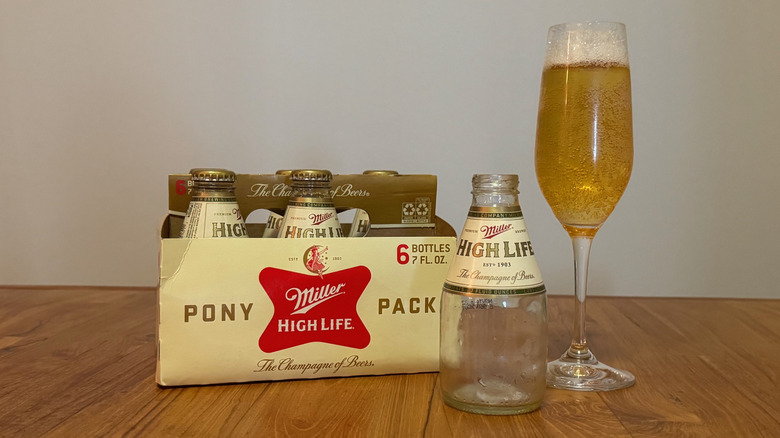
We tested a Miller High Life that came in a clear glass bottle. While we could already tell the color, we poured it into a glass for a consistent tasting experience. The beer had a distinctive golden color and a frothy head that settled quickly. It's a robust beer with a hint of sweetness. There wasn't much bite to it, and it went down easily. Our testers appreciated the overall flavor, but noted a slightly skunky aftertaste that lingered on the palate.
The beer was launched as the flagship beer of Miller Brewing Company in 1903. According to the website, it is brewed with a proprietary blend of malted barley, hops from the Northwest, and Miller yeast. It picked up its Champagne of Beers moniker within three years of its release, and the name has persisted over the following decades.
We poured it into a flute, and while the head settled quickly, the beer was effervescent and bubbled slightly in a way that proved true to its name. Overall, it's an attractive beer, but this isn't a beauty contest. While our testers enjoyed the crispness of the lager, it wasn't enough to propel High Life into the top three. The bitter aftertaste was enough to keep it in fourth.
Busch
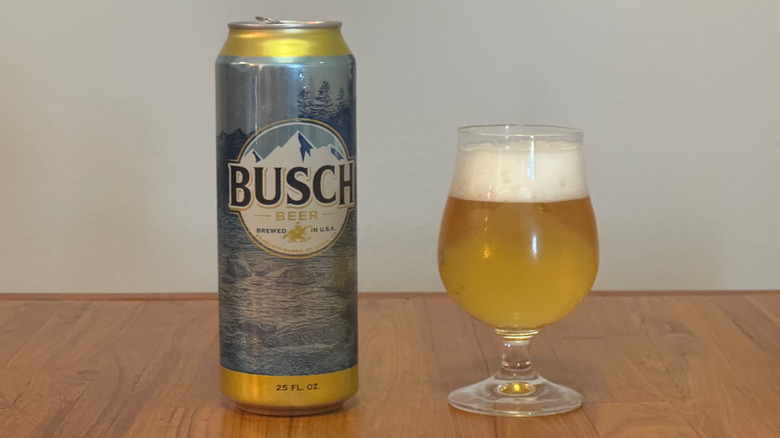
Busch debuted in 1955 as the first new brand from Anheuser-Busch after Prohibition ended. There's an interesting story behind that, but we'll get to it after we talk about the beer's appearance and taste. It had a light golden color that poured with a creamy head. The flavor was soft and well-rounded, with a complexity that propelled it past the mid-pack beers and into our top three.
Now, on to that origin story. The catalyst for the release was giving a middle finger to Major League Baseball. When Anheuser-Busch bought the St. Louis Cardinals in 1953, it wanted to name the stadium Budweiser Stadium. The commissioner refused to have a stadium named for a beer and blocked the attempt. The family name was proposed instead, and it was named Busch Stadium. Following that, Anheuser-Busch released Busch Bavarian Beer, meaning Major League Baseball had a stadium that shared a name with a beer.
While the origin story is amusing, it's the quality of the brew that lands it near the top of the list. We found it to be light, but still packing plenty of flavor. In the cheap beer market, Busch is a solid option and worthy of a bronze.
Modelo Especial
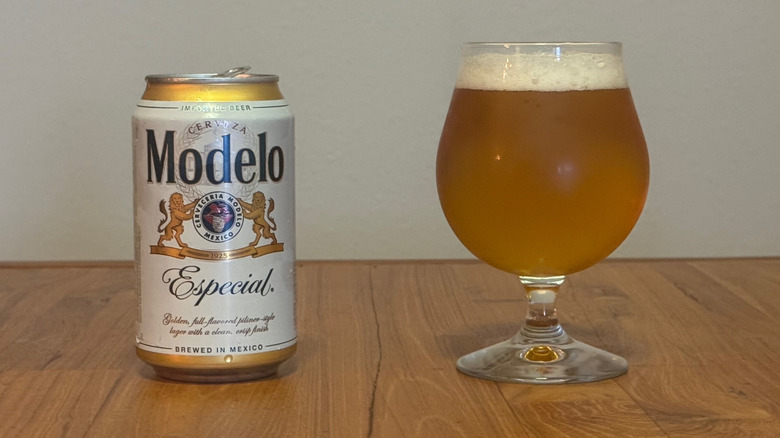
There is a reason Modelo is the top-selling beer in America by dollar sales — it's a good beer. It had a surprisingly dark color. It wasn't quite amber, but compared to the faint hue of most value beers, it almost felt that way. The head built slowly and never rose too high, but was persistent. Despite the dark color, it was smoother than many of the other beers we tested. It was flavorful enough to rise to the top of the list, but still subtle with a crisp finish.
The beer is a pilsner-style lager that is brewed with barley malt, unmalted cereals, and hops. The brewery was established in 1922, but Especial wasn't introduced until 1966. It's been the most successful beer from the Mexican brewery, and completely won over the American market.
Modelo made a strong argument for the top spot. Our rankings were based entirely on flavor, but it's worth noting that Modelo was the priciest beer we tested. It wasn't enough to bump it out of the cheap beer category (it's currently $3.41 for a 24-ounce can at our nearest Whole Foods), but a noticeable difference. Based on taste alone, Modelo was well-deserving of its position on this list, and on another day might have taken the crown.
Coors Banquet Beer
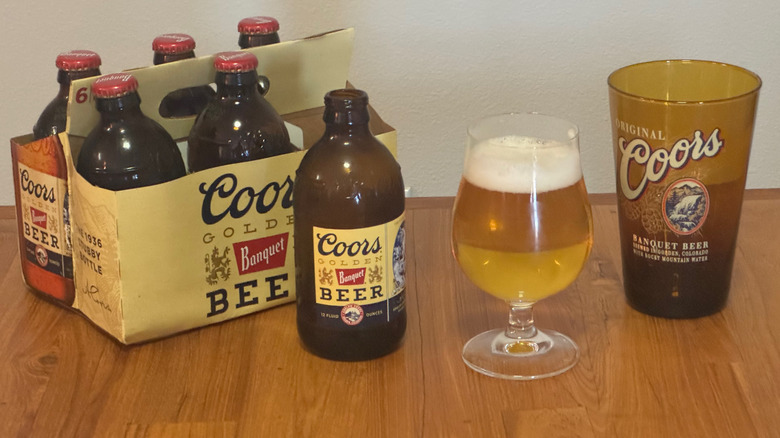
According to our testers, Coors Banquet Beer is the absolute best cheap beer on the market. The one we sampled came from a brown, stubby bottle that obscured the color. Once poured into a glass, it was a much lighter color than we anticipated. We had to work to build a head, but once it started to foam, the head was creamy and persistent. The beer was flavorful, well-rounded, and had a clean finish.
So, what kind of beer is Coors Banquet anyway? It's an American lager, brewed in Golden, Colorado, using Moravian barley and Rocky Mountain water. Adolph Coors founded the brewery in 1873. Most of the initial customers were miners who worked in the surrounding mountains, and the beer was served at gatherings large and small. In 1937, the brewery officially adopted the Banquet Beer name to toast those early customers.
It was a favorite of the miners — and it was the favorite for our testers, too. After testing 10 value beers, Coors Banquet Beer stood out as the clear winner. When you are looking to save money without sacrificing quality, reach for a can (or stubby bottle) of Coors.
Methodology
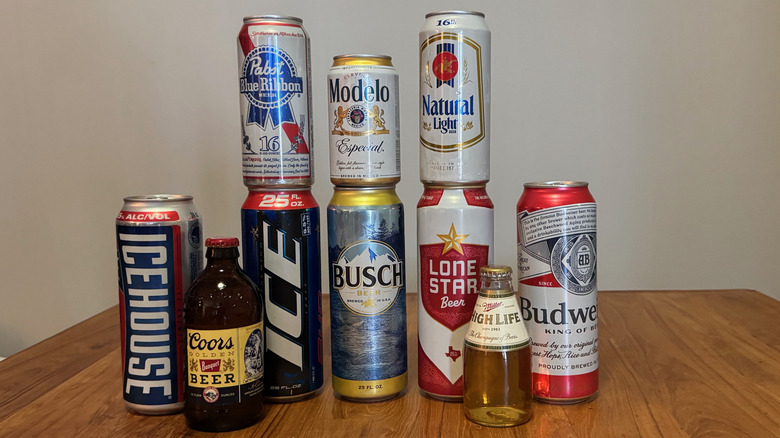
We focused the analysis on value-priced beers available in most markets. With the exception of Lone Star, regional specialties and microbrewery releases were excluded. For the initial pool, we selected 10 of the cheapest beers available at retailers in downtown Austin. This is by no means a definitive list of all cheap beers. We excluded hard seltzers, malt liquors, and cider, and also avoided mainstream light beers such as Bud Light, Miller Lite, and Coors Light (those belong in a category of their own).
While the beers were poured into a glass to examine their color and head retention, they were judged based on flavor alone. We used three tasters to represent different drinking styles: a former bartender who typically drinks IPAs and hoppy beers; a recent college graduate who just moved out of a frat house and is a connoisseur of cheap beer; and a former waitress and bartender who is more often at a wine tasting than a brewery. Combined, the testers brought more than 50 years of beer-drinking experience to the analysis.