

Charred Vs Burnt: How To Master Flavor Without Grilling Your Meal To Death
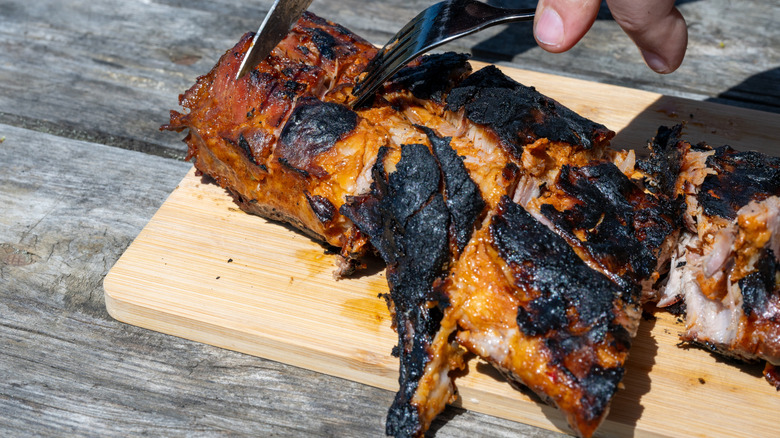
Almost no one likes burnt food, but there's a whole culinary approach that involves nearly (but not quite) burnt food which many people love. This is known as charring, and while it may appear burnt, it involves careful cooking to bring out specific flavors in food without burning it. You often see it with hot dogs, which can be charred to perfection even without a grill. But how do you stop yourself from just destroying that hot dog? We asked Ashley Lonsdale, chef-in-residence at ButcherBox, to explain the difference between "charred" and "burnt."
Lonsdale says that with practice, you can develop a fine-tuned sense of when a food is perfectly charred and not burnt. That said, it's also easy to tell just by the food's appearance. "A burnt piece of protein or vegetable will be entirely covered in black, instead of gradients of golden-brown and dark crispy edges," says Lonsdale. Charring is basically an extreme form of browning meat (also known as the Maillard reaction), which goes beyond the usual richer flavors to create smoky, mildly nutty, or toasted flavors.
Once the food burns, all the carbon has ignited and the brown texture becomes black; as a result, you lose all that flavor and are left with only bitterness. "If you think you're about to cross over the edge, grab your tongs, pick up your pork chops or chicken thigh, and inspect," explains Lonsdale. "It can always go back on the grill or pan or under the broiler to get more color."
Precisely charred or carelessly burnt meat
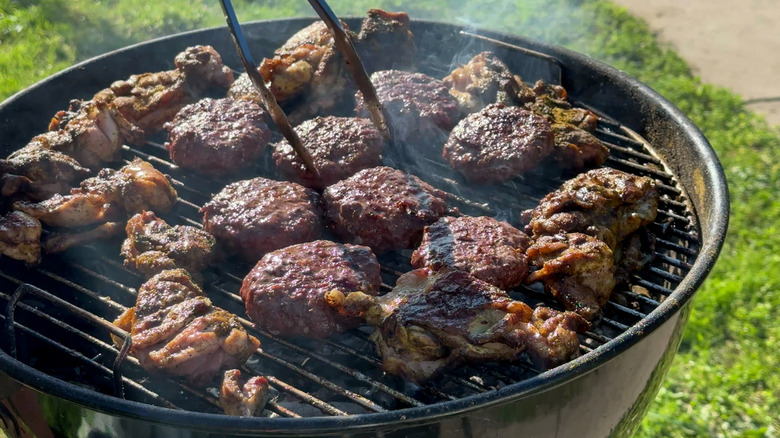
How quickly you need to act to prevent charred meat from burning also depends on where you stand on the charcoal vs gas grill debate. According to Ashley Lonsdale, "Charcoal grills get significantly hotter than gas grills, so the key difference is to watch your ingredients closely to prevent them from crossing the line into burnt territory." In either case, she recommends a flat top to allow for some more precise heat. "When charring over a grill, a cast-iron flat top is a great tool to mediate the heat of the open flames and help get an even char on your grill ingredients," notes Lonsdale, adding that flat tops can go over both charcoal and gas grills.
There are plenty of tricks you can learn once you've grasped the basics of charring food. When we asked Lonsdale about her own preferences, she shares, "I love char-grilling chicken thighs on my gas grill. I do this directly on freshly cleaned grates and always grab in-season fruit or vegetables to go alongside. Everything gets a slick of olive oil to prevent sticking and encourage even browning." She also pairs the chicken with peaches, that juicy summer fruit which gives meat marinades a good sweetness. Beyond that, you can work up to fancy maneuvers, like only charring some ingredients, like onions, to add strategic bitterness. There are also unique cooking tricks for making black and blue steaks, which are raw inside and charred outside. It all takes practice.