

The Secret To Caesar Salad That Tastes Like It's From A Restaurant
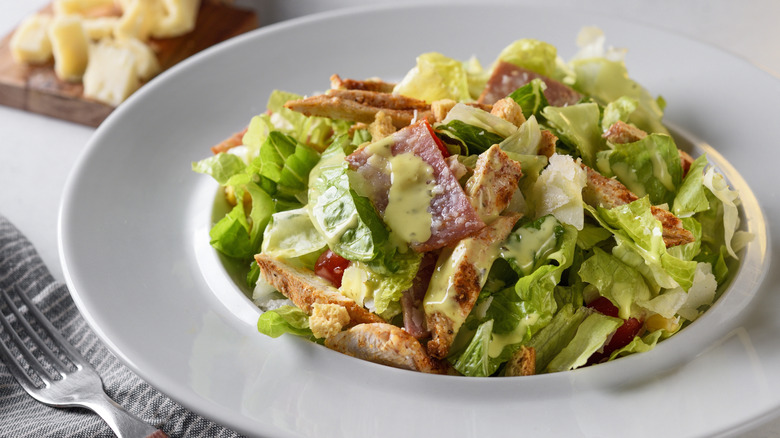
Despite its name, Caesar salad was actually invented in 1924, nearly 2,000 years after the original Ides of March. Within this past century, Caesar salad has become a crunchy, savory staple on restaurant salad menus, but it often feels difficult to make your home salad compare to restaurant quality. For help, we spoke to chef Lee Bennett, the VP of Culinary at the global, award-winning hospitality group Noble 33, where he leads menu strategy and operations across several restaurants like Toca Madera, Mēdüzā Mediterrania, Casa Madera, Sparrow Italia, and 1587 Prime.
According to Bennett, the clear advantage which restaurants have comes down to higher-quality ingredients and professional equipment. "In restaurants, we use ingredients like aged Parmigiano Reggiano, a wider variety of oils, and carefully developed variations of the dressing," Bennett says. "High-powered blenders allow us to emulsify the dressing more effectively, creating a thicker, more cohesive texture that coats the leaves." Naturally, there's also an element of experience since these are career chefs making the salad.
What can you, humble home salad maker, do to bring your Caesar salads closer to restaurant quality? According to Bennett, "Try blending in a small number of salted anchovies rather than white anchovies — they're less oily and deliver a deeper, more intense umami flavor. On their own, they can be overpowering, but in a dressing they add real depth. Another tip is to grate fresh lemon zest over the finished salad to cut through the richness of the salad."
A more complex, concentrated anchovy Caesar dressing
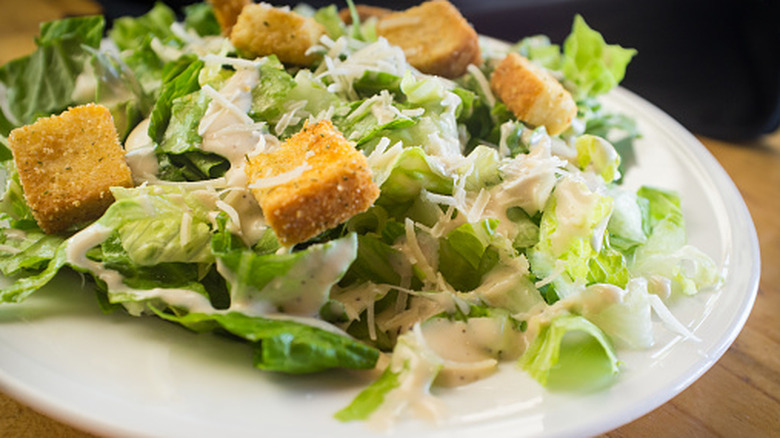
If you're entirely new to Caesar salads (or if you buy bottled dressing) then you may not know that anchovies (or anchovy paste) are a common ingredient in Caesar dressing, alongside other strong, savory ingredients like garlic and egg yolks. Anchovy paste is a time-tested way to make bottled Caesar dressing taste restaurant-worthy, but thinking about your specific anchovy style is helpful.
Any anchovies you buy come from the same fish species, but white anchovies are preserved by being pickled in vinegar. Meanwhile, salted anchovies are typically dried out and salt-packed, and the lack of moisture concentrates its flavor (naturally, they taste especially salty too). You're adding other liquids anyway, so salted anchovies help add a stronger flavor without much downside.
If you're making a chicken Caesar salad, elevate it with one additional step by marinating the chicken with common Caesar ingredients like anchovy paste, garlic, lemon juice, or parmesan. If you can, swap parmesan cheese for Parmigiano Reggiano, which is aged longer and uses higher quality ingredients. These little flavor details add up when you're presenting the finished salad. Lastly, Bennett offered one final tip for croutons. He mentioned that professional chefs often add seasoning to croutons or mess around with the texture by adding parmesan crisps. However, "for those with gluten intolerance, swapping croutons for crispy fried chickpeas is a great way to maintain that essential crunch and texture," Bennett said.