

Why You'll Almost Never Find Grade B Eggs At Your Local Grocery Store
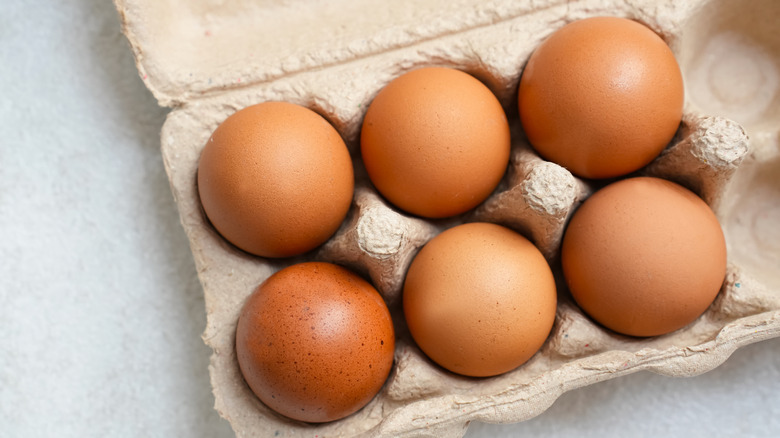
Eggs are one of the most basic staple foods around the world, but despite their apparent simplicity, shopping for this protein-packed ingredient in the United States requires sorting through quite a few choices. You can opt for brown or white, jumbo or extra-large, cage-free or not, and vegetarian-fed or pasture-raised. However, one choice American egg shoppers don't typically get to make is between Grade A and Grade B eggs. The USDA labels eggs as one of three consumer grades: AA, A, and B. Most of us have probably purchased quite a few cartons of Grade A eggs, and maybe even a few Grade AA, but Grade B eggs are conspicuously absent from most grocery store shelves.
Grade AA eggs are the cream of the crop and are required to have a clean and unbroken shell, firm and clear white albumen (the egg white), and little or no defects in the yolk. Grade A eggs, which make up the majority of grocery store egg sales, must meet very similar standards to AA, but the whites may be slightly less firm. Grade B eggs, in contrast, can have abnormal shells with discolored areas, watery whites, and other visible defects. For this reason, Grade B eggs are rarely sold by the dozen at grocery stores. Instead, they're most often reserved for making liquid eggs (which are used by many fast food chains), frozen or dried egg products, or commercially-produced baked goods and other eggy processed foods.
Can you ever buy Grade B eggs?
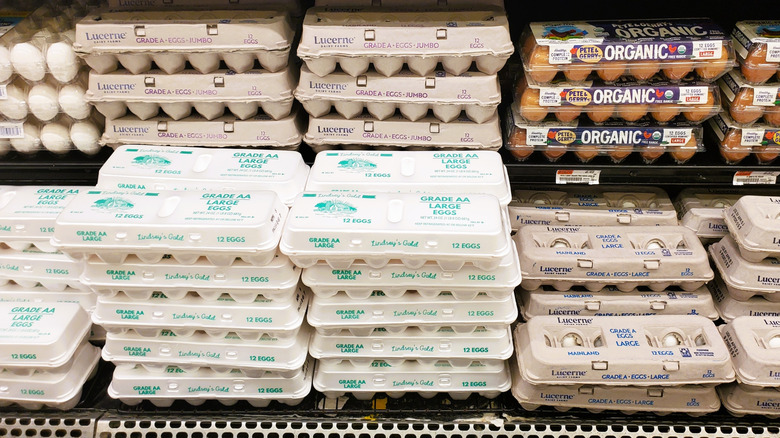
To be clear, Grade B eggs are perfectly edible. Nutritionally, they're practically identical to Grade A and AA eggs, and in most cases, you're unlikely to notice a taste discrepancy, especially if they're whipped into savory scrambles, springy egg bakes, or sweet international egg-based desserts. The main difference is simply that Grade B eggs are not as aesthetically pleasing as their higher-graded (and more expensive) counterparts. In other words, they're the ugly ducklings of the egg market.
This may lead some consumers to wonder, in the face of ever-inflating grocery prices, if buying cartons of Grade B eggs could be a way to enjoy all of your favorite eggy dishes without breaking the bank. Unfortunately for budget-conscious shoppers and the subreddit obsessed with weird eggs, that's pretty much a no-go. Some grocery stores have sold Grade B-labeled eggs as a special measure during bird flu-induced shortages, but generally speaking, the vast majority of Grade B eggs go directly to commercial food producers and, as such, are highly unlikely to be found in the aisles of your local grocery store. While you probably can't buy Grade B eggs to save dough, you can try these 13 budget-friendly egg substitutes for baking.