

Why Your Fried Food Never Turns Out Crispy And How You Can Fix It
We may receive a commission on purchases made from links.
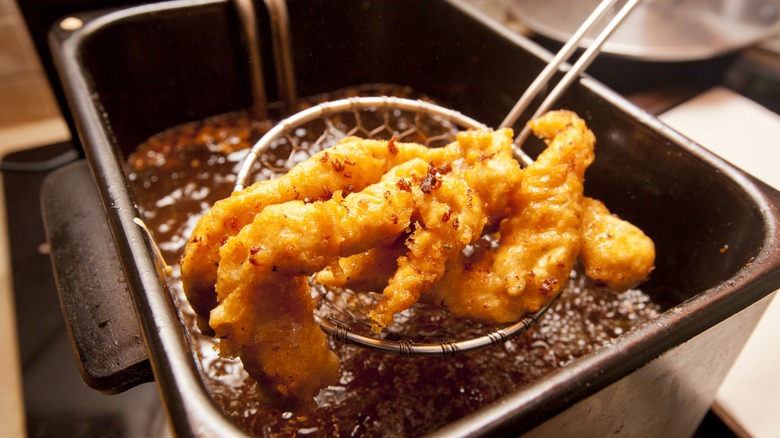
Be it coconut shrimp, homemade mozzarella sticks, or a tender and juicy chicken fried steak, one element above all else will make or break them all: texture. If the batter hasn't attained that delectable crunch you're expecting going in, alarms go off as you quickly realize you've become a victim of a fried food fail. The worst part is that the greasy, soggy outcome is completely avoidable if you're paying attention to the most critical aspect of frying food: the oil.
Jamie Milne, a content creator and cookbook author of "Everything Delish," revealed that when fried food isn't as crispy as it should be, it's not just bad luck. Generally, it's a consequence of your frying medium being too cold. "Oil temperature controls how quickly the coating crisps and seals the food's surface," Milne told The Takeout. Even when you're using one of the best oils for frying chicken or any other fried dish, things quickly go awry if the temperature isn't on point. "If the oil isn't hot enough, the food absorbs it instead of crisping up, making it greasy," she explained, later adding, "When the oil is at the right temperature, the exterior crisps up quickly while the inside cooks perfectly."
For most fried dishes, you're shooting for somewhere between 350 and 375 degrees Fahrenheit. Of course, even if you studiously temp the oil before dunking food in, it is still possible to come away with less-than-ideal results if you're trying to fry everything at once. "Another mistake is overcrowding the pan, which lowers the oil temperature and prevents proper frying," Milne said.
The Goldilocks oil rule for crispy fried food
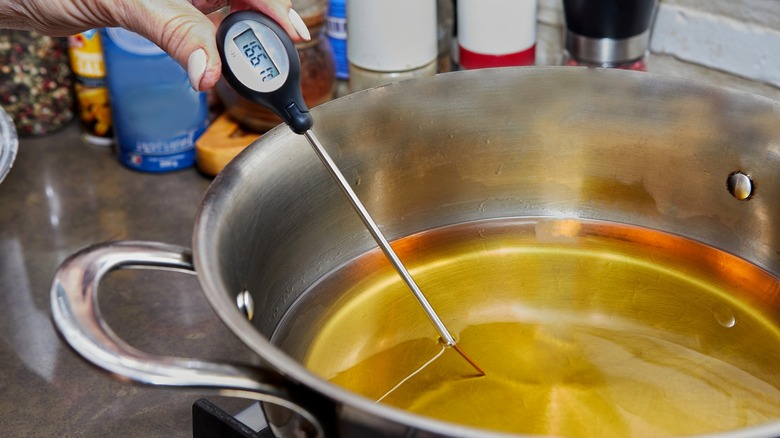
The optimal 350 to 375 degree Fahrenheit range doesn't offer much wiggle room when making a fried chicken sandwich at home. But Jamie Milne explained that straying too far in one direction or the other causes equally disappointing outcomes. That Goldilocks "just right" sweet spot is crucial to a crispy texture. "If the oil is too hot, the outside can burn before the inside has time to cook," Milne said.
A trusty meat thermometer will be able to give you an accurate assessment of how hot your oil is, as it can typically read high temperatures. Still, many people prefer the convenience a candy thermometer provides, given that you can clip it onto the side of your frying pot and regularly monitor the oil. It's a bit clumsy to use in a shallow pan, but you shouldn't be making deep fried food at home in a frying pan in the first place unless you relish the thought of cleaning up oil splatters that will undoubtedly cover your stove.
Still, not everyone has a thermometer lying around, or you might realize that your meat thermometer is an older model that won't read high temperatures. Milne recommended using an old-school approach to determine if your oil is ready if that's the case. "A thermometer is definitely the most reliable way to control frying temperature, but if you don't have one, you can test the oil by dropping in a small piece of bread or a breadcrumb," she said. "If it sizzles immediately and turns golden in about 30 to 60 seconds, the oil is ready."