

11 Aldi Secrets Only Employees Know
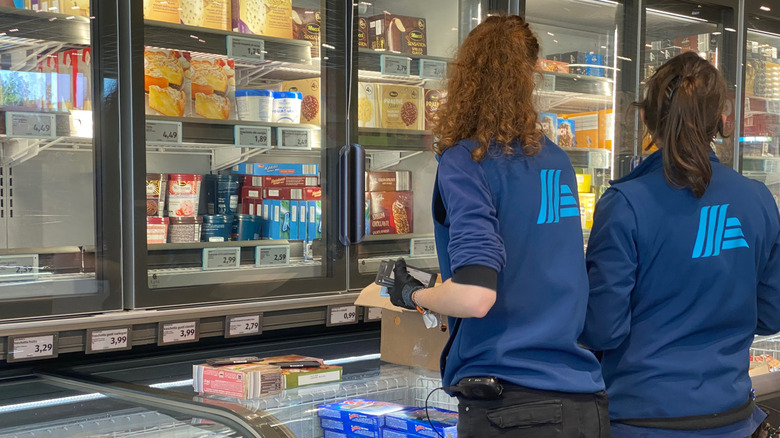
To many discount-hunting grocery shoppers, they have the keys to the kingdom. They know what's behind the curtain at Oz. They have precious access and insight to go with those blue polos. They are Aldi employees. And without their efforts on the front line, the German grocery giant wouldn't be the most rapidly expanding supermarket chain in the U.S. , opening up hundreds of new locations every year (there are already 33 Aldi outposts in Chicago alone).
Overall employee satisfaction may be mixed at Aldi, but one thing is for sure, the staff knows how the shop operates. Heck, they are the operation. So, what covert knowledge do they hold? What cache of intel separates them from the mere mortals pushing carts down the aisles and squinting at the sliced bread? And most tantalizingly, where do they keep those stickers? Let's ignore the big red classified-stamp and open the folder revealing 11 Aldi secrets only employees know.
Bagging your groceries while they're still being scanned is a no-no

Let's truth a moment: Having to bag your own groceries is not Aldi customers' favorite thing in the world. Sure, there are some enterprising shoppers with an independent spirit that prefer to bag their own items, at Aldi and elsewhere. Nice for them. But the rest of us really don't mind when somebody does a thing for us so that we don't have to do it. It's kind of an American pastime, actually. So, let's agree that Aldi's self-bagging policy is a not-ideal yet small-enough sacrifice that helps out an already taxed workforce. Good? Yes?
What tests that compromise is the revelation that the store strongly prefers customers not to start bagging until all the items are scanned and payment is complete. According to cashiers, they are judged by their bosses on their timeliness. Shoppers slowing things up by ignoring this streamlining may — unfairly or not — affect an employee's standing, through no real fault of their own. Best thing to do: Finish checking out, then go off to the area on the side to bag up your things. If everybody did this, no one would be holding up anyone else, all shoppers could complete their errand in a timely manner, workers would meet their pacing goals, and the world wins.
Scanning your credit or debit card mid-checkout speeds up the process
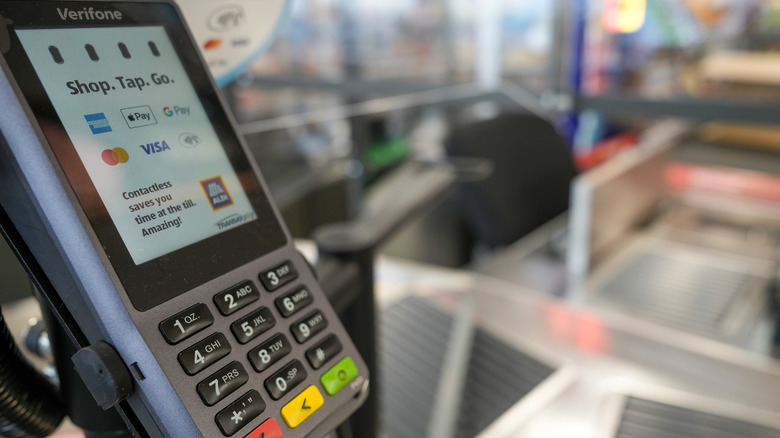
Speaking of speeding up the checkout line for the sake of the greater good, there's another little tip employees know but many customers don't. And no, it has nothing to do with manipulating the space-time continuum. Rather, with something that most customers probably think is a pretty expeditious activity already: paying.
Aldi, naturally, expects you to pay for your goods. No surprise there — it is, after all, a business. And Aldi must-buy items aren't must-buy unless they are actually bought. So it appreciates you rendering legal tender. But what employees want you to specifically know is that payment, in the form of your debit, credit, or EBT card, can happen at any time during checkout. Or rather, the card can (and should) be swiped while the groceries are still being scanned. That way there is no delay when everything is finally tallied up. You can just collect, bag up, and go home. And most importantly for the cashier, they can move on to the next customer.
Is it, in most cases, a matter of seconds we're talking about saving? Sure. But add those seconds up over a day, a week, a year, and that's an aggregate chunk of time that employees have to account for. Remember, they are timed by corporate. So, this is a piece of advice they hope shoppers heed.
Employees can't accept tips
Generosity should never be discouraged, really. In a world where a lot of people could use a bonus, a little bit of giving can go a long way. And charity that's earned through service, aka a tip, is perfectly reasonable in our society. Not to mention that workforces for entire industries such as hospitality rely on the act.
With that said, Aldi employees, no matter the degree of help they provide a customer, are prohibited from accepting tips from the grateful. For the average Aldi workers, who already have strict rules to follow, this may seem like one of the harshest. Because really, should something freely given to another person out of appreciation, especially if its just a few bucks that might help pay for a lunch or two, be banned? Regardless, it is a fixed regulation for Aldi staff, including curbside grocery pickup.
You might think it's down to tipping not being so ubiquitous in Europe. But Aldi's home country of Germany is actually a tipping culture, albeit to a lesser degree than the U.S. Maybe Aldi just rightly assumes most people don't tip at the supermarket, so what harm is having some boilerplate rule in place? Regardless, save your money for the cash register only. Oh, and that one quarter for the shopping cart. Speaking of which ...
Employees will lend you a quarter for a shopping cart
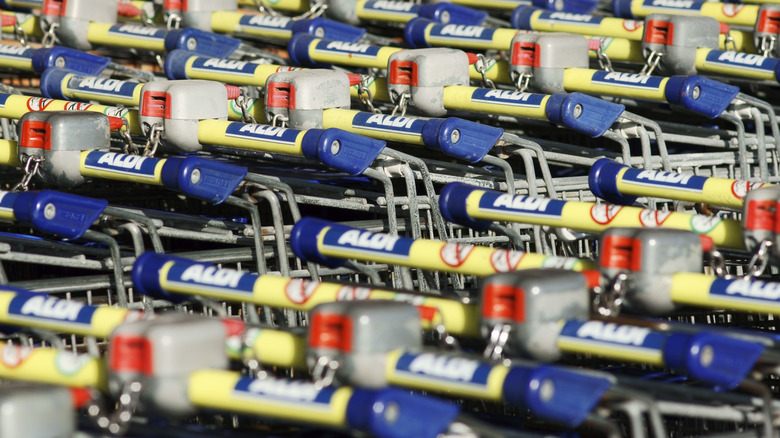
Fewer and fewer of us carry around paper money these days, forget actual coinage. Running into anything that needs a coin to operate feels like you stepped into the past, and may even have you looking for portals back to the present before dimensions are forever altered. This can be what using a shopping cart at Aldi feels like.
As Aldi shoppers already know, you have to deposit a quarter in order to use a shopping cart, but many folks struggle fruitlessly to find change in their pockets. And although some people have found dodgy methods to try and circumvent this seemingly small exchange, most just assume they're flat out of luck and will have to break the laws of physics to shove a cart's worth of groceries into a basket.
Here's the good news: You don't have to vandalize, because Aldi employees will simply lend you a quarter. No strings attached (other than the presumed return of the quarter). And even though some Aldi staff members may take matters into their own hands and deny a customer this aid (especially if said customer is a serial forgetter and/or quarter keeper), the general custom is that they pretty much have to.
Return an item you ate, as long as you have the packaging

Aldi's reputation as a consumer-forward retailer is not without merit. Not to suggest they're some non-profit charity. On the contrary, they're a huge, multinational, expansionist machine that reels in vast amounts of revenue. But the company realizes going above and beyond to satisfy a customer creates a happy customer. A happy customer is a returning customer, and a walking advertisement to other potential customers. All this adds up to a bottom-line boon.
One aspect of this approach is the store's famous Twice As Nice Guarantee. Essentially, you can return any item exclusive to Aldi, with the original packaging, any part of the product still unused, and the receipt, and you'll not only get a cash refund, but a replacement of that item. It actually, amazingly turns it into a profit for the shopper. For national brands, alcohol, or Aldi Finds that aren't food products, you can get a full refund, with the receipt and within 60 days of buying it. Even without the receipt, you'll probably get at least a store credit.
But one thing employees know, that may not seem obvious, is how one of the stipulations in the rule — regarding original packaging — creates this wild loophole for return. You literally just need the packaging. Torn and tattered, crinkled up, barely holding on, it doesn't matter. And it doesn't even matter if the product was fully eaten. You can down an entire bag of Clancy's chips, return with just the bag and the receipt, get the money back, and get a new bag of Clancy's chips to boot.
Perishables can get marked down three days before expiration
For many Aldi shoppers, looking for discounts has become something of an art form. They treat sale-hunting like an expedition, and they're becoming sharper and savvier in their ways. They keep an eye out for color-coded stickers, save money on Aldi dupes, and navigate budgets like a hawk-eyed CPA. Needless to say, any kind of leg up they can get on markdowns, any kind of mere hint, would be insider information treated with the gravity of a top-secret Area 51 reveal. Turns out, there's really no big, elaborate, juicy secret behind it all.
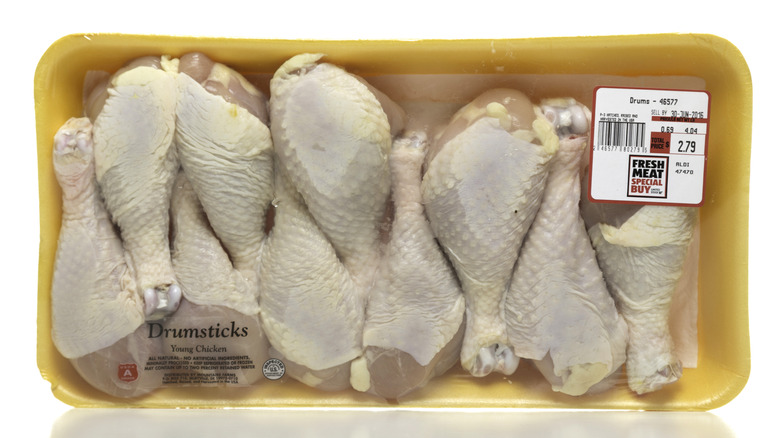
According to employees, perishable items can start getting marked down within three days of their expiration date. That's the policy. Almost certainly by the day before, staff will be jabbing big-time sale stickers on everything from meat to eggs to cut fruits. And although this is key information, it really just means shoppers need to be on their toes even more — since the discounts vary depending on the dates of the produce, as opposed to a set weekly event like the Wednesday Aldi Finds release.
Arrive early for the best chance at marked-down bread and meat

In keeping with the markdown-scouring theme, there is actually a specified time that works best for seizing certain discounts. In this case it's pertaining to meat and bread — although whether you want to take a chance with some of Aldi's lunch meats in the first place is entirely up to you. Slight problem is, the price-cutting on these two food items comes at a point in the day on the opposite end of the best time to shop peacefully, according to an employee – which is late at night.
Alas, it seems that employees do the markdowns on bread and meat right before the store opens. Meaning that a morning shopping trip gives you the best chance to nab these two categories of discounted items before they're gone. And chances are they will have vanished by the end of the day. Aldi bargains — like typos on a billboard — do not go unnoticed. Best advice then: Get a good night's rest, set your alarm, have a fortifying breakfast, and be the early bird that gets the Aldi worm. Er, chicken thighs.
Bread and milk are pulled from shelves three days before expiration
With all the product turnaround and constant shelf restocking that goes along with Aldi's deliberately limited inventory, you might wonder if items past expiration get overlooked by the busy staff. Nobody wants to bring home moldy bread or milk that's gone bad. Thankfully, Aldi has a system in store to make sure that doesn't happen.
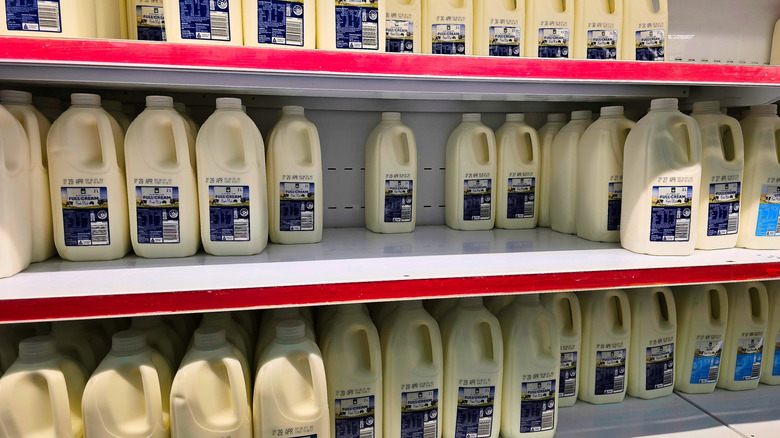
According to Aldi employees, the hard and fast rule is that both bread and milk are taken off the shelves three days before they're set to expire. Although some employees claim it used to be five days, creating some confusion among staff members, it seems the consensus is three. It's a comfortable level of breathing room that pretty much guarantees you're out of the margin-of-error date range for lapsed freshness.
And if you're wondering whether or not all that de-shelved product (that's still technically good, albeit for a short time) goes to waste, don't worry. Aldi has partnered with local food banks to redistribute products that are still safe to eat, which gives these items a good chance of being consumed instead of thrown away.
Ask an employee about discounts — they might find you a sticker
In an age of social distance, where people are tuned out of the world and more aloof than ever, where genuine, in-the-flesh human contact can sometimes seem like a rarity, it turns out Aldi is trying to bring that back. Well, maybe only employees know that. Because it turns out, by simply asking staff members about discounts on items that aren't stickered, you might just conjure a bargain.
Granted, it's much more likely to happen if there's a good reason for the discount. Like if you already know a policy (like one ex-employee did and shared on Facebook, realizing that meat expiring in a day wasn't marked down like it should've been), the worker you speak to will likely promptly and gladly remedy the situation.
Next time you're perusing the bread aisle, for example, and you see an un-stickered loaf on the shelf that's expiring in three days, find an employee, point it out, and reap the rewards. Basically, if its obvious a product should be marked down, speak up (respectfully). Even bringing it up at the register can still get you the deserved discount.
The fine print on price tags can tell you a lot
It's already well-known that Aldi has a whole color-coded price tag system which committed customers have been studying and deciphering for years: red for sales, blue for seasonals, red and white for a forced markdown (usually due to expirations or season-based rotation).
But there is deeper information hiding in plain sight on said price tags. And depending on your innate interest in the subject matter, this may well just blow your mind. It pertains to the small number-letter combinations on the fine print of price tags. It's a string of characters that are almost completely ignored by the average shopper. But they very much indicate something, according to employees.
Check that fine print again on the bottom right corner. If that line starts with a number followed by the letter D, that indicates the product arrived at the store frozen. The number that preceded the D represents the amount of days the product is good for after it has been thawed out. That way you know which products are at their freshest. Has your brain melted yet?
Meat expiring the next day can be 50% off
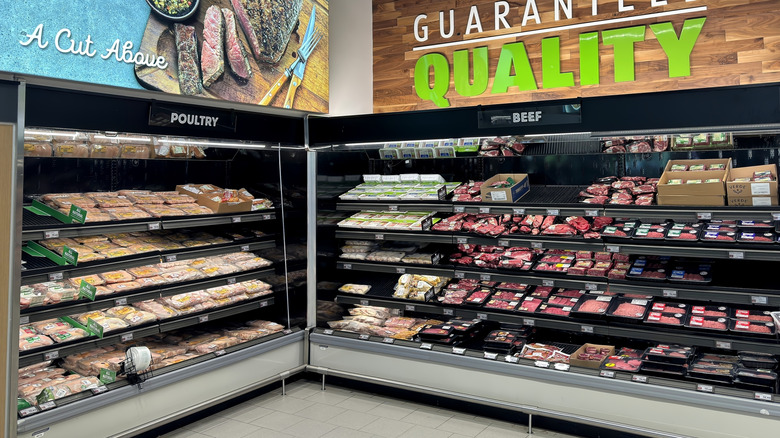
As is well-established, Aldi wants to move product. And sure, every business wants to move its product, otherwise there will be no business anymore. But Aldi makes it a point to do that. It's endemic to the corporation's overall strategy. And Aldi's sales results show that this tactical focus is very much working for the supermarket chain.
One way Aldi manifests this mode of turnover is in its meat section. Many supermarkets, big and small, will lower prices on fresh meat products that are reaching their sell-by date. It's common form. But Aldi goes a step further and slashes the price considerably when it comes time. The day before meat is set to expire, employees do their thing: On the low end they'll chop 30% off. On the high-end, as much as 50% off. Half-price steak, chicken, or pork is no joke. That can be a feast someone otherwise couldn't afford. So keep an eye out when perusing the meat aisle. Check dates. Anticipate with cunning and basic arithmetic.