

The Absolute Oldest Chocolate Bars That Are Still On Shelves Today
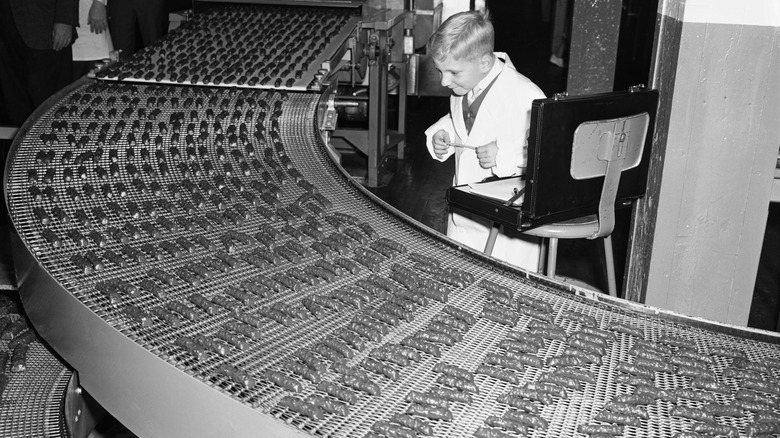
A chocolate bar is brand new to the child who bites into it for the first time. But many of the famous treats on shelves today have actually been around for a heck of a long time. Don't let modernized aspects, such as sleek packaging, offshoot flavors, or the relentless march of snack shrinkflation, fool you. Staple candy brands can have a deep history (which includes some hilarious old-timey advertisements).
The fact that over a dozen such bars are still stocked in your average candy aisle in 2026 is a testament to the enduring power of both the formulations and the American sweet tooth. You might be enjoying the same treat as, say, Amelia Earhart once did, or Lou Gehrig, or a World War II combat soldier. It's probably too much to say that every bite into a Mr. Goodbar is like stepping into a time machine — but for the sake of upping the drama of this article, we'll say exactly that.
Here are 14 of the oldest, most grizzled chocolate bars still actively retailed nowadays. Barring a few, you most likely know every one. But their historical origins are another matter altogether. Although 2026 has brought its own wave of hot new chocolate candies, sometimes the legacy labels need to retake the spotlight. Shine on, you crazy diamonds.
Hershey's - 1900
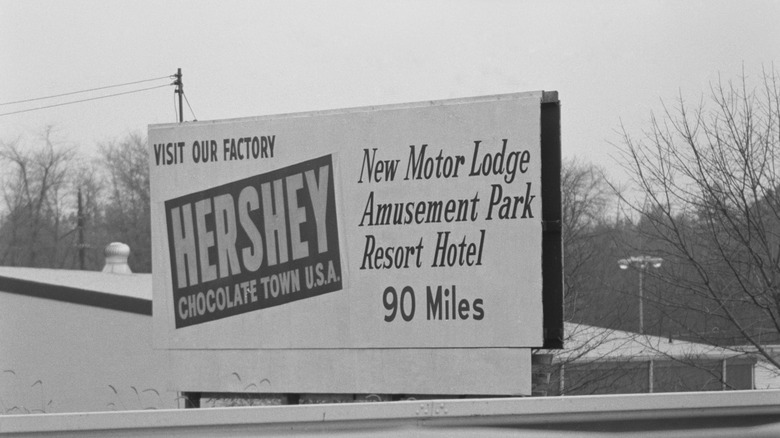
Where else to begin than at the beginning, and Hershey's stands right at the genesis of retail chocolate in the U.S. Before the theme parks, before the corporate omnivory, before the many rankable Hershey variations, there was a Pennsylvania man with a dream; a yummy, sugary dream.
You have to give Milton Hershey credit. He committed years of his life to finding a way to turn milk chocolate — inspired by manufacturing equipment he saw at an 1893 expo in Chicago — into a sustainable, mass-produced product. Hershey went all in on experimenting to find the ideal formula.
Selling his caramel company in 1900 (seeing that as nothing but a passing candy fad), he turned the heretofore subsidiary Hershey Chocolate Company into his main gig and, in that same year, sold the very first Hershey's bars for a few pennies each — before standardizing it with a uniform, five-cent offering. The rest is history.
Turtles - 1916
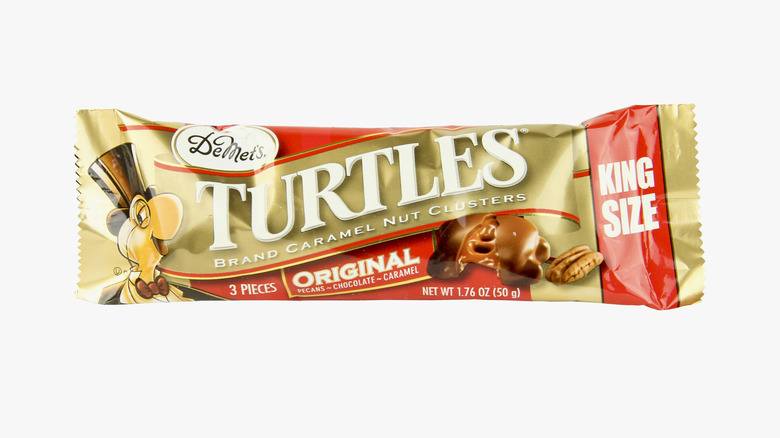
Take nothing away from Turtles, even if it may be one of the less familiar names on this roster of longstanding treats. The chocolate, caramel, pecan combo has proven a winner over the generations ever since it was first sold at George DeMet's Chicago candy store in 1916 (the name comes from the distinctive, testudinal shape of the original clusters).
Now under the ownership of global snacking company Pladis (after being bought and owned by Nestlé for a time), the Turtles line has since branched off. Today, the treats come in classic milk chocolate, dark chocolate, sea salt caramel, and peanut and caramel; along with several different versions of both the bars and the clusters.
Chicago has no shortage of enduring, iconic foods, from the three types of Windy City pizza to the Italian beef sandwich of "The Bear" fame. But DeMet's Turtles should get every bit of the laurels for being a timeless treat from Chi-town. It won't be the last one on this list.
Clark - 1917
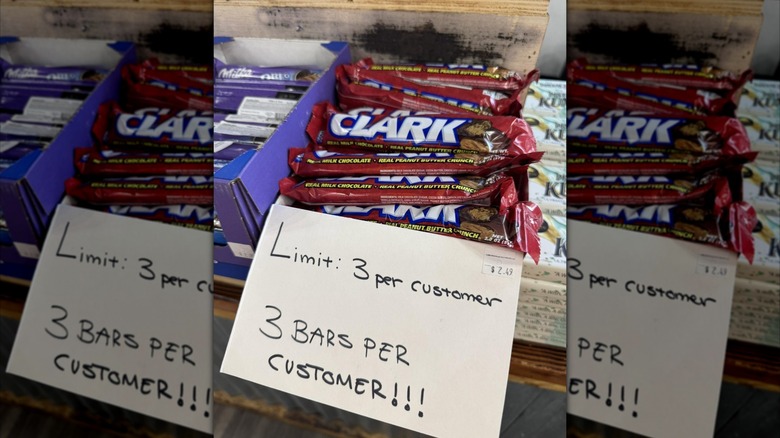
Decades before M & M's were invented specifically for troops in World War II, a different candy bar was created for a different war. That candy was the Clark Bar, and the war was The Great War, aka World War I. It was an Irish immigrant by the name of the David L. Clark who formulated the caramel-peanut-milk chocolate treat in Pittsburgh.
Once the conflict ended, the Clark bar was sold nationwide, became a big hit, and lived on as a pride of the Steel City (and it re-enlisted its services for World War II troops, to the tune of 1.5 million bars sent overseas each day). In 1965, it was reformulated to remove the caramel center, making it a full-on peanut and chocolate extravaganza.
Over the years, stewardship of the Clark bar has gone from the Leaf Candy Company in Chicago, to the New England Confectionery Company, back to Pennsylvania via the Boyer Candy Company. Many would argue that's where it has always belonged.
Oh Henry! - 1920
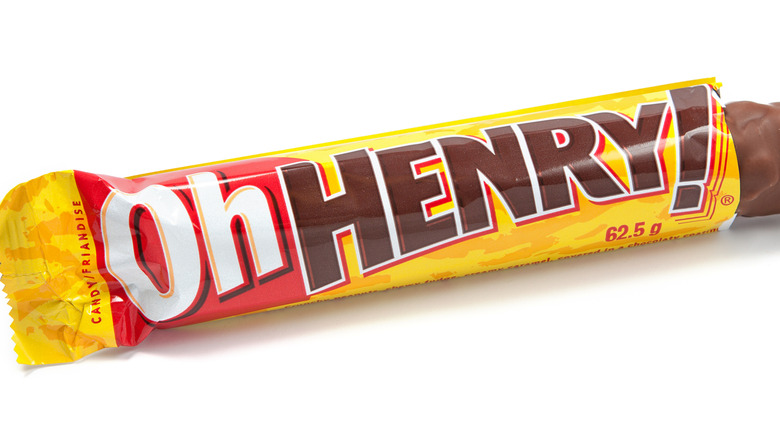
Yep, Chicago is responsible for another iconic candy invention. This time it came from one George Williamson and his Williamson Candy Company. In 1920, Williamson combined fudge, caramel, and roasted peanuts and wrapped them in a milk chocolate, creating a rich, lumpy mouthful of salty sweetness. The name seems to have a murky origin, with apparently nothing to do with the famous writer O. Henry (in case you were wondering).
Although it became a pillar of the candy aisle in America for decades, it disappeared at one point. Nestlé eventually owned the label, but the problem came when the rights were sold to Ferrara Candy Company in 2018. A year later, Oh Henry! was nowhere to be seen on American shores (it's still on the shelves in Canada, however, via Hershey Canada).
Blair Candy Company has taken the current reins, and has now made Oh Henry! available to Americans through online ordering. For fans desperate for this beloved candy, that means they're either doing some interwebs shopping or physically crossing the border. The former is easier but the latter allows you to check out Niagara Falls in person.
Mounds - 1920
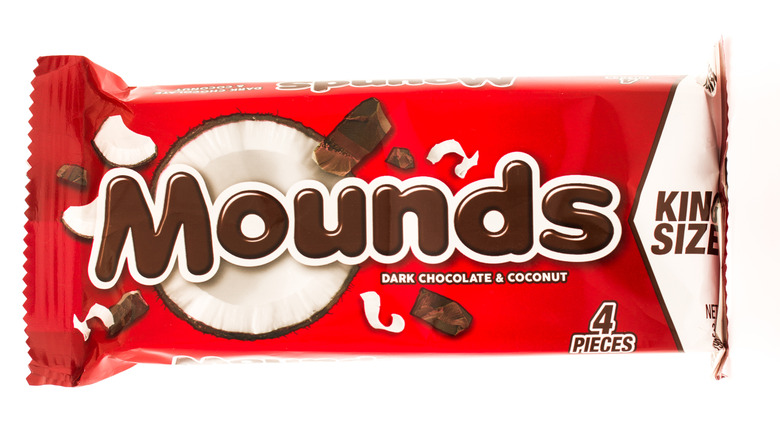
A candymaker and West Haven, Connecticut resident by the name of Vincent Nitido invented the Mounds bar in 1920. One piece of the coconut and dark chocolate confection was originally sold for five cents. In 1929, the Peter Paul Candy Manufacturing Company bought the rights to Mounds and began selling two pieces for the same five-cent price.
Mounds would survive the lean, rationing times of World War II when Peter Paul Candy Manufacturing stopped making everything else except that (until 1946, when its co-star Almond Joy would debut). In the 1970s, the famous "sometimes you feel like a nut" ad campaign premiered and gave Mounds (and Almond Joy) a nice, comfy spot in the collective consciousness.
In 1978, Peter Paul Candy Manufacturing merged with Cadbury. Ten years later, Hershey bought Cadbury, and therefore the rights to Mounds, which it has held ever since. It may not be a candy bar that's for everybody, but Mounds has obviously appealed to enough folks for it to have lasted well over a hundred years.
Baby Ruth - 1921
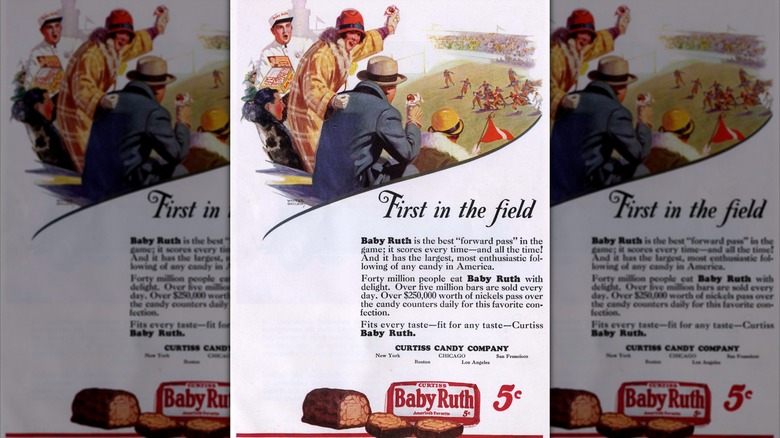
Based on the era of its genesis, its completely understandable for anyone to assume the Baby Ruth bar is named after, or at least referencing, legendary New York Yankees slugger Babe Ruth. In 1921, the homerun-swatting Ruth was starting to become bigger than life. While in that same year, a candy bar with a much lower profile was released by the Curtiss Candy Company in Chicago.
Baby Ruth was a confection of peanuts, caramel, and nougat wrapped in a chocolate exterior. But what made it reach extraordinary sales heights, seemingly, was its name — which people almost certainly associated with the famed slugger, despite the man not receiving a penny out of it.
The biggest irony came when Ruth himself decided to release his own candy using his name and likeness, only to have the Curtiss Candy Company sue him for copyright infringement. It's flimsy claim was that the bar wasn't named after the ballplayer at all, but the daughter of former president Grover Cleveland Alexander. Sure, she was named Ruth, and sure, she was at one time a baby — but she was also born 30 years earlier and had in fact tragically died in 1904. Still, the candy company won when the court ruled against Babe Ruth. Pays to have good lawyers.
Charleston Chew - 1922
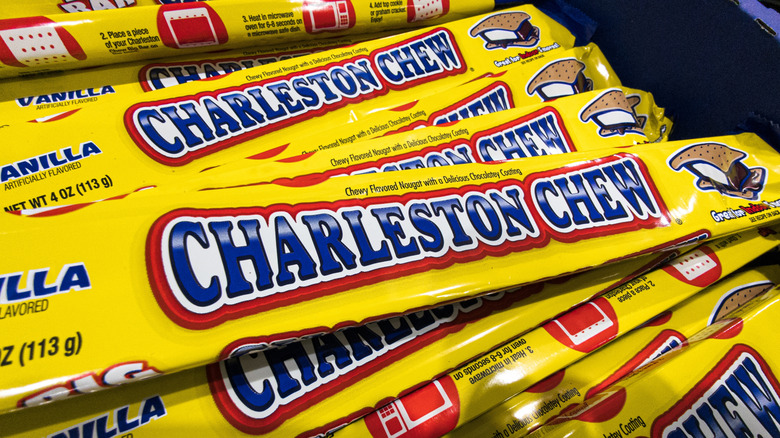
Although Charleston Chew is associated with Cambridge, Massachusetts, and named after a bygone dance craze from the 1920s and not the South Carolina city, it was actually started by an actor who fell off a stage in San Francisco and pivoted his career to candy. That injured thespian was named Donley Cross, and — with his friend Charlie Fox — he opened the Fox-Cross Company in 1920.
Two years later, the enterprising pair covered vanilla nougat with milk chocolate and began selling it. Why and how the candy's manufacturing ended up in Cambridge is not really clear, with records showing the company was based in the city of Harvard University by 1931.
Although the Charleston Chew had a measure of initial popularity, it wasn't until a man named Nathan Sloane acquired the Fox-Cross Company in 1957 that the bar really took off. Sloane expanded and automated the production, turbo-charged the advertising, and introduced two new flavors: Strawberry and chocolate. Sloane eventually sold the company to Nabisco in 1980, who flipped it to a company called Warner Lambert, who then sold it to Tootsie Toll Industries in 1993, its current home.
Milky Way - 1924
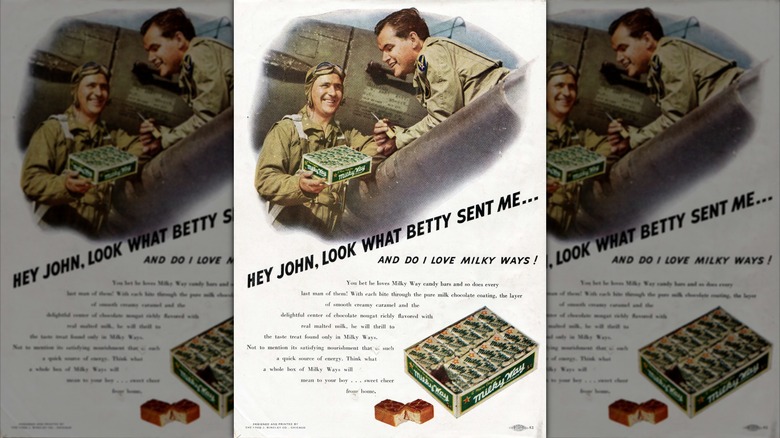
In the beginning, there was the Milky Way. Well, in the beginning of the Mars candy company anyway. Named not after the galaxy inhabited by planet Earth — or for that matter, planet Mars — but a once-popular malted milkshake (which itself had to be named after the galaxy, so therefore you could argue the Milk Way bar was, indirectly, named after the galaxy), the pioneering, flagship confection is the oldest offering from Mars, Inc..
Simply a mix of chocolate, caramel, and malted nougat, Milky Way was invented by Frank C. Mars in 1924, in a shared office building in Minneapolis that belied the eventual gargantuan corporation the business would become (the idea for the bar itself apparently came from Frank Mars' son while the two were sitting in a diner).
Frank had something. In its first year, Milky Way bar brought in over $800,000. It would never look back. It's still one of the most recognizable names in the biz and is an automatic in any candy section of nearly any store in the U.S.
Mr. Goodbar
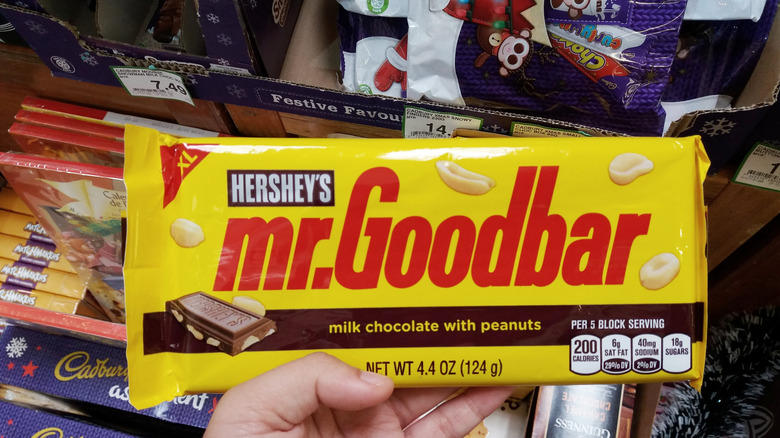
After Hershey's revolutionized the chocolate bar industry — really, invented it — the company wouldn't have another offering outside of its original Hershey's bar for nearly 20 years. That's when a chemical engineer named Samuel Hinkle joined the company payroll, bolstered the research laboratory, and experimented with a confection that was comprised of peanuts fried in fat (although they called them roasted), combined with the famous milk chocolate. In 1925, Mr. Goodbar was born.
Like many candy bars, it sold well during The Great Depression, marketed as a two-for-five-cent lunch (Hershey's really leaned on the peanut component to sell the nutritional value). The name apparently came from the aging Milton Hershey mishearing someone complimenting the candy, but it stuck. And it endured.
Nowadays, Mr. Goodbar, with its distinctive yellow packaging, is really only ever found in its miniature form, which trick or treaters have become all too familiar with. However, if you're really on the look-out for Hinkle's invention, you can still find the rare, full-sized Mr. Goodbar at Dollar Tree.
Heath - 1928
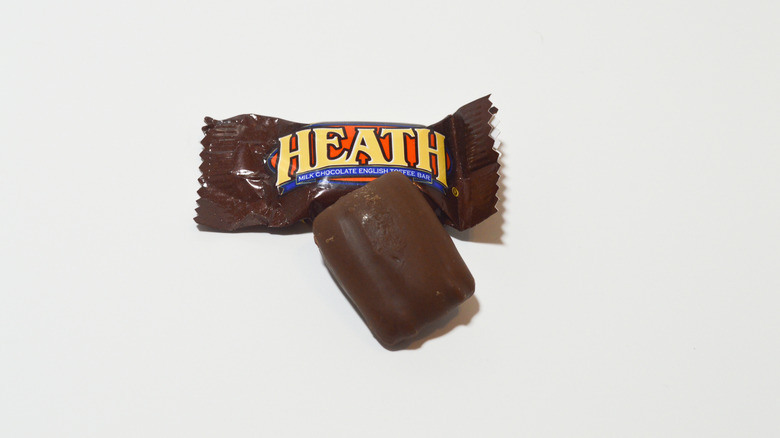
Some chocolate bars have a creative, eye-catching, sweet-tooth-enticing name. Then there are those which are just straight-up named after the people who made it. Hey, if it's successful, what does it matter? And Heath bars certainly have been a success.
A decade-plus after L.S. Heath bought a confectionery shop for two of his sons to run in 1913, in Illinois, the Heath boys came across a toffee recipe that would change their fortunes. They began selling Heath English Toffee in 1928. Early on it was promoted, in a hilarious sign of the times, as a health bar. As a reminder, it contained milk chocolate, butter, almonds, and sugar cane. These ads even included a bottle of soda to go with it.
It worked. Or at least something worked, because Heath bars grew in popularity through The Great Depression (when people had like no money) and into the post-war years. The Heath bar stayed in the family until a Finnish company named Leaf, Inc. bought the business in 1989, only for itself to be acquired by Hershey in 1996, where the Heath bar remains to this day.
Snickers - 1930
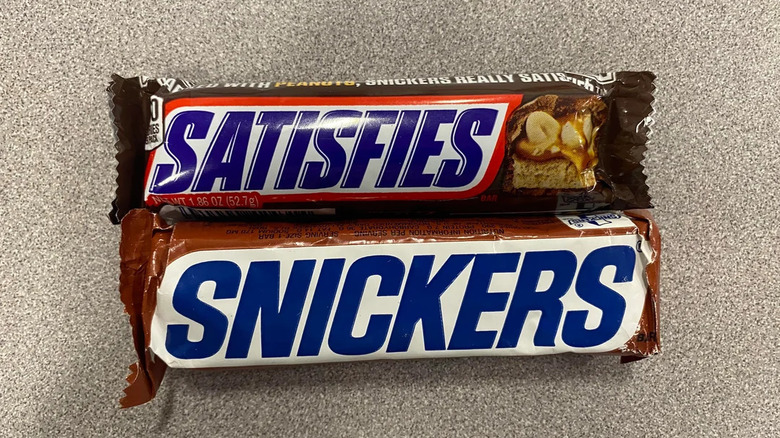
Chicago again, people. But for the first time, a horse is involved. That's because the name of the chocolate bar in question, Snickers, was rumored to have been named after one. Not just any horse, mind you, but the favorite horse of Ethel Mars — as in Frank and Ethel Mars, the folks who started Mars, Inc. It apparently took the couple three years of experimenting before releasing the first Snickers bar in 1930 out of the company's Windy City factory — selling it for five cents a pop.
From 1967 to 1990, however, Snickers wasn't the name of the unmistakable nougat, caramel, and peanut snack in the U.K. Over the Atlantic it instead went by Marathon. If you look at a retro photo of a Marathon bar, with those strange letters on such familiar packaging, there's a mental dissonance. It's like if a Coca-Cola instead had the words Argy-Bargy on the bottle.
Eventually, the Brits got their act together and used the name we know today, the one in front of the bar that reached $1 billion dollars in U.S. sales in 2013. Obviously, Snickers has branched out into many different variations, with retooled versions coming out all the time. No matter. The original is the one with the real staying power.
3 Musketeers - 1932
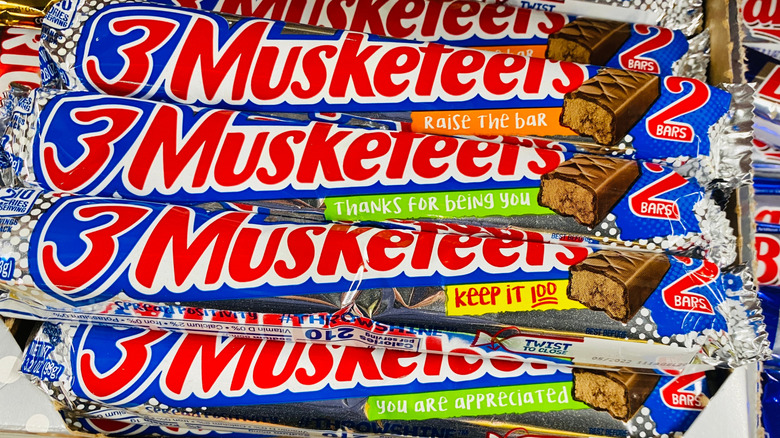
A true Mars company original, 3 Musketeers first came into the world in 1932. At first, it was sold three to a pack, hence the name (and probably the fact that no royalties had to be paid to the long dead French author Alexandre Dumas). Not only did it come in triplets, they each had a different filling: Chocolate, vanilla, and strawberry.
That all changed in 1945, when the vanilla and strawberry ones were ditched for good and the chocolate went solo (thus turning the name of the bar into a curiosity forever after). The modification didn't come from lack of popularity for the other two flavors. Or rather, the main reason was the sugar rationing during World War II, which made the manufacturing of all three flavors too budgetarily unwieldy.
The simplified whipped chocolate filling has defined the bar ever since, and makes 3 Musketeers one of the easier candies to make yourself at home. Although, isn't it way easier to head to the corner store? Or swipe it from a kids' Halloween basket?
5th Avenue - 1936
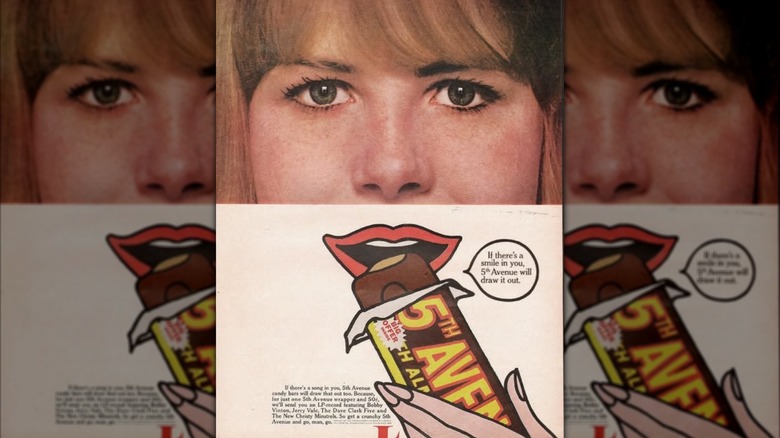
5th Avenue is a low-key GOAT candy bar for many (this writer possibly included). The melding of crunchy peanut butter filling offsets so beautifully with the decadent, yet not overbearing, chocolate coating that even those who aren't sweets-crazy can enjoy it. One might think, because of the name, 5th Avenue was a New York City invention. You'd be wrong.
It was Pennsylvania, in fact. And not only that, but the company that created it back in 1936 was none other than Luden's. Yes, that Luden's, of the famously mild cough drops that have probably assuaged very few actual coughs. Initially, the bar was topped with toasted almonds, which just sounds weird and was rightfully done away with in due time.
5th Avenue has been under the stewardship of Hershey since the chocolate giant bought Luden's in 1986, and is now just part of an expansive roster of corporate confections. In the hearts of its fans, however, 5th Avenue is far from under the radar.
Krackel - 1938
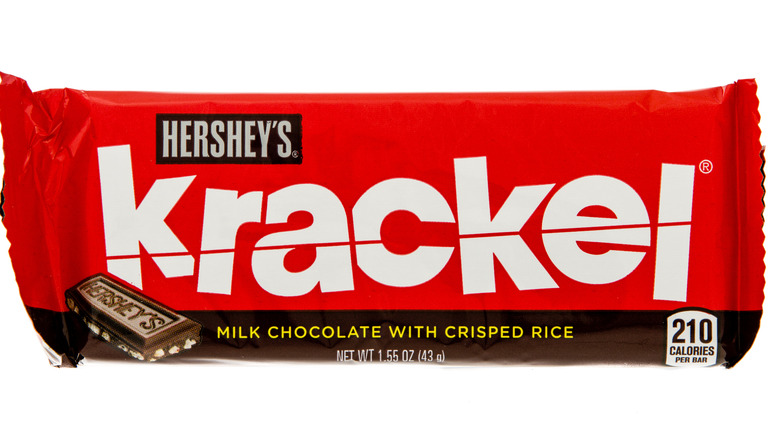
A Hershey's offering that's now most commonly seen as part of a standard grouping of miniaturized Halloween treats, Krackel first entered the game in 1938. Nowadays, it's only sold in shrunken, fun-size versions. But at one time, the milk chocolate and crisped rice confection was a full-sized bar. (That iteration was discontinued in 1997 before making a brief, temporary comeback in 2014.)
Not only that, the original Krackels included almonds as an ingredients, with peanuts being thrown in there in 1939 (the nuts were removed completely and for good only two years later). Along with Nestlé's Crunch bar, Krackel is credited with forerunning the crisped rice-milk chocolate combo that just works so well.
The two iconic candies were both introduced in 1938, with Krackel containing a higher proportion of chocolate than Crunch and, therefore, a bit less of a crisp. Personal preference is obviously the sole decider on which is the superior, but no one can deny the history behind each.