

What A Dozen Eggs Cost The Year You Were Born
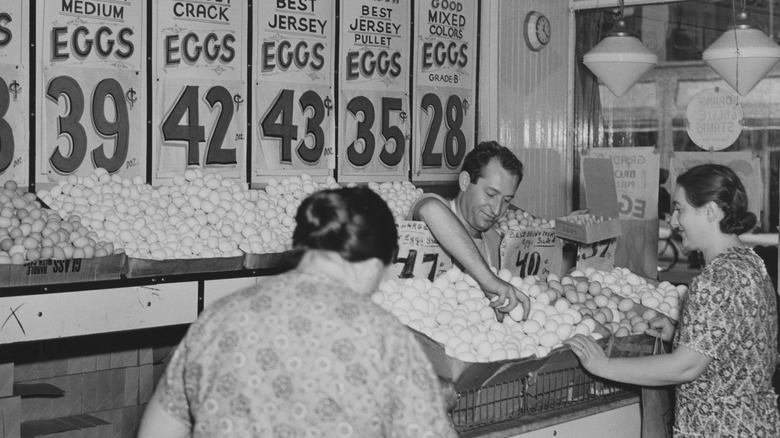
We're all still recovering from the dark days of "eggflation." When avian flu drove the price of eggs sky-high in 2025, the effects were felt in homes and kitchens everywhere. Even though the average price of a carton has returned to relative normality since then, that sharp spike showed just how reliant on eggs we are as a society. It's reassuring then — and perhaps quite surprising — that, when adjusted for inflation, eggs from past decades cost proportionately more than they do in 2026.
We found the average price of eggs per decade. Information from 1940 to 1979 was based on research done by the Chicago Tribune, and figures from 1980 to the 2010s were largely based on data provided by the United States Bureau of Labor Statistics (BLS). Though exact prices varied by region and BLS numbers tended to be a few cents higher than those from The Chicago Tribune, finding the mean price for each 10-year segment gives a succinct idea of what you were paying for a dozen eggs at any given point during the period. We then assigned that average to January of the middle year of each decade (1945, 1955, 1965, and so on) and converted it to 2026 dollars using the official BLS Consumer Price Index Inflation Calculator.
Thus, the following is what you were likely to pay for a carton had you been born within that decade (or, rather, what the grownups responsible for feeding you shelled out). It's not just an examination of raw numbers but an egg-shaped window into the past.
1940s
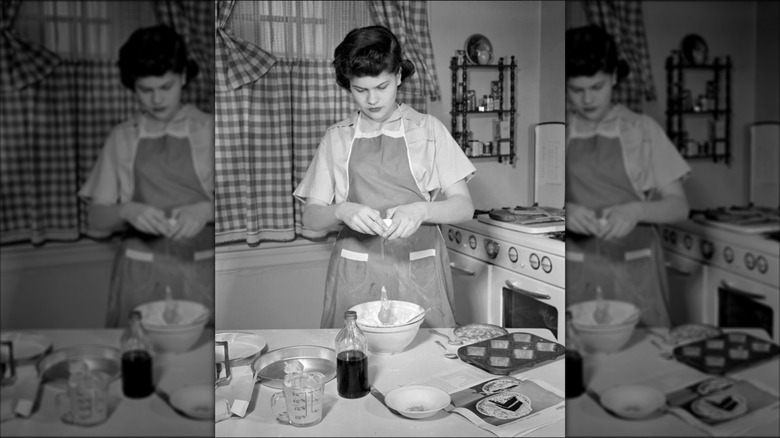
It's the decade that was defined by World War II, which affected all sectors of the economy and culture at large. This included eggs. Resource shortages and military needs saw the price of eggs swell throughout the decade (so much so that powdered eggs were introduced as a replacement, if you can really call them that).
A dozen eggs cost $0.27 on average in 1940. By 1949, the price had reached $0.57, peaking at $0.60 the year prior. Although the average going rate for a carton was $0.46 for the 1940s as a whole, buying them looked very different on either end of the decade. Yet, even that mean number, when adjusted for inflation, was costly to the consumer — to the tune of around $8.71 in 2026 dollars.
1950s
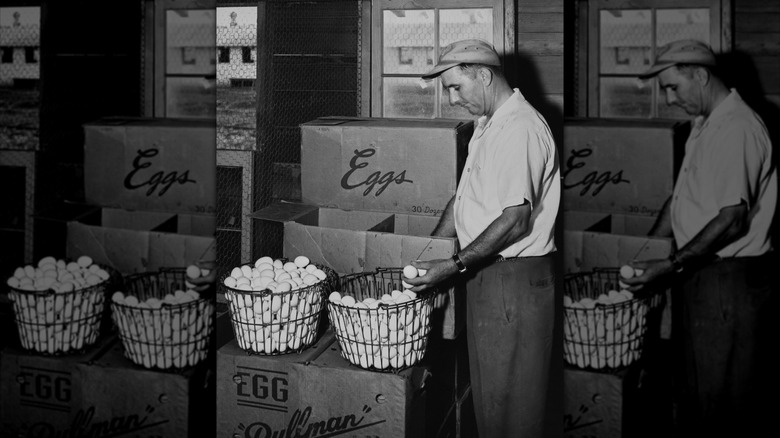
This was the decade that baby boomers were booming, TVs were brought into many homes for the first time, highways were being built, and eggs were a part of the blossoming American household. The average price of a dozen eggs throughout the 1950s was $0.51 (inflation adjustment: $6.44).
Unlike the turbulent '40s, however, egg prices remained steady throughout the steadying '50s — and even dropped by the end of the decade to only $0.44 in 1959. Again, that's much more than even eggflation prices were in 2025 when factoring in inflation but still a welcome reduction from the previous decade.
1960s
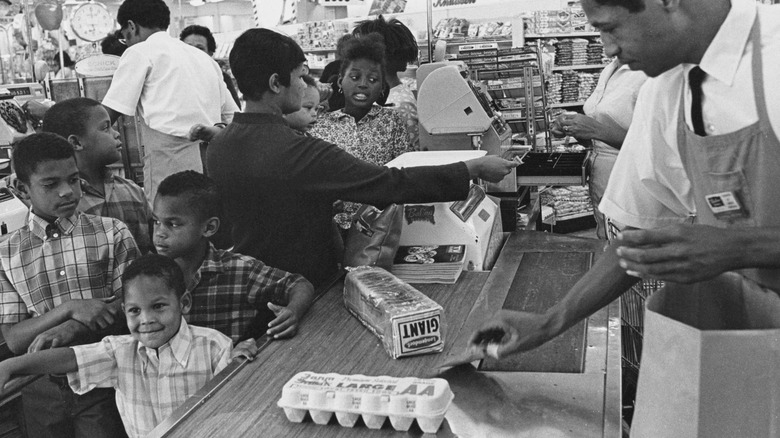
In the same decade that John Lennon sang, "I am the eggman," there was a continuing consistency to the price of an egg, man. Although the swingin' '60s was a wild rollercoaster ride, it was not reflected in the steadiness of egg retail (unless you were in a certain, ahem, '60s state-of-mind while grocery shopping, in which case nothing there would seem steady).
The average price of a dozen eggs in the 1960s was $0.46, with the price never reaching higher than $0.53 in any given year. In 2026 bucks, $0.46 equals $4.97. You can see costs are starting to get more recognizable to present-day us.
1970s
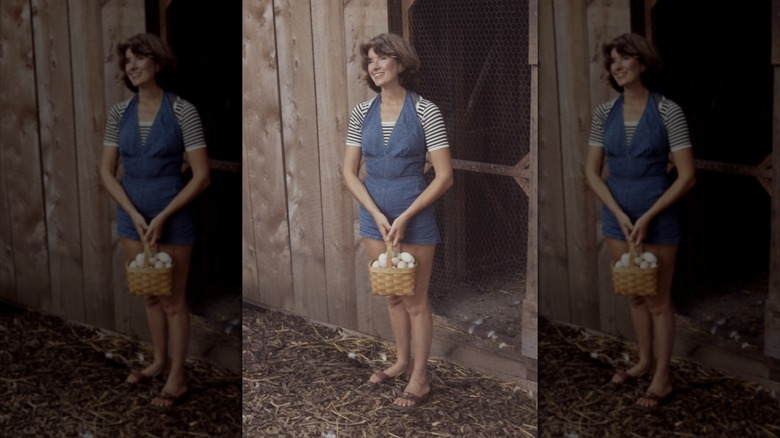
You knew things couldn't stay rosy for long in Eggville. As the 1970s lapsed, all kinds of cultural and economic turmoil would come to pass. "Stagflation" became a term to describe the brutal one-two of rising inflation and low employment (the unemployment rate was as high as 8.2% in 1975, according to Investopedia).
The price rise for goods included eggs, with a dozen going for $0.62 on average for the decade. In 1970, the average price was $0.53, so there was nearly a $0.20 increase over that 10-year span. The $0.62 average, by the way, equals approximately $4 in today's money. That's nothing to sneeze at for struggling consumers, especially when you had a bunch of stuff to buy for iconic '70s cookout dishes.
1980s
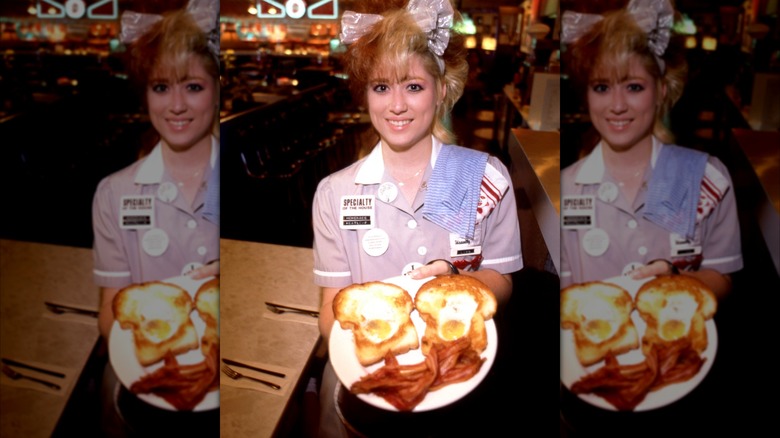
The decade of Reagan, greed, and big hair was also a decade of a substantial jump in egg cost but a big dip in relation to present-day money. With supermarkets playing Phil Collins and Roxette over their speakers, the '80s average price of a dozen worked out to $0.88 (per BLS).
Even when looking at the more conservative figures from the Chicago Tribune, that's still at least a $0.16 increase from the 1970s mean rate. What that looks like when adjusted for inflation, however, is only $2.81 in 2026 smackaroos. That's less expensive than many egg offerings in grocery stores nowadays (including Walmart's scandalously fake organic eggs).
1990s
The '90s not only saw the tech boom (and bygone fast food items that still live in our heads rent free), but it also saw the average price of a dozen eggs reach higher than $1 for the first time. When it all shook out, the average for the entire decade was roughly $0.97, but 1996's mean reached $1.11.
That's an inflation-adjusted rate for the decade of $2.17 – a pretty tolerable amount through our 2026 eyes. Interestingly, this would be the lowest adjusted rate in both the preceding and subsequent decades. In theory then, there was no better time in the past 80-plus years to buy eggs than the 1990s. Just another thing to fuel millennial nostalgia –- as if that was needed.
2000s
We entered the new millennium, and, since Y2K didn't quite bring the apocalypse some expected, eggs were still being bought and eaten as they always had. The noughties would see a progressive rise in the average price for a dozen, then a dip in the middle years to almost as low as 1996. The peak was nearly $2 in 2008, but there was another decrease in prices to see out the decade.
All told, the 10-year average here was $1.33 ($2.35 in 2026 dough), making it the biggest decade-to-decade jump so far, at about $0.36 higher than the '90s average. The inflation rate doesn't make it seem as stark through our lenses, as that cost difference would probably barely register with many grocery shoppers now.
2010s
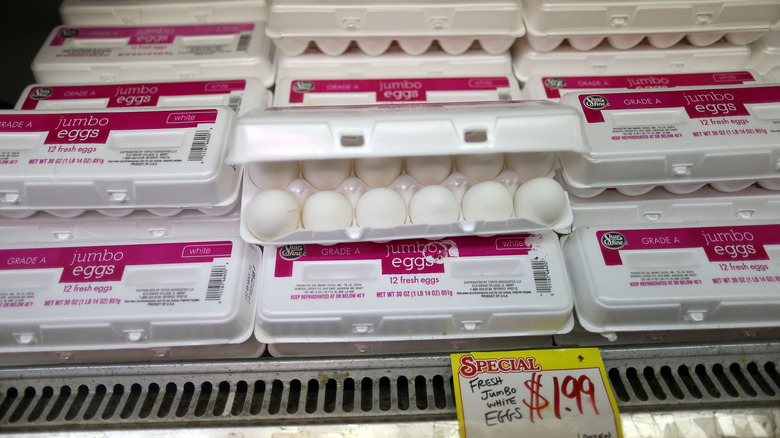
The teens would see a gradual rise in the price of eggs from year-to-year, with the average jumping about $0.45 from 2014 to 2015, where it reached $2.47, the highest contemporaneous rate so far. Thankfully, the price would drop pretty significantly the following year (a steep $0.79 decrease), and by the time 2019 came around, the price was down to $1.40 for that year.
In the end, the average cost of a dozen eggs for the 2010s was $1.80, and that's about the equivalent of $2.60 in 2026. There are plenty of myths you can stop believing about eggs, but another one is that the cost of a dozen is worse than it's ever been — considering inflation, it's not.