

Is There Really A Hidden Message In Oreo's Cookie Design?
There are few things more enticing to conspiracy theorists than hidden messages in everyday items. Some say that the pyramid on the one-dollar bill is an Illuminati symbol. Others will even tell you that PepsiCo foreshadows world events through Mountain Dew flavors. All those symbolological portents may make you want to enjoy some comforting milk and cookies, but bad news: According to certain people, Oreos contain hidden messages in its cookie design. Or should we say, certain wrong people, because there's no real truth to it.
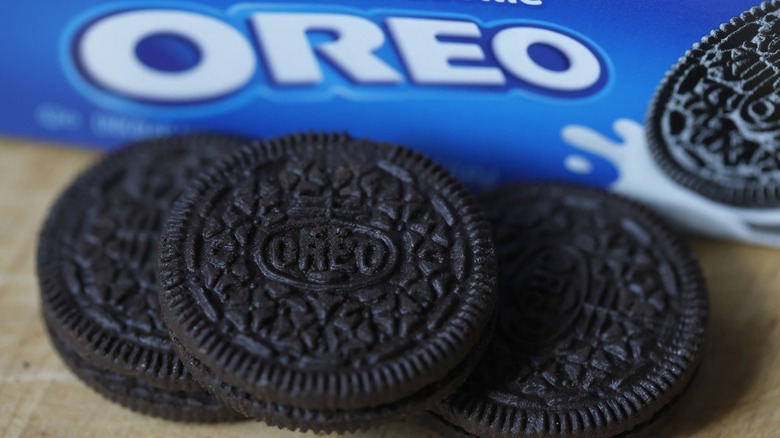
Maybe you haven't looked at an Oreo in a while, being too busy shoveling them into your mouth. (We don't judge, of course; we're in the same boat.) But it does have a curiously intricate design, doesn't it? Just look at those four-leaf flower pattern marking each wafer, or the curious cross-shaped symbol over the word "Oreo." Where did they come from? One theory holds that they're using imagery from the Freemasons, a fraternal order which is a magnet for conspiracy theories.
The cross symbol may be the Cross of Lorraine, used by the Knights Templar (to which the Freemasons have no connection, though a Masonic order does use the Templar name), and those flowers resemble the cross pattée pattern frequently used by the Freemasons. It goes even deeper than that, though, as one Reddit post posits. "The dots, flowers and dashes represent the 3 degrees of Ancient Craft Freemasonry. The arranging of the dots around the cookie were strategically placed to form the 5 Pointed Star; the symbol of the Order of the Eastern Star. All of these symbols are still used throughout the Masonic bodies, including the Eastern Star, Knights Templar and the Scottish Rite." Spooky!
No, there isn't a Masonic code in the Oreo design
Here's the part where all the different conspiracy theories about hidden messages get tripped up. Suppose that the guy who designed Oreos was a Freemason (he wasn't, but just go with it), and he put elements of esoteric Masonic design into a popular cookie. To what end? How does it further the Freemasons' nebulous agenda, and why would an allegedly all-powerful organization leave a little breadcrumb trail for us to find? (One recalls Nick Mullen's classic standup bit mocking 9/11 conspiracies. "There's only one step left: the clues!")
Answers range from suggesting that it makes eating an Oreo akin to an unholy communion (which is why we see so many Satanic rituals during snack time in fourth grade, we guess) to saying that the Freemasons hide in plain sight for mysterious reasons , which sounds suspiciously close to "for no reason." The truth is a lot more quotidian. William Turnier, who created the modern design for Oreos in 1952, was not a Freemason, and embedded no secret message. The little cross atop the Oreo symbol was used as a symbol of quality entirely separate from the Knights Templar; as for the four-petal flowers, he just thought they looked neat. Oreos are owned by Mondelez (which owns many other brands), not the Freemasons, and the worst thing done in its name remains those weird dill pickle-flavored Oreos.