

Consumer Reports Says These Are The White Rice Brands With The Least And Most Amounts Of Arsenic
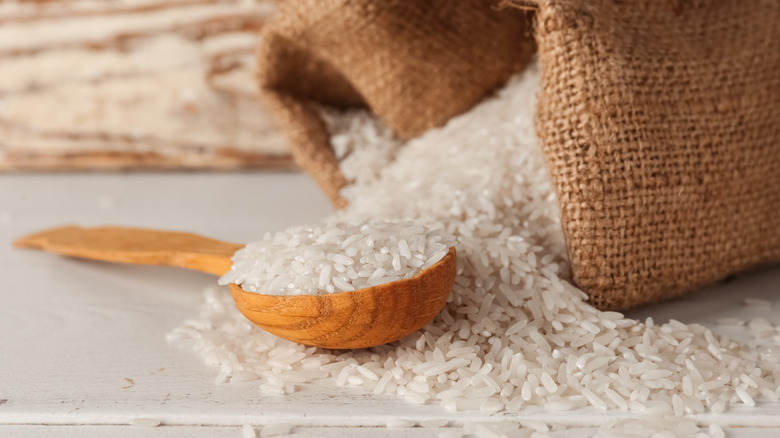
There are some foodstuffs that divide opinion regarding their health benefits. Are eggs good or bad for you? Is dark chocolate really a healthy snack? And so on. But there are some things on which scientists and nutritionists have a pretty firm consensus. Arsenic, for instance. You're not going to find many doctors recommend you boost your arsenic levels after a check-up. That's a shame because popular kinds of rice contain more arsenic than you'd hope (which is to say, any amount at all). Luckily, Consumer Reports did some work to find the brands of white rice with the most and the least amount of arsenic. It has good news for fans of Royal Basmati Rice, and bad news for those who buy Carolina Gold.
Of the 25 brands of white rice tested by the Consumer Reports team, the brand with the least amount of arsenic was Royal Basmati Rice, containing 32 parts per billion (ppb) of arsenic per ¼ cup serving. Silver and bronze go to Lundberg Organic Sushi White Rice (39 ppb) and Great Value Basmati Rice (44 ppb). Brands that contained the most arsenic were Carolina Gold Extra Long Grain Parboiled Rice (108 ppb) followed by Iberia Enriched Extra Long Grain Rice (101 ppb) and Good and Gather Enriched Long Grain White Rice (100 ppb). If you're wondering where the regulators are in all this, don't hold your breath. Although the FDA allows no more than 100 ppb of arsenic in infant rice cereal, there is no upper limit on the arsenic allowed in rice for general consumption.
Why is there arsenic in your rice, and what can you do about it?
So, why exactly is there arsenic in your rice? Is someone trying to poison us all very, very slowly? Well, no, it's nothing so dramatic. Generally speaking, arsenic is a naturally-occurring element found in water, rocks, and soil; all of which finds a way of filtering into the food we eat. But while this is true, most arsenic found in our food is a result of arsenic-based pesticides which were banned in the 1980s. Despite being out of use for decades, they have left behind a residue which continues to affect the food supply to this day. Rice is especially vulnerable to arsenic because it's often grown in water-logged paddies (much of our irrigation water contains arsenic) and its porous nature allows for greater absorption.
You're not liable to keel over from a mouthful of flavorful seasoned rice like some victim in an Agatha Christie novel, but longtime exposure to arsenic (even small amounts like the kind contained in rice) increases your risk for diabetes, cardiovascular disease, and cancer. Similar to the mercury levels found in tuna (this affordable brand has the lowest mercury levels), it's a matter of how much you eat and what brands you choose. If you'd rather proactively decrease your risk, you can eat a well-rounded variety of grains, like farro or polenta, to minimize the arsenic in your diet.