

If You've Been Breaking These 8 Chopstick Rules, We Need To Talk
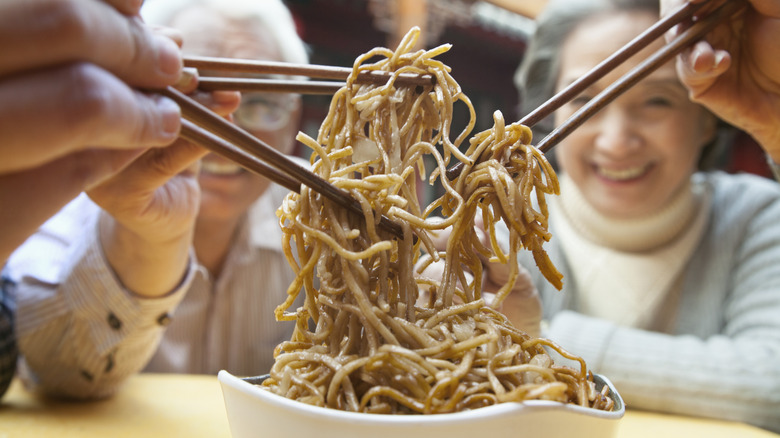
Over one-third of Earth's 8 billion-or-so inhabitants are thought to use chopsticks as their primary eating utensil. They've existed for roughly 5,000 years, since China's Late Neolithic Period — an era deep in time where much of the country's mythology is set. The thinking goes, as these ancient years lapsed, a growing population fighting for resources shrunk the size of food portions into smaller chunks, negating the need for cutlery to be developed and solidifying the chopsticks' place in the dining culture of East Asia forever.
As the chopsticks' journey brought them to the Korean peninsula and the Japanese islands, among other places near China, they were adapted to those respective cuisines (distinctions we still see today). Beginning in the 17th Century, cultural exchange between China and Western countries increased, and the very word "chopsticks" may have come out of improvised trade language that mashed up English, Cantonese, and Portuguese. The term first appeared in written English in 1699, with the Oxford English Dictionary and others claiming it derives from the pidgin phrase "chop-chop," meaning quick or hurried.
No matter the etymology, chopsticks have become a staple at tables the world over, sat around by people of many different ethnicities and backgrounds. Yet, not everyone knows how to properly use, handle, approach, or even respect them. The Takeout is here to help, using the extensive knowledge of a pair of experts: Rich Wang, chef of the acclaimed Taiwanese restaurant Minyoli in Chicago, and Ken Hosoki, Executive Chef of Blue Ribbon Sushi at Green Valley Ranch Resort & Spa in Nevada. After this, you'll be able to hit up the best Chinese restaurants in the U.S. full of food-handling confidence.
Thinking you need a Ph.D. to use them right
The last thing you probably want is for your brain to try and fit another piece of info in there. Just living life in this crazy world is enough to fill your cerebrum to capacity. You've probably even had to move out a few things just to function: How to divide fractions, what the capital of Lithuania is, the names of all the characters on "Full House," earth science. Now, here comes The Takeout, trying to squeeze the rules of chopsticks into your already taxed noodle.
Firstly, the capital of Lithuania is Vilnius. Secondly, learning how to use chopsticks in the right manner does not take any specialized brain work. "A common misconception is that they're difficult to learn," says Ken Hosoki. "Most people can become comfortable with them after just a few meals." Rich Wang reassures us as well, saying, "People tend to feel intimidated by the idea of learning how to use chopsticks because they think it requires the kind of dexterity/technique that is hard to acquire. But in fact, like any other utensil, it is just something to help people pick up foods."
There, feel better? If not, Wang adds that not even he was taught how to use chopsticks step-by-step. He picked it up naturally through observation and light guidance. "Think of it as a helpful tool. We run it; it doesn't run us." Invaluable advice for either a course-corrector or a novice (along with using wooden chopsticks to begin learning).
Sweating the technique
Whether it's shooting free throws, practicing yoga, doing the Argentine tango, or welding, the right form can mean the difference between effectiveness and severe burns (okay, the latter is just welding). Chopsticks, being a tool, demand technique. Technique demands effort, care, and practice. The good thing is that the degree of effort, care, and practice required for chopstick proficiency isn't impossibly challenging. Often, the case is that people bungling chopsticks first picked them up without either being shown, or ever bothering to ask about, the right technique.
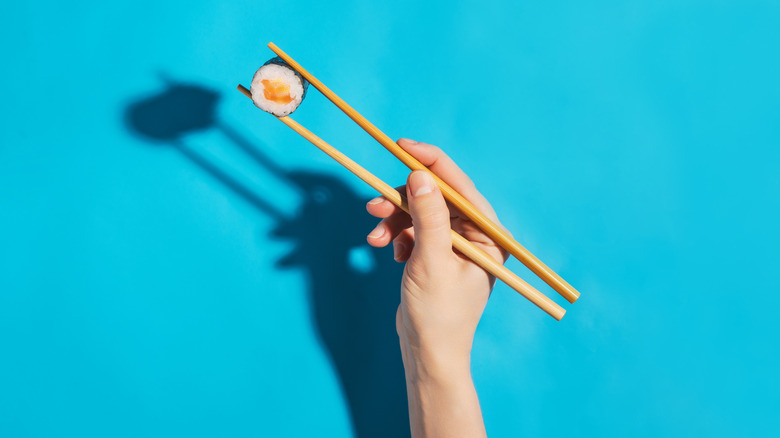
Don't worry, nobody is judging you as you learn the art of chopsticks. On the contrary, experts like Rich Wang are here to help. "The fundamental mechanics of using chopsticks involve resting the lower chopstick still on the ring finger tip and moving the higher chopstick with a combination of thumb, index finger, and middle finger," he explains.
Ken Hosoki confirms that steadying the lower chopstick is key, saying, "The basic technique is to keep the bottom chopstick still while moving only the top one. It may feel awkward at first, but with a little practice it becomes very natural." Hosoki also reminds us that it's more than a technical endeavor, especially in Japanese culture, where it's part of incorporating care and attention to the meal. A beautiful notion, and a far cry from the approach to, say, Buffalo wings.
Being all improper
Aside from basic technique, there's a whole list of "don'ts," not only about how you physically wield chopsticks, but also about the general respect shown to the time-tested and time-honored utensil. Some improper chopstick use is nuanced and requires a bit of a primer. For other no-no's, though, we'd like to think they would be obvious. But have you met humans?
Regarding the subtler improprieties, Ken Hosoki fills us in on a couple, saying, "Many people grip the chopsticks too tightly." Hosoki also points out, well, misusing the points. "Another common mistake is using them to stab food," he explains. "Chopsticks are meant to gently pick up food." Rich Wang offers another useful grip tip, that holding the chopsticks too low, "lower than the halfway point," makes it difficult to maintain leverage.
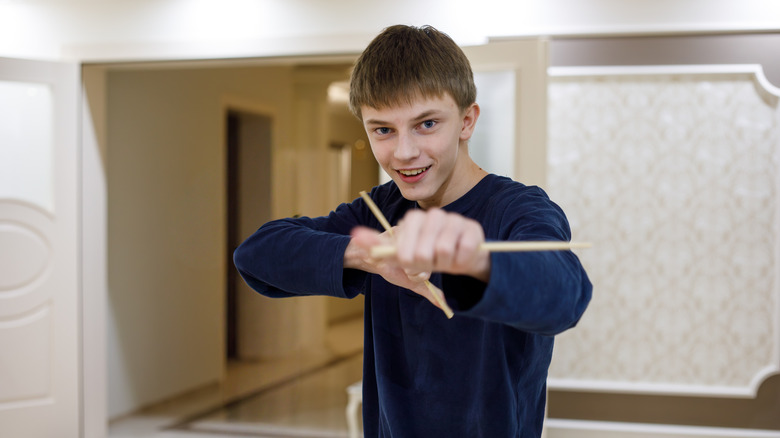
Wang also implores people to avoid more blatant blunders, such as mistaking them for a totally different utensil altogether. "It's also considered rude to use chopsticks as knives (holding them with two hands to cut things)." And even more blatantly blundering, Wang feels the need to point out, "is banging chopsticks on plates or bowls as if they were drumsticks." That's just obnoxious across any culture, especially from anyone who's older than eight or isn't Travis Barker. Although, even if you are Travis Barker, it's probably not welcome. Don't you have Blink-182 for that?
Selecting the wrong chopsticks for the cuisine
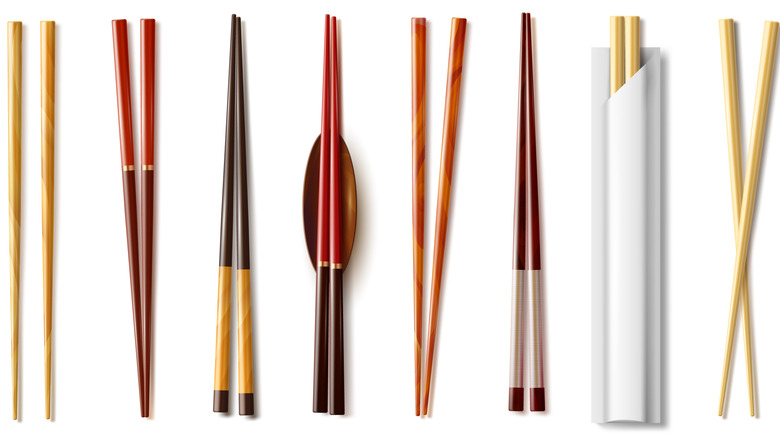
Would you use a snow shovel to eat cottage cheese? How about a straw for your steak? Okay, these might be over-the-top examples (or the impetus for some new TikTok challenges), but the point is you need the right equipment for the food at hand. Chopsticks have been adapted to the cuisine of the cultures they come from, and the key to using the right chopsticks for the right dishes is knowing what those differences are.
Richard Wang illustrates for us. "Chinese chopsticks are the longest with a less tapered blunt end. This is because traditionally Chinese people enjoy meals family-style around large tables. Longer chopsticks allow adequate reach to dishes situated farther from your seat." He also explains that the blunt end offers a firmer grip to slippery, oily foods in a stir-fry wok. Ken Hosoki tells us that "Japanese chopsticks are usually shorter with pointed tips, which makes them perfect for delicate foods like sushi and fish." Wang also points out a reason Japanese chopsticks are short is because meals are often served individually — no need for reaching across your fellow diners.
Wang also goes on to talk about the chopsticks used by China's abutting neighbor. "Korean cuisine traditionally includes many pickled foods and soupy dishes," he says. "Therefore Korean chopsticks have developed to have a rectangular profile near the tip." That flat edge makes it easier to pick up submerged ingredients and wet, brined foods (unless your kimchi is just topping your hot dog). Another thing Wang adds is that "Korean chopsticks also tend to be made with stainless steel, which is more durable when routinely used to eat food with high acid."
Not using chopsticks for messy junk food
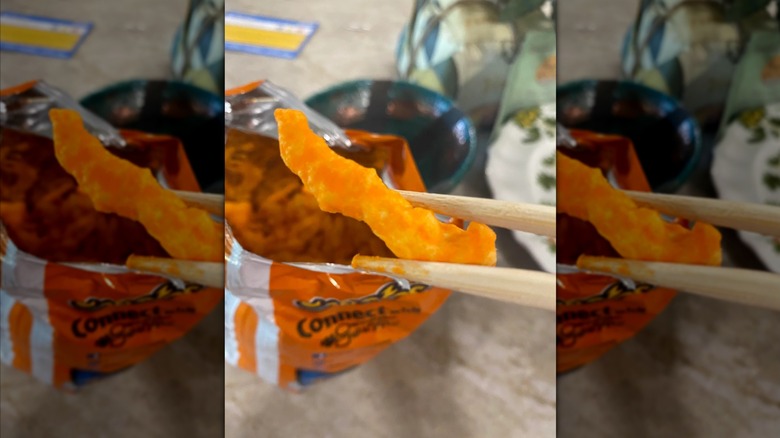
"Chopsticks are like an extension of fingers; you are able to pick up a wider range of foods with more precision." What does this preface from Richard Wang lead to him saying? "It's easier to avoid Cheetos fingers with a pair of chopsticks than with forks." Yes! A real-deal culinary pro just gave everyone permission to use chopsticks for messy, skin-staining junk foods (Frito-Lay even has an official name for this discoloring, orange Cheetos dust). The ivory tower has officially been toppled. Revolution fills the streets.
Granted, tons of people have already been using chopsticks for exactly this purpose and broadcasting it on social media. But now they have received a blessing. The heretofore hesitation from others was understandable — there is cultural meaning attached to chopsticks, and no empathetic person wants to sully such a thing with Dorito powder. However, snacking while laid up on the couch is not the same as sharing a sit-down meal in mixed company.
Not only do you negate a flesh-mess by using chopsticks with junk food, but you may also find yourself finding a kind of snack nirvana. Ken Hosoki boils chopsticks down to their essence by reminding us that they "encourage smaller, more mindful bites, which allows you to better appreciate the flavors, textures, and presentation." This can apply to sashimi as much as it can apply to Takis.
Sticking chopsticks in food between bites
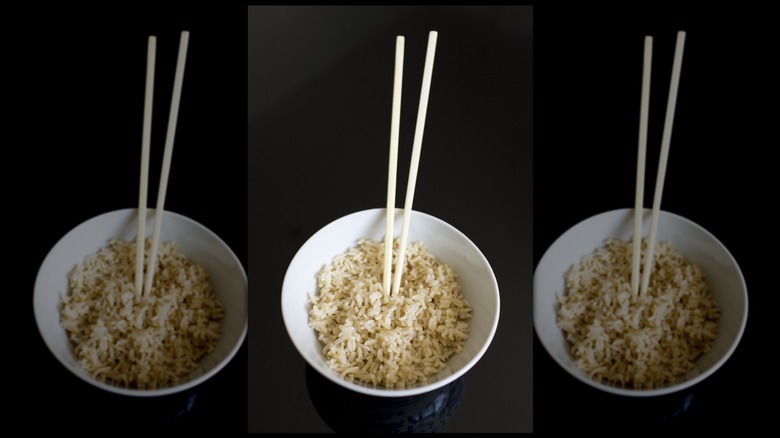
From cultural sidestepping to cultural veneration we go, and this may require a bit of muscle memory for those with, say, a more Western upbringing. Because, let's be honest, planting sticks upright into anything is kind of a primal human instinct. It's the same impulse that drove us to plant flags and build fortifications (and Stonehenge). However, staking your chopsticks into your food between bites is something of a taboo, and it should be avoided at all costs.
"You should never stick chopsticks upright into a bowl of rice," Ken Hosoki plainly states. Rich Wang corroborates this important notion, and goes deeper into the why. "I can't really speak to other Asian cultures, but for Taiwanese and Chinese households, it is impolite to stick your chopsticks into your bowl of food (instead of resting them on the table, plate, or chopstick holder like you're supposed to)," he explains, "because sticking chopsticks in a bowl of rice is a funeral rite reserved for worshipping ancestors only."
There you have it then. Even if you don't have direct attachment to such cultures, think about something about your background that could be insulted, either by maliciousness or ignorance. Even if it's a seemingly small thing to outsiders. It doesn't take much to keep that in mind when dining with chopsticks. After all, why bring either guilt or antagonism into an awesome meal?
Passing food from chopsticks to chopsticks
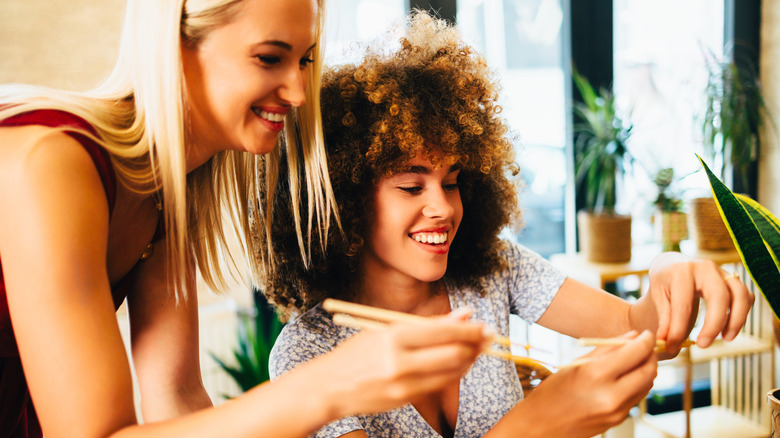
Here's another faux pas that has been deemed so by none other than Confucius himself. Yes, that Confucius. And although it may seem an innocent, even communal move to the naive chopstick wielder, it holds a tremendous amount of symbolism. Richard Wang warns us that passing food from chopsticks to chopsticks — rather than from chopsticks to a plate — "is a big no-no in Confucius cultures." Why? "Because using chopsticks in this manner [resembles] using them as weapons," such as fighting sticks.
Ken Hosoki is equally on board with this rule, but for a different reason. He enlightens us that passing food from one person's chopsticks to another (like with sticking chopsticks into a bowl of rice) is associated with funeral customs. Perhaps, if you're out with friends enjoying a sushi boat, you can even forego the chopsticks altogether and just use your hands to avoid such cultural affronts (although not with sashimi — no hands allowed there).
However, if chopsticks are in your grip and you want to pass somebody some food, just use the chopsticks to place it right on their dish. Besides, isn't trying to pass something cleanly from chopstick to chopstick just an incredibly difficult task on its own, independent of cultural meaning? Imagine trying to pass a cue ball to someone using pool cues. Damn near impossible (if perhaps another good TikTok challenge).
Sifting through shared plates
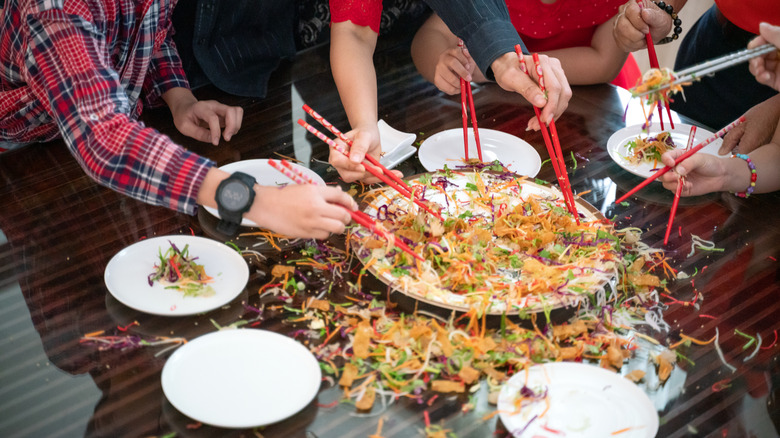
Here is another no-go in a setting that can seem like a minefield of potential chopstick mistakes: Family-style dinners. Many of these rules outlined happen to apply to shared dining situations, where it may feel like any wrong move is offending the ancient spirits of the Far East. No need to get so dramatic. It's just about avoiding bad manners.
Another addition to that bad-manner roster, according to Rich Wang, is "using chopsticks to stir shared plates in order to pick out what you like." This can seem like a difficult move to lay off of, depending on what you're eating — especially for dishes with numerous components, like hot pot.
Let's be real, though, whatever you're pulling out of a plate with your chopsticks is probably going to be good. Why the need to scour in the first place? "Oh, man, I wanted that noodle instead of this noodle," said no reasonable person, ever. All in all, this bit of guidance fits in with the rest of the article's spirit, and corresponds with the overriding ethos of the chopsticks: Be calm, be patient, be mindful, and above all, enjoy the food in front of you.