

How To Stop Yourself From Over-Mashing Your Mashed Potatoes
We may receive a commission on purchases made from links.
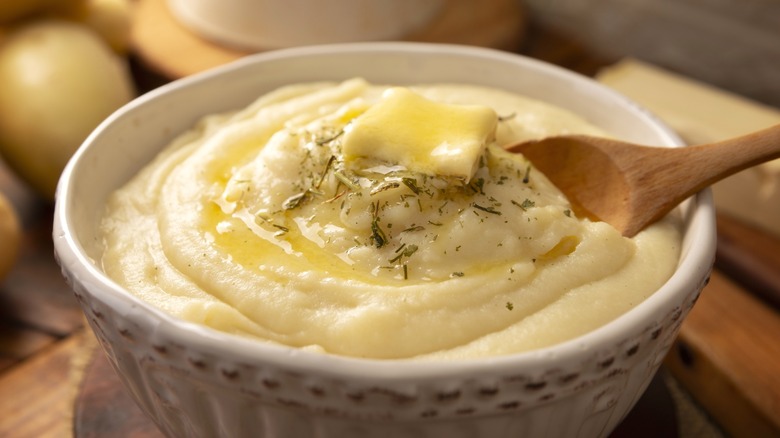
Mashed potatoes can be a hit-or-miss dish depending on texture. When they're fluffy and creamy, it's gourmet ecstasy. Yet all the butter and cream in the world can't save them if they're gummy. There's no joy in that tacky, glue-like mouthfeel, and even if they're edible you're probably only choking them down in a last-ditch effort to avoid admitting you over-mashed them. Luckily there is a surefire trick to ensure your mashed potatoes are smooth as silk every time.
Henry Johnson, the chef de cuisine at Palladino's Steak & Seafood in Dallas, had a recommendation for folks who want to prevent their mashed potatoes from becoming a gluey mess. "Use a ricer," he said. "It gently pushes the potatoes through tiny holes, therefore reducing the amount of friction or pressure as to not aggressively release the starch from the potatoes."
Because kitchen tools are always overpriced at grocery stores, it's best to purchase a potato ricer online or from a dedicated culinary outlet. The advantage of using one to hinder that excess starch from ruining your favorite comfort food is well worth the modest cost, but your work isn't done once the spuds have run through the utensil. Johnson had another tip to share that, on top of using a ricer, guarantees you'll be enjoying fluffy mashed potatoes from here on out. He said, "Instead of mixing cold butter and milk into the potatoes while mashing, warm your butter and cream first and gently fold them in using a spatula."
How over-mashing wrecks mashed potatoes
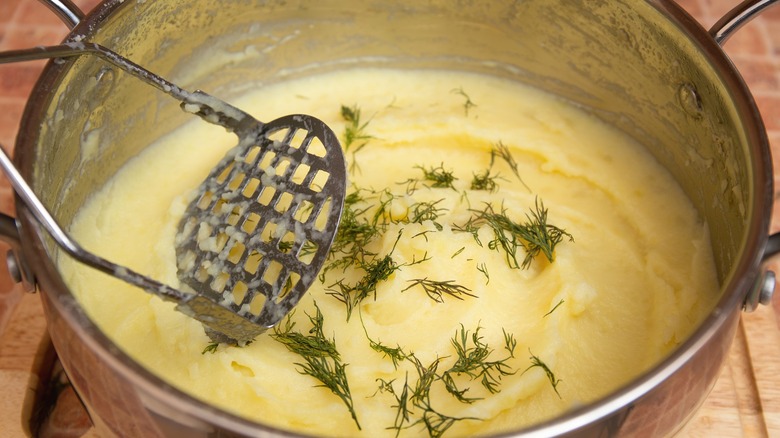
Even using the best type of spuds for fluffy mashed potatoes won't prevent them from becoming a sticky nuisance if they're over-mashed, and it all has to do with the starch. Johnson broke down how starch is transformed when potatoes are cooked and why being heavy-handed with them makes them aggravatingly gluey. "During the cooking process of the potatoes, the starch cells are expanding and absorbing," he said. "When you start the 'mashing' process, that is when the starch cells become activated."
That's why a delicate hand (and preferably a ricer) are crucial if you prefer a silky outcome. "If you are too aggressive in your mashing, then the starches will 'explode' so to speak and turn your taters to glue," Johnson said. "Slow and steady/gentle is the key here." Johnson noted that it can be easy for some folks to assume that mashed potatoes are done when they achieve a smooth consistency, but that smooth appearance doesn't disqualify them from being gluey. Aiming for smooth mashed potatoes without taking into account how the starch in the spuds is affected by over-mashing is a recipe for failure.
It's best to take your time and make sure you're treating the potatoes with the same care you would a show-stopping protein, because if you wreck the texture, that's all she wrote. "Once you over-mash/work your potatoes and they become gluey, you are at the point of no return," Johnson said. "Try using them for crafting projects where you need strong adhesive."