

How The Real Life Pioneers Cooked And Ate On The Oregon Trail
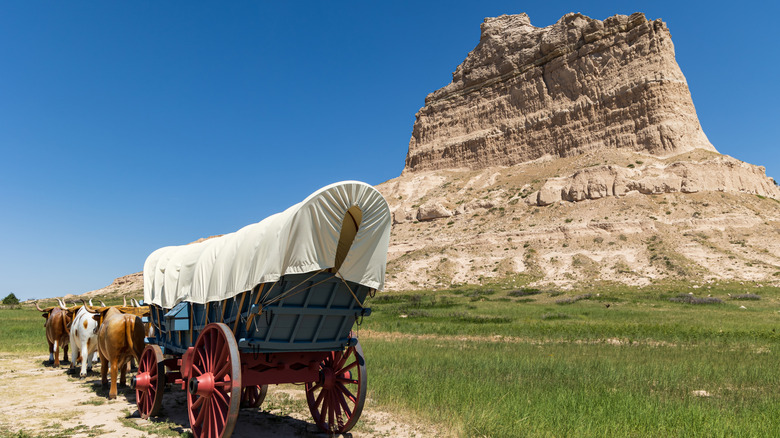
Existing for a few decades on either side of The Civil War, the Oregon Trail saw many thousands of people — some estimates say over 600,000 — make their way west in search of betterment, opportunity, freedom, and refuge. It spanned around 2,000 miles, starting in Independence, Missouri, and terminating in Oregon City, Oregon, winding through what today is Kansas, Nebraska, Wyoming, and Idaho.
Along with helping to create the American mythos of the pioneer, the Oregon Trail has also become a byword for long, attritional journeys. There were many dangers and afflictions experienced by those who grabbed everyone they loved, everything they had, and traversed the still-untamed West. How did they survive? Specifically, what did they survive on?
These are the foods of these frontiers-folk, and how they ate, preserved, and protected them. We spoke to Dr. Elizabeth White Nelson, associate professor of history at University of Nevada, Las Vegas, as well as author and historian Allen J. Wiener, to get deeper insights into the eating habits of these 19th-century people on the move. Going on an arduous odyssey like they did would seem unimaginable to most of us today. How did they sustain themselves along the way?
1. Flour, cornmeal, and pork
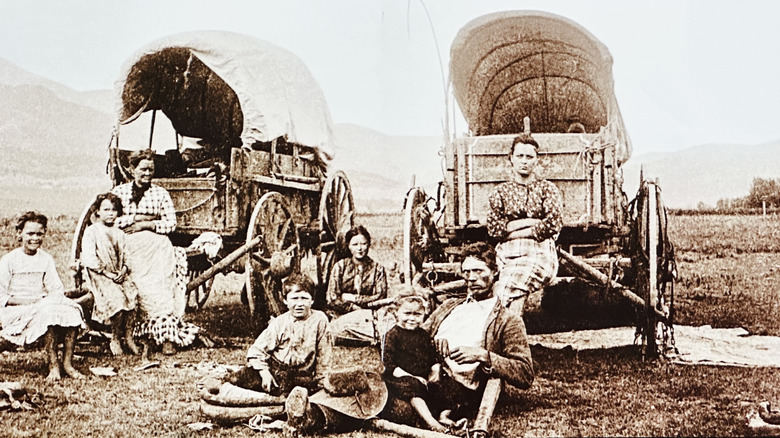
The first visual that usually comes to mind when the Oregon Trail is mentioned are the covered wagons. But these weren't the large Conestoga wagons you sometimes see portrayed in pioneer-era recreations and dramatizations. These were prairie schooners, not much bigger than a lot of vehicles on the road today. "It is important to remember that a covered wagon was approximately the size of a minivan or midsized SUV, so space was very limited" said Elizabeth White Nelson.
Aside from food, the wagons were loaded up with everything the party needed for eventual life on the homestead, such as farming supplies, bedding, and perhaps furniture. ("Although this often proved too heavy for the oxen to drag," caveated Nelson.) What space they did have for comestibles included, on a very basic level, barrels of flour (up to 200 pounds), cornmeal, and bacon that was very salted and extremely smoked, according to Allen J. Wiener.
Butter churns were also common equipment, especially for travelers who had their own livestock. "Cows produced milk that was placed in a churn attached to the wagon," Wiener claimed. "The rocking motion of the wagon gradually turned the milk into butter." Travelers and families with more means would also be looking at rice, pepper, sugar, salt, tea, vinegar, dried fruits, and dried beans. And let's not forget, as Wiener put it, "the all-important coffee."
2. Food was smoked, dried, and (along with one famous corpse) pickled
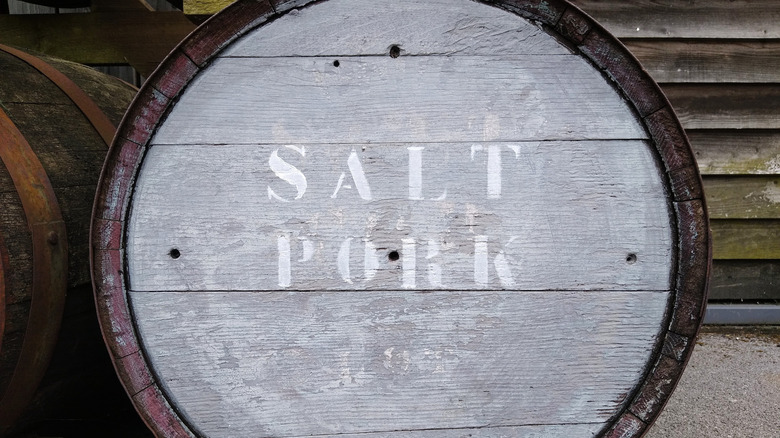
Preservation of food was a constant challenge, especially when it came to meat. Excess meat that was hunted en route, whatever it might be, would have to be salted and smoked to keep it from going bad — "but it did not last forever, and some was discarded when it spoiled," according to Allen J. Wiener.
Drying was a method that was also used for meat preservation. As Elizabeth White Nelson illustrated: "European Americans had adopted meat-drying methods from Indigenous people, so some families might have had beef jerky, or salt cod. It would have been used to flavor stews, not used for snacking." Then, there was the brining approach. Pickling is something that anyone can do at home these days, but it was a bit more challenging for life on a 19th century wagon (especially during a pre-Mason jar era). "Pickling would have been done in a crock, so probably used less than salting and drying because it would have been heavy and messy to transport," said Nelson.
There's also the incredible story of a pioneer himself being pickled. When a young man named Willie Keil died of malaria prior to his family taking off on their Oregon Trail journey, his father kept his body in a coffin filled with whiskey and placed him at the head of the wagon train, fulfilling the promise to let his son lead the cross-country caravan.
3. Bacon was a welcome staple
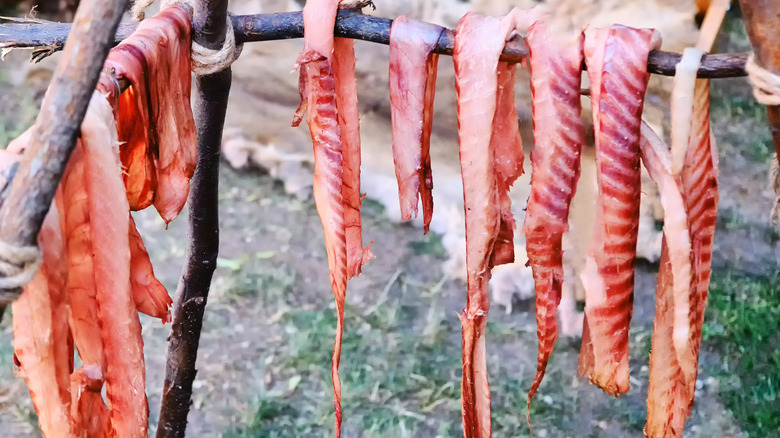
Most folks on the Oregon Trail started off the trip armed with lots of bacon – a food that we still don't get tired of. They would carry as much as 80 pounds of the succulent pork belly. "Smoked and salted bacon was a particular favorite, and the overlanders ate it several times a day," according to Allen J. Wiener. And they had to, because even this preserved meat would spoil after awhile, forcing it to be eighty-sixed onto the roadside.
Bacon was even combined with its age-old friend eggs, creating a cozy breakfast that might allow you to briefly forget you were in the middle of the Oregon Trail. Families also traveled with chickens, which provided fresh eggs or poultry, according to Wiener.
The fat from the bacon was also important for greasing pans and frying bread, Wiener explained. Elizabeth White Nelson affirmed this notion as well: "Fritters or biscuits might have been possible, but these required fat, probably rendered from the salt pork."
4. Dutch ovens were the standard cookware
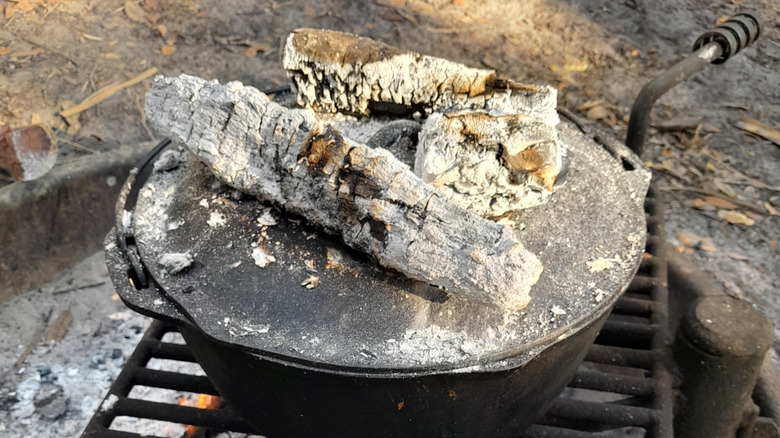
Nowadays, a Dutch oven is seen as a versatile piece of cooking equipment. On the Oregon Trail, though, it was an essential. "Given that all meals had to be cooked over an open camp fire," Elizabeth White Nelson said, "most food would have been cooked in a large Dutch oven that would sit on a spider" — a spider being a three-legged, cast-iron platform that leaves space for coals to be piled under the pot. It was also possible to bake bread in the Dutch oven, but Nelson thinks it was rarely used for that.
Before the Dutch oven could even heat up the meal, however, the flames would have to get going, which started first thing in the morning, according to Allen J. Wiener. Nelson added that they would have reused the coals from the prior evening's blaze: "Because the fire would burn all night, it could be raked up in the morning to heat up a morning meal." This would also be a method for hastening up the fire prep for dinner, if they saved some of those leftover coals for later in the evening.
When it got to points on the journey where wood was scarce, a certain animal would have to be relied upon. Or rather, its leavings. Buffalo chips, aka buffalo excrement dried in the sun, was a vital source for creating fires in the tree-less lands of the frontier.
5. Stews were the order of the day
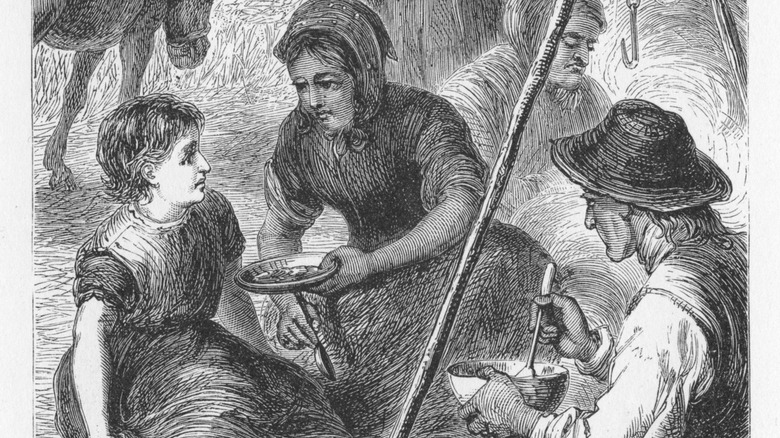
The result of this heavy reliance on a Dutch oven: Stew was often on the menu — made with "meat that was killed along the way, foraged greens, perhaps, and maybe some cornmeal to thicken it," according to Elizabeth White Nelson. These probably weren't up to par with Martha Stewart's beef stew, but they kept people alive and would probably be pretty tasty and nourishing in the context of the rough travel.
As far as the meat that was included in the stew, this would have been any kind of game they could get their hands on, including everything from deer ("especially in a large group," said Nelson) to squirrels. There were also some goodies to dunk in the stew, which included biscuits and fritters — patties they would fry in a skillet (the other staple cookware along with the Dutch oven). These patties were referred to as Johnnycakes. They were typically a mix of cornmeal, salt, butter, and molasses, which was made into a dough when boiling water was added and formed into flattened portions.
6. The many Germans took along their sauerkraut
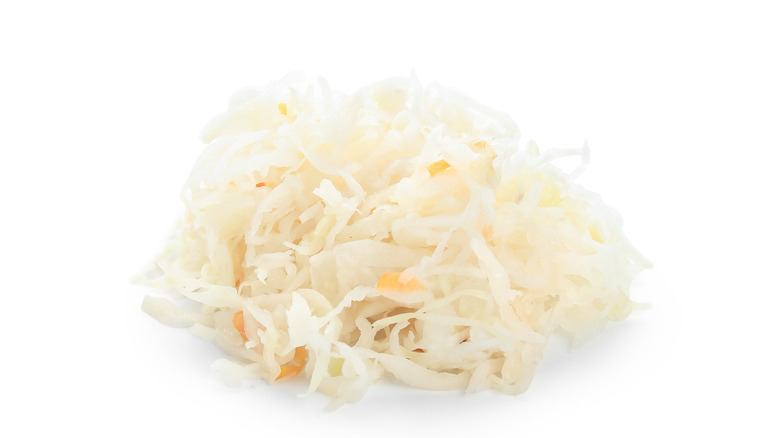
According to Elizabeth White Nelson, German pioneers would have dealt with hauling pickled items on the Oregon Trail, since sauerkraut was a staple. Germans made up a sizable portion of, not only settlers traversing the trail, but immigrants in America throughout the 19th century.
Many fled the Franco-Prussian war in Europe to follow the promise of the Homestead Act, passed in 1862. It stated that adults of any ethnicity could claim 160 acres of free land as long as they stayed on-site and made the requisite upgrades. Eventually this would include a substantial subset known as Volga Germans — Deutschlanders who once settled by the Volga River in Russia.
Of course, no matter the German, they brought their beloved sauerkraut with them, a dish adopted in the 1200s from the fermented cabbage that Mongolian peoples had created over a thousand years prior. (Funny to think ancient Mongolians were indirectly responsible for the Reuben sandwich.)
7. The beverage selection wouldn't blow you away
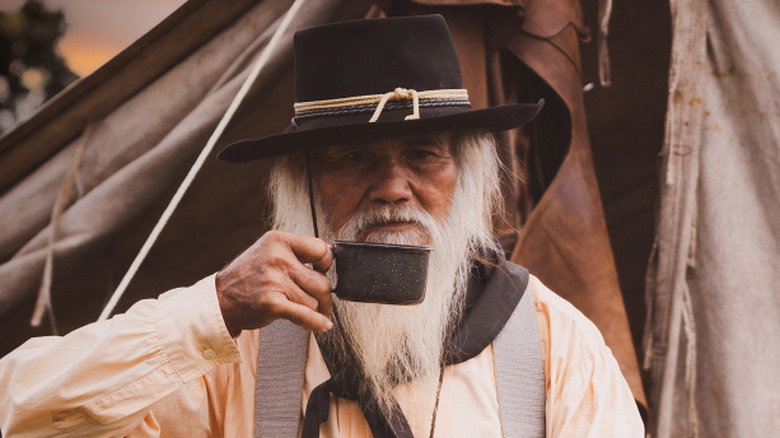
Folks on the Oregon trail had to wash all that cornmeal and squirrel down with something. Unfortunately the beverage selection was not as extensive as the food menu. Water would have been one of the subsisting liquids, of course, but even this was wrought with issues. As Allen J. Wiener explains: "While they might bring some water in barrels, it was not expected to remain fresh for long; thus, an average day's travel would include a search for fresh water." The fact that the trail ran along rivers aided in this search.
There was a catch: "But these rivers might run dry or run so low that the water gathered there was filled with dirt that had to be filtered out, and rarely could all of it be removed." This meant folks were forced to drink their water or coffee with a complement of soil. Speaking of coffee, it was very much a go-to drink. But it wasn't like they could just open a package of 365 from Whole Foods and make a pour-over. Wiener explained they had to fry and grind green coffee beans before they could even boil them into imbibable coffee.
As for booze, even this was rarely used to bring a buzzy relief at the end of a hard day. Alcohol was saved for a different kind of relief. "Spirits such as whiskey or brandy were largely kept as medical supplies," according to Wiener. In other words, very few fancy espresso martinis were being served.
8. Hunters did not pick on someone their own size
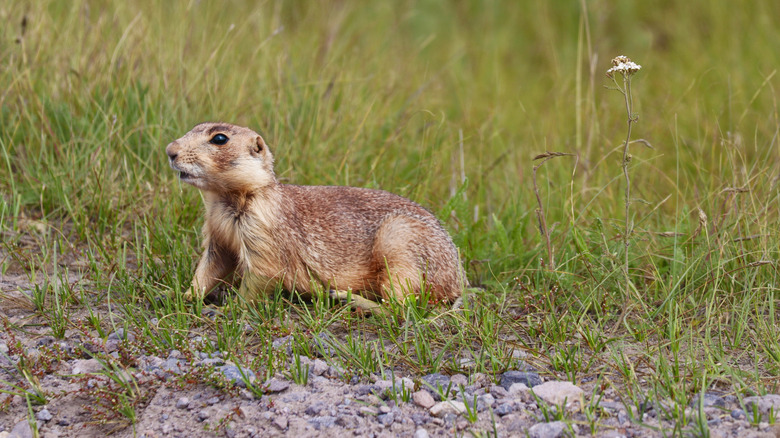
Hunting wildlife was a major source of sustenance for overlanders crossing the Oregon Trail. They really couldn't afford to be selective either. "Travelers hunted any animals they came across and had a particular taste for antelope meat," according to Allen J. Wiener, who added that bison, prairie dogs, and snakes were also common.
Elizabeth White Nelson counters this a bit: "While there probably was some hunting of larger animals [...] there really wasn't any good way to preserve the meat from a large animal for more than a day or two, especially in hot weather." This made the likes of rabbits, squirrels, and opossums a more likely protein source, being that they could be snatched up and eaten within a day.
And the little critters certainly became a target, doubly so because travelers didn't have to waste ammo on them. "These animals would have been caught in traps which also conserved bullets — a limited commodity," said Nelson. Aside from the aforementioned animals, the more diminutive prey included prairie dogs, wild hens, and snakes, according to Wiener (long predating the snake pizza from Hong Kong Pizza Huts). Wiener also noted that, "despite the rivers' frequent proximity, fishing was apparently rare."
9. Foraging was important (and unfortunate for the city slickers)
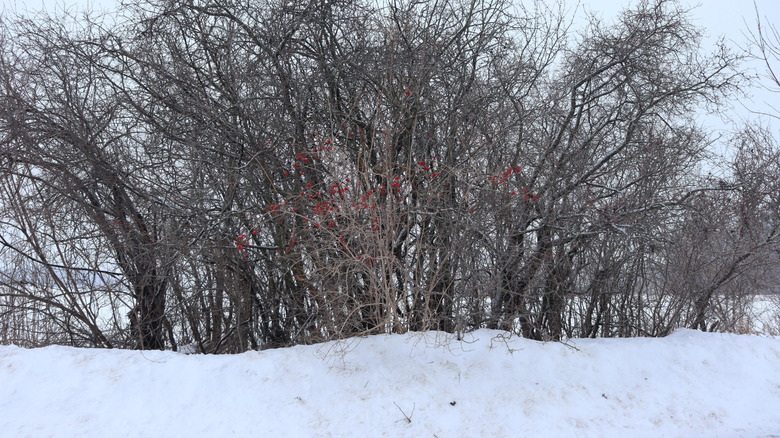
The counterpart to hunting was foraging, which was an equally vital source for precious nutrition. This especially favored the trekkers who were from a more agrarian background. "Rural people (not all pioneers were rural people) would have had considerable foraging skills and been able to collect edible plants and berries," clarified Elizabeth White Nelson, although she does admit, even the earthier folk would have come across unfamiliar species that would've thrown their search.
Foraged fruit and vegetation was both eaten fresh and dried for preservation, including raspberries, blackberries, wild carrot, and purslane, an herb. These could augment the stock travelers would have often started out with, according to Allen J. Wiener. "Fresh fruits, such as apples, peaches, and raisins, and vegetables, including beans and peas, were dried before the journey began."
Hopefully, the city folk that were dropping their cosmopolitan life for an uncertain frontier one loaded up plenty on those items. When it came to foraging, as maintained by Nelson, "pioneers who came from urban settings had a lot to learn."
10. Pioneers managed three squares a day (or settled for hardtack)
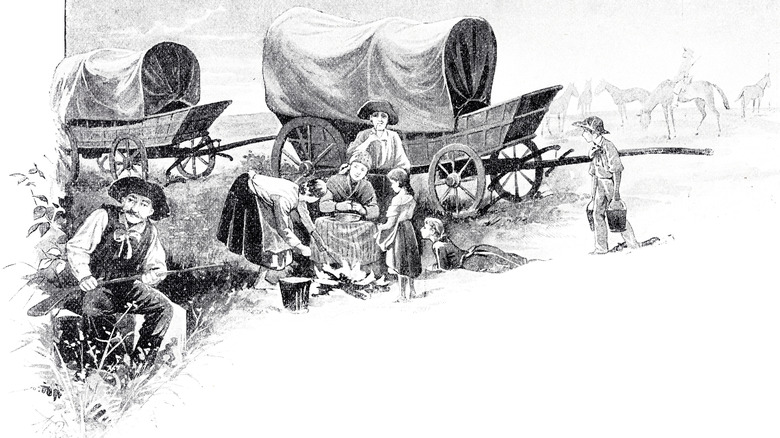
Despite the trying conditions, it seems pioneers did stick to the three-meals-a-day routine. Aside from the steady presence of bacon we mentioned, Allen J. Wiener said, "breakfast might include cornmeal mush, a hot cereal made by boiling cornmeal with water and salt; fresh-baked bread; biscuits; Johnnycakes; or perhaps a bowl of rice."
They also used the remaining breakfast for a more expedient second meal, which Wiener described as a quick lunch stop that included those leftovers — along with perhaps cold beans, bread, rice, or dried beef. He also thinks that dinner didn't seem to vary much from the first two repasts of the day. "The wagons halted by early evening, and dinner was pretty much the same as breakfast and lunch, plus any fresh game or berries that might have been killed or gathered along the way." But there was room for a bit of flair, despite everything. If they got creative enough, things like pudding, pies, dumplings filled with wild berries, and gingerbread could be on the menu.
The big letdown was when inclement weather interfered with cooking. This meant the travelers had to settle for eating hardtack — which is about as appetizing as it sounds. Probably the least-desired food on the trail, Wiener described hardtack as "A very hard cracker or cake made with flour, water, and salt, then cut into biscuits and baked." Hardtack could last for years but it was a challenge to chew and eat.
11. Hazards. Oh, the hazards.
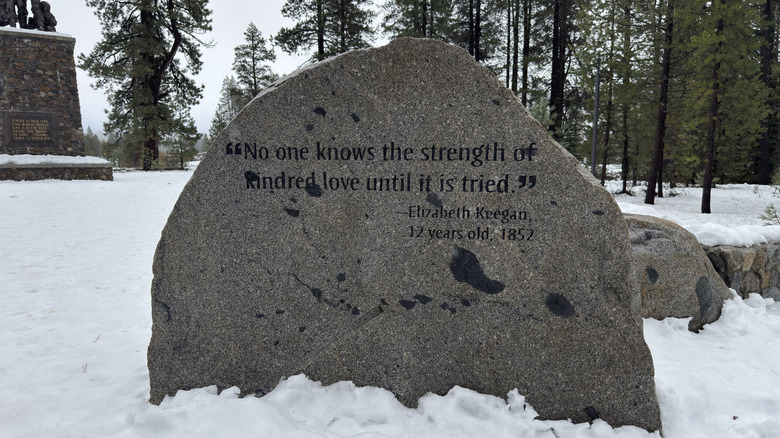
What would the Oregon Trail be without its problems and pitfalls. The benefit of time allows us to talk about this kind of stuff more breezily, but in those moments on that toilsome path, the threats were all too real — to both human and food. "Disease was the single greatest threat faced by travelers," said Allen J. Wiener, which included often fatal bouts of dysentery and cholera.
Food stores were also under threat from numerous angles. First, you had the weather, including, according to Wiener, "severe storms with torrential rain and hail, lightning, and high winds, any of which could damage food, supplies, and wagons." Elizabeth White Nelson confirmed this tumult, noting that flour was especially at risk of spoilage in damp conditions. She also noted another fun possibility: that broken axles or other damage would force the abandonment of a wagon. This downturn of events would mean a limited number of supplies could be salvaged for the remaining journey.
Oh, and did we mention beetles with a ravenous appetite for anything starchy? "There was always the danger of weevils," said Nelson. As for non-insect attacks, like, say, from humans, that was, unfortunately and unsurprisingly, also a worry. "Most crime occurred among the travelers themselves, often involving theft," said Wiener. While Nelson added, "The fear of attacks from the Indigenous tribes was real and could result in the destruction of or loss of food stores." Although Wiener does remind that the vast majority of dealings with Native American peoples were peaceful in nature.
12. St. Louis and Salt Lake City were some of the provision stops
Although there were long periods of remoteness and isolation on the Oregon Trail, travelers weren't always alone. As more people came out West, settlements large and small cropped up. "By the 1850s, and particularly after the 1849 gold rush, trading posts did open along the Trail," said Allen J. Wiener, "along with forts where overlanders could restock essentials such as coffee, bacon, sugar, and flour, as well as wagon parts or other equipment, but typically at notoriously high prices." (There's always a rub.)
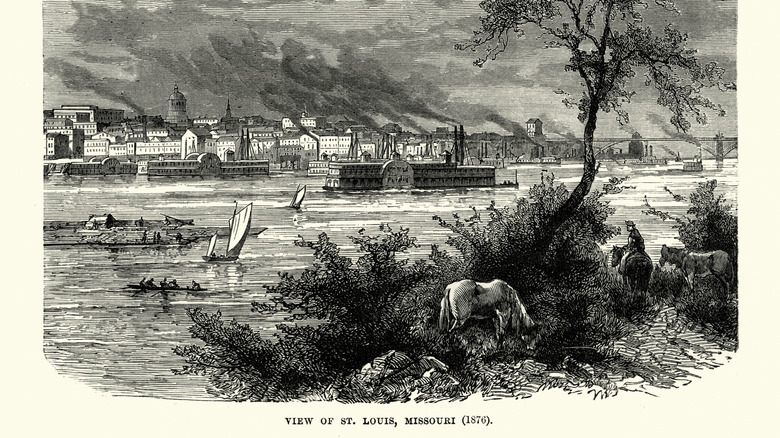
Two cities in particular — one still emerging, the other already a Midwestern hub — offered more productive opportunities for supplies. "St. Louis and Salt Lake City were major provisioning stops," Elizabeth White Nelson explained. St. Louis — already the eighth biggest city in the U.S. by 1850 — was the fuel-up center on the front end of the trip; while Salt Lake City, only founded in 1847, was the burgeoning town toward the back end. Both would have been crucial to the success and survival of the many thousands who took on the Trail.