

Trader Joe's Thick & Creamy Greek Yogurt Vs Chobani: Which Is Better?
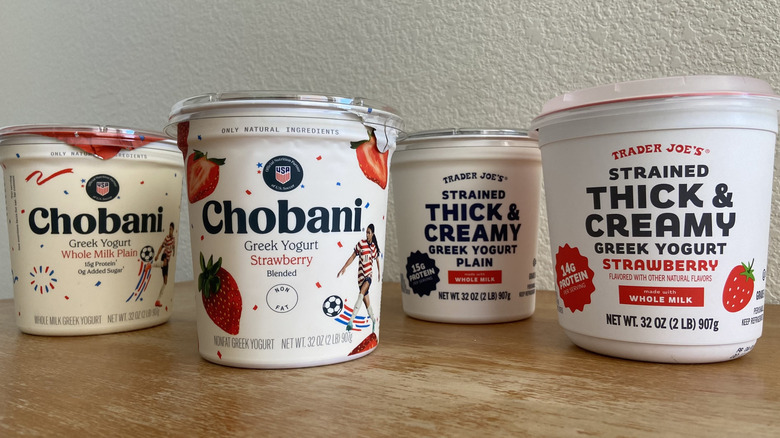
Welcome to Dupe Detective, a new column where I'll be reviewing a name brand food product's competitor product to find out how well it compares to, or even beats, the original.
Protein has become such a selling point, it's easy enough to list at least 14 high-protein foods no one asked for, each of which shoehorns in added protein content to practically comical effect. Of course, foods that have classically served as good sources of protein have benefitted from the trend too — for example, for a previous installment of Dupe Detective, I compared Fairlife's ultra-filtered milk to Target then-new ultra-filtered milk. Another high-protein mainstay that has become perhaps more relevant than ever is Greek yogurt.
Chobani ranks among a number of legacy brands that started spotlighting its yogurt's high protein content. Meanwhile, Trader Joe's bolstered its existing yogurt selection around late 2024 with a Thick & Creamy Strained Greek Yogurt. Then, in January of 2026, Trader Joe's introduced a Strawberry flavor. While Trader Joe's had already carried Greek yogurt, the new line of products billboards its protein content on the front of the container, the design of which conspicuously resembles the look of standard Chobani. So, I picked up both Plain and Strawberry flavors of the Trader Joe's Thick & Creamy Yogurt in addition to their nearest Chobani equivalents. Ahead are my thoughts after trying all four items, before my pick for whether or not the Trader Joe's Chobani dupe is better than its name-brand inspiration.
Taste test: Trader Joe's Thick & Creamy Greek Yogurt
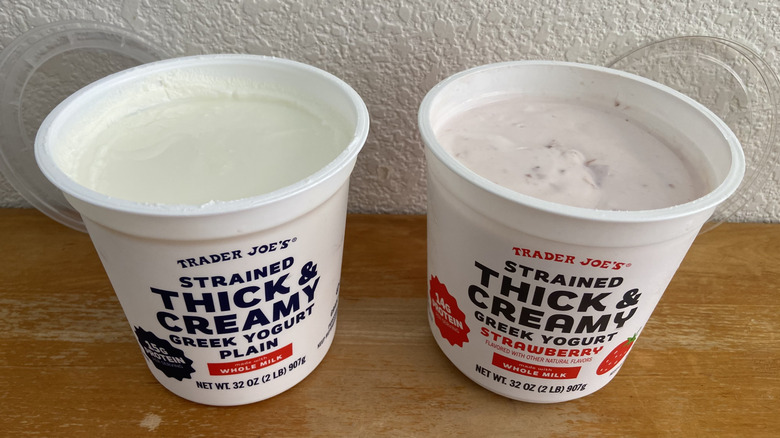
Both my Plain and Strawberry Trader Joe's yogurts were mild and restrained in character, which I — initially at least — found to be to their benefit. Contributing significantly to that sense was my Plain yogurt's consistency. Whereas some Greek yogurts can be so thick they're almost chunky, my Plain Trader Joe's yogurt deftly balanced density and smoothness, landing in a nice textural sweet spot. Meanwhile, its flavor was minimal, lacking somewhat in the signature sourness of a plain yogurt. Between its standout consistency and the blank canvass of its flavor, I found Trader Joe's Plain Thick & Creamy Greek Yogurt ideal for, say, adding berries, mixing with jam, or even using in a baked yogurt, a versatile breakfast treat made with just three ingredients.
I found my Trader Joe's Strawberry yogurt nominally thicker, but still pretty much in the same textural sweet spot as its Plain sibling. Contributing to its consistency were small strawberry pieces, but they didn't really shift the needle one way or another. Its flavor was certainly defined by strawberry, but mildly so, with a prominent fruitiness only emerging in its aftertaste. Overall, it tasted more like a health food than a sugary treat. While that could have been fine were it actually a health food, I noticed that the the Strawberry yogurt contains 18 grams of sugar per ¾-cup serving. In other words, it didn't offer the level of indulgence it should have with that much sugar.
Taste test: Chobani Greek Yogurt
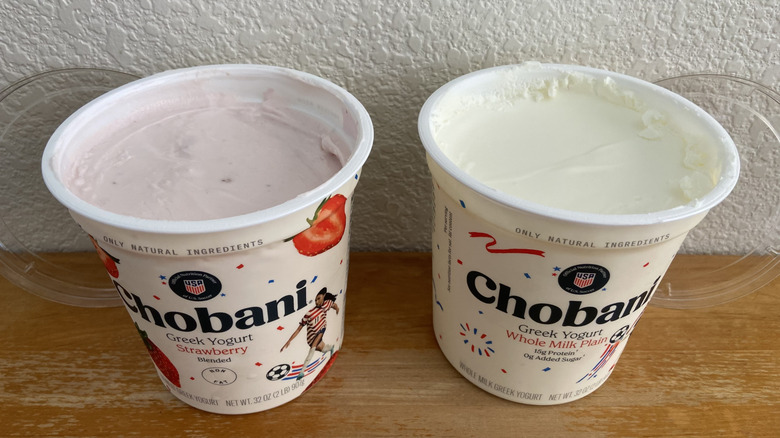
For better or for worse, my Plain Chobani Greek Yogurt pretty closely matched my expectations for a standard Greek Yogurt. Texturally, it was thick, to a just slightly excessive extent. Its flavor was sour and tart. I found it palatable, to be clear, but not ideal on its own. Whereas I found that the relative plainness of its Trader Joe's equivalent would make an ideal base for a sweet treat, the bolder character of Plain Chobani would work just as well in a savory context. For example,Greek yogurt makes for a suitable substitute for sour cream in a pinch.
It's worth noting that my Chobani Strawberry yogurt was the only product of the four I tried made with non-fat milk rather than whole milk, simply because Chobani doesn't seem to make a whole milk strawberry Greek yogurt. In practice, I found that the discrepancy hardly mattered, because its thick texture was close to that of its Plain counterpart.
Furthermore, despite containing one gram of sugar per serving less than the Trader Joe's dupe, it tasted quite a bit more indulgent, resulting in a strawberry flavor that was bolder and therefore more enjoyable. As it turns out, the nostalgic classic that ranks as the most popular yogurt flavor is none other than strawberry. Chobani's take on the leading yogurt flavor is sweet and satisfying — perhaps not great for you, but tasty all the same.
Final verdict: Trader Joe's makes a better Plain flavor, while Chobani's Strawberry is superior
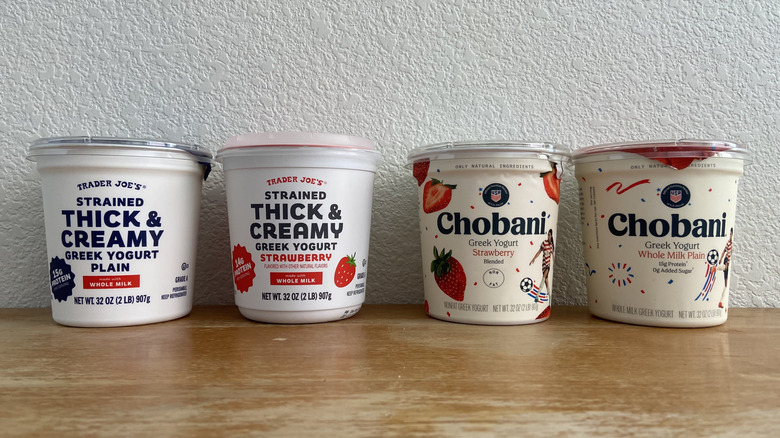
Normally I like to pick a definitive winner, even when I'm trying multiple products per brand. But in this case I had to come to a split decision, because Trader Joe's Plain Thick & Creamy Greek Yogurt was handily superior to Chobani's Plain, while the reverse was true of the Strawberry flavors. For the Plain Trader Joe's yogurt, its mildness was a major strength, especially since plain Greek yogurt is rarely eaten without some sort of accoutrement — jam, for instance, which is arguably the tastiest way to sweeten plain Greek yogurt. Chobani's Plain yogurt was fine, but due to its thicker texture and stronger tart flavor, it felt like an inferior template for add-ins. For what it's worth, it also didn't taste as good on its own.
In the Strawberry department, Chobani's Greek yogurt is more overtly indulgent than its Trader Joe's equivalent, despite the fact it contains one gram less of sugar in an identical serving size. The Trader Joe's yogurt was solid, and if it had, say, half its sugar content, I might have found it the overall superior option. However, since the Trader Joe's Greek yogurt hides its sugar while the Chobani Strawberry yogurt flaunts it, I found the Chobani yogurt to be the better product overall.
How do Trader Joe's and Chobani's prices and nutritional content compare?
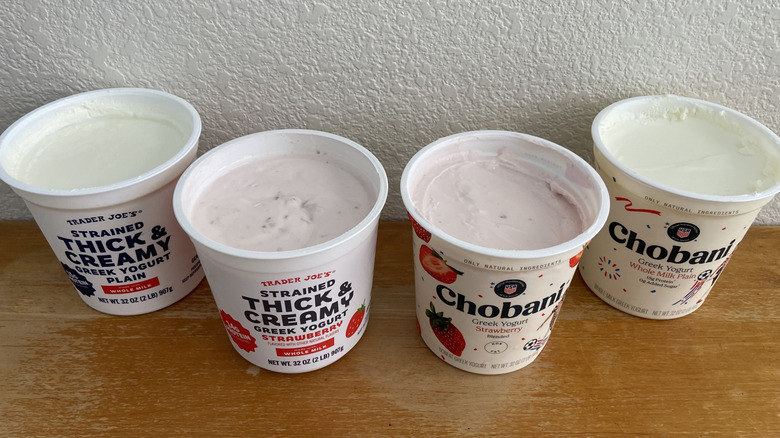
At my local Trader Joe's in Henderson, Nevada, near Las Vegas, each Thick & Creamy Greek Yogurt totaled $5.49. At a nearby Sprouts Farmers Market, the equivalent Chobani products were $6.99 each — nearly identical in price to those same yogurts at Smith's, where they're a mere $0.20 cheaper.
Nutritionally, a ¾-cup serving of the Trader Joe's Plain yogurt totals 170 calories, 9 grams of fat, 6 grams of which is saturated fat, 35 milligrams of cholesterol, 60 milligrams of sodium, 8 grams of carbs, 6 grams of sugar, and 15 grams of protein. Strawberry equals 190 calories, 8 grams of fat, 5 grams of which is saturated fat, 30 milligrams of cholesterol, 70 milligrams of sodium, 22 grams of carbs, 18 grams of sugar, and 14 grams of protein.
That same serving size of Plain Chobani Greek Yogurt, meanwhile, is practically identical to its Trader Joe's counterpart, at 170 calories, 9 grams of fat, 6 grams of which is saturated fat, 35 milligrams of cholesterol, 60 milligrams of sodium, 7 grams of carbs, 6 grams of sugar, and 15 grams of protein. Finally, due to its fat-free milk content, Chobani Strawberry equals 130 calories, 5 milligrams of cholesterol, 105 milligrams of sodium, 19 grams of carbs, 17 grams of sugar, and 13 grams of protein.
Methodology
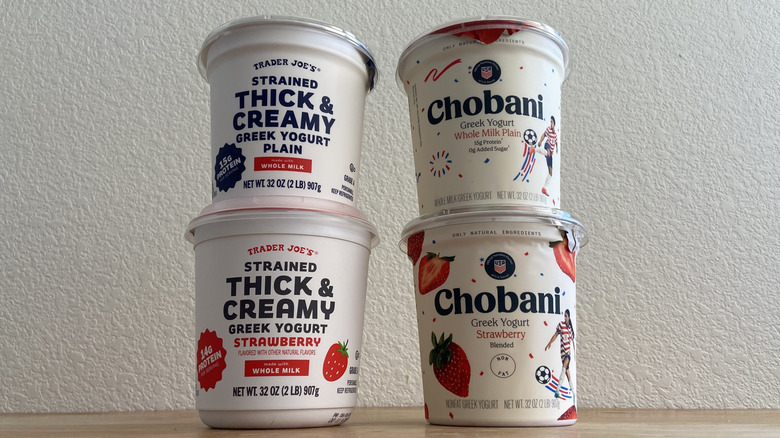
I purchased my respective Trader Joe's and Chobani yogurts on two separate shopping trips, and tried them a few hours after bringing the Chobani yogurts home from a Sprouts Farmers Market in the suburbs of Las Vegas. Since that Sprouts was close to my home, the Chobani products spent enough time in the refrigerator such that each yogurt started out at the same temperature.
To start, I tried first the Trader Joe's Plain yogurt, then the Trader Joe's Strawberry yogurt, to get a sense of what Trader Joe's brought to the table overall. Then I tried their Chobani equivalents in the same flavor order. After noting down my initial thoughts on each product, I tasted them in reverse to see if that might reveal any new insights. Each of my assessments is based entirely on this experience, and not any thoughts I may have had on the featured products or brands previously.