

The Old-School Grocery Store Loyalty Program Boomers Will Remember

Although some things about American life have remained relatively stable over the past century, much has changed since the boomers were born. One thing that's different these days is how loyalty programs work. Back in the 1960s (when the oldest boomers were starting to graduate high school), the majority of Americans were taking full advantage of something called S&H Green Stamps. These were literal green stamps akin to what people still attach to physical mail today. But instead of designating that your mail has been paid for, Green Stamps could be redeemed for a wide variety of home goods at one of the hundreds of distribution centers the Sperry & Hutchinson Company built all across the United States.
If you shopped at any of the participating retailers (which largely consisted of grocery stores and gas stations, among others) you would receive one stamp for every $0.10 you spent in the store, or 10 stamps per dollar. You would then take those stamps home, lick the back end, and stick it in one of your S&H booklets, which you could then take to one of the distribution centers and redeem for anything from lamps to pianos and bicycles to furniture. It was largely home goods that were on offer, and the S&H catalogue was distributed every year in the millions. The existence of fast food loyalty apps, grocery store loyalty programs, and coffee shop punch cards you see everywhere today can all trace their existence back to S&H Green Stamps.
S&H Green Stamps have gone the way of the dodo
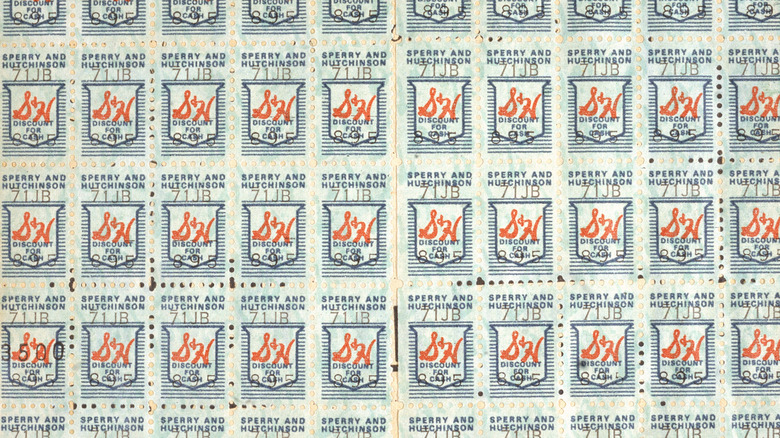
The prevalence of S&H Green Stamps peaked in the 1960s and was basically finished by 1981, when the family business was sold. A descendant reacquired the company and has been attempting a renaissance, but by and large, this phenomenon was finished. When Green Stamps were in their prime, an estimated 80% of Americans were participating; the kind of market saturation most corporate executives can only dream of. The long story short of why it's no longer around is that the retailers got wise and simply cut out the middle man by starting their own loyalty programs.
In the digital age, grocery store loyalty programs make money by selling your personal data. (If the idea of someone paying to peek in your shopping cart makes you nervous, Trader Joe's is famous for not having a loyalty program.) But the story of S&H Green Stamps and its eventual fall also points at something deeper. In 1960, the American economist W.W. Rostow published a paper titled "Stages of Economic Growth," which is now a classic text in the field. In it, he claims that the highest stage of economic development is what he called High Mass Consumption, a stage which he believed was achieved by the United States and other similarly developed countries.
With hundreds of S&H distribution centers handing out high-quality, American-made home goods to millions of Americans for free at the time he wrote the paper, it's easy to see how this descriptor fit the bill. These days, Subway can't manage to keep a loyalty program afloat for three months before backtracking.