

15 Popular Energy Drinks Ranked By Caffeine Content — Find Out Which Packs The Most
We've all thought about it at some point: How much caffeine can I funnel into my body to ensure that I can get through this day, shift, or all-nighter? Okay, maybe not all of us, but many of us. And it's in those moments that you know coffee alone won't cut it. You need something more. You need an energy drink.
The average cup of coffee contains 96 milligrams of caffeine. Black tea comes in at half that, at 48 milligrams in an 8-ounce serving. Your average cola has 33 milligrams in 8 ounces. In contrast, energy drinks often contain triple, quadruple, or quintuple these amounts.
Let's be clear, though — caffeine consumption should be handled with care. The U.S. government suggests limiting caffeine intake, for adults, to 400 milligrams per day. Otherwise, you could deal with negative side effects such as heart palpitations, high blood pressure, sleep issues, anxiety, nausea, and more. As such, when you're considering just how you'll go about keeping sharp and alert when you need to, pay attention to exactly how much caffeine is in that energy drink that you picked up from the gas station. You might want to avoid drinking more than one. Here are some of the most popular energy drinks available on the market, ranked by caffeine content per serving.
GFuel (140 milligrams)
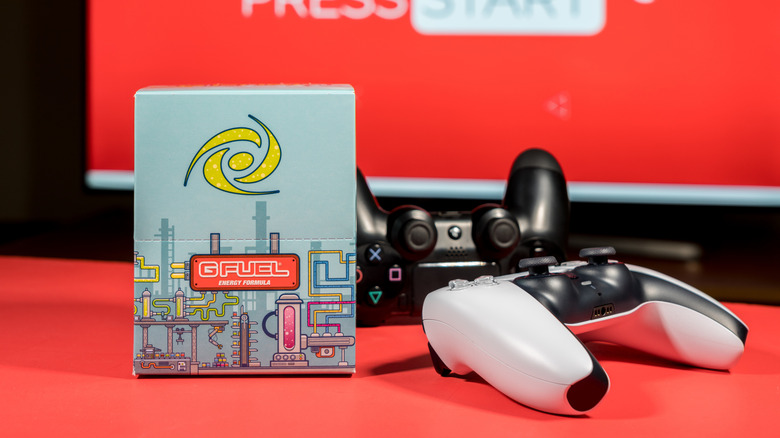
Some energy drinks are marketed toward athletes and some are geared toward another cohort of individuals who need a lot of energy — gamers staying up all night. Such is the case with GFuel. GFuel serves up 140 milligrams of caffeine in its energy drinks, but also has expanded beyond energy drinks to sell energy powders, hydration packets, and more.
As of late, GFuel has undergone a bit of a transformation. In 2025, it announced it would be adopting what is basically the GFuel formula "2.0," with new ingredients and more antioxidants — and, of course, at that time, in keeping with the gamer-focus, GFuel collabed with PewDiePie to release some lingonberry-flavored beverages.
Still, regardless of its status in the gamer community, GFuel doesn't really impress on the caffeine front. Sure, you'll be getting more than you'd find in your average cup of coffee, but drink two cups in the morning and you'll be outranking what GFuel can give you.
Red Bull (151 milligrams)
When talking Monster and similarly familiar brands, the only other energy drink brand that can outrank them all, at least for cultural relevance, is Red Bull. For many, it's the very first energy drink that they come across. Red Bull is so ingrained in American culture that we all know what it is — which makes it somewhat surprising that it ends up second-to-last on this list. The drink that's supposedly going to give you wings only gives you 151 milligrams of caffeine per 16-ounce serving? As that's less than a 16-ounce cup of coffee, you really aren't getting all that much — and anyone who acts like Red Bull is fueling their day isn't such the extremist they might think they are.
That said, Red Bull does have some sugar (at least if you're buying the original version), which can add to the "high" feeling that most expect from caffeine. Additionally, it's a lot easier to chug a Red Bull than it is a cup of coffee, so that caffeine is hitting your bloodstream a lot faster. So, if you're looking for a low-caffeine energy drink, Red Bull can do the trick — just don't expect it to be nearly as effective as Bang.
Monster (160 milligrams)
If you're asking which is the most popular or most well-known energy drink brand on this list, some might argue that Monster Energy takes the cake (or that it at least rivals one other brand, which we'll discuss in a moment). Even if it's not the most energetic option, at its 160 milligrams of caffeine, it's one of the oldest brands on this list ... if you're willing to have an open mindset and accept that this drink's history is a bit of a winding path.
The company that originally gave birth to Monster Energy was Hansen Beverages, also sometimes recorded as Hansen's Fruit and Vegetable Juices. Whatever you call it, it can trace its history all the way back to Los Angeles in 1935. A local family fresh juice business, it grew throughout the region and expanded into shelf-stable juices and sodas, but competition made things tough and the original company declared bankruptcy in 1988. The Hansen's Soda brand was acquired and the powers that be eventually pivoted into a relatively new field: energy drinks. Hansen's Energy hit store shelves in 1997, but the product required some fine-tuning, and Monster came out in 2002.
NOS (160 milligrams)
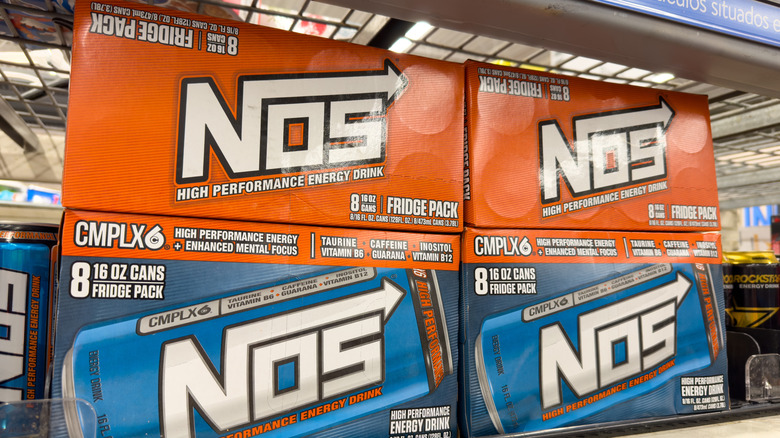
While other energy drinks seem to be trying to go hard or go home, introducing as many flavors as possible — and marketing as creatively as they can — NOS takes a refreshingly simple approach. It's big into the racing world, and it offers up a handful of flavors.
NOS Original gives you 160 milligrams of caffeine in a 16-ounce can. And there's a zero-sugar option. It's also worth mentioning that NOS, like so many other energy drink brands, did previously introduce a higher-caffeine option, in 2020, NOS Turbo, with 300 milligrams of caffeine in each can, but it's no longer readily available either.
Rockstar (160 milligrams)
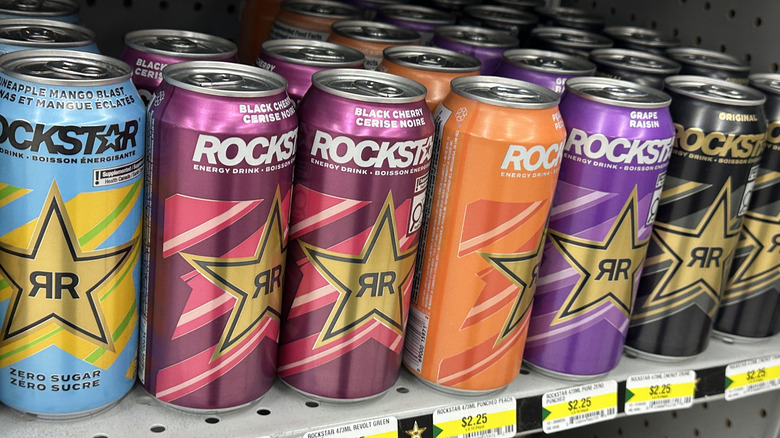
Rockstar's original formula packs a modest 160 milligrams of caffeine. That's just about half of what you'll get when you start sipping a Bang, but that's hardly lessened Rockstar's value on the energy drink market. The brand claims that 160 milligrams of caffeine is enough to keep you wide-eyed and bushy tailed for up to five hours, and that lesser amounts of caffeine have been known to increase mental performance.
Celsius has certainly taken notice of Rockstar's value. The parent company Celsius Holdings acquired Rockstar in 2025, taking Rockstar from PepsiCo, as part of its effort to expand its footprint within the industry — and it's certainly doing a good job of that. As of May 2026, Celsius oversees about 20% of the energy drink market throughout the United States. In addition to its own Celsius products, it also owns the aforementioned Alani Nu.
Prime (200 milligrams)
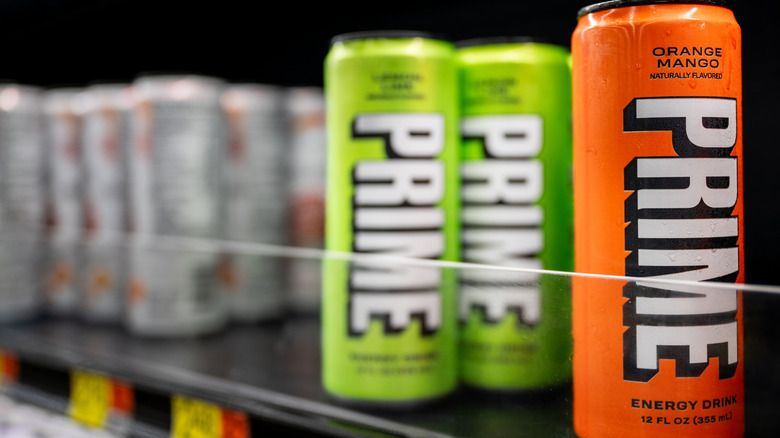
Prime likewise sits in the sweet spot of offering 200 milligrams of caffeine per can, so there's not really anything special about it per se — until you look at the drink's background. A few years ago, Prime launched to the delight of Logan Paul fans across continents. Initially, cans of the drink were in high demand and resold for shocking amounts.
Today, you won't see that same demand or value on the resell market, but you will still be able to find Prime on store shelves. Why the decrease in interest? There were multiple factors that dimmed this drink's light. For one, there was a lawsuit that said the drink actually contained more caffeine than was advertised (up to 225 milligrams as opposed to the packaging's purported 200 milligrams). Another lawsuit claimed that the drink contained what are known as "forever chemicals." Then, yet another lawsuit came to light, between Paul's Prime and Lionel Messi's Más+ by Messi. It's been a lot — and the brand hasn't held up as well as it might've.
Alani Nu (200 milligrams)
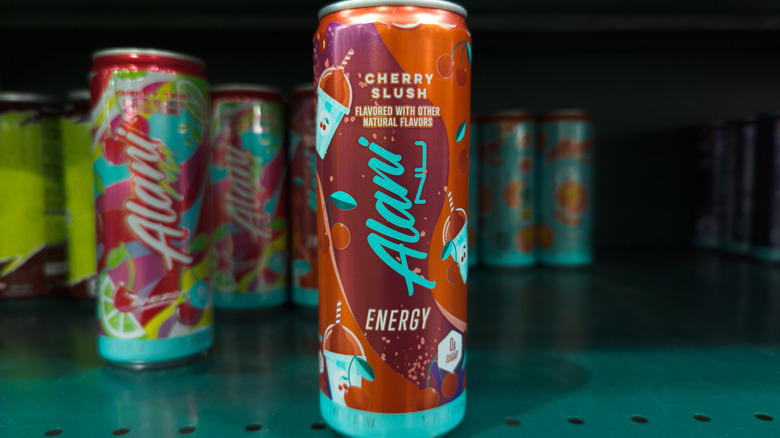
And that gets us into Alani Nu. This is an energy drink brand that was recently purchased by Celsius. The drinks come with 200 milligrams of caffeine in each 12-ounce can — which isn't all that bad on its own — but Alani Nu has been in some hot water.
In 2025, a Texas teen died and Alani Nu was allegedly partially to blame, according to the girl's family, who is asking for $1 million for damages. Lawsuits against Alani Nu say that the products are marketed to teens and children, who may not be able to handle caffeine as well as adults, and that the risks associated with such drinks aren't made entirely clear. However, the brand reported that it complies with all federal labeling requirements, and reiterated that the product is not intended for those under 18.
Celsius (200 milligrams)
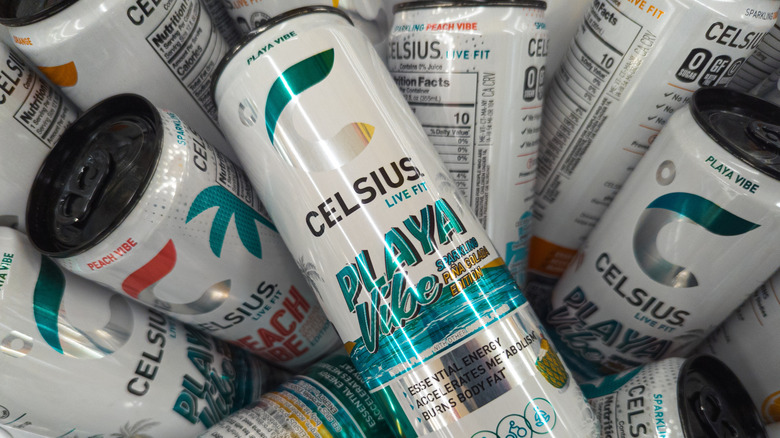
When we get down to Celsius' most basic product and the original formula that started it all, you'll find that it contains just 200 milligrams of caffeine per can. This definitely is still a respectable amount of caffeine, but it falls a little short of what you'd get from the top-ranking energy drinks on this list.
Still, that's nothing to shake a stick at, as we'll see when we get into one of the brands that Celsius actually owns, Alani Nu, next. Remember: It's really only advised that you drink up to 400 milligrams of caffeine per day. A lot of us are already drinking a few cups of coffee in the morning. Let's estimate that that's 200–300 milligrams of caffeine from your coffee alone. Add in a can of the original Celsius and you've bumped up your caffeine intake for the day to 600–700 milligrams — and if you're trying to get over your mid-day hump by drinking more than one can, you're fully placing yourself in the danger zone.
Ghost Energy (200 milligrams)
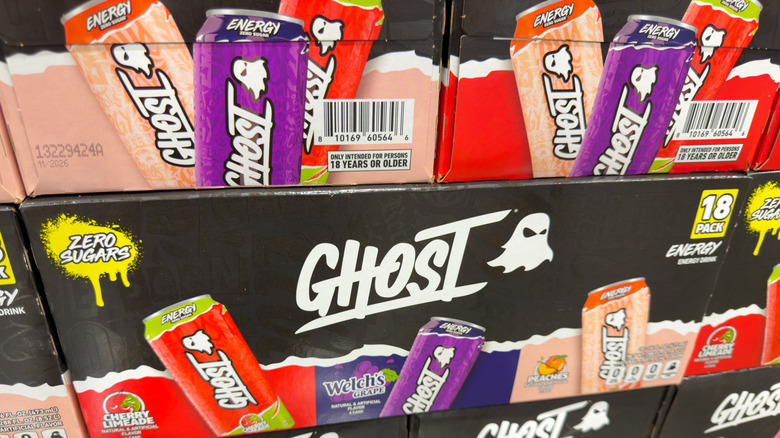
Ghost Energy is admittedly a fun brand. The 16-ounce cans feature a somewhat cute and saucy-looking little ghost. Inside, each drink delivers zero sugar, 200 milligrams of caffeine, and a range of flavors that are supernaturally creative. We're not talking your typical fruity flavors (though Ghost does offer some basics like strawberry watermelon and blue raspberry). No, from Ghost, you can expect flavors that deliver nostalgia and surprise in every sip. There are Welch's Grape and Grape-Cran flavors, a 7-Up inspired combo, and collaborations with brands like Bubblicious and Warheads. Then, you've got the childhood-favorite flavors like 'Merica Pop (aka, a Bomb Pop) and creamsicle. Ghost even took things a step further with a Yoo-hoo-inspired protein drink.
Additionally, Ghost has also released energy sticks that give you many of the same benefits of the OG Ghost Energy, including 200 milligrams of caffeine, 25 milligrams of AstraGin, and 100 milligrams of NeuroFactor, just in powder form. Toss 'em in a bottle of water and you're ready to go.
Rockstar Punched (240 milligrams)
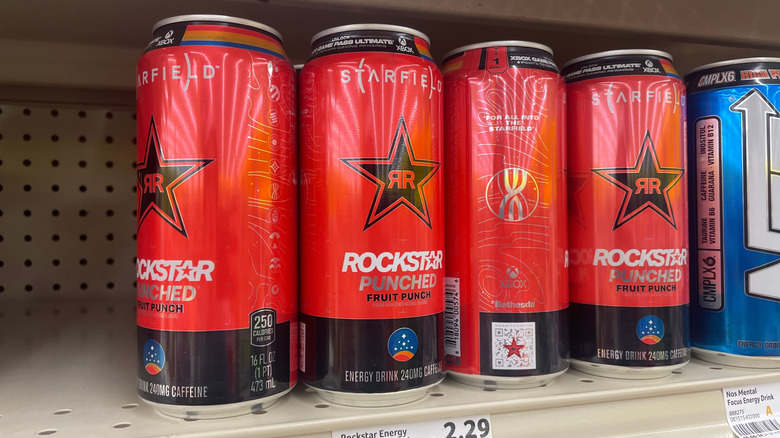
Again, like Monster, like Celsius, Rockstar has also churned out new energy drinks that take what the brand was already doing, to the next level. In this case, Rockstar dubbed its efforts, Rockstar Punched. It's a nice little double-meaning; the amount of caffeine is certainly punched up, but the flavors are somewhat fruity and punch-focused as well, with flavors such as fruit punch (obviously), blackberry, lime freeze, and pineapple. As for the caffeine content, this one measures in at 240 milligrams per 16-ounce can.
Also similarly to a lot of brands on this list, Rockstar once-upon-a-time sold another, even higher-caffeinated beverage that has been discontinued: Rockstar XDurance. It came with 300 milligrams of caffeine per serving, meaning it would've easily punched its way up to the top of this list, had it lasted. As for now, Rockstar fans will have to rely on Rockstar Punched if they want a truly harder hit of caffeine.
Celsius Essentials (270 milligrams)
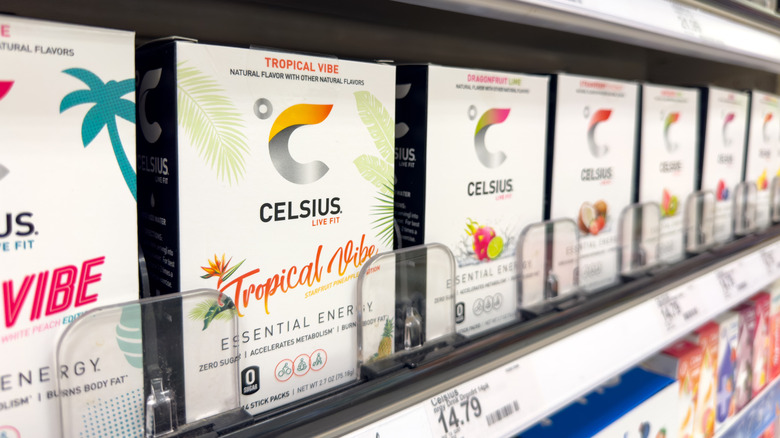
Like Monster, the Celsius brand offers several variants of energy drinks within its main line of products, with some containing more caffeine than others. This is the case for Celsius Essentials, which contains 270 milligrams of caffeine per 16-ounce can. (Previously, Celsius also offered Celsius HEAT, with 300 milligrams per can, but it has been discontinued.)
Originally introduced in 2023, Celsius Essentials is yet another energy drink that's built with the athlete in mind, versus the average consumer. (That's not kept the general public from this drink, though.) Celsius Essentials comes in six flavors: grape slush, blue crush, dragonberry, orangesicle, cherry limeade, and watermelon ice. In addition to the caffeine, it also contains green tea extract, guarana seed extract (guarana seeds contain double the amount of caffeine that you'll find in a coffee bean), ginger root, vitamin C, vitamin B, and aminos.
Cocaine (280 milligrams)
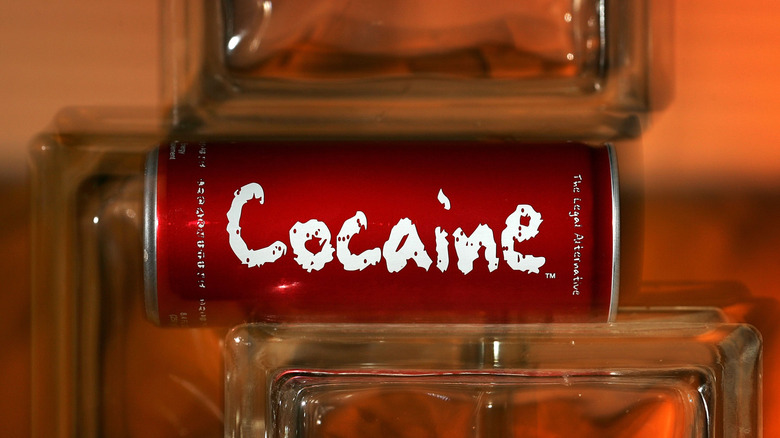
With a name like Cocaine, is it any wonder that this drink made our list? This beverage, with its unique packaging (because we all know what that font looks like), first debuted in 2006. However, it quickly sparked controversy and, in 2007, had to be removed from stores. According to the U.S. Food and Drug Administration (FDA), the drink's maker was technically and illegally marketing the drink as a street drug alternative, due to the verbiage used in the drink's advertising and web presence — even though the brand was adamant that that was never its intention.
Now, you can still purchase Cocaine as "Cocaine Energy Supplement," but it's almost amusing that the FDA went after this drink when it doesn't even prove the same health risk as, say, several others on this list that contain higher amounts of caffeine. Cocaine serves up 280 milligrams as compared to the 300 milligrams found in the most highly caffeinated beverages on the market today.
Monster Killer Brew (300 milligrams)
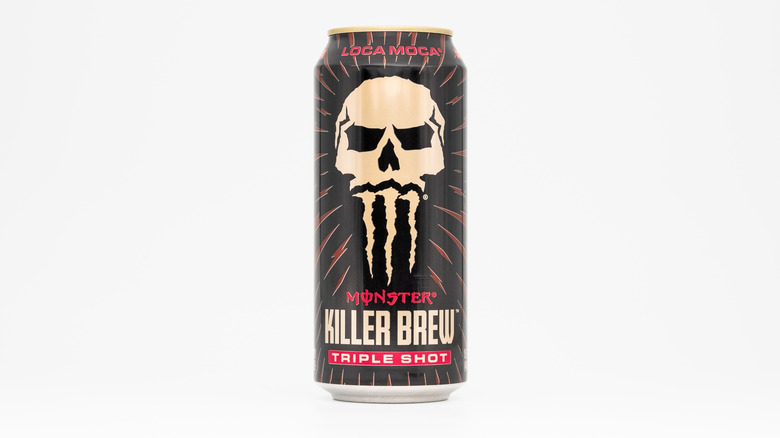
Monster has been around quite a long time, but its Killer Brew is a relatively recent addition to the line-up, introduced in 2025. A coffee-inspired extension of its Java drinks, Monster's Killer Brew has that coffee-derived flavor but also packs in a whopping 300 milligrams of caffeine, in one 15-ounce can, making it one of our top three most highly caffeinated beverages that you can buy today.
There are two Killer brew flavors, Mean Bean and Loca Moca. Mean Bean is reminiscent of vanilla coffee, while Loca Moca has more of that mocha slant. The 300 milligrams of caffeine come from both the Monster energy formula and the included coffee.
Don't worry — if you love the flavor but can't handle that much caffeine, the original Monster Java series isn't going anywhere. You can still get similar flavors, but with 200 milligrams of caffeine instead of the 300 milligrams found in Killer Brew, when you opt for the OG Java Mean Bean and Loca Moca. Just keep a close eye on the can as you pick it up at the store; it's easy to make a jittery mix-up.
C4 Ultimate (300 milligrams)
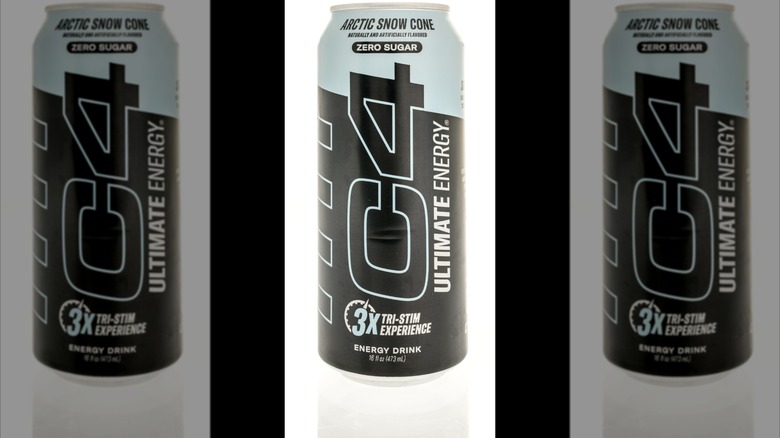
C4 Ultimate comes in with 300 milligrams of caffeine per 16 ounces as well. It also comes in cool flavors like arctic snow cone, frost-bitten citrus, frozen bombsicle, tropical tundra frost, and others.
One thing that makes C4 stand out is that a lot of people consider it a pre-workout drink, and even the brand itself recommends drinking C4 Ultimate about 20 to 30 minutes before exercising, to give you an extra boost of energy. It does make sense, when you consider that C4 sells a lot more than just energy drinks. The brand also encompasses protein powders, energy and amino powders, and supplements. So, this isn't necessarily a company built on giving just the average person a little boost — it's here to fuel your next extra-difficult workout and gym session. (Though, if you wanted to pick up a C4 Ultimate to see you through meeting your next work deadline after the kids are in bed, we wouldn't blame you.)
Bang (300 milligrams)
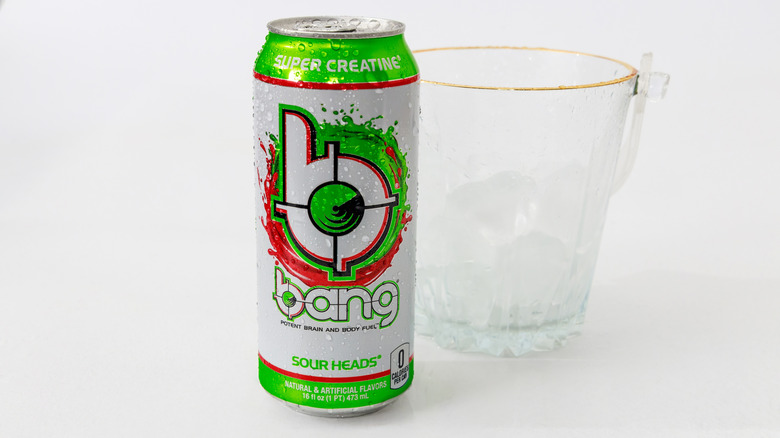
And finally Bang also sits as one of the top energy drinks on the market, as judged by caffeine content. Bang contains a respectable 300 milligrams of caffeine per 16-ounce can. As you're slurping down all that energizing goodness, you'll also be treated to 0 calories, 0 sugar, and a bit of electrolytes and vitamins. Bang comes in a range of cool flavors, too, like cotton candy, and, most recently, lime pop drop.
There have, in the past, been other energy drinks that have outranked Bang — for example, as recently as just a year ago, Spike Hardcore Energy was the drink with the most caffeine, at 360 milligrams. It has since become unavailable, with rumors circulating of it coming back in a different format, though there's little to back up those rumors. So, for now, if you're looking for the most caffeine possible, you'll have to settle for Bang or one of the handful of other brands that rank similarly.