

Bananas Originally Looked Completely Different From What They Are Today
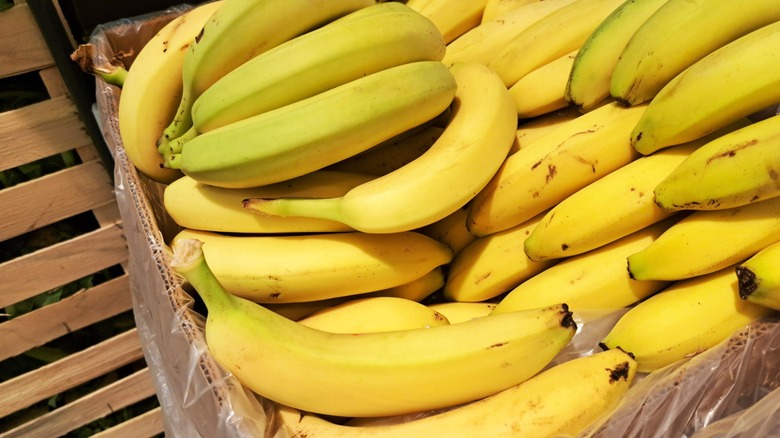
We don't want to make any assumptions about you, but we're guessing you know what a banana looks like. It's a longish, curved fruit wrapped in a peel, with a few seeds in the middle. (This actually makes it a berry, weirdly enough — we know, you don't usually think of bananas as berries, but it's true.) But did you know that the banana wasn't always the visually appealing delight it is today? In fact, thousands of years ago, bananas looked, if you'll excuse the technical jargon, kind of busted.
The earliest examples of bananas looked vaguely similar to the bananas we know today, but the details are very different. They were much smaller, for one thing — small and squat and green — and for another, they were filled with hard black seeds. Not exactly the most appetizing fruit in the world, we're sure you'll agree; if muesli existed back then, we could think of at least a dozen other fruits we'd like to chop up and toss in our bowl before those ur-bananas. But food history is filled with humans modifying crops into being more useful for us, long before the term "GMO" became a hot button issue. (What are ancient grains, for instance, if not grains from before the modern days of selective breeding?)
Humans selectively bred bananas into becoming more palatable
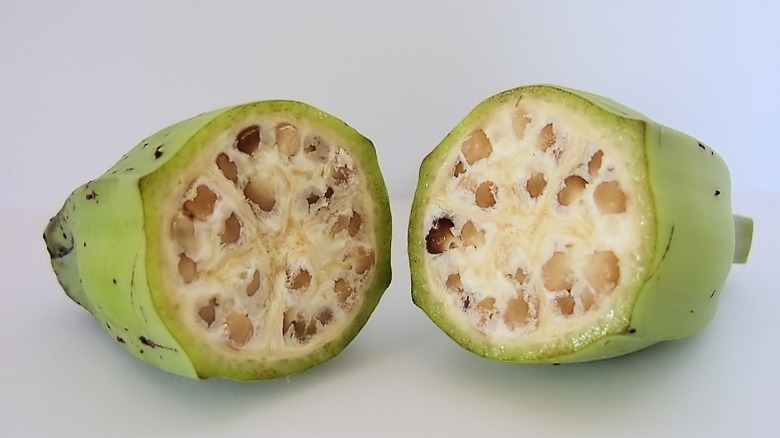
So how did the green, seed-filled fruit you see above become the long, luscious, yellow banana we mash up and put in our bread (elevated by the star ingredient)? Selective breeding, that's how. Every now and then, ancient bananas would produce a fruit that was parthenocarpic, or seedless; this was a mutation, of course, but the people of the Kuk Valley in Papua New Guinea (where the banana was likely first domesticated) selectively bred bananas so that seedless varieties would occur more often.
This kind of breeding is par for the course when it comes to agriculture, and continues to this day. It's how we ended up with the dominant banana cultivar of the early 20th century being the Gros Michel, and how, after the Gros Michel was decimated by Panama disease and never made a comeback, the Cavendish became the dominant banana. (Of course, the Cavendish is now in danger of succumbing to Panama disease, and may itself need to be replaced. What fun!)