

9 Things Real-Life Pirates Ate On The High Seas
When you think of pirates, you might picture a life like that shown in "Pirates of the Caribbean," full of adventure and mischief. But what you may have never stopped to think about is what pirates actually ate while on those strenuous voyages. After all, this was long enough ago that things like refrigeration or sanitation requirements had not been invented yet. Even when they ventured to the shores, what they ate may seem mysterious.
To help us discover what pirates indulged in, we asked for assistance from three trusted experts. Cindy Vallar is an editor of the Pirates and Privateers history column, as well as an award-winning author. Her expertise, combined with that of Benerson Little, a historian with several pirate-themed works, and William C. Davis, a retired Virginia Tech history professor, with several historical novels, provides valuable insight into the topic.
Before leaping into the nitty-gritty, it's important to note that pirates from different eras and parts of the world had access to various types of food. Cindy Vallar provides one example of this, noting, "The culinary delights of Eastern pirates differed; while I don't have a lot of information on their foods and recipes, rice was a staple just as it is today." For the sake of simplicity, this article will focus mainly on what pirates ate in the Caribbean and the Americas during the Golden Age of Piracy, which ran from about 1680 to the 1720s.
Boucan
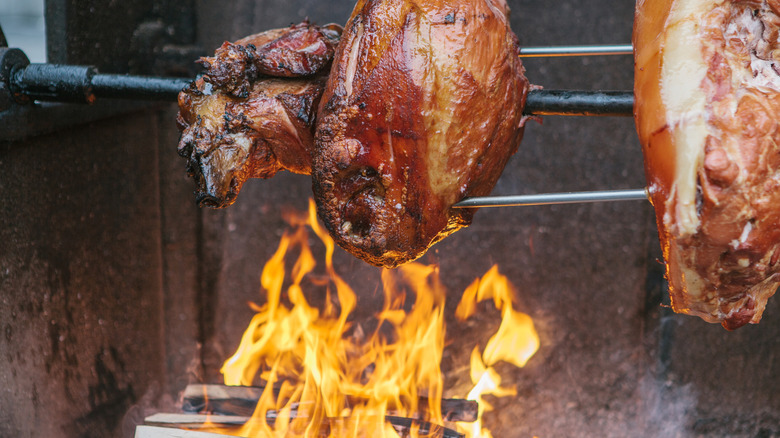
Although there are similarities — just as Italian pulled pork is different from the BBQ version — boucan is not the same as current-day BBQ. The boucan was a wooden contraption set over a fire, originally used by Indigenous peoples in South America to slow-cook various meats. The technique was later brought to the West Indies, where hunters living on the Caribbean island of Hispaniola used it. These hunters later became known as buccaneers, a play on the name of the contraption.
Eventually, these hunters were chased off the island by the Spanish. By the mid-17th century, they had become pirates, plundering Spanish ships and even attacking Spanish towns with a thirst for revenge. This distinction becomes important when separating the Golden Age of Piracy. "We can break this era down broadly for the sake of food into two parts," Benerson Little explains. "The buccaneers (circa 1655 to 1700) ... and the black flag pirates (circa 1713 to 1725)."
If you're wondering what meat pirates would cook on the boucan, Little uncovers the mystery. "Boucan was slow-smoked pork," he confirms. He goes on to mention that buccaneers (more commonly, the French buccaneers) would only have two meals a day, both with some form of boucan. "Invariably, it was boiled cornmeal seasoned with pork lard (more flavorful than the modern processed lard), usually served with boucan boiled to render it soft enough to eat." Cindy Vallar points out that this style of cooking could also be called barbecue. "Barbecue is still enjoyed today, although there are differences between what is eaten and how it's cooked."
Rum
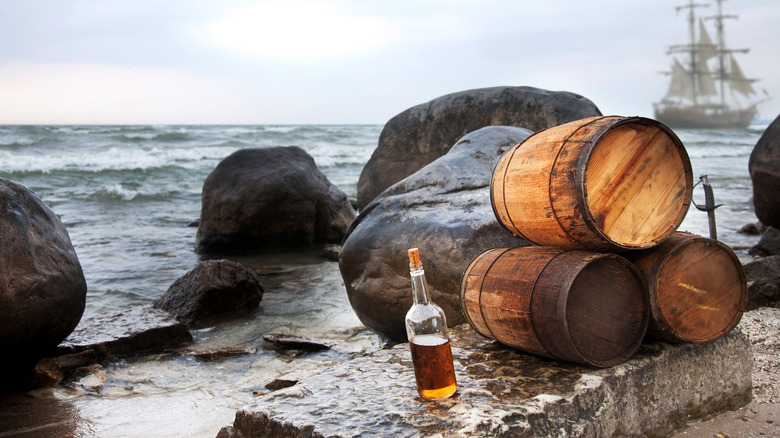
One thing all our trusted experts agree on is that the connection between rum and pirates is not a figment of fiction. "Rum was the most easily available alcohol, along with beer," William C. Davis confirms. Benerson Little chimes in that the liquor "was the most common alcoholic beverage among the working class English, French, and probably Dutch in the Caribbean and North America." Little adds that the working class included slaves, servants, and, of course, pirates.
"Rum was what late 17th and early 18th-century Caribbean pirates preferred," Cindy Vallar states, though she also points out that pirates did not have a rum-exclusive drinking relationship. "Pirates weren't noted for being choosy when it came to what they drank. If their plunder from a prize included alcohol, they drank it." Little adds one more beverage to this list, mentioning that wine was another common beverage aboard ships.
He also mentions that pirates used to make a mixed drink with rum, which they called punch. In fact, Caribbean rum punches boast a tumultuous history. Punch was a mixture of rum, sugar, water, and lime juice, often topped off with grated nutmeg or allspice. Little also explains that even though the cause of scurvy (an illness spawned by not eating enough vitamin C) was not totally understood at the time, the rum punch likely helped pirates avoid it in many cases.
Cornmeal
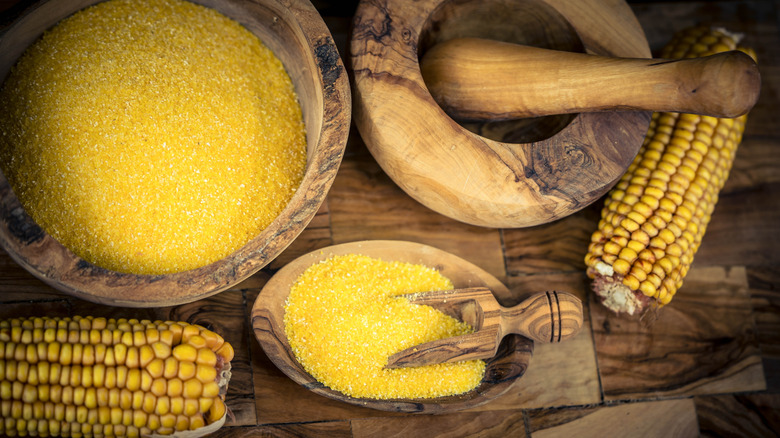
You may not have thought that a primitive form of grits would have made it into the stores of a pirate ship. However, Benerson Little explains that cornmeal was a popular food among buccaneers and pirates. "Cornmeal and pork were nothing more than the common food of the poor and working classes in the Caribbean (in North America, the cornmeal was often baked into bread), and it kept well at sea, thus it was also the food of buccaneers and pirates," Little details. He goes on to express a similar sentiment: "I still remember first eating grits, eggs, and bacon or fried pork at my grandparents' house long ago, and learning later that buccaneers ate much the same thing surprised me."
Although cornmeal was consumed similarly to how it is now, there were slightly different methods of cooking it. Typically, it could be boiled or fried, with the black flag pirates that would reign the seas after the era of buccaneers likely consuming it in much the same way. Now and then, though, pirates would get creative with their cornmeal. "English buccaneers often made their cornmeal (and probably wheat flour when they had it) into doughboys as they called them, and fried them in pork lard," Little describes. The result of this recipe was likely very much similar to a plain cornmeal or masa-only arepa.
Sea animals
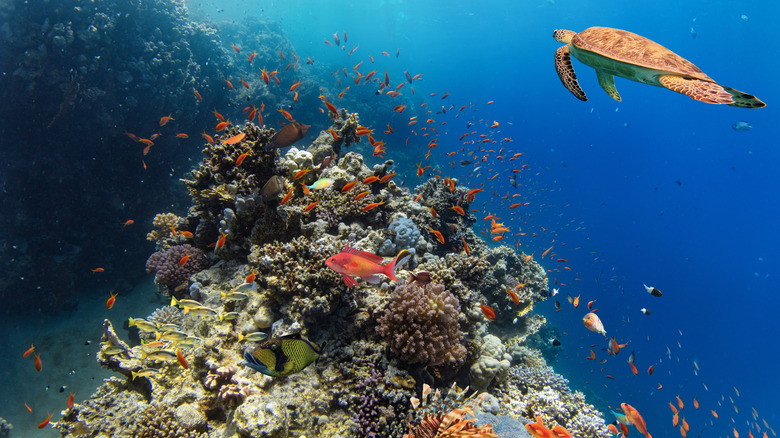
With the nature of pirate life often playing out in the middle of the ocean, it's probably no surprise that the buccaneers consumed sea animals. "Pirates ate whatever meats were available. Fish, of course, could be caught while at sea," Cindy Vallar mentions. Benerson Little also points out that sometimes fish was stored on board the ship, though this was exclusively salt fish and typically cod.
If pirates got tired of eating their salted pork or cornmeal stores during their journey, Little shares that they would resort to fishing and snacking on many types of fish. "Dorado (mahi mahi) was well-regarded, flying fish were easily had, and shark was often eaten boiled. Other fish were eaten as well," Little clarifies.
Sea turtles, an animal that is now on the list of meats illegal in the U.S., as well as manatees, were also popular, Little describes. With an adult sea turtle typically weighing between 300 and 350 pounds, it's not surprising that the amount of meat from this catch would be enticing to pirates. "Buccaneers would provision with it at times, being plentiful, first rolling turtles on their backs before slaughtering them," Little goes on to explain. The meat would be preserved by salting it in casks for later (if not eaten immediately). If turtle eggs were found, Little mentions, pirates would eat them as a treat of sorts.
Fruit
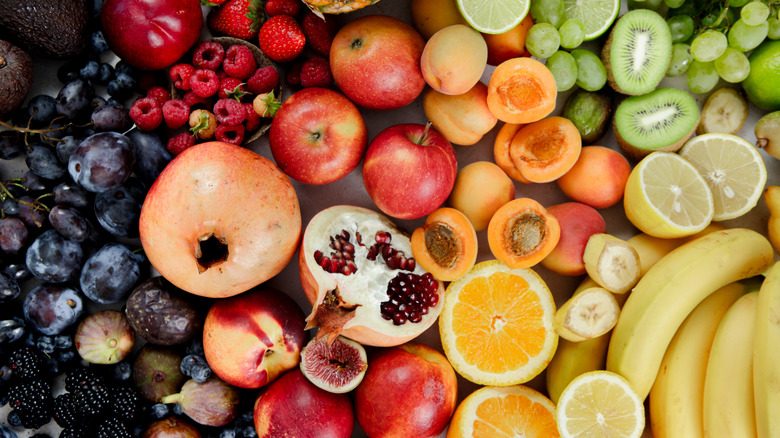
Pirates ate everything that they could get their hands on, it seems, and one of the items they were able to gain access to through either going ashore or plundering was fruits. There are accounts of pirates eating all sorts of fruits, Cindy Vallar says. "Bartholomew Sharp's crew availed themselves of apples, pears, cherries, apricots, peaches, strawberries, and gooseberries when they raided the gardens and orchards of Coquimbo (Chile) in 1680." William C. Davis chimes in on the matter, pointing out that pirates had to take into account how quickly things would spoil. "Fruit and root vegetables that did not spoil quickly, like apples and potatoes," he points out, would be selected for voyages.
Although it was not considered a delicacy per se, if the crew had been stuck at sea for long enough, by the time they got their hands on some fruit, it might be considered as such in the moment. "At sea, they had fresh fruit, but it wouldn't keep for long. What they did usually carry if they could was lime juice," shares Benerson Little.
Vallar also provides further insight into this, explaining that items that perished quickly were consumed first while on board. Items with a longer shelf life were added to the menu later on in the voyage when fresh items ran out. "They added new fresh items when they plundered ships or went ashore to refill water barrels or trade with locals," she clarifies.
Livestock
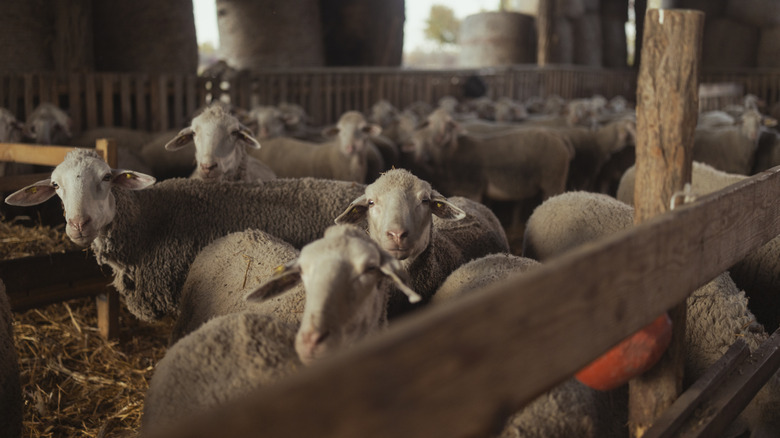
In a time before modern-day storage and preservation methods, sailors were forced to heavily salt meat and soak it in brine for several days, then store it in a cask until needed. During this process, though simple at first glance, there was plenty of opportunity for things to go awry, leaving the crew with a batch of spoiled meat. If a cask sprung a leak, for example, and no one on board caught it, this could cause issues when they were finally ready to cook. One way pirates could bypass this entire process was by bringing livestock aboard.
Benerson Little says that pirates would often steal livestock from ships they attacked, especially those owned by merchantmen (who were known to have livestock in abundance). "Chickens, turkeys, goats, pigs, even ducks and geese were common, and even a few cattle were seen at times," he explains. Cindy Vallar concurs, adding, "It was common for ships in the Age of Sail to bring livestock on board so the crew and any passengers could have fresh meat. Pirates took advantage of this when they found them aboard captured ships." If the term "Age of Sail" has thrown you for a loop, it simply refers to the span of time between the mid-16th and mid-19th century when ships were popular for warfare, travel, and trade.
Leather
While these days people wonder if they can get a refund on that terrible festival food they've ordered or whether they want Chinese BBQ for breakfast, rest assured that your problems are minuscule. Especially when compared to those of the sea-faring pirates of the Golden Age. The chance of scurvy, for example, was certainly one of them, not to mention the dangers involved with plundering ships. But crews would also occasionally find themselves in another sort of bind: in dire need of food. When this happened, they would be reduced to eating whatever they could find or spare. In some cases, this even meant eating leather (not unlike how Donald Trump enjoys eating his steak.)
One such example of this was when Sir Henry Morgan's ship ran out of food in 1670, says Cindy Vallar. "They even concocted a recipe for this," she continues. "First, they cut the leather into strips, which they then soaked for a time before tenderizing the strips by beating and rubbing the leather with stones. After scraping off the hair, they roasted or grilled the strips before slicing them into bite-sized pieces. They also recommended serving these with a lot of water." Benerson Little agrees that when pirates got desperate, they ate whatever they could. "Starving pirates have eaten monkeys, whelks, even their belts, you name it."
Hardtack
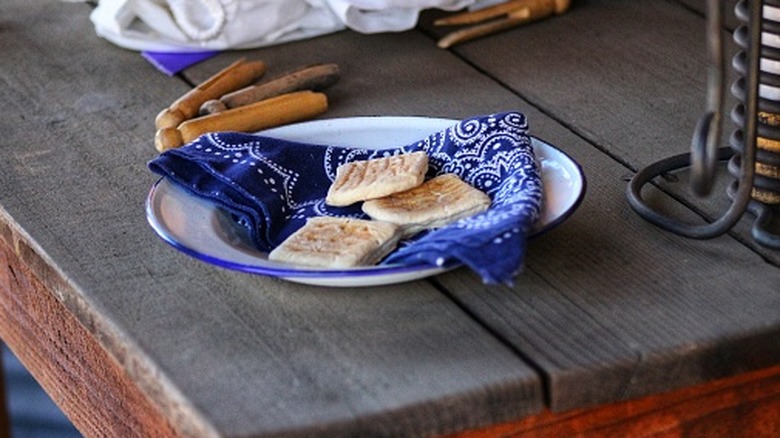
Life on the seas demanded that pirates bring items that would not succumb easily to mold. This necessity formed the hardened cracker known as sea biscuit, or later, when it was eaten during the Civil War, hardtack. Even if this biscuit was known for being tough to eat because of its hard-as-a-rock composition, it was better than nothing when stuck at sea. "[Hardtack] could be almost petrified and often had to be crushed to be palatable," William C. Davis adds. It was so hard, in fact, that Benerson Little warns, "It really needs to be soaked in something to render it soft enough to eat." He also notes that even this complete lack of moisture would not keep the insects out during the journey, leaving an unpleasant mental picture at best.
If you're wondering what the heck this type of bread would even taste like, our experts have you covered (no need to jeopardize your taste buds). Cindy Vallar says it tastes like "a very dry, unsalted cracker or biscuit, hard enough to break one's teeth if it could be chewed without soaking." She continues to say that the item is essentially just a mixture of flour and water. Despite the unpleasant eating experience it provides, it does its job in keeping well. "In 2018, hardtack from the Battle of Trafalgar was put up for auction, so it lasts a long time," Vallar shares.
Whatever they could plunder
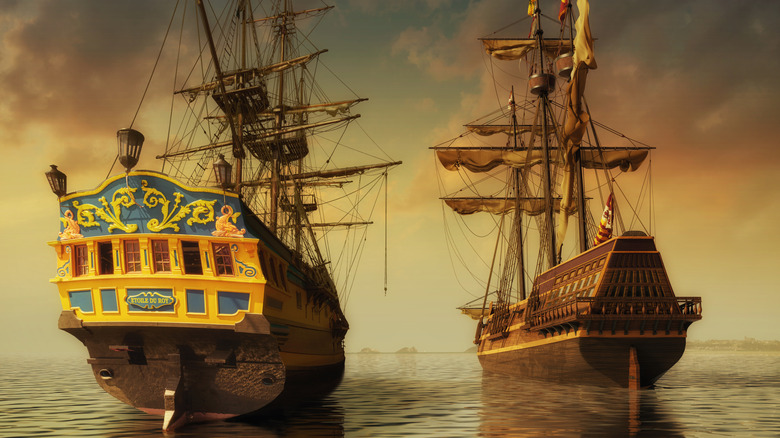
When you're busy plundering other ships and others' belongings, it doesn't exactly bode well for you to pull into a regular ship port, William C. Davis points out. An outlaw pirate couldn't go through the ordinary channels for obtaining supplies. "He would have to depend instead on whatever he took from captured vessels and what he could steal or purchase at informal shore stops out of reach of the law," Davis continues, pointing out that their diet would largely be composed of whatever happened to be available at the time.
Cindy Vallar points out, "Food and beverages were plundered from the ships the pirates captured rather than relying on bringing a lot of food with them." Benerson Little chimes in on this as well, clarifying that though buccaneers ate cornmeal fairly frequently, the black flag pirates consumed it less so. Instead, Little shares that black flag pirates ate "more of the common food at sea as carried by merchantmen, given that pirates plundered them not only for cargo and coin, but for food and medicine." With this in mind, their diet likely had salted pork and beef, boiled oats, cheeses, and potentially even boiled peas, he lists. It wasn't just bland items they plundered, either. Little further shares that pirates indulged in delicious treats like hot chocolate and marmalade. So there you have it, the hot-chocolate secrets have been spilled, even pirates enjoyed a good sweet treat now and then.