

You Only Need 4 Ingredients For A Stanley Tucci-Level Frittata

In what has become typical Stanley Tucci fashion, the actor turned travel show host recently shared his technique for a simple but delectable four-ingredient frittata on his Instagram channel in a post captioned, "In case you're wondering what to make for brunch." The actor — once famous primarily for movies like "The Devil Wears Prada" and "Big Night" — is now perhaps more well known for his Italy-themed food and travel shows "Searching for Italy" and "Tucci in Italy" (and for slamming the iconic Olive Garden chain). As a result, fans feverishly await his uncomplicated, straightforward recipes, which effortlessly capture the soul of Italian cuisine.
For this brunch frittata, Tucci mixes just four ingredients in a bowl: eggs, salt, freshly grated Parmigiano Reggiano — which is not just a fancy way to say parmesan — and wild garlic. (Regarding the last one, you didn't think it would be that simple, did you? We'll get to wild garlic in a minute.) He then heats some oil on what appears to be medium heat in his crepe pan — though any large sauté or fry pan should work fine — and simply pours in the mixture. He shakes the pan slightly and stirs the mixture gently until it begins to firm up. Though he mentions that this dish can be finished in the oven, he prefers to slide it onto a large plate, which he then uses to flip back into the pan. Finally, once the frittata has set, Tucci adds another heaping grating of fresh cheese.
What the heck is wild garlic anyway?
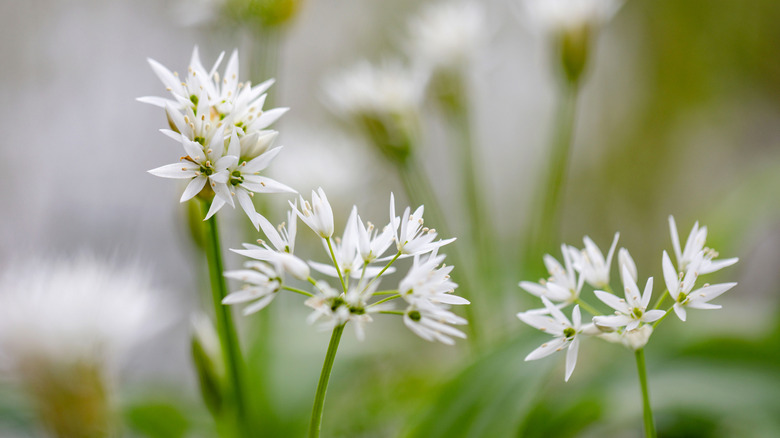
As noted above, Tucci uses what he refers to as "wild garlic" in his frittata recipe, an ingredient that's not particularly easy to come by in the United States (and is certainly not something one will find in grocery stores). Though this name might be used colloquially to describe a number of plants, technically wild garlic should refer to allium ursinum, which sometimes goes by other names such as ramsons, buckrams, or bear's garlic — the latter because bears supposedly like to eat it. Though native to Europe and Asia, where it grows wildly in damper woodlands and marshlands, wild garlic can be grown in the U.S. in moist, shady conditions. Though it might be occasionally found in specialty contexts like farmers' markets, the easiest way to source it here would be be to grow it at home from seeds.
Though it shouldn't be surprising, wild garlic is redolent of garlic bulbs, though it tends to be more delicate. It's probably most similar to ramps, a wild onion species which are likely easier to find in the U.S. (both are in season during the springtime), where their current trendiness has actually put their existence at risk. Other similar allium species include garlic scapes, green garlic, and leeks, and while using any of these would produce a slightly different final dish, the basic premise should remain the same. To remain true to Italy, use whichever of these ingredients can be found locally, and it'll surely produce a delicious frittata that would make Tucci proud.