

The Natural Reason Sausage Casings Look So Veiny

Sometimes, things have a pretty reasonable explanation. Why did the chicken cross the road? To get to the other side, of course — why else would it do such a thing? Similarly, you may have looked at a package full of Italian sausages, or perhaps some other kind of naturally cased sausage link, and wondered why on earth they're so veiny. Well, there's a perfectly sensible reason for that: sausage casing is made out of pig intestine, and pig intestines have veins in them. (We said it was sensible; we didn't say it wasn't gross.)
Maybe we should be a bit more specific. Not all sausage casing is made out of intestine. But natural casings definitely are — they're generally made from the submucosa layer of the small intestine. Rich in fiber and collagen, it's an ideal choice for a sturdy yet pliable sausage casing. But it's also quite vascular, which is just a fancy way of saying "veiny." It can be a bit of an unwelcome reminder that you're eating one of the less photo-friendly parts of an animal (which Americans don't do too well with, as seen with our aversion to offal), but it's perfectly harmless, and elevates your sausage experience to boot.
Alternatives to natural casing exist, if you'd rather not deal with veins
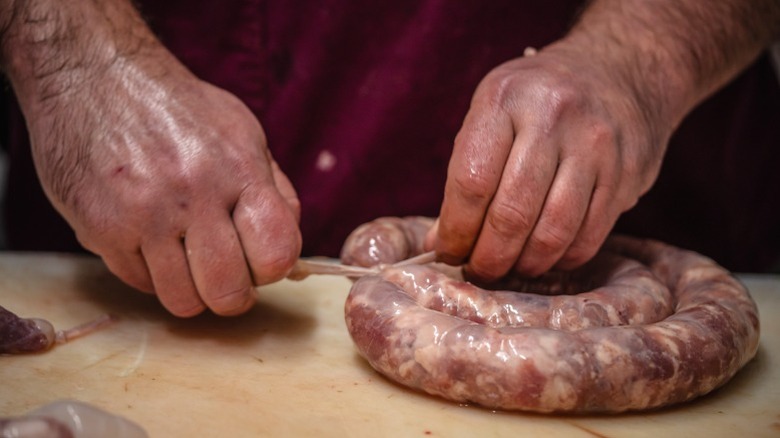
There are a few benefits to using natural casing. Aside from being quite elastic, letting it accommodate plenty of stuffing, it's more permeable than other kinds of casing, allowing smoke and other flavors to penetrate inside and make the sausage taste even better. But if you're especially squeamish and would rather not deal with more veins than strictly necessary, you have options. (Although we question why you'd be chill with everything else that's in sausage but draw the line at veins.)
There are, of course, sausages made with synthetic casing. That doesn't mean they're necessarily made without animal parts, though — they're often made from collagen or cellulose, both of which are sourced from an animal's body. There are even sausage casings made out of plastic, although you should take care to peel them off the sausage before eating if that's the case. Say what you will about veiny sausage casing, but it's not going to dose you with microplastics if you eat them. (Not that you can really avoid eating microplastics, anyway.)