

Forget Fiestaware And Le Creuset: This Kitchenware Brand Is The Ultimate Thrift Store Find
Whether you're trying to live more sustainably or just want your dishes to remind you of mornings at grandma's house, thrifting a good dinnerware piece is always a win. If you've been overlooking vintage Corning Ware for other brands, you're probably missing out on a solid addition to your kitchen rotation. Corning Ware made over 750 million varieties of casserole dishes, Dutch ovens, teapots, loaf pans, soufflé dishes, and more. And until 2000, Corning Ware was made with Pyroceram, a durable ceramic-glass invented in 1953 by Stanley Donald Stookey. What makes Pyroceram so remarkable is that it can withstand temperature changes of up to 840 degrees Fahrenheit and not succumb to cracking or shattering from thermal shock. This made the material perfect for oven and stovetop use.
Corning Ware continued producing Pyroceram pieces until the late '90s, when the company was sold and became CorningWare (one word instead of two). There are a few ways to tell whether you've got a Pyroceram piece. The easiest way to tell is to check for a stamp. Pre-1998 pieces will be stamped with the words "Corning Ware" and "Made in the USA." Another, albeit more research-intensive method, is to check the pattern name and production number. This will tell you when the piece was manufactured. You can use websites like CorningWare411 as a reference guide. If you sell thrifted goods or are simply cleaning out old belongings, there's even a chance you might have some vintage dishware that could be worth big bucks. But with Corning Ware, you have to know what to keep an eye out for.
The cost of Corning Ware dinnerware varies drastically
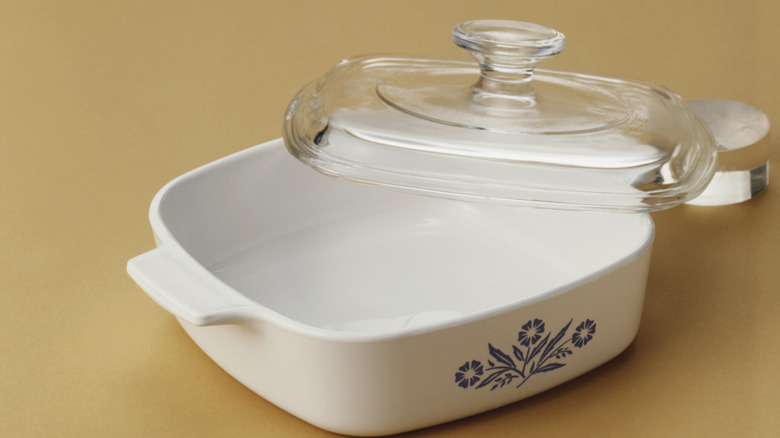
Much like vintage jars you should never leave behind at a thrift store, there are specific markers of a high-value Corning Ware piece. Popular or highly sought-after patterns may cost more depending on how long the piece was in production. The blue cornflower pattern is popular and may be easier to find since it was the company's signature pattern. Other popular patterns that might be harder to come by include the atomic starburst, which was made from 1959 to 1963, and the floral bouquet pattern, which was made from 1969 to 1974.
Other factors to consider are the type of dish that it is. Some pieces, like the casserole dish, are more popular than others. A dish that still has a lid will generally be more desirable than one without a lid. Though prices in thrift stores and online vary widely between tens and thousands of dollars, and, according to a CorningWare Reddit thread, even rare dishes can sell for a low dollar amount. "99.999999% of all CorningWare sells for $5-50, depending on size and condition. Even legitimately rare pieces often struggle to sell for much more than average," wrote one Redditor. This is good news for those looking to buy a piece. Just be sure that, whether you're shopping for functionality or for nostalgia, don't use vintage Corning Ware if it's cracked or chipped for the same gross reason you should throw out all your cracked dishes — bacteria. A cracked dish shouldn't serve food, but it can still serve as a marvelous display piece.