

This 7-6-5 Grilling Rule Makes For Dry, Overcooked Pork Tenderloin. Here's How To Fix It
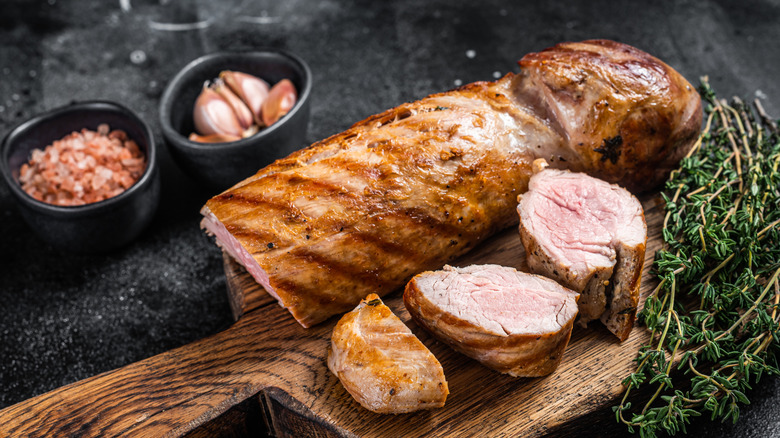
Easy-to-remember "rules" in cooking seem like good ideas in theory, but not all of those guidelines actually work in practice. The 1-2-3 rice rule doesn't work every time, and the 5-6-7 rule for a medium burger isn't without its nuance. Anyone who has run across the 7-6-5 rule for cooking a juicy pork tenderloin may believe it's foolproof, but in reality, it's a great way to ruin dinner.
Here's how the 7-6-5 rule works: Put a pork tenderloin on a grill preheated to about 450 degrees Fahrenheit for seven minutes with the lid closed, flip it, and cook for six more minutes. Then turn off the burners and cook using the residual heat for five minutes. After resting for 10 minutes, the theory is that your meat should be 145 degrees Fahrenheit throughout.
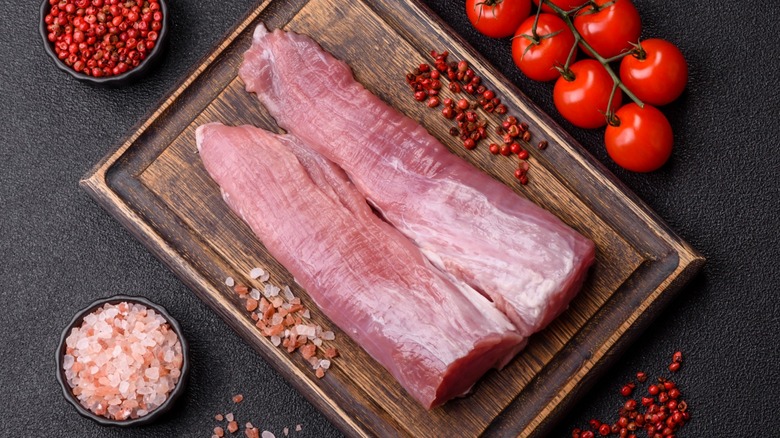
Scott Thomas, owner of The Grillin' Fools, has a bone to pick with this one-size-fits-all approach to preparing arguably the best part of a hog. "Pork tenderloin has a fat end and a very skinny end," he explained. "Cooking tenderloin like this may result in that fat end being 145 degrees Fahrenheit, but the skinny end is going to be way overcooked and dry."
He advised a couple of workarounds if you're set on using this method. You can fold the thinner end and tie it in a U-shape so that the width of the whole tenderloin is more uniform. Or, truss two tenderloins together, aligning the fat end of one with the skinny end of the other. "Then work on that timing," Thomas said. "It will take longer as the two tenderloins will insulate each other, but that's okay."
The trouble with the 7-6-5 pork tenderloin rule
It's fair to note that Scott Thomas hasn't actually attempted to cook pork tenderloin using the 7-6-5 rule — and that probably won't change anytime soon. When asked if he would use this technique, he said, "Nope. For reasons stated above, plus the times don't take into account the size of the pork tenderloin."
The primary issue with the 7-6-5 method is that it assumes everyone is buying pork tenderloins that are the same weight, thickness, and length. Some pre-packaged brands are relatively consistent from package to package but not entirely identical. Even if you didn't have to worry about the thin and thick sides of the tenderloin, a small difference in overall size throws the whole 7-6-5 technique into question.
Thomas noted, "If someone tries this with a somewhat smaller pork tenderloin, it's going to be significantly overcooked and dry. Doing this with a big fat pork tenderloin will result in it being dangerously underdone." His advice? You should reverse sear. "Truss them together and smoke them until they hit 135 degrees Fahrenheit," Thomas said. "Then crank up the heat and give them a sear to take them to the recommended 145 degrees Fahrenheit." It's not as simple as the 7-6-5 rule, but if you want to do a pork tenderloin justice, a little extra effort can make all the difference.