

Don't Expect Bartenders To Like You If You Make This Major Faux Pas

Ordering drinks at a bar isn't quite like ordering food at a restaurant. They don't often hand you a menu, and even if they do, there's almost always more on offer than what's listed. There's a whole world of cocktails out there, and bartenders are stationed behind the bar to help get one in your hand, so why not order whatever you want? While that may sound reasonable, there are some unspoken rules about ordering drinks that are worth keeping in mind. To find out what those are, we spoke to Yu Jiang Zhao, the founder of Kobayashi Bar.
The conversation we had with Yu revolved around complicated drinks and when it's okay to ask for one. "There is nothing wrong with complex drinks," he said. "However, when you order one and there are already three guests in the queue, it slows everybody down." There's a time and a place for everything, so paying attention to what kind of bar you're drinking at can help you determine what drinks are okay to order.
"When a bar is small, the menu short, and the backbar features mainly call brands and well products, then that is a place where you should ask for a vodka soda," explained Yu. "On the other hand, fresh lemons and limes, a Lewis bag, and a menu with house specifications can imply that the bar strives to make a special drink even on Friday at 11." In other words, a complicated drink is probably something you should order at a speakeasy, not a local dive that mostly does shots and beer.
What makes a cocktail complicated?
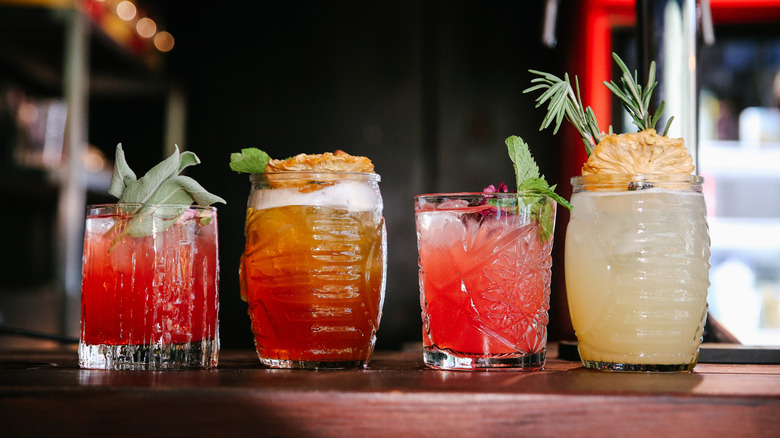
Just because you aren't hanging out at a bona fide cocktail lounge doesn't mean you're stuck tossing back questionable shots and shooters. You should order what you like, just while keeping in mind the kind of drinks the bar tends to serve. But calling a drink complicated is a bit vague, if we're being honest. Does everything with more than two ingredients count as complicated? Probably not. As Yu Jiang Zhao explained, "The complexity of drinks includes such elements as muddled fresh fruits, separation of eggs, Ramos gin fizz, and ordering a cocktail that needs to be looked up." (In case you didn't know, bartenders hate making the Ramos gin fizz.)
A Negroni is only three ingredients, and it comes together with little more than a stir. It's obviously more complicated than a gin and tonic, but most bartenders won't cast you a disparaging glance if you ask for one unless you're at a really low-key place. Meanwhile, Death in the Gulf Stream is even simpler as it's essentially a Collins glass filled with genever and Angostura bitters. But because nobody is going to know what a Death in the Gulf Stream is, they're going to have to take the time to sneak a look at their phone for the recipe — if they bother entertaining the idea at all. That may be fine at 5 p.m. on a Tuesday, but it isn't going to fly on a Friday night. It's all about reading the room.