

The Shocking Milk Swap Cereal Commercials Use
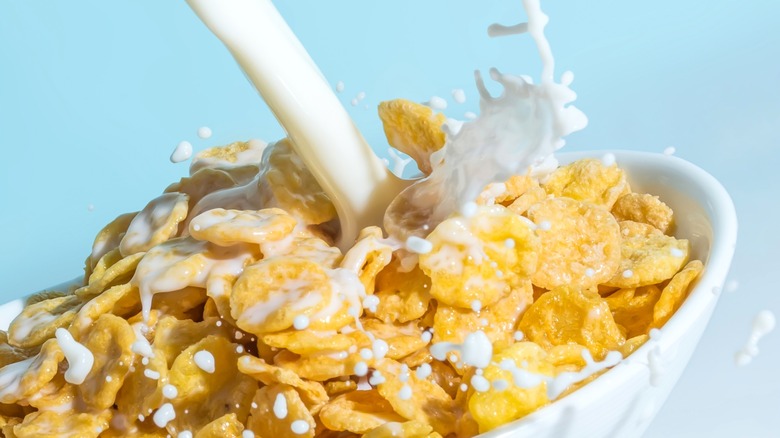
We've all been there. You see a tantalizing dish on a commercial that makes your mouth water, only to realize the actual product fails to represent what you saw. In commercials, food always looks amazing. It has to; otherwise, folks won't want to buy the product. But that doesn't mean what you see on screen is tastier — certainly not with cereal. Food stylist and recipe developer Nathan Carrabba dropped some insider knowledge with The Takeout, revealing a trick used behind the scenes to make cereal look more appealing on camera, and it's not appetizing.
Got milk? Not if you're shooting a cereal commercial, apparently. "Food stylists frequently use Elmer's glue in place of milk because it mimics milk's appearance while being thicker and more viscous," Carrabba said. "This prevents cereal from sinking to the bottom or getting soggy during long shoots." The ingredient swap also helps the moo juice look its best. "The glue also provides a bright white sheen that photographs better under studio lights than regular milk."
Hopefully this doesn't put anyone off their favorite breakfast combo (it definitely won't for one of our writers here at The Takeout, who thinks that milk has no business in cereal to begin with). If it helps, Carrabba noted that many food commercials commonly utilize glue. "While glue is most famously used as milk in cereal ads, it's actually a versatile tool throughout food styling," he said. "Stylists use it to hold burrito folds in place, secure sesame seeds perfectly on burger buns, and countless other applications where they need precise control over food appearance and positioning."
Is all the food in commercials fake?
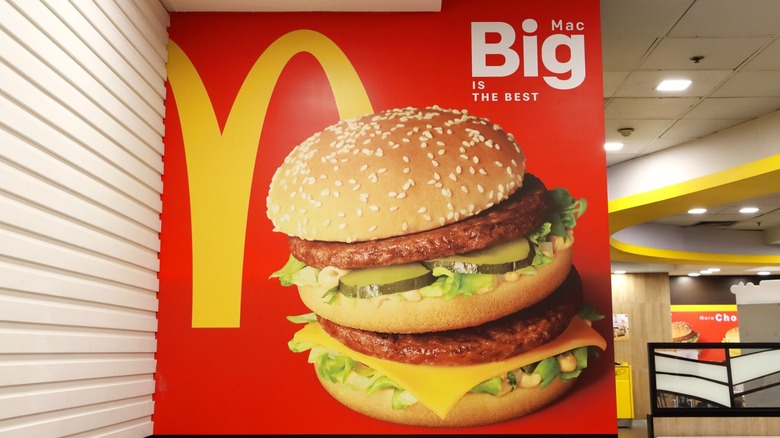
With all the glue used in food commercials, it makes one wonder what other ingredients are swapped for impostors. Substituting shaving cream for whipped cream is a common trick, as is using mashed potatoes as a stand-in for ice cream. Still, Carrabba insisted that, generally, what you're seeing on-screen is genuine food.
"Actually, the idea that fake food dominates advertising is a common misconception," he said. "Modern technology has largely eliminated the need for extensive food substitution as real food often looks better than fake alternatives." That's not to say you'd want to eat those staged products, though. "Food styling still involves strategic manipulation to make food look its absolute best," Carrabba said.
That could mean putting cardboard in a burger to give it a little more height or using a specialized device to mimic steam when the patty is just room temperature. It doesn't mean the bright green lettuce, vivid tomatoes, and gleaming beef aren't authentic (although the shimmer on the burger could be from the same ingredient commercials use to make steak glisten), but they're all finagled to create an illusion of grandeur.
Carrabba gave a detailed example of how real food is manipulated for the camera to entice potential buyers. "For instance, turkeys are often barely cooked to keep the skin tight, then sprayed with a mixture of angostura bitters, gravy browning, food coloring, and dish soap for that golden-brown perfection," he said. "A fully cooked turkey might have torn or shriveled skin that doesn't photograph well. This controlled approach ensures the food looks as appetizing as possible because, ultimately, people eat with their eyes first."