

The Absolute Best Time To Add Garlic To Your Pan
Home cooks often assume they know what they're doing in most cases, until someone comes in and rains on their parade. Apologies in advance, folks, but this may be one of those times. The foundation of many meals, from a beefy stir fry to underrated old-school chicken dishes, relies on two of the most revered ingredients in the culinary world: garlic and onion. People often start cooking the two without a second thought, focusing more on the next step. But if you're adding them to a hot skillet at the same time, I'm sorry to say you're doing it wrong.
The Takeout recently spoke with recipe developer David Davidov from The Cooking Foodie about one of gastronomy's simplest tasks — heating garlic. He noted that because it cooks so quickly, tossing it in simultaneously with other fragrant ingredients is a mistake that can ruin a dish. "I almost always add garlic after the main aromatics (like onions or shallots). Garlic cooks fast and burns easily, so if you add it too early, especially to a hot pan, it can burn and turn bitter," Davidov said. Burnt and bitter likely isn't what you're going for, no matter what you're whipping together.
Instead of throwing in everything at once, Davidov indicated it's best to wait until the other alliums are nearly done. "Once the onions are soft and fragrant, that's the perfect moment to add garlic and let it bloom," he said. After all, garlic doesn't need much time to work its magic — usually only about 30 seconds to 1 minute, just until fragrant. "You're not really 'cooking' it, you're releasing its aroma," Davidov said.
More expert tips for perfectly cooked garlic
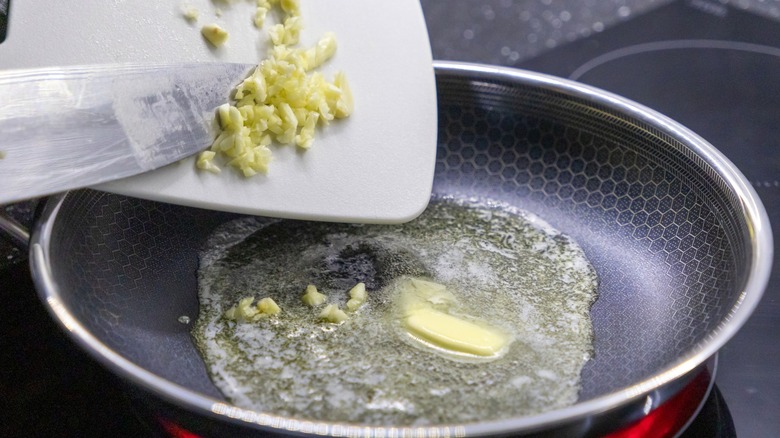
Unless you're a fan of using Antonia Lofansa's culinary nemesis, "jarlic," you're probably chopping up your garlic before it hits the pan. David Davidov revealed that how it's cut, if at all, significantly affects the appropriate cooking time. "Minced or grated garlic: cooks very fast, 20 to 30 seconds," he said. Thin slices can take slightly longer, about 30 to 60 seconds, while whole cloves can stay in the pan longer, for up to a couple of minutes on lower heat, he said.
However, if you chuck garlic into the skillet and it lands on onions, shallots, or whatever else you're heating, it won't get the full benefit of the heat. It's best to push aside those other ingredients and create a small well where the garlic can come into contact with the hot pan. Then you're just moments away from moving on to the next phase of your dish.
Still, if 30 seconds to a minute is a bit too quick for your tastes, some people recommend giving yourself more control over the timing by starting the garlic in a cold skillet. Once heat is applied, it will take less than half a minute for the garlic to begin cooking. However, you won't hear that sizzle telling you it's 30 seconds away from being done. Davidov indicated that folks should rely on their noses to determine when garlic has had enough time to cook, and their eyes will tell them if they need to start over. "Biggest tip: the moment you smell that strong, nutty garlic aroma, that's your cue," he said. "If it starts turning dark brown, you've already gone too far."