

The Best Way To Prepare Bacon For Deliciously Wrapped Foods
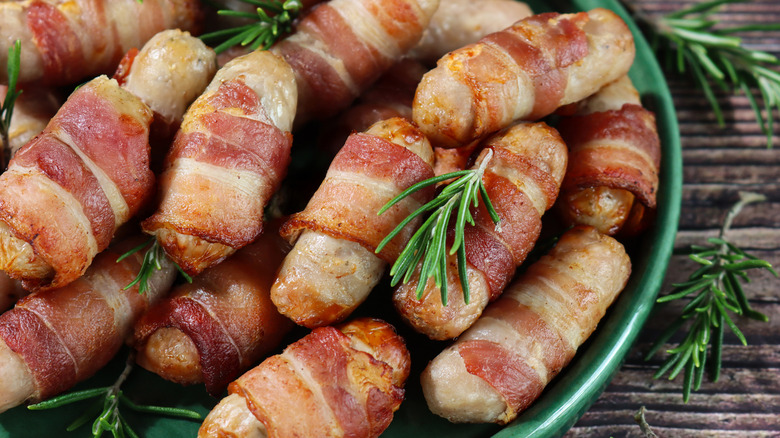
The age of bacon being a "funny" food may harken back to an earlier age of the internet, but there's something about wrapping foods in bacon which remains satisfying and extremely filling. You can turn dill pickles into the world's best appetizer by swaddling them in bacon, while a bacon wrapping is the key ingredient in giving jalapeño poppers a smoky twist. Common wisdom often suggests that, to ensure a soft bacon strip can properly wrap around your food, you should run the blunt side of a knife over the bacon to gently stretch it out. Does this actually work, or is it not worth the effort? We asked George Ryle, in-house chef at Swaledale Butchers.
According to Ryle, there's a bit of real science to this technique. "It does work, up to a point," Ryle said. "Running the back of a knife down the bacon can stretch it a little and help stop it tightening up too much in the pan. You only need to do it very lightly, and one side is enough. You're not trying to flatten it, just loosen it slightly." However, Ryle clarified that this isn't the most important part of prepping bacon for a wrap, adding, "I think how you cook bacon matters more." If the bacon isn't cooked to be crispy on both sides, or if it's so crispy that it breaks or tastes burnt and bitter, it won't matter whether you stretched it.
Stretching bacon with a knife before cooking
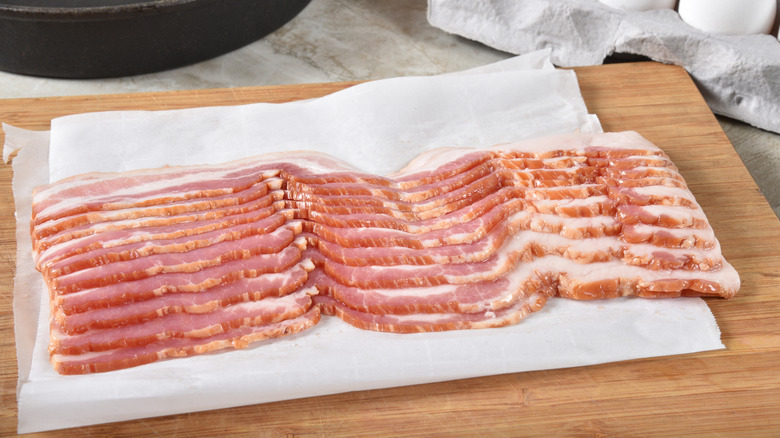
There are a few things to keep in mind while you're stretching out a strip of bacon. You'll do this step before you cook the bacon because the raw bacon will be softer and less brittle than it will be once you've properly cooked it. Make sure you've got the bacon on a flat surface (like a cutting board) and that you're using the back of the knife since the sharp end might snap the bacon in half, making it useless for wrapping. You should ideally see the bacon stretching out before your eyes, but as Ryle said, it will only stretch a little. Bacon wrappings are best suited for small foods like pigs in a blanket or other appetizers, so you shouldn't need to stretch them far.
More importantly, there's some solid foundation to Ryle's note about how cooking matters more. "A cold pan and a bit of patience usually gets you further than kitchen tricks," he said. It pays to cook bacon on a cold pan rather than a preheated surface because it renders (aka melts) the fat more slowly, which gives the bacon a better texture and stops it from curling up too early. The knife trick helps, but it'll only get you so far if the bacon isn't cooked well.