

The 13 Best Food Scenes From Movies, Ranked
Food and movies have been intertwined since the beginning of cinematography. One of the first films ever made by the pioneering Lumière brothers was a 1895 short featuring their family eating: "Le Déjeuner de Bébé" ("The baby's lunch"). "How Bridget Served the Salad Undressed" was a popular early twentieth-century comedy where a worker misunderstands her boss's meaning of "undressed." In the many decades to follow, the depiction of food on film has evolved with the art form, bringing about some of the most treasured and indelible moments in motion picture history.
In making this list, it was tricky to land on exact criteria. In the end, it seemed best to take a two-fold approach. Some of these entries are simply great, iconic scenes where food and eating are included. Some depict food in such an artful and affecting way that the viewer can almost taste it. Some are both.
The final ranking was determined by a subjective balance of those elements. Enough highfalutin', cinephiliac prattling, though. Let's get to the scenes we all love and the eats that steal them. Here are the thirteen best food scenes from movies, ranked in descending order. Action!
13. The Return of the King: Denethor dines
Despite the hobbits' well-known love of a warm, rustic meal, the "Lord of the Rings" series probably isn't the first thing you think of when it comes to top-notch filmic food scenes. Yet, amid all the orcs, elves, wizards, and giant, flaming eyes, there's one dinner that makes quite the impression.
It's found in the third and final installment "The Return of the King." Denethor, steward of Gondor (essentially a caretaker king), has gone a bit broody in the face of evil Lord Sauron's inevitable conquering of Middle-Earth, for which he has a front-row seat on his throne in the city of Minas Tirith. In this self-absorbed malaise, he's gone and sent his last living son on a pointless mission of no return.
With this, and existential annihilation at his doorstep, Denethor still manages to gorge himself on his supper (via YouTube). The splatter of what looks like a cherry tomato, the slap of some meat on his platter, all done to the mournful singing of an indentured hobbit. It's dinner and a show as the world goes to hell around him.
12. Howl's Moving Castle: bacon and eggs
Legendary Japanese animation house Studio Ghibli — led by visionary director Hayao Miyazaki — is responsible for some of the most imaginative, endearing, and inspired storytelling of the modern movie era. That artistry is seen in the numerous ways they've featured food in their films, from succulent stews to silken noodles; from fresh rice to meticulous sandwiches.
That said, it's in "Howl's Moving Castle" — with a simple breakfast of bacon and eggs — that Ghibli makes your mouth water for the classic comfort pairing (via YouTube). A young girl named Sophie, who has been turned into an elderly woman by a witch, invites herself into the moving castle of the wizard Howl. At one point, Howl procures the ingredients for a classic breakfast, which Sophie cooks over the captive fire demon Calcifer before serving it to Howl and his young apprentice Markl.
Markl gorging on the bacon is all of us. The sequence has made such an impression that it's inspired fans to recreate the exact meal itself –- sometimes frame by frame. But of course, we don't need "Howl's Moving Castle" to tell us what we already know: cooking eggs and bacon together is the proper way to go about it.
11. The Godfather: Michael Corleone cuts dinner short
"The Godfather" is one of the most pivotal films in cinema history, and one of its most pivotal scenes took place in a real Bronx Italian joint known as Louis' Restaurant. The white-tablecloth eatery closed soon after the movie was shot, but it will live forever as a story setting. This sequence was the moment Michael Corleone (played by Al Pacino) became Michael Corleone (via YouTube).
After rival mafia boss and drug-trafficker Virgil "The Turk" Sollazzo attempts to kill disapproving Corleone patriarch Vito (played by Marlon Brando), Michael volunteers for a sit-down with Sollazzo. This is, ostensibly, to sort things out between the two clans. But Michael — up to this point a clean-nosed, military-vet golden boy — has grimmer plans.
Sollazzo brings along his bodyguard: The police captain McCluskey, who, confident of his weapon-frisking abilities, tucks a napkin into his shirt and orders the veal ("best in the city," Sollazzo tells him). Little did either of them know about the gun planted in the bathroom by the Corleones. Coming out of the restroom, and then sitting down and waiting for the nearby train to pass, Michael makes his forever move. McCluskey never finishes his veal.
10. Inglourious Basterds: Hans Landa's strudel
Has there ever been something so appetizing in a scene this stomach-knotting? Two things are expertly crafted in this chilling "Inglorious Basterds" sequence: the German strudel (with cream; have to wait for the cream) and the character of Nazi colonel Hans Landa (via the fathomless thespian skill of one Christoph Waltz).
In this scene, the reprehensible Landa comes face-to-face with Shoshanna: The girl whose family he murdered when she was a child. Yet here they are, in forced, polite company at a restaurant. When Landa orders her a glass of milk –-a callback to the massacre –- you can't help but wonder: Does he know? Does he know that she knows?
It could be argued that "Inglourious Basterds" is Quentin Tarantino's finest work, as far as deftly constructed set-pieces which scale from the intimate to the epic. And yes, it even feels like the strudel here is at the top of its game. This is no Costco strudel approximation. It looks absolutely delicious –- except when Landa plants his cigarette smack in the middle of it, unfinished.
9. Do The Right Thing: The wall of fame at Sal's Pizza
Spike Lee has had, and continues to have, an illustrious filmmaking career. Powerful and unflinching movies like "Malcolm X," "BlacKkKlansman," "25th Hour," "Crooklyn," and "He Got Game" are just a sampling of his formidable motion picture output. But it's "Do The Right Thing," released in 1989, that's considered Lee's magnum opus. The fulcrum of the narrative is an old-fashioned New York pizza joint.
Set on a single block in Bed-Stuy, Brooklyn, during the hottest day of the year, "Do the Right Thing" explores racial identity and cultural interaction through a chorus of local personalities. Two of those characters are neighborhood firebrand Buggin Out (played by Giancarlo Esposito) and pizzeria owner Sal (Danny Aiello). It starts with Buggin Out complaining about the amount of cheese on his slice for $1.50, which hints at the simmering ethnic contentiousness in the air.
When Buggin Out notices that Sal only has photos of white, Italian-American luminaries on his walls — even though his customer base is predominantly African-American — it all comes to a boil (via YouTube). Buggin Out tries to lead a boycott of Sal's Pizza, which eventually leads to a series of incendiary events and a senseless fatality. And to think, it all started with a dollar slice (which is now practically dead in NYC).
8. Goodfellas: Sunday sauce in prison
We find ourselves in an extreme close-up of a garlic bulb being finely cut with a razor blade, set to the opening notes of Bobby Darin's "Beyond the Sea." The manicured fingers meticulously slicing belong to Lucchese crime boss Paul Cicero, aka Paulie (played by Paul Sorvino). He's in a prison cell with fellow inmates and mafia cohorts, including Henry Hill (played by Ray Liotta). They're preparing a veritable banquet (via YouTube).
As frozen lobsters are delivered, steaks are seared, and a meaty tomato sauce simmers (with apparently too many onions), it's clear this is no ordinary prison stint. Or rather, these are no ordinary prisoners. Eventually, Henry shows up with a sack of fresh bread, cured meats, a bottle of Scotch, and two bottles of wine. Now, Paulie declares, they can finally eat.
"Goodfellas" is a mafia masterpiece directed by Martin Scorsese. Scenes like this epitomize the movie, which both glorifies the mobster life and, at the same time, conveys its dangerous pitfalls and deep amorality. There's a more important message, however: That three onions are way too much for two cans of tomato sauce.
7. The Taste of Things: meal prep masterpiece
Both French food and French cinema are considered high points of world culture. One of the main characteristics of both aspects, when done well, is beauty. "The Taste of Things" is a beautiful film because of its authenticity: in how it's shot, in how it's acted, and in how the food is illustrated.
The movie takes place in the late 1800s, centering around a cook named Eugenie (played by Juliette Binoche), and her employer-slash-lover Dodin (Benoit Magimel), along with the incredible food they make together. In the opening scene, the pair prepares a meal for a group of Dodin's friends. However, "preparing" seems a flimsy word. It's more like crafting. Building. Shaping. Conjuring. In other words: making art.
It's truly a quiet symphony of cooking (via YouTube). The rack of veal is drizzled like a baptism, and the turbot is placed like a bathing baby in a pan of hollandaise. There's real work that goes into every dish being prepared. But behind that work is love, as conveyed by the ever-so-subtle yet constant grin on Eugenie's face as she goes about her tasks. Unlike many other foods portrayed on screen, all of this is real, and the performers did the actual cooking. Cue salivation.
6. Big Night: il timpano
Released in 1995, "Big Night" was co-directed and co-written by Tucci, who knows a thing or two about Italian eating. In the film, Stanley Tucci and Tony Shalhoub play Italian-immigrant brothers who open a restaurant on the 1950s Jersey Shore.
Food is a vital component of the story, which features more than a few amusing culture clash moments, such as when clueless and extremely American customers order a side of spaghetti and meatballs with their risotto. But it's when the brothers are hoodwinked into thinking the great musician Louis Prima is going to visit their restaurant that the film's feast for the eyes truly washes over us.
As part of their gargantuan dinner prep, the brothers construct the ultimate pièce de résistance: il timpano (via YouTube). Also known as a timballo, the dish is a baked, savory, pie-casserole monster. A slice into the finished crust reveals the film's version of the showstopper: It contains meat, eggs, cheese, and pasta in one belly-busting bite. Oh, it's glorious.
5. Pulp Fiction: Samuel L. Jackson chews the scenery
Quentin Tarantino has had characters spout a lot of his snappy, verbose, and gleefully profane dialogue while eating food. Highlights are the Jack Rabbit Slim scene from "Pulp Fiction," the vulgar Madonna discussion at a diner in "Reservoir Dogs," or Uma Thurman trying to eat white rice with a destroyed hand in "Kill Bill."
However, none have quite had the combination of humor, tension, and power as this particular sequence from "Pulp Fiction" (via YouTube). It may have even been the scene that turned the actor Samuel L. Jackson into the industry of Samuel L. Jackson. In it, he and his partner in criminal muscle (played by John Travolta) pay a visit to Brad (played by Frank Whaley), who has transgressed upon their underworld boss, Marsellus Wallace.
Jackson proceeds to enjoy a bite of the very nervous Brad's cheeseburger — from Big Kahuna, of course — while making small talk about what they call a quarter-pounder with cheese in France. ("Royale with cheese," because of the metric system.) After getting the package they came for, Jackson biblically unleashes on the poor dudes, in both violence and recitation. But for those wanting to try a Big Kahuna burger for themselves: Sorry, it's fictional.
4. Bicycle Thieves: mozzarella en carrozza
A classic of Italian neorealism and world cinema, Vittorio De Sica's timeless "Ladri di Biciclette" ("Bicycle Thieves," or sometimes referred to as "The Bicycle Thief") was ranked the greatest film of all time by Sight & Sound only four years after its release. Time has done little to dim the greatness of this eternal ode to the marginalized.
Unemployed Antonio Ricci has finally found a job in post-war Rome. However, the bicycle he needs to do the job — and for which his wife pawned their bedsheets — has been stolen. Antonio and his son Bruno go on a quest throughout the city to find the bike, lest he lose the employment he so desperately needs.
In a moment of hedonism amid their difficult lives, Antonio and Bruno sit down at a restaurant to enjoy a bottle of wine (yes, for the kid too), and something else that caught Bruno's eye: mozzarella en carrozza. Has not each and every one of us been little Bruno stretching his cheese in unadulterated eating joy? No wonder mozzarella in carrozza is an absolute must-order at any decent Italian restaurant to this day.
3. Modern Times: the Feeding Machine
There are several classic food-centric sequences in the Charlie Chaplin catalogue. Think of the grubby pancake breakfast in "The Kid," or the restaurant scene where the Tramp is way out of his depth in "City Lights." That said, it's in "Modern Times" where one of the greatest combinations of food and comedy takes place — and it never gets old.
In this film, Chaplin's Tramp character is employed –- and completely overwhelmed –- by a cutting-edge factory replete with all manner of "modern" machinery. It's a satire of industrialization and commercialism, but it's also downright hilarious. This is especially true when it comes to one of the gizmos the poor Tramp has to demonstrate: the Feeding Machine (via YouTube).
The idea that anyone would ever need a machine like this is obviously humorous, but when the corn on the cob feeder goes haywire, the real comedy begins. The funniest aspect might be the automated napkin consistently dabbing his mouth after every messy malfunction — until it too turns against Chaplin's hapless guinea pig.
2. When Harry Met Sally... : I'll have what she's having.
Released in 1989, "When Harry Met Sally..." has since entered the pantheon of great rom-coms. Directed by Rob Reiner, who co-wrote the screenplay with Nora Ephron, the film stars Billy Crystal and Meg Ryan as the title characters. Beginning with the pair as college graduates driving from Chicago to New York in 1977, the story jumps forward in time to various points in their lives, crossing paths as friends. Eventually, they become something more.
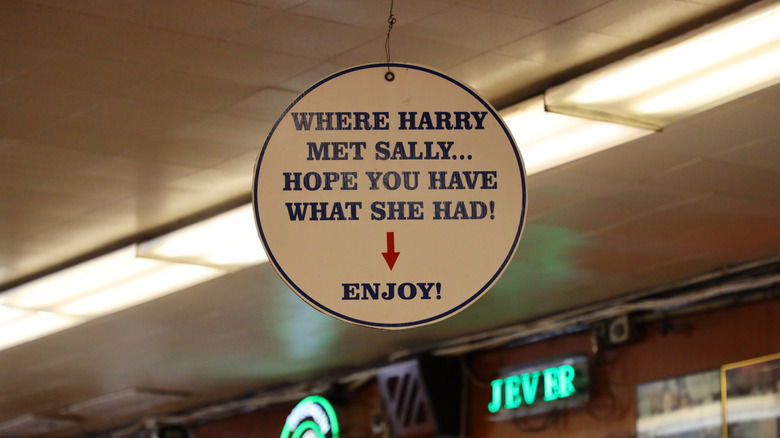
Speaking of more, it's fair to say that Meg Ryan gives a lot more in perhaps the movie's most famous scene (via YouTube). Eating in the legendary Manhattan pastrami hut Katz's Delicatessen (a place Reiner loved), Ryan's character Sally demonstrates for Crystal's Harry, loudly, how a woman can easily fake a convincing orgasm. Cue silence from the dining crowd after she finishes. An older woman nearby then turns to the server: "I'll have what she's having."
The hall-of-fame line wasn't actually in the original script — it was suggested on the spot by Crystal — and the actress saying the line was none other than Rob Reiner's own mother. The scene has since been forever entwined with Katz's Deli, and there's even a sign marking the spot where it was filmed.
1. Ratatouille: Anton Ego's flashback
It's rare when a movie can celebrate food in such a transcendent way that it touches on the profundity of the human condition. It's even more remarkable when it happens in a movie starring a cartoon rat. "Ratatouille" usually appears on lists of the best Pixar films ever made, and along with the other themes explored, it's a love letter to gourmandizing.
The plot follows a Parisian rat named Remy who has a very un-vermin-like and sophisticated taste palate — so much so that he winds up puppeteering a feckless young kitchen worker at a famous French restaurant in order to prepare haute cuisine. The idea of a rat cooking for discerning diners in Paris is an inspired one. None of those diners is more discerning, however, than the "Grim Eater" food critic Anton Ego.
Ego (voiced by the legendary Peter O'Toole) seems more capable of penning a withering, ruthless restaurant review than cracking anything even resembling a smirk. But when Remy masterfully prepares a ratatouille for Ego, the stone-hearted critic –- with one bite –- is immediately transported back to his happy childhood (via YouTube). It's as moving a moment as celluloid has ever produced. No surprise, then, that according to Anthony Bourdain and others, this is the best food film ever made.