

The Popular Grocery Store Chain That Didn't Install Barcode Scanners Until The 2000s
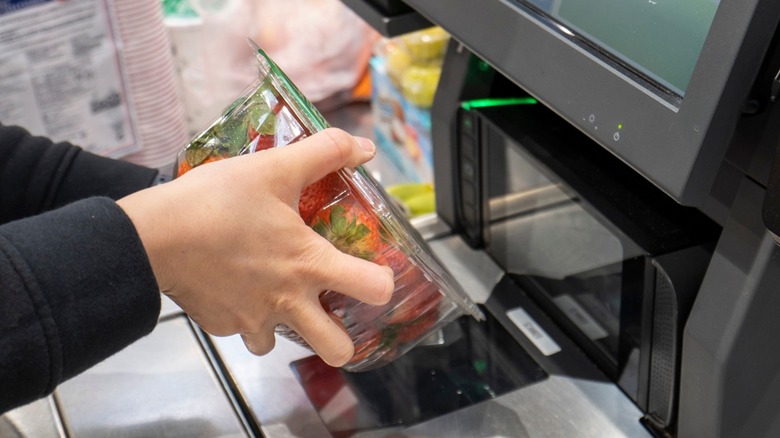
These days, people don't bat an eye as grocery store cashiers effortlessly ring up products using a barcode scanner to read UPC codes. Witnessing someone enter the price of every item manually would actually seem bizarre, given that many people have never experienced this classic checkout method in their lifetimes. Yet, long-established Aldi devotees who have been shopping at the German-based supermarket for decades don't have to look far into the past to remember when it was the norm at the discount grocer.
While most popular American grocery store chains adopted the UPC barcode scanner system long ago, Aldi was a notable holdout. It wasn't until the early 2000s that the petite shopping centers installed the technology, which other supermarkets had begun to introduce roughly three decades prior. Unbeknownst to some, Aldi is technically two companies: Aldi Süd and Aldi Nord (a disagreement about cigarettes split Aldi in half). The company that manages American Aldi locations — Aldi Süd — began implementing the barcode scanner system in 2000, with its European counterpart following suit in 2003.
In contrast, the old-school supermarket chain where the first barcode was scanned — Marsh Supermarket in Troy, Ohio — began doing so in 1974. Unfortunately for customers waiting in Aldi's checkout lines, the store had no desire to get on board with the futuristic scanning technology until decades later. Better late than never, I suppose. And to be fair, other companies didn't institute the automated system in their stores until years after it was invented.
Barcode scanners took years to develop
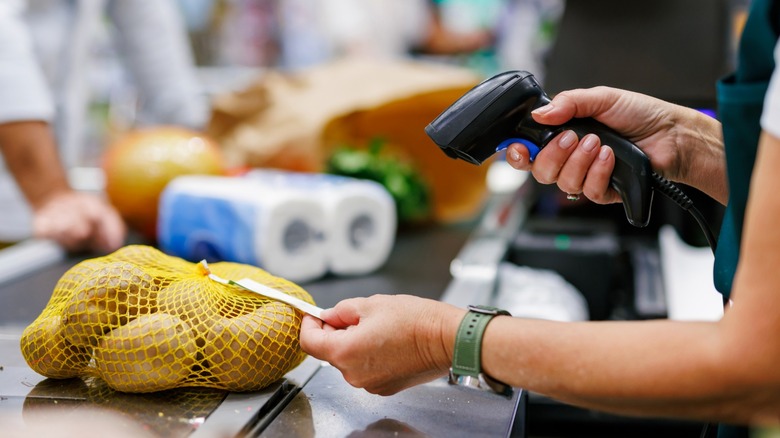
Although it took Aldi much longer than other grocery stores to implement an automated system to ring up and monitor what it was selling, the idea didn't take off en masse until decades after its inception. The mind behind the idea, Joe Woodland, conceptualized the solution to faster service and conveniently track goods sold in 1949, securing a patent for the technology three years later. After hearing about a grocery store manager longing for a more effective way to run his business, Woodland was inspired by Morse code and dreamed up the unique system on a beach in Miami.
His original design was different than the barcodes folks are familiar with — the thin and thick lines were arranged in a circular pattern similar to a bull's-eye. However, there wasn't an efficient way for a machine to read the barcode until the invention of the laser in 1960. Soon after, George Laurer of IBM tweaked Woodland's design to make it smaller and less prone to reading error, forging the small, rectangular UPC codes we all know today.
People have Woodland and Laurer to thank for the ability to efficiently ring up anything from pasta to car batteries to this day. It's unclear who was responsible for finally allowing cashiers to quickly scan all those high-protein Aldi finds. Whoever decided to get with the times should be celebrated by every customer waiting in a checkout line — as long as it may sometimes take with Aldi's minimal staffing, it was undoubtedly worse 30 years ago.