

Yes, You Can Put Aluminum Foil In The Microwave — But Always Check This First
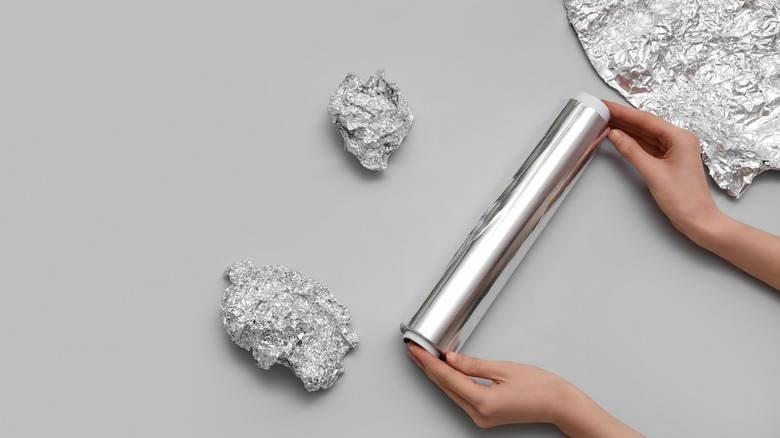
In some ways, the microwave is the most intuitive appliance to use. Simply put in your food, punch in the cook time, or hit one of the many pre-set buttons microwaves have; you can even make poached eggs in there. It's also easily cleaned when it gets grimy, making maintenance a breeze. Even if you're relatively new to the surprisingly versatile world of microwave cooking, you've probably heard the important warning to never microwave metal. Even if you don't know the science behind it, the "no metal in the microwave" rule is supposedly ironclad (pun intended). But is it? Actually, not entirely. You can, in fact, microwave aluminum foil if (and only if) your microwave manual specifically gives you the go-ahead.
While some microwave manufacturers simply avoid any mention of aluminum foil, others give instructions for how to microwave aluminum foil safely alongside explanations of different microwave settings and other information in the manual. If the manual says it's okay, you're in luck. So long as you follow the instructions, aluminum foil can be safely microwaved. A study from the Fraunhofer Institute for Process Engineering and Packaging found that aluminum foil caused no danger or damage in over 200 test scenarios. That said, it's best to play it safe when it comes to your own microwave. Use foil sparingly, and only if the manual gives you the go-ahead.
Why the no metal in the microwave rule exists in the first place, and why it can be broken
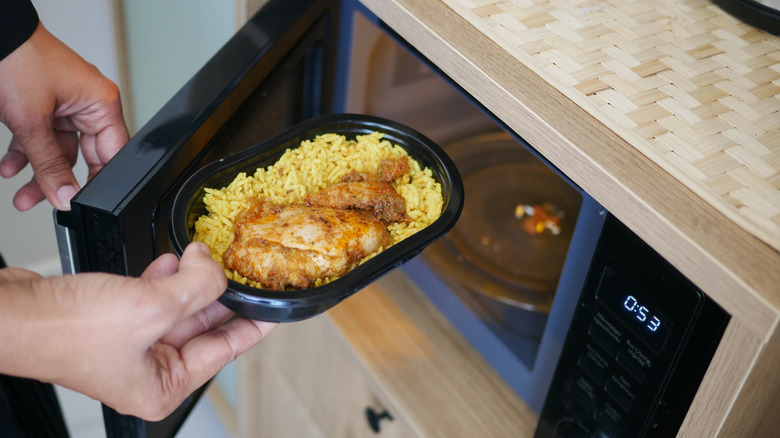
If aluminum foil is actually okay to microwave, why aren't you supposed to microwave metal? The answer is simple — to avoid setting your kitchen on fire. Well, that's the short answer, anyway. The longer, more scientific explanation is that metal reflects microwaves. Remember, a "microwave" is a type of wave on the electromagnetic spectrum. A microwave (as in, the appliance) is an oven that uses microwaves to heat food. The food absorbs the energy waves, heating the liquid inside the food and releasing excess heat as steam. The problem is, metal doesn't release steam. Instead, it will heat up until it simply catches on fire. Metal will also reflect the microwaves back at the machine which can cause sparks that are also a fire hazard.
The reason aluminum foil can, at times, be safely microwaved is that it's very thin. This means that, in small quantities, it won't reflect enough microwaves to cause dangerous sparking. It will, however, heat up quickly, so even if your microwave can safely handle aluminum foil be sure to use oven mitts when you're removing whatever it is you've heated with the foil. It will still reflect waves off the food, so it shouldn't be covering your dish entirely or it won't heat properly.