

Why Shaking Your Eggs Isn't The Scrambling Hack You Might Think
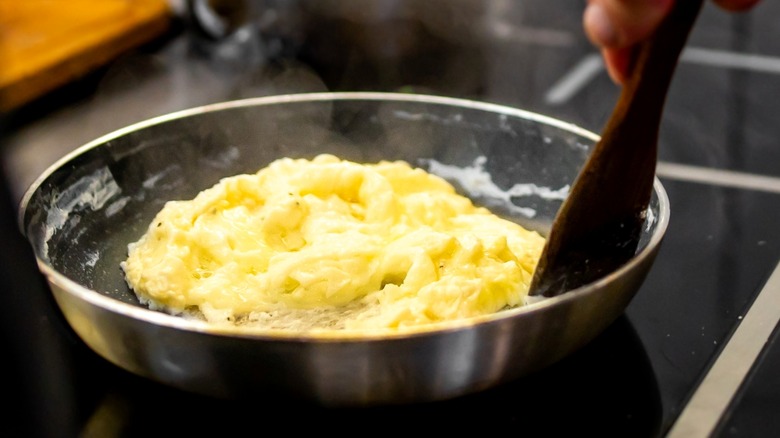
People have been whipping up fluffy scrambled eggs for breakfast for much of human history without seeing a need to improve the dish. Yet, somewhere along the line, someone got the impression that what wasn't broken needed to be fixed (much like all those viral TikTok hacks that don't work). One technique centers around putting eggs into a lidded jar and giving them a vigorous shake to achieve a better consistency. The idea is that it will enhance the overall texture of the dish, but unfortunately, if you're someone who subscribes to that theory, you're about to have your bubble burst.
As a chef and the director of innovation at the American Egg Board, Nelson Serrano-Bahri is a bona fide eggspert (I had to) on making silky smooth scrambled eggs. When asked about agitating them prior to cooking them, he mentioned that there is one advantage to the practice. "Shaking can help you get a more uniform mixture (fully combined whites and yolks) and incorporate some air," he said.
But do you really need that extra air? Not according to Serrano-Bahri. "Air alone doesn't equal creaminess," he said. "Creamy eggs come from small, tender curds and controlled heat, not maximum bubbles." In a worst-case scenario, shaking your eggs before they hit the heat can actually be detrimental to the consistency of the dish. "Too much aeration can make scrambled eggs feel drier or spongier if you then cook them hot or too long," Serrano-Bahri said.
Simpler is better with scrambled eggs
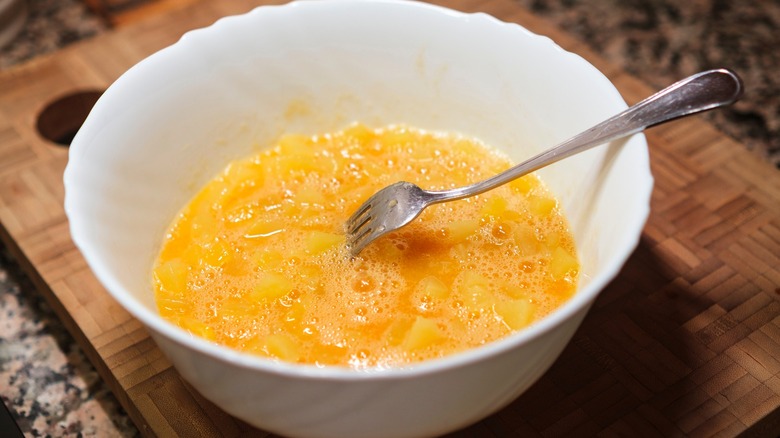
Whether you're making a quick 40-second scrambled egg breakfast or getting bougie with your meal and topping it with bottarga like Alton Brown, violently shaking the main ingredient beforehand isn't the best idea. But not to worry, after dispelling the shaking myth, Nelson Serrano-Bahri suggested a better method for cooking up a plate of pillowy, creamy goodness. "If your goal is controlled aeration and good texture, whisking in a bowl is better than shaking," he said.
Taking the old-school approach by whisking the eggs together in a bowl provides a few advantages. One is that you can actually see what you're doing and stop whisking if you notice the eggs starting to froth. You also won't risk large air bubbles forming, and you can incorporate any seasonings you want to include evenly.
"Whisk vigorously with a fork or whisk for 15 to 30 seconds until fully blended and slightly lighter, then cook gently," Serrano-Bahri said. "If you want 'luxury' texture, focus less on aeration and more on low heat, constant movement, and pulling early — that's the real cheat code." Don't forget to pay close attention to the edge of the pan with your trusty spatula, where the scrambled eggs will start to set first.