

The 15 Most Memorable Old-School Happy Meal Toys
We may receive a commission on purchases made from links.
Since its more humble beginnings, McDonald's has prided itself as a restaurant that the whole family can enjoy. However, there were early signs of appealing directly to kids, such as Archy's trick-or-treat bag from 1964. McDonald's first attempts at curated kids' meals were the short-lived Captain Crook Sea Bag and the Mayor McCheese Bag. It wasn't until 1977 that ad exec Bob Bernstein, inspired by toys found in his son's cereal box, came up with the Happy Meal. It was a revolutionary idea, housing a meal and a toy in a fun paper box, complete with games and puzzles. When it launched nationwide in 1979, even one-time rival Burger Chef, which introduced a kids' meal that included a toy called the Funmeal in 1975, was jealous and sued McDonald's for improving upon its idea.
While the initial Happy Meal toys weren't the coolest, the chain quickly got into the groove, and kids were begging for trips to McDonald's. In the almost five decades of existence since, Happy Meal toys have continued to leave a lasting impact on kids of multiple generations. Everyone has their own favorites, but some, without question, are more memorable than others. The Takeout would like to salute 15 of these Happy Meal toys.
Spaceship (1982) / Boats 'n Floats (1987)
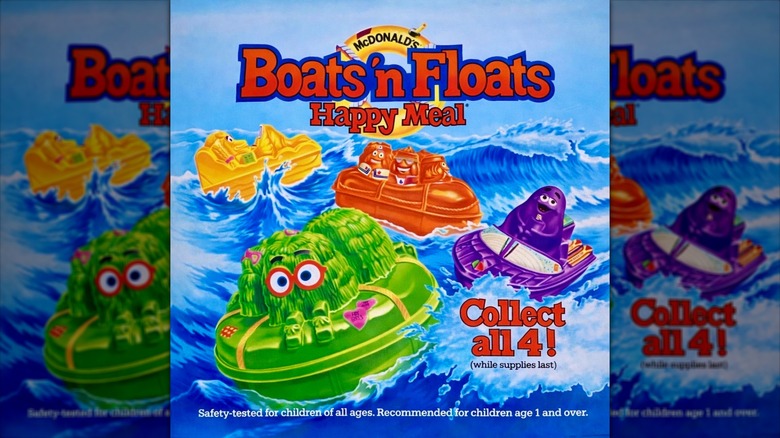
Long before Boo Buckets became the ghoulish carriers of Happy Meals, McDonald's blazed the trail with a set of four Spaceships. Each was a different colored plastic vessel (complete with stickers), and they landed at the United States Golden Arches in early 1982. They also invaded Canada, the U.K., and Australia. Ads invited customers to "Have your next meal in a spaceship" and afterwards to throw them around as a sort of Frisbee.
Five years later, in June 1987, this fun idea was recycled into more earthly vehicles known as Boats 'n Floats. This collection leaned into the McDonaldland characters, with flotillas featuring the green Fry Guys, yellow Birdie, purple Grimace, and red McNugget buddies. After the meal, they could join a kid in the bath, pool, or ocean for some smoothie sailing.
Playmobil (1982)
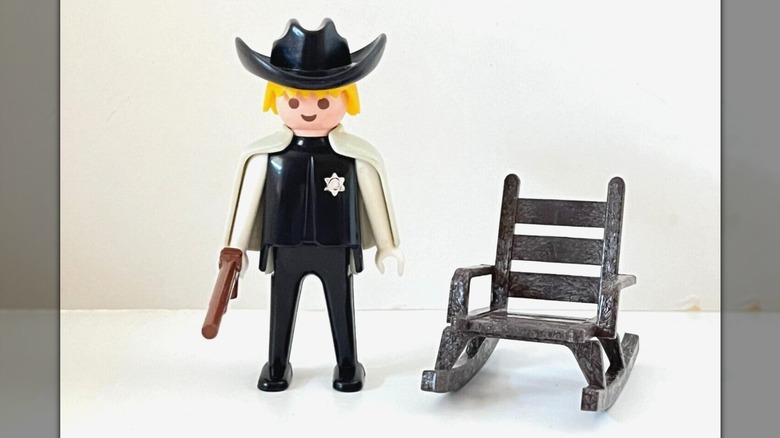
Playmobil figures were born in 1974, and figured into Happy Meal history starting on October 22, 1982. The theme was frontier land, and there were five figures in all: a farmer, a girl holding an umbrella, a sheriff, his horse, and a Native American complete with headdress, spear, and peace pipe. The boxes they were housed in included a small Playmobil comic strip, and they had pieces that could be punched out to form structures for the figures to hang around. It also came with a coupon; if a customer collected three of them, they could be sent away for a deluxe 18-piece accessory set that included a totem pole, canoe, and tent.
While the toys and boxes were noteworthy, what made this collection memorable was the recall of 10 million toys from all 5,700 U.S. locations halfway through its run. Turns out, the sheriff's gun was a danger. Not for packing heat, but posing as a choking hazard for children under 3. Playmobil has yet to return to American Happy Meals, but has recently starred in ones in the U.K. and Singapore.
Feeling Good (1985)
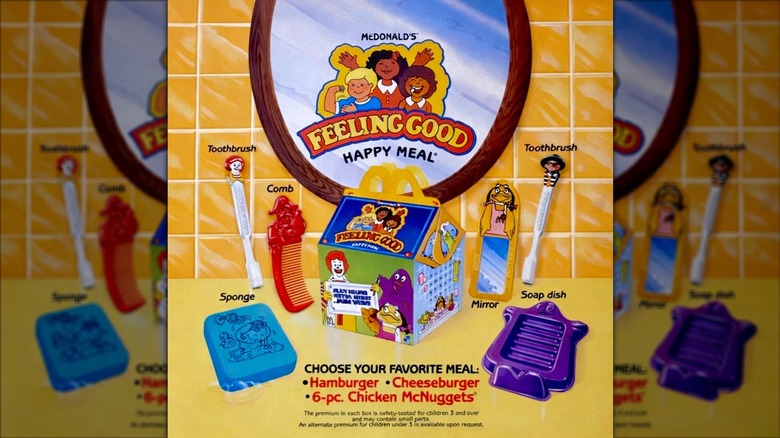
While Happy Meals have mainly been nothing but fun and games, some have carried a positive message. In 1983, toothbrushes were doled out as a "Happy Teeth" promotion. In 1986, from January 15 through March 9, McDonald's was hoping its customers were "Feeling Good" about its latest Happy Meal. Bill Pengra, owner of two McDonald's restaurants, told The Lake Geneva Regional News back then, "The 'Feeling Good' Happy Meal is aimed at promoting good grooming and dental health habits and exercising."
The Feeling Good box contained puzzles and games that promoted good health, including tips on how to warm up before exercising. On the inside was one of the following gems: a white Ronald McDonald or Hamburglar toothbrush, red Captain Crook pocket comb, yellow Birdie mini-mirror, aqua Fry Guy sponges, plastic duckies with Fry Guys riding them, and perhaps the pièce de résistance: a purple Grimace soap holder.
Changeables (1987, 1989, 1991, 2026)
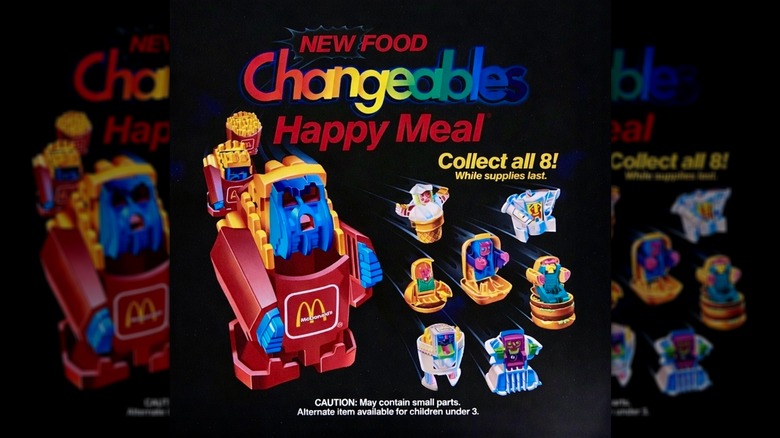
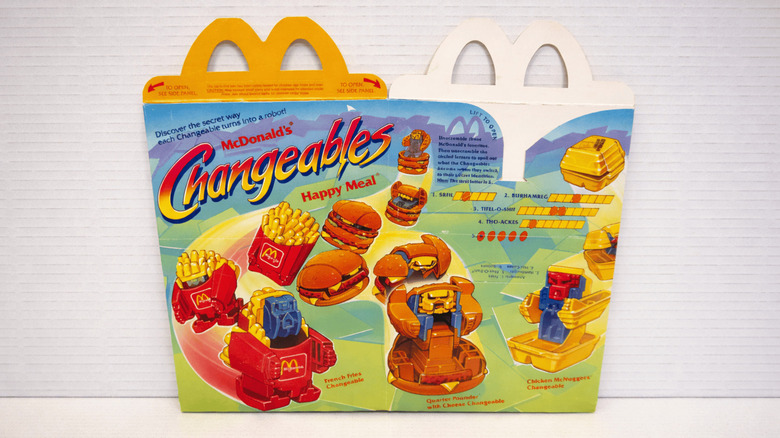
One of the most famous Happy Meal toys of all time is McDonald's take on Transformers: Changeables. The first series debuted in 1987 and featured familiar fare, such as a Big Mac, Quarter Pounder, McNuggets, Egg McMuffin, fries, and a soda cup, but there was more than met the eye here. A quick turn, and all were transformed into robots. Changeables returned two years later with similar toys in tow.
In 1991, McDonald's thought a bit outside of the (Happy Meal) box and changed things up with a new series entitled McDino Changeables. In lieu of robots, prehistoric dinosaurs hid under McDonald's food. The cutest was McNuggets-O-Saurus, who had its head, arms, and legs pop out the side of an old-school clamshell container. In 2026, McDonald's caved to popular demand and brought back Changeables, updated for a new generation. There were 16 in all, including one called Vash, who looks a lot like our old friend McNuggets-O-Saurus.
McNugget Buddies (1989, 1993, 1996)
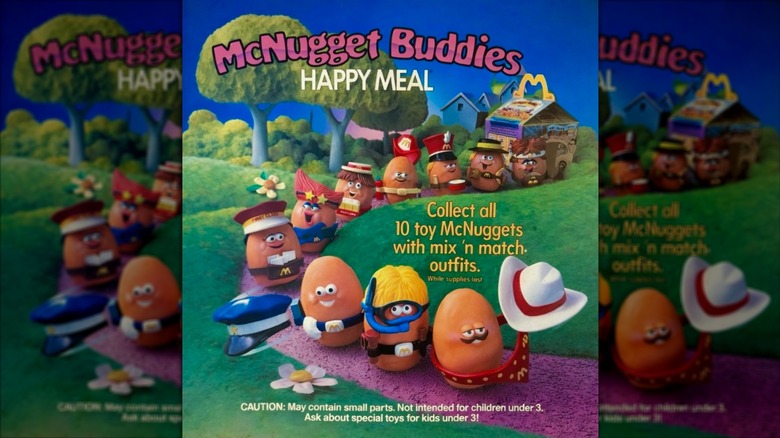
The colorful characters of McDonaldland were introduced in 1971 before starring in ads, lending their likeness to playground equipment, and, of course, being used in an array of toys. The McNugget Buddies were added to the team in 1983, and the golden-brown fellers evolved over the years to don all kinds of costumes and hats.
In 1989, the McNugget Buddies leapt off the screen and into kids' hands when they were drafted to become Happy Meal toys. The first set offered up 10 for the taking, with two available each week of the promotion. Their costumes were removable, making them a sort of McDonald's version of Mr. Potato Head.
As fans of playing dress-up, they were perfect to employ in ads to sell Halloween Boo Buckets in 1990, and in October 1993, that idea was channeled into the Halloween McNugget Buddies toys. They would rise from the dead three years later for more scary good fun. The McNuggets Buddies lay dormant for quite a while before being resurrected in 2023 for an adult Happy Meal co-created by New York artist Kerwin Frost.
Chip and Dale Rescue Rangers (1989)
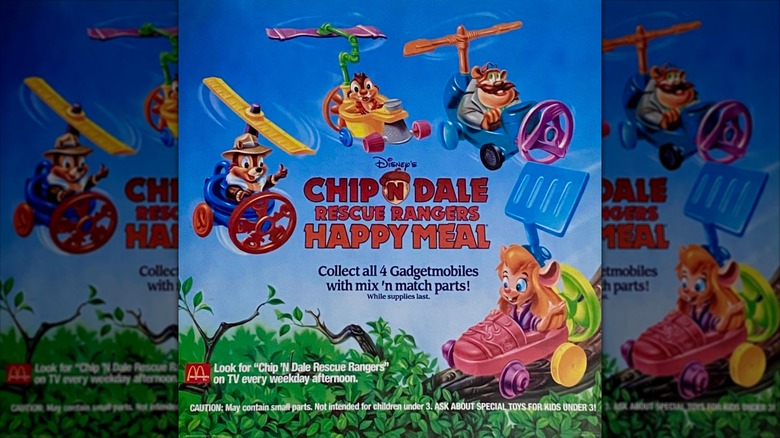
Rascally chipmunks Chip and Dale debuted in the world of Disney cartoons in 1943. In the ensuing decades, they became one of the House of Mouse's most endearing characters. In the late '80s, Disney made a push into the after-school TV landscape and plucked the dynamic duo to star in their own show ("Chip 'n Dale: Rescue Rangers") with a few new cute rodent characters joining them. The show became a hit and warranted tie-in products, such as fudge bars, fruit snacks, and a Happy Meal complete with some really cool toys.
The Rescue Rangers always tried to make things right in a big, bad world, and employed real-world items to help save the day (with a lot of help from its most crafty team member, Gadget). Gadget's inventive spirit was captured in this Happy Meal in four "Gadgetmobiles." A phone, a cup, and a shoe served as the shell for these vehicles, which were decked out with fans and propellers. One of the neater aspects of these toys was that the parts were interchangeable from one to the next, which probably made Eli Whitney blush from the great beyond.
101 Dalmatians and 102 Dalmatians (1991, 2000)
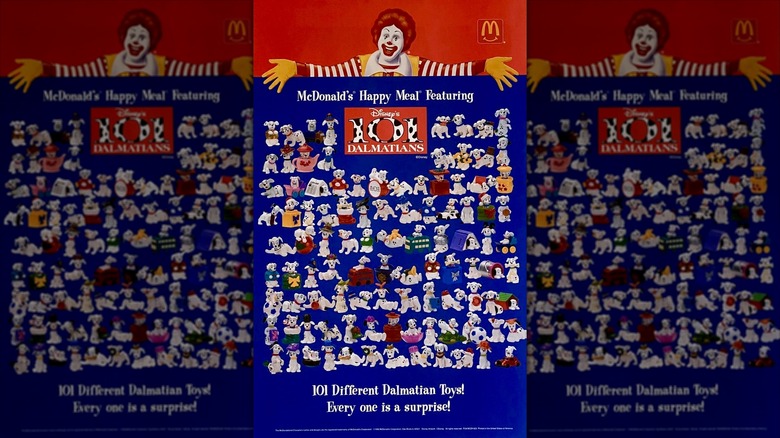
One of McDonald's best-selling Happy Meals of 1996 was "101 Dalmatians," to help promote the live-action film. True to its title, there were 101 Dalmatian dog figures to acquire. The mania was immediate, and adults were as into collecting them as much as kids were. Texan McDonald's owner Richard Castro told The El Paso Times, "The demand is so great it's hard keeping them in stores." Some owners were selling the toys directly for $1 without having to purchase a Happy Meal.
Another issue is that a buyer was unlikely to get all 101 if they simply bought that exact number of Happy Meals, since repeated toys were bound to pop up. Alan Rimm-Kaufman, an M.I.T.-educated statistics expert, revealed to The Richmond Times-Dispatch that, on average, it would take 528 buys to get all 101 toys. At $2 a piece, it would cost $1,056. Beyond the end of this Happy Meal's promotional period, McDonald's was still receiving calls seeking the toy pups, and collectors even met in local swap meets to complete their sets. However, despite all the hullabaloo, anyone could actually purchase the whole set for $101, plus shipping and handling.
An encore of this mammoth undertaking came about in 2000 with the release of a sequel, "102 Dalmatians." This time, the 102 toys came in 13 different themes, including wind-up, light-up, and even fuzzy toys. If one wanted all 102 toys without the guessing game, McDonald's offered them all for $150.
Boo Buckets (1989, 1991, 2022)
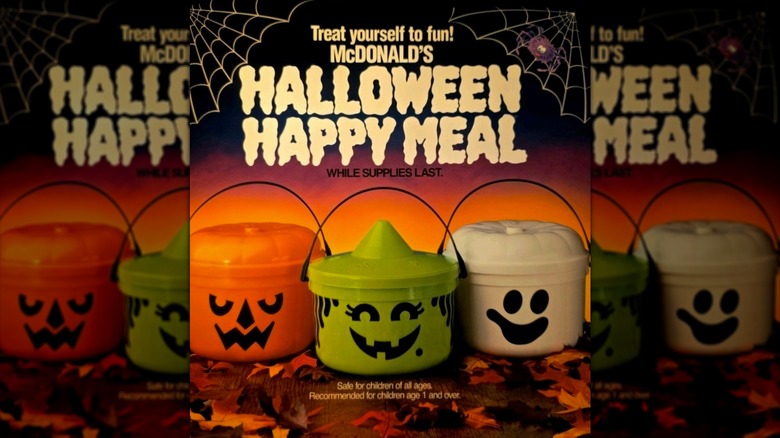
Trick-or-treaters always need a good bucket to carry around on the big night, and McDonald's offered a fun alternative starting in 1985. New Yorkers and New Englanders flocked to McDonald's to grab pumpkin-shaped pails with carved-out facial features that went by the names McPunky, McJack, and McBoo. This Happy Meal was devised by Arnold & Co., and 1.9 million of their creations were sold out in less than two weeks.
When they returned in 1989, a ghostly white bucket and a bewitching green one added a splash of color to the overly orange holiday affair. In the following years, the tradition would continue, with additional expressive details added to the buckets' faces to further build character.
The term "Boo Bucket" existed before, but started to be applied to those Halloween Happy Meal buckets by at least 2004. It was finally put into official play when Boo Buckets returned to McDonald's in 2022, and it seems to have returned every Halloween since.
Mystery of the Lost Arches (1992)
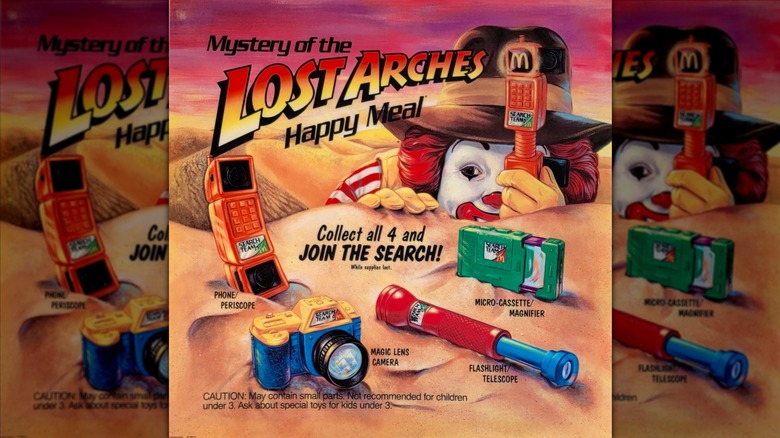
Indiana Jones rode off into the sunset with his "Last Crusade" in 1989, but his legend loomed large into the following decade. McDonald's tapped into the archaeologist's adventurous spirit in the early days of 1992 with its Mystery of the Lost Arches Happy Meal. The campaign and packaging borrowed heavily on the Harrison Ford-starring series, with Ronald sporting a fedora, and even its logo nicking Indiana Jones' famous red-to-orange gradient title treatment.
To help Ronald's quest in finding those lost Golden Arches, the chain supplied "search team members" with four tools to join the cause. There was a flashlight that turned into a telescope, a micro-cassette that had a hidden magnifier, a phone that doubled as a periscope, and a camera with a magical kaleidoscopic lens. The adventure played out in a series of TV ads, with Ronald and the gang rumbling through the jungle. In the final chapter, they found the lost arches and walked off into the moonlight.
Tiny Toon Adventures Cars (1992)
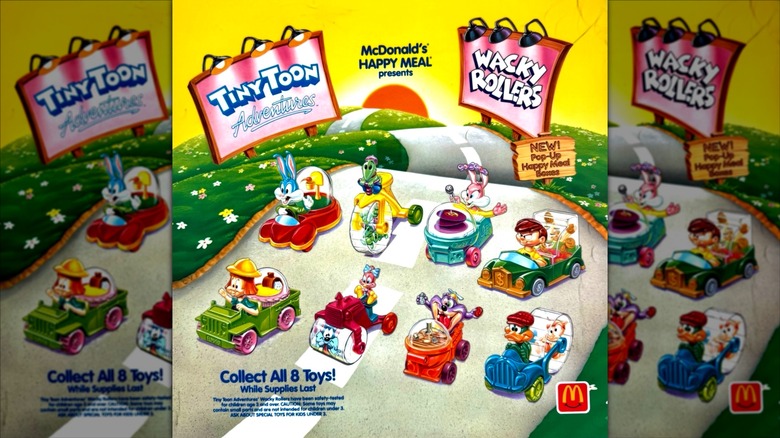
In addition to Disney, McDonald's also found time to give some love to Warner Bros. cartoons like Looney Tunes, including "Space Jam" movie tie-ins, and also for its little offshoots, "Animaniacs" and "Tiny Toon Adventures." Many of these Toon meals centered around vehicles with the characters driving them, and the best of the lot was the Tiny Toon Adventures Wacky Rollers that rolled into stores in late October of 1992.
There were eight total cars in the Wacky Rollers collection: Buster Bunny, Babs Bunny, Plucky Duck, Sweetie, Dizzy Devil, Gogo Dodo, Montana Max, and Elmyra Duff. What set these apart was that they had a secondary element beyond the car: Some were outfitted with a hamster wheel featuring another character, and others had a little see-thru bubble, which did things such as shoot basketballs into a hoop or toss coins within a cash register.
The Flintstones (1994)
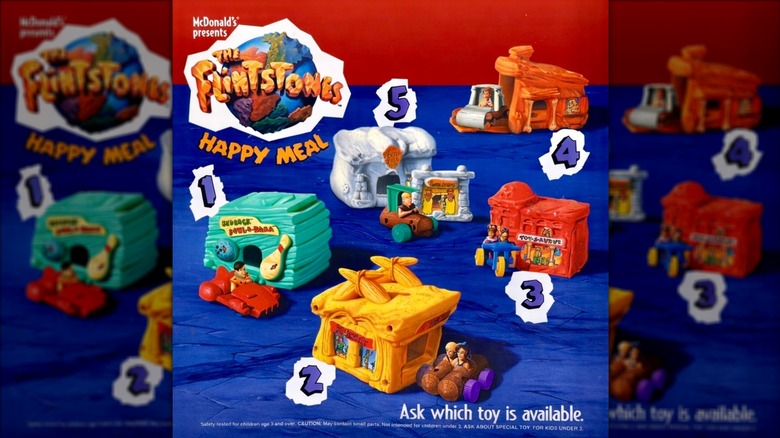
The Flintstones were the modern Stone Age family cartoon that ruled TV from 1960 to 1966 and got the live-action, big-screen treatment in 1994. Promotion for the film seemed endless. In the food department, that included Nestle ice pops, granola bars, mac and cheese, Frito-Lay products, and a McDonald's takeover. In the film, they had a RocDonald's, and in the real world, McDonald's sold frosted Bedrock Mugs for the adults and a totally rocking set of Happy Meal toys.
The Flintstones Happy Meal featured not only the characters in a vehicle, but also a building they could hang out at, as well as store the vehicle inside. There were five in all: Betty and Bamm-Bamm could hit up RocDonald's; Barney could fill up his car with fossils; Wilma stayed close to her own home; Fred could be seen at the Bedrock Bowl-O-Rama; and Pebbles and Dino went shopping at Toys-S-Aurus. For those with a complete set, they had a whole Bedrock foundation in miniature.
Sonic the Hedgehog (1994, 2003)
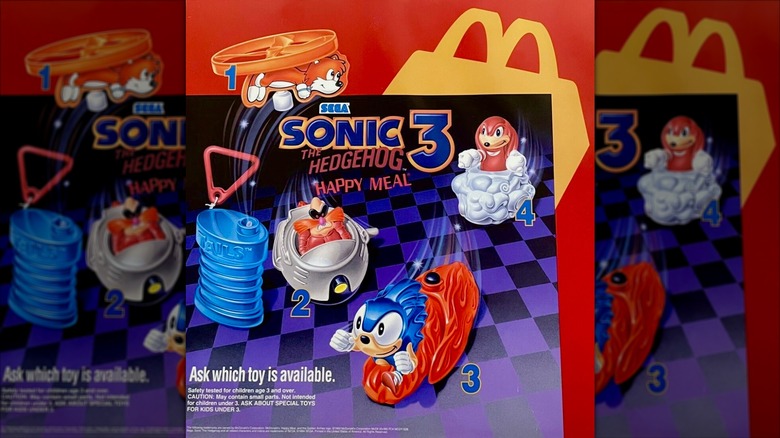
From February 4 through March 3, 1994, four fun figures helped Sonic sell his third-ever video game. One featured our hero Sonic, who would shoot off in a hurry with the press of a button. Another had Tails with a ring propeller, and he went flying in the air with the pull of a string. Knuckles' figure was more grounded, but if you slide him back and forth, his figurine would go into a rapid spin. Dr. Robotnik may be a mad scientist, but he got stuck with the simplest one: a wind-up toy.
In the summer of 2003, Sega one-upped the Happy Meal game by including handheld ones within the box. There were six of these LCD, two-button handheld games to play: Knuckles Soccer, Shadow Grinder, Sonic Action Game, Sonic Speedway, Tails Sky Patrol, and AiAi Banana Catch (the only non-Sonic related one). They were reportedly good for 400 plays before it was game over for their batteries. This McPartnership worked so well that one of the 2004 winter holiday seasons was blessed with eight new games.
Inspector Gadget (1999)
Inspector Gadget bumbled his way to solving cases with a lot of help from actual gadgets in a cartoon that ran from 1983 to 1985. In 1999, Matthew Broderick embodied him in a feature film. Like with The Flintstones before it, McDonald's latched onto this new film and offered up something for the adults and the kiddies. The young at heart had a chance at prizes through the QPC Code Game, and for the young, another best-selling Happy Meal.
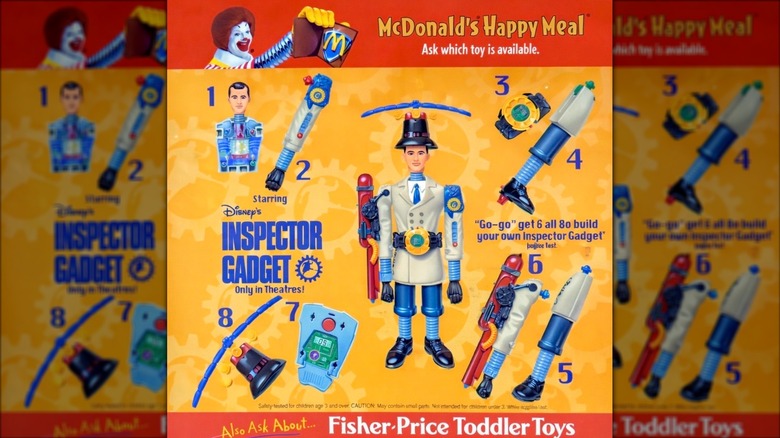
Up for grabs were eight gadget-body part combos, which cobbled together to form an Inspector Gadget figure. McDonald's marketing Vice President R.J. Milano told the Los Angeles Times, "It is unlike anything that has been done in the industry and unlike anything we've ever done as well." The promotion began in July of 1999, with even ex-Duke basketball star Shane Battier helping to push it when he interned that summer at McDonald's ad agency Golin.
Like with the 101 Dalmatians Happy Meal, some customers had a hard time finding all the pieces. One desperate soul in Kentucky took to placing a newspaper ad looking for just the right leg with a flashlight. Martha Reyes of Brooklyn was averaging four trips to McDonald's per week and told The New York Daily News, "I'm going broke" doing so. McDonald's spokesman Palmer Moody noted to the same publication, "We don't want to hassle parents or frustrate them," adding, "Our goal was to create a fun toy for kids to play with and collect."
Disney's Tarzan on Video (2000)
Disney released Tarzan in theaters in the summer of 1999 and naturally had a Happy Meal starring its characters in toy form. They were nothing particularly special, but, when it came time to promote its home video release a year later, McDonald's literally went ape with its next set of toys.
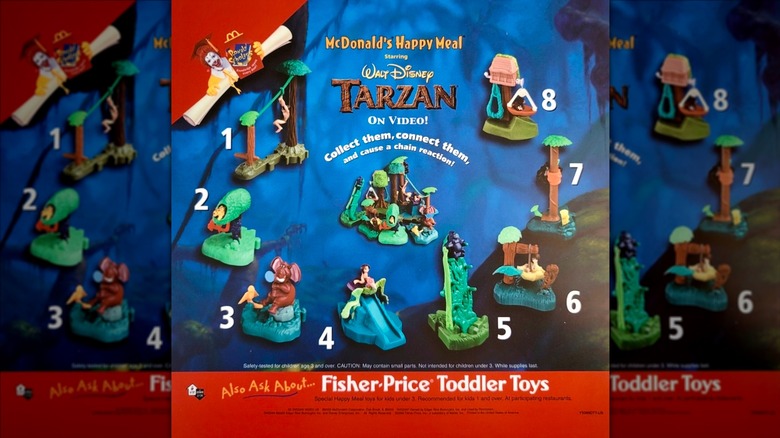
Yes, there were character figures included in the 2000 Tarzan on Video Happy Meal, but they also came with a little extra jungle-y setting to play around in. The action of the movie was perfectly translated into these toys, where young Tarzan goes down a slide, the older version swings from a vine, Terk tumbles down a tree, Jane flips over one, and Kerchak twirls down his own. There were eight toys in all. If you had them all, the bases connected to form a crowded island. When together, if you started playing with the adult Tarzan vine swinger one, it would activate the rest one after the other, like a plastic Rube Goldberg machine paradise.
Spy Kids (2001)
The 2001 family-friendly film "Spy Kids" was looking for a fast-food promotional partner. The rhetorical question easily became, "Did someone say McDonald's?" The partnership ran both ways, with a dehydrated Big Mac packet magically turned into a juicy burger on the big screen and franchisees and operators nabbing roles as extras in the film. Over at the Golden Arches, "Spy Kids" not only starred as a Happy Meal, but as the XL version that was recently launched, called Mighty Kids Meals.
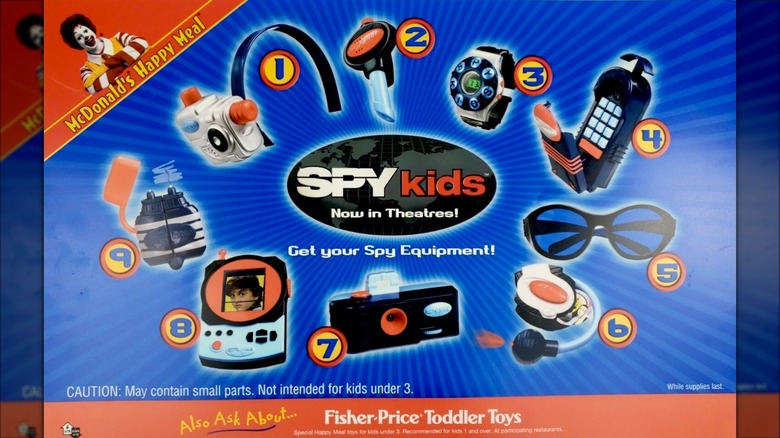
The Spy Kids set contained nine different gadgets, including a spy watch, a phone, a Pog disc shooter that doubled as a spy light, a twisty musical pencil topper, an actual camera that took real film, an invisible ink pen, and a cool pair of shades. It became the best-selling Happy Meal of 2001. When movie sequels came calling in 2002 and 2003, so did sequels for Happy Meals and their spyware toys.