

These 10 Companies Own (Almost) Every Brand In The Supermarket
Capitalism is kind of a big deal in the U.S. Many people are as patriotic about this country's system of free enterprise as they are about the stars and stripes, mud-strewn Ford pickup trucks, and college football. One of the tenets of capitalism is consumer choice. The thinking goes: The more untethered businesses and markets are, the more options and freedom customers will enjoy. And walking into your local supermarket, there truly is a dizzying array of products to choose from. But that choice is, more often than not, something of an illusion. Behind the multitude of brands and labels stocked in grocery store aisles, there are just a handful of megacorporations that own virtually all of them.
It's estimated that over 80% of grocery items have almost half their market share controlled by fewer than five companies. Even seemingly independent products such as craft beer are generally owned by giant multinational beverage conglomerates like Anheuser-Busch. Which means that, unless you shop exclusively at a local co-op store or live off the land like an ancient hunter-gatherer, your pantry and fridge are likely stocked with mass-produced goods from a global syndicate. Whether you're okay with that or not is a matter of personal preference. But knowing the reality can't hurt. With that said, here are the 10 companies that own nearly every brand in the supermarket.
General Mills
It started as a single flower mill. Originally known as the Washburn-Crosby Company, General Mills was founded in the mid-19th century with one mill overlooking the northern reaches of the Mississippi River near Minneapolis. Granted, it was the largest mill west of New York at the time and was soon followed by a second, even bigger location to accommodate the company's growth. Eventually, in 1928, Washburn-Crosby merged with other flour mills, prompting the name change to General Mills. Around this time, and over the succeeding decades, General Mills launched household-name brands such as Betty Crocker, Wheaties, Bisquick, and Cheerios, setting the company on the path to grocery store dominance.
But General Mills didn't limit itself to the supermarket. The brand purchased Red Lobster in 1970, and yes, General Mills even started Olive Garden from scratch. Not only that, in 1953, it helped create the progenitor of the Black Box (as in airplanes) with the Ryan flight recorder. General Mills officially became one of the largest food companies in the world with the acquisition of Pillsbury in 2001. Today, along with its original stalwart cereal and baking brands, General Mills owns Annie's, Gold Medal flour, Häagen-Dazs (outside the U.S.), Green Giant, Nature Valley, Progresso, Blue Buffalo, and Cascadian Farm –– to name just a few of the 100 or so labels under its name.
Nestlé
The origin of Nestlé is really a tale of two companies. There was the Anglo-Swiss Condensed Milk Company, which was founded in 1866 in Switzerland by a pair of brothers. And then there was Henri Nestlé, a pharmacist, whose company developed a hugely important – and for many life-saving –- mass-produced infant formula in 1867. About 40 years later, the businesses combined forces and called themselves the Nestlé Group. Starting with around 20 factories in 1905, making products for African, Asian, Australian, and Latin American markets, Nestlé experienced a century of massive expansion (minus a few hiccups like the Great Depression and World War II). This included going beyond food and dairy to acquire pharmaceutical and cosmetic companies in the '70s.
Although Nestlé has had its fair share of recalls and controversies, there isn't an aisle in the grocery store where you won't find its tracks. From baby formula (Gerber), coffee (Nespresso, Coffee Mate, Starbucks Coffee At Home), pet food (Purina), and ice cream (U.S. Häagen-Dazs) to sparkling water (San Pellegrino), hot chocolate (Nesquick), candy (KitKat), frozen foods (Stouffer's, Hot Pockets, DiGiorno), and numerous international foods, the list goes on and on. After acquiring a majority stake in Orgain in 2022, even plant-based nutritional products are under Nestlé's purview.
Kraft Heinz International
Even before the gigantic companies merged in 2015, Kraft and Heinz were already, on their own, titans of industry. Back in 1869, it might have been hard for Henry J. Heinz to imagine being a namesake for the fifth-largest food and beverage company in the world. The 25-year-old was just trying to sell the bottled, grated horseradish he grew in his family's home garden in Pittsburgh. In 1905, H.J. Heinz Company became incorporated. Buoyed by its famous ketchup and canned baked beans, Heinz was the top dog in pre-made meals in the 1930s.
On the other hand, J.L. Kraft and Bros. was founded in 1909 and soon after was selling over 30 varieties of cheese. Philip Morris (of tobacco infamy) bought the company in 1988. And in 2012, Kraft Foods divided into Kraft Foods Group Inc. and Mondelēz International. Kraft then joined forces with Heinz three years later. The megacorporation nets nearly $30 billion in annual sales as a unified market force.
Spurred by declining share value in recent years, Kraft and Heinz are splitting up into two companies. Yet its combined product roster remains as ubiquitous in supermarkets as ever. This includes staple brands such as Ore-Ida, Stove Top, Cool Whip, Kool-Aid, Maxwell House, Capri Sun, Grey Poupon, Oscar Mayer, Lunchables, Philadelphia cream cheese, and, of course, Kraft cheeses and Heinz condiments.
PepsiCo
Sometimes one is defined by their rivalry. Think of these Aldi dupes you'll probably recognize due to their name-brand equivalents, for example. Similarly, soda giant Pepsi is often seen in the context of, and as second to, Coca-Cola. Pepsi's parent company, PepsiCo, is far from a minnow of a food company, however. In fact, it's a leviathan.
The first Pepsi was formulated by Caleb Bradham in 1893, at his North Carolina pharmacy-slash-soda fountain (not an uncommon hybrid in those days). He called it "Brad's drink" before deciding to try harder, coming up with the moniker Pepsi-Cola. Like Coke, it was originally marketed to have health benefits (like aiding in digestion) before simply gaining popularity as a delicious soft drink. With savvy advertising (including an early example of celebrity endorsements way back in 1913), Pepsi soared.
The mid-1960s saw two seismic business moves for the company: the purchase of Mountain Dew and the merger with snack giant Frito-Lay. As the enterprise continued to grow, acquiring numerous brands and even restaurants such as Pizza Hut, Taco Bell, and KFC (which is partly why certain fast food restaurants sell only Pepsi or Coke), its reach in the food market became substantial. Browsing your grocery store today, you'll come across myriad PepsiCo brands: Cheetos, Lipton, Doritos, Aquafina, Bubly, Gatorade, Pearl Milling Company, Quaker, Cap'N Crunch, Rockstar Energy Drink, Sabra, Muscle Milk, SoBe, and Sun Chips –– just to name a few. Or, you know, many.
Mondelēz International
Mondelēz International is a relatively new kid on the mega-globo-food-corp block. Back in 2012, Kraft Foods split, and each half would be independently publicly traded. One, Kraft Foods Group, eventually became Kraft Heinz. The other was Mondelēz. Kraft would hold on to many iconic products, but Mondelēz was not exactly left with scraps. On the contrary, it's a standalone company with an astonishing global footprint, selling products in more than 150 countries across five major geographic regions. Its ownership of Cadbury alone –– which it retained after the divorce from Kraft –– means Mondelēz boasts about 15% of the world's candy market. In recent years, the company has pivoted from junk food and turned to healthy snacks to meet growing customer demand (and keep up with fellow food conglomerates). Well-known brands like belVita and Good Thins were created to jumpstart this shift.
Regardless, Mondelēz has not forgotten its roots. Although maybe not a recognizable brand itself, the multinational definitely owns a huge number of household names: Honey Maid, Easy Cheese, Chips Ahoy!, Clif, Ritz, Triscuits, Nutter Butter, Lorna Doone, Toblerone, Wheat Thins, Halls, Sour Patch Kids, and, oh yeah, a little cookie called Oreos.
Unilever
"Uni" as a prefix means one, but that doesn't come close to encapsulating Unilever's multitudinous brand roll call. Nevertheless, like many other companies, Unilever came from modest beginnings. The story of the London-based company is one not of ice and fire, but of soap and margarine (slightly less exciting, perhaps). In 1884, William Lever began selling packaged soap that was well-marketed and became wildly popular. Meanwhile, across the North Sea, two Dutch families –- Van den Bergh and Jurgens — started a margarine company called Margarine Unie. With both companies brought together by a shared need for fat (as an ingredient), they merged, and in 1930, Unilever was born.
As the 20th century rolled on, Unilever expanded, diversified, and acquired new brands along with its established household products. First, in 1943, it acquired the Birds Eye line of frozen products, which later included the first frozen peas ever sold in the U.K. Eventually, brands such as Lipton, Breyers, and Klondike were purchased. Nowadays, Unilever boasts supermarket stalwarts like Hellmann's, Dove, TRESemmé, Vaseline, and a load of other household names. Unilever even teamed up with the app Too Good To Go, meaning customers can order discounted Unilever products that are approaching their sell-by date.
Danone

Giant food companies can seem to the average person like faceless, multi-tentacled monstrosities. This impression can belie noble beginnings, however, as with Danone. In the early 1900s, malnutrition and poor digestive health were major problems for children. In 1919, a Greek immigrant and concerned father named Isaac Carasso, who lived in Barcelona, Spain, was inspired by the Nobel Prize-winning microbiologist, Élie Metchnikoff. Metchnikoff's work gave Carasso the belief that yogurt could improve children's intestinal wellbeing. Carasso developed a gut-healthy yogurt and founded Danone, which was named after his son Daniel. The first Danone products were sold in pharmacies.
Daniel would later take over the company and steward its rise as a major global food player. He expanded the brand to France (where it's still headquartered today) and then the U.S. (where it's known as the instantly recognizable Dannon). He also added fruit to the yogurt, making the snack more appealing to U.S. palates. A period of mergers and acquisitions over decades has led Danone to dominate the "healthier side" of the grocery store. It owns staple shelf and fridge brands such as Oikos, Silk, evian, Activia, Danimals, Follow Your Heart, STōK, Happy Baby, and YoCrunch.
Campbell's
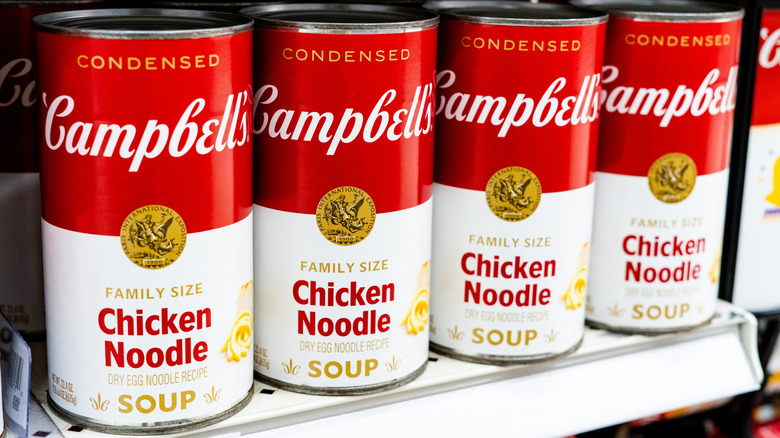
When Andy Warhol created his era-defining painting series of the Campbell's soup can, he knew what he was doing. It wasn't just the pleasing, clean aesthetics of the packaging, but the name. It was, and still is, an iconic American product. But Campbell's is so much more than its humble soup can. The company itself is a behemoth. Founded in 1869 in Camden, New Jersey, by Joseph Campbell (a produce wholesaler) and Abraham Anderson (a canner), it seemed to be the perfect match and would portend unimaginable success. In 1895, Campbell's Beefsteak Tomato Soup (the first Campbell's soup flavor) was sold in jars, and two years later, it was canned for the first time. The brand was off to the races.
Throughout the 20th century, Campbell's diversified its famous soup line and acquired brands like V8, Pepperidge Farm, and Pace Foods, while launching SpaghettiOs, Chunky, and Prego. In recent years, it has purchased broth and soup giant Pacific Foods and snack giant Snyder's. Campbell's history adds up to an impressive lineup of product brands under its ownership, including Goldfish, Cape Cod, Kettle Brand, Swanson, Rao's Homemade, Michael Angelo's, Eat Smart Snacks, Stella D'oro, Archway, and Snack Factory.
Coca-Cola
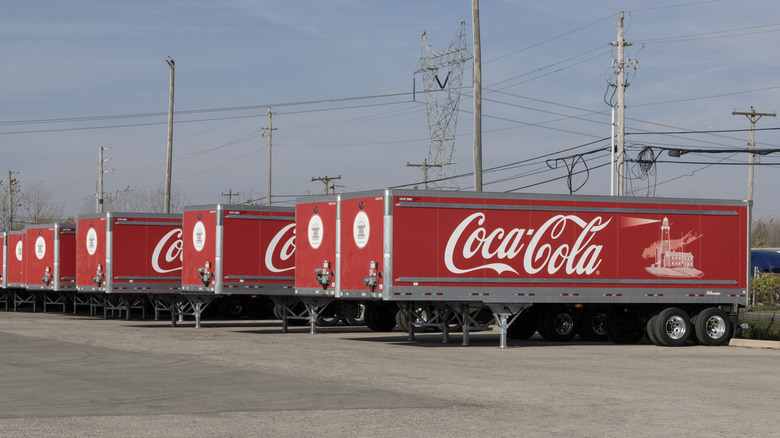
It's a juggernaut that the entire world instantly recognizes. In fact, it might be the one brand that immediately screams "America!" to anyone, even in the furthest reaches of the globe. Of course, Coca-Cola's origins as a company are probably just as well known. On May 8, 1886, in Atlanta, a pharmacist (this is a recurring theme) named John Stith Pemberton concocted Coca-Cola and sold it at the soda fountain in Jacobs' Pharmacy. Almost from the get-go, it was a hit. Once the name Coca-Cola was officially trademarked in 1893, there was no going back. In 1904, annual sales reached $1 million for the first time. In 1946, it purchased Fanta, and about a decade later, partnered with McDonald's. Shortly after, Coca-Cola acquired Minute Maid and introduced Sprite. This furious expansion activity went on all the way up to the company's first dairy brand purchase in 2020: Fairlife.
As of this writing, original Coca-Cola occupies nearly half of the U.S. beverage market. Although soda consumption has decreased in recent decades, Coca-Cola still raked in nearly $50 billion in annual revenue in 2024. The brand isn't just making bank off its famous red-labeled elixir (and Coca-Cola's many uses in the kitchen), however. For starters, some of Coca-Cola's other brands include Dasani, smartwater, Minute Maid, Powerade, and vitaminwater. It's also a significant shareholder in Monster Energy drinks. And that's not all. You can add Costa Coffee, Del Valle, Fresca, Gold Peak, Schweppes, Simply, and Topo Chico to the roster.
Mars, Inc.
Buttercream candies. That's how it all started. Frank C. Mars began selling buttercream candies out of his kitchen in Tacoma, Washington, in 1911. After moving his business and family to Minneapolis, his son had an idea for a chocolate bar. It was called Milky Way, and it was a hit. So much so, Frank moved the entire company and its employees to Chicago, where, boosted by the introduction of Snickers and 3 Musketeers, a period of immense growth ensued, including entrance into the European market. World War II saw the manufacturing of M&M's: hard-shell candies that didn't melt, perfect for soldiers stationed overseas. They became so popular and the demand so great from the general public that Mars had to open new factories. The company's profits soared over the years, and it eventually made inroads into other products like pet care and rice.
In 2008, Mars acquired Wrigley's for $23 billion, further stamping the company's mammoth impression in the grocery store. The even bigger get, however, was its 2025 purchase of the Kellanova brand (aka Kellogg's). Besides candies like Skittles and Twix, Mars also owns Ben's Original rice, Eggo, Bear Naked, Cheez-It, Pop-Tarts, and many iconic cereals such as Frosted Flakes and Rice Krispies. Pet brands under its purview include Pedigree and Whiskas.