

16 Breakfast Foods That Were Invented In The US
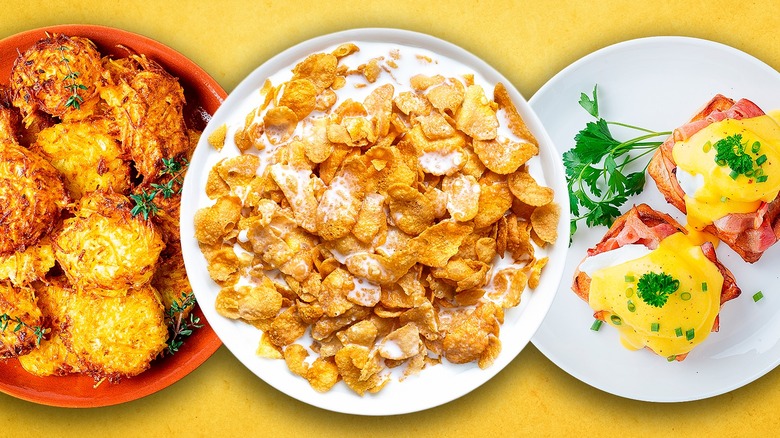
The most important meal of the day wasn't always regarded so highly. In fact, in the Middle Ages, many saw morning eating as unnecessary and even gluttonous. Most ate only two meals a day. If they did have breakfast, it consisted of simple foods and leftovers from the previous night's dinner. The idea of eating first thing in the morning became a cultural mainstay largely due to the Industrial Revolution, when it functioned to fuel workers throughout the day. Later, a 1944 cereal marketing campaign by Grape Nuts solidified breakfast as a distinctive, crucial daily meal.
Then there's the quintessential American breakfast, a successor of the English-style meal. You know the one you see in the movies: pancakes stacked tall and doused in syrup, fluffy eggs, crispy strips of bacon, and a cold glass of orange juice. Plus an apple, which is somehow the only thing anyone has time to eat on TV before rushing out the door and leaving the rest of the decadent meal untouched. While some of these foods have origins outside of the U.S., many breakfast staples have their roots right here on American soil. You're probably imagining brightly colored cereals lining grocery store shelves and fatty strips of bacon on griddles. But there are some breakfast foods on this list that may surprise you, from lesser-known regional meals to fusion dishes.
Eggs Benedict
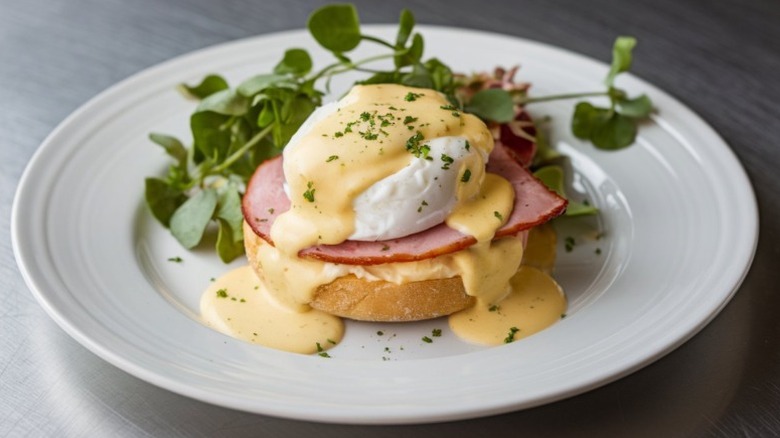
While breakfast has become commonplace, some still prefer to fill their stomachs later in the day. If that's you, brunch may be your saving grace. This breakfast-lunch combo usually features sweet options such as pancakes and waffles, substantial egg dishes, and cocktails. One of the most popular brunch choices is eggs Benedict. The dish consists of halved English muffins topped with Canadian bacon, poached eggs, and hollandaise sauce.
There are a few stories explaining how the classic came to be. One starts at Delmonico's, a restaurant that has served New York City since 1837. It is considered a pioneer of fine dining, and that's apparently not where the innovation stops. As the story goes, chef Charles Ranhofer created the dish to captivate two regular customers, Mr. and Mrs. LeGrand Benedict. Ranhofer's version used brioche and Black Forest ham in contrast to today's recipe.
Another potential origin story goes that a man named Lemuel Benedict found himself at The Waldorf Hotel, looking to cure a hangover. He ordered the foods that make up a modern eggs Benedict, but with toast and bacon in lieu of an English muffin and Canadian bacon. Oscar Tschirsky, who was working at the hotel at the time, saw this and added the new concoction to the menu with the fixings we see today. The one thing certain about both of these stories is that whoever invented the dish probably didn't anticipate just how big it would become.
Cereal
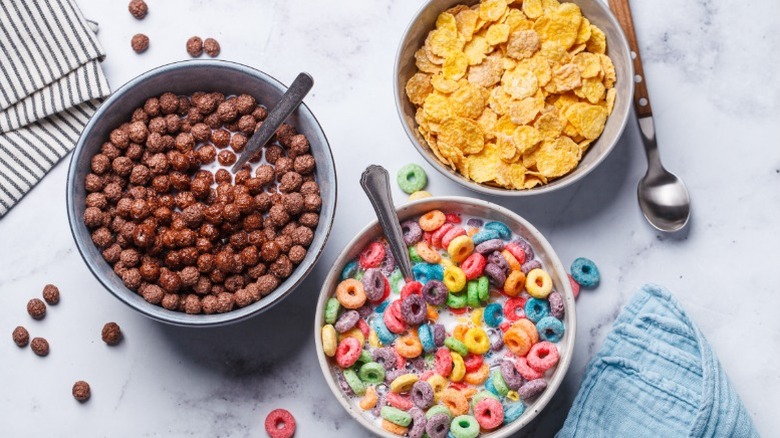
Have you ever wondered why American breakfasts are so sweet? It seems like 90% of the cereal boxes you find in grocery stores are packed full of sugar and colored in every shade of the rainbow. But the breakfast staple didn't always look this way. Cereal actually started out as a potential health food long before organic eating became popular.
James Caleb Jackson was a nutritionist credited with making the first cereal. It was called "granula" and was made from a dried, hardened graham flour dough. The milk wasn't used for flavor so much as it was to soften the pieces overnight to an edible consistency. Later, a surgeon by the name of John Harvey Kellogg made his own version that he hoped would aid with digestive health. One of his own patients, C.W. Post, was inspired by the idea and started the Postum Cereal Company in 1895.
But the real cereal fad would eventually circle back to Kellogg's. By 1906, John's brother, Will Kellogg, gained the rights to Corn Flakes. Will Kellogg added sugar to the cereal, founded the Battle Creek Toasted Corn Flake Company, and began widespread marketing. Soon, cereal wasn't just sustenance. Over the years, it became increasingly aimed at children, complete with cereal box prizes, smiling mascots, and TV advertisements paving the way toward a sugary revolution. While health-conscious options are in again today, the appeal of sweet cereals still hasn't waned.
Pork roll
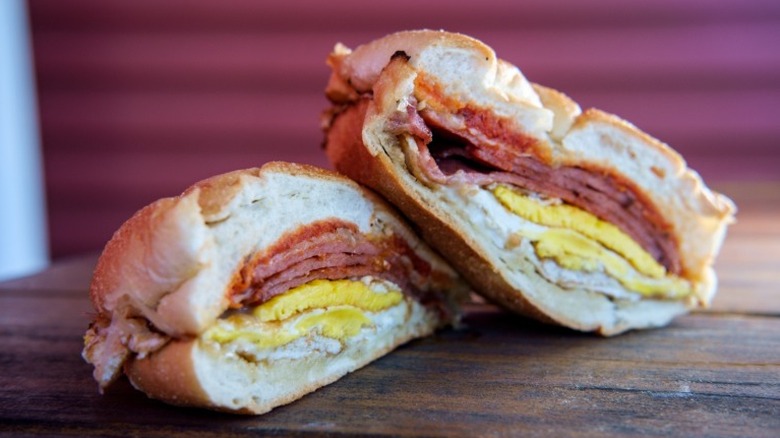
Pork roll is a New Jersey treasure that's been around since 1856. It is a processed pork product flavored with different spices and sugar. The slightly tangy, salty meat product comes in a log that is then sliced and scored for cooking. The slices are typically layered with egg and cheese to form a classic Jersey breakfast sandwich. Pork roll is also known as Taylor ham, though which name is correct is a subject of hot debate within the state. Those in northern New Jersey would say Taylor ham, while those in the southern parts of the state would argue in favor of pork roll.
This name debate actually stems from the product's own history. When it was first created by a man named John Taylor, it went by the name Taylor's Prepared Ham. However, the Pure Food and Drug Act of 1906 later altered what exactly constituted "ham," forcing Taylor to change the name. Despite failed attempts to trademark the term "pork roll," the product has remained ubiquitous throughout New Jersey, regardless of its moniker.
Grits
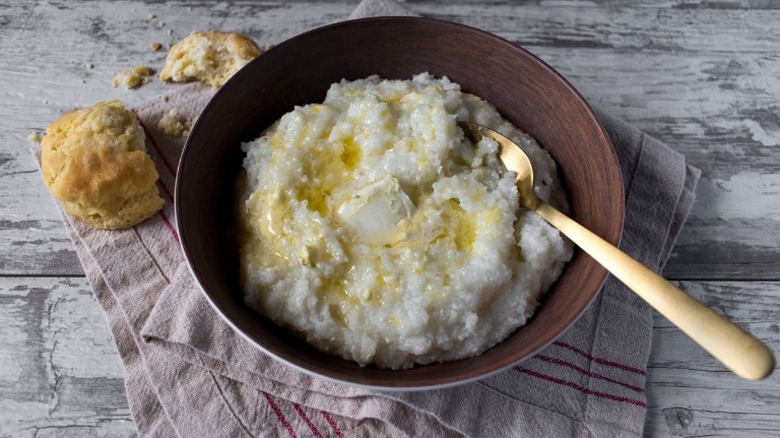
Travel down to the South, and you'll find that a warm bowl of grits is just as much of a breakfast staple as pancakes or cereal. Grits are made up of ground corn. They can be made from any number of corn varieties, typically either white or yellow, but can also be made from blue corn in some areas. When cooked, the grits take on a creamy porridge consistency that can be topped with a simple pat of butter or taken a step further with a range of savory and sweet toppings.
Grits began with the Native American Muscogee tribe, who would grind corn into a porridge. Settlers in the region are thought to have called this dish "grist" before the name became "grits." At the time, grits were an accessible and filling meal that wasn't too difficult to prepare. Later, variations like shrimp and grits arose, likely from the Gullah Geechee. The Gullah Geechee are descended from Africans who were enslaved at coastal plantations in the southeast. The coastal environment and rationing of corn made shrimp and grits a common dish that later spread throughout the South.
Breakfast burritos
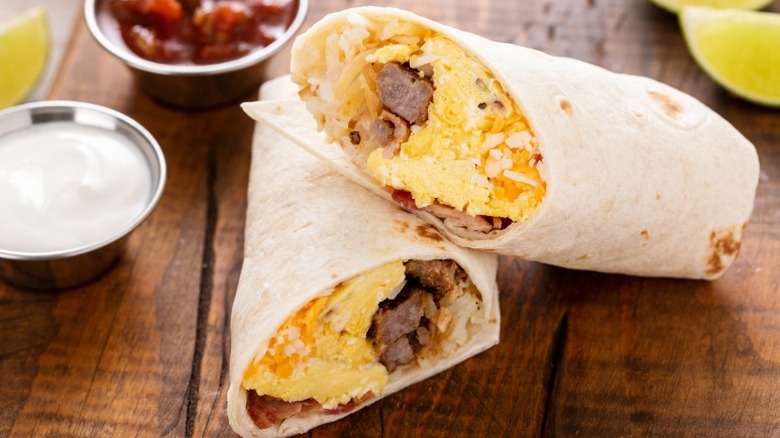
Breakfast burritos are a great way to pack a lot of flavor into one portable compartment. You can find them served at all kinds of restaurants, from McDonald's to trendy LA hotspots. But you can also easily meal prep breakfast burritos for a high-protein breakfast at home. These burritos usually come filled to the brim with eggs, cheese, meats, vegetables, and more. But how did a traditional burrito evolve into a breakfast titan?
The first official breakfast burrito turned up in New Mexico at Santa Fe diner Tia Sophia's. Before that, however, people in the Southwest had been wrapping up all kinds of foods in tortillas, including eggs. Tia Sophia's was the first to put a name to the concoction when it was added to the restaurant's menu in the '70s. However, there is another contender to be recognized in the race to the first breakfast burrito. Dee Rusanowski is a former restaurant owner who claims to have invented the first hand-held breakfast burrito about a year later. While there could be some truth to this, vaqueros and other workers in the region were probably carrying them around long before.
Hash browns
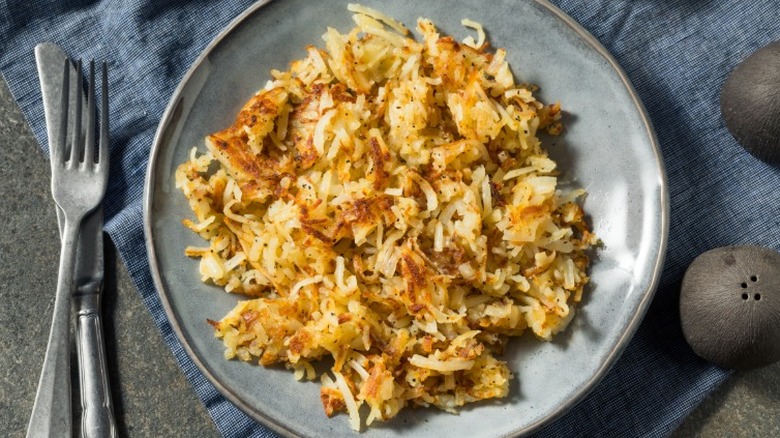
Potatoes find their way onto breakfast plates in a myriad of ways. You'll find them roasted with various seasonings, turned into home fries, or even made into breakfast-style baked potatoes. But, by far, one of the most enjoyable ways to have your potatoes in the morning comes in the form of hash browns. These golden brown, julienned or patty-shaped potatoes are a staple in homes and diners across the U.S.
The first mention of the dish is in the "Minnesota Farmers' Institute Annual of 1835," where you could find recipes for hash potatoes, brown hashed potatoes, and brown creamed hash potatoes. Later, in 1887, Maria Parloa's book, "Kitchen Companion," provided a brief history of the food. Originally, hash browns were a way to use potato scraps and avoid wasting food. Eventually, hash browns grew in popularity, becoming a common menu item in New York, even at upscale hotels. Now they can be found across the U.S. and beyond for a quick breakfast.
Biscuits and gravy
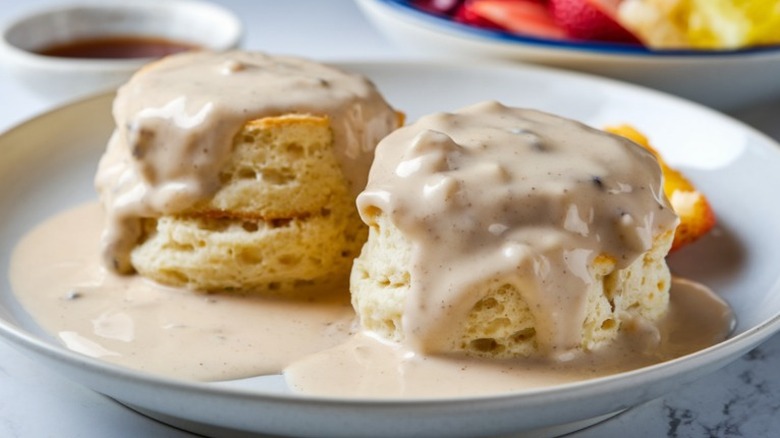
Biscuits and gravy is a Southern dish that has its roots in Appalachia. Warm, flaky biscuits are served smothered with a thick and savory gravy, creating a delicious meal that sticks to the ribs. The filling nature of the dish is, in fact, part of the reason for its invention. The first biscuits and gravy did not look like its modern-day counterpart. In the late 1800s, biscuits — specifically, beaten biscuits — were typically very hard and smothered in bulldog gravy, made with flour, liquid, and leftover pork fat.
This early version of the dish allowed workers to have a filling meal that would sustain them in their labor while also using easily accessible ingredients. After the Industrial Revolution, access to greater machinery and ingredients allowed biscuits and gravy to evolve into the flavorful, melt-in-your-mouth dish we know today. Yet, the simple ingredients at its core are still what make it shine.
Dutch baby pancakes
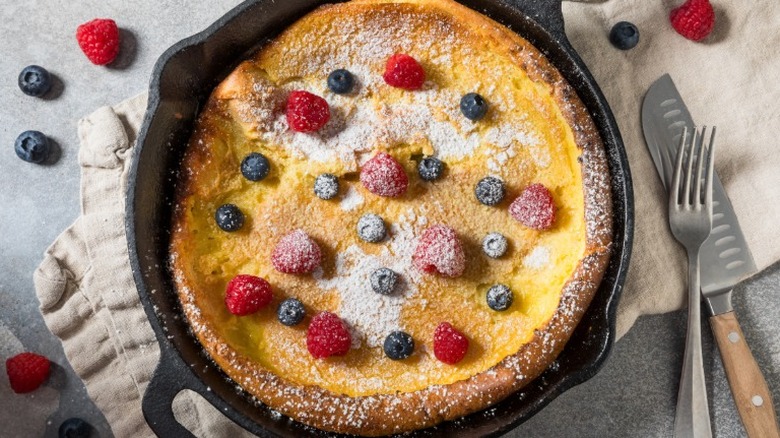
In spite of what its name might suggest, Dutch baby pancakes were invented right here in the U.S. This dish is essentially just a large pancake baked in a skillet. As it bakes up in the oven, it puffs up, leaving it with distinctive crisp edges and a soft center. Dutch babies are often topped with fresh fruit and powdered sugar, but can be served as a savory dish.
Its name was coined in Seattle at a restaurant called Manca's Cafe. Victor Manca, inventor of the Dutch baby pancake, may have taken inspiration from German Pfannkuchen, which are large, crepe-like pancakes cooked on the stovetop. The first Dutch babies were smaller, hence the name, and could be popped out quickly for hungry customers. The "Dutch" part of the name is said to come from Victor's daughter, confusing the word with "Deutsch." The altogether perplexing name was trademarked in 1956 and remains popular.
Bagels and lox
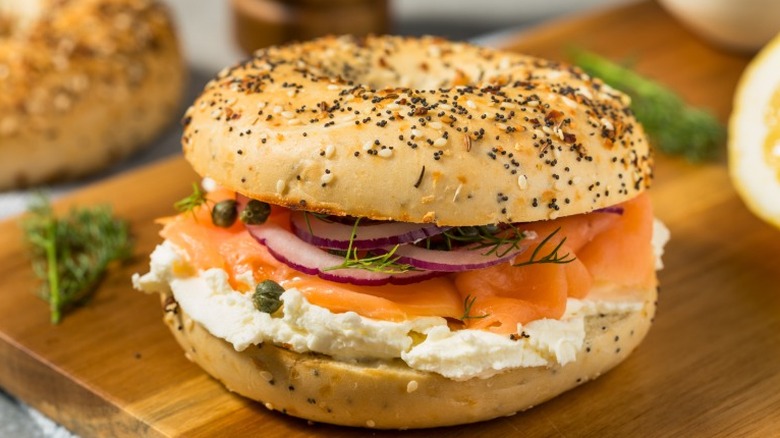
The components of bagels and lox hail from all different places, but the combination itself is wholly American. An elevated version of a cream cheese bagel, this dish adds smoked salmon, red onions, and capers to the equation. It can be found in restaurants and delis, especially in New York, where it originated.
Lox, a type of cured salmon, comes from Scandinavia and was popularized in the U.S. by Eastern European Jewish immigrants. Bagels likely came from Poland, and capers from the Mediterranean. Cream cheese, a New York invention, tied everything together into today's sandwich that graces delis and brunches everywhere. Foods like this and breakfast burritos are an eclectic mix of cultural influences that prove that the American breakfast table has far more to offer beyond bowls of Cheerios.
Johnnycakes
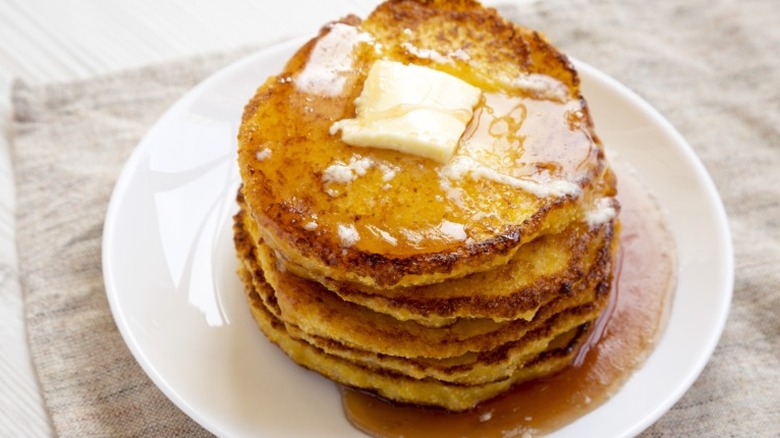
Before the syrup-soaked American-style pancake came about, johnnycakes were holding down the fort. Unlike pancakes, traditional johnnycakes don't contain a leavening agent. The batter is made from a simple mixture of water or milk and cornmeal, along with a bit of salt or sugar. Recipes have evolved to include other ingredients like butter and eggs, but the original still holds up. Also known as hoe cakes, this New England staple actually has Native American roots.
While today's johnnycakes are credited to Rhode Island, the original cornmeal pancakes likely have their roots in Native American cuisine. The first johnnycakes were made with white flint corn meal, cultivated in the area. Today, many Rhode Islanders prize this cornmeal as the only acceptable base for a true johnnycake — or rather, a jonnycake. Spelling the name without the "h" serves as a sign that only the best, Rhode Island-derived corn is being used.
Banana bread
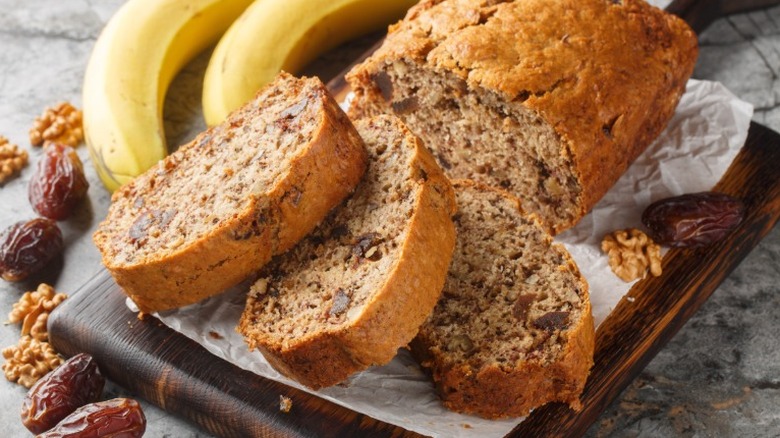
Banana bread is one breakfast food that will instantly sweeten up your morning. A slice of this sweet bread paired with a cup of coffee is especially comforting on a brisk morning when simply leaving the house seems like a chore. The star of the show is the banana, of course, but many recipes call for nuts, fruits, and other additions to take your banana bread to the next level.
This bread, like many foods, was born out of necessity. In the 1930s, at the height of the Great Depression, recipes focused on making the most out of what scarce food people could access. This meant that when bananas went overripe, they still needed to be put to use. Add to that greater access to baking powder and soda through mass production, and the perfect storm for banana bread's invention was brewing. Nowadays, it remains a simple way to reduce food waste while enjoying a sweet treat.
Eggs and bacon
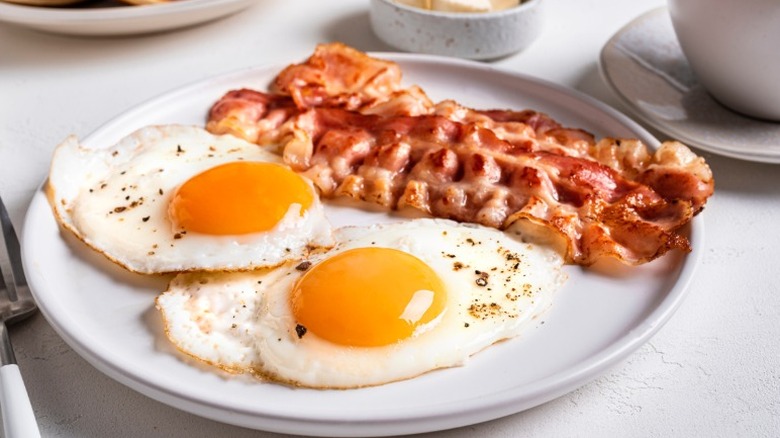
Nothing screams American breakfast quite like eggs and bacon. However, bacon wasn't always a part of the equation. For a long time, Americans ate lighter breakfasts, although a pairing of eggs and bread was common. You'll be shocked to learn the true story behind how bacon became a key player in the classic American breakfast.
Bacon's surge in popularity can be credited to a man named Edward Bernays. In the 1920s, amid a lack of demand for bacon, the Beech-Nut Packing Company turned to Bernays to help consumers see the beauty of bacon. Bernays, nephew of neurologist Sigmund Freud, created a campaign that claimed eating bacon for breakfast had health benefits. He surveyed doctors who said that a heavier breakfast was preferable. By using the words of trusted professionals as endorsements, he was able to increase bacon sales and forge a classic American pairing.
Toaster pastries
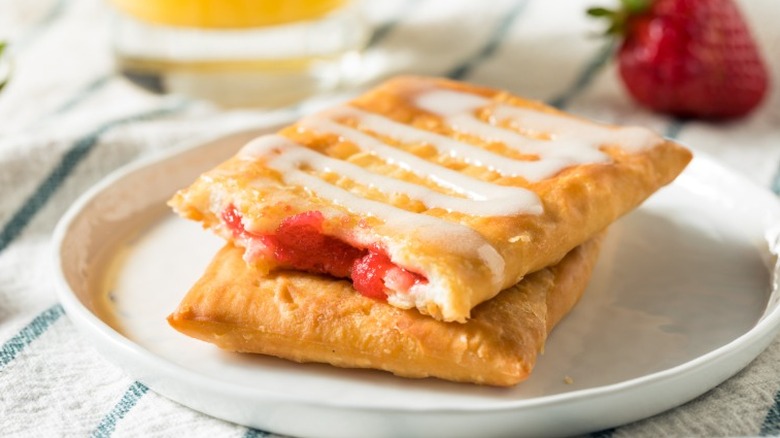
While an elaborate breakfast plate sounds amazing, sometimes convenience is king. That's where the beloved toaster pastry comes in. While Pop-Tarts may be the epitome of American toaster pastries, with Toaster Strudels coming in close second, neither is the first of their kind. The first fruit-filled pastries were called Country Squares and were teased by Post Consumer Brands in February 1964.
However, when they weren't released immediately, Kellogg's, which had long been in competition with Post Consumer Brands, acted quickly. Kellogg's came up with what were then called Fruit Scones. Then, in September 1964, with the new name, Pop-Tarts, Kellogg's launched a test run in Ohio for the product that would become one of America's best-known food items. The nationwide release of Pop-Tarts in 1965 came with advertisements apologizing for their mass popularity, which only made them more popular. Pillsbury's Toaster Strudels and Country Squares (which returned under the name Toast'em Pop-Ups) put up a fair fight, but none reached the gold standard of the Pop-Tart.
Fried chicken and waffles
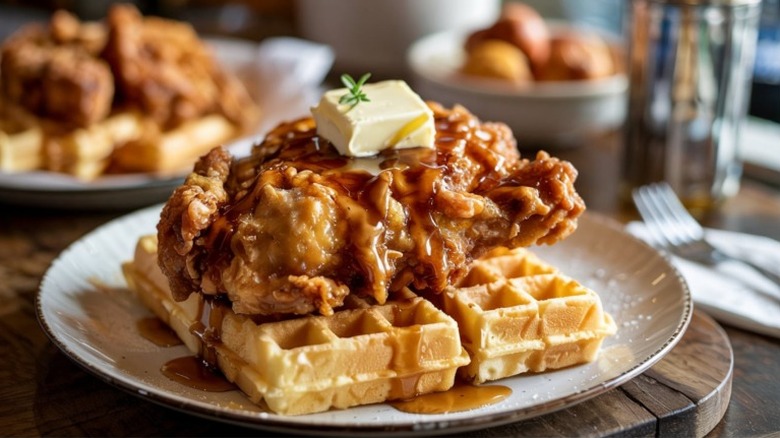
Chicken and waffles are one of the most notable sweet and savory combinations out there. To some, pairing savory chicken with waffles doused in syrup doesn't sound ideal, but try it, and you'll find it works surprisingly well. While there are other versions — such as the Pennsylvania Dutch take, which uses stewed chicken – the quintessential Southern dish tops waffles with crisp fried chicken.
It's unclear who exactly invented fried chicken and waffles, but they were popularized at Harlem's Wells Supper Club in the 1930s. During that time, many jazz musicians would find themselves leaving late-night gigs looking for a bite to eat. Chicken and waffles provided the perfect balance between breakfast and dinner to match the strange hours they kept. The dish spread past the East Coast and spilled over onto the West Coast in 1975 when Herb Hudson, who hailed from Harlem, opened Roscoe's House of Chicken and Waffles in Los Angeles. The dish has continued to cross state lines and is today considered a Southern staple.
Breakfast pizza
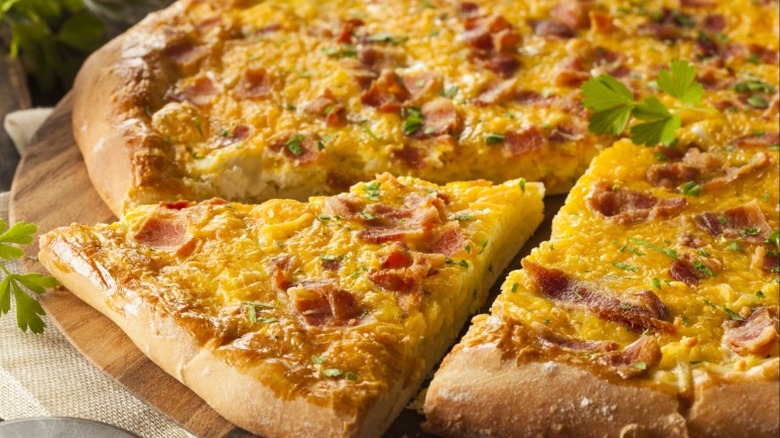
An easy way to simplify mornings is to turn your breakfast leftovers into a delicious pizza. Much like a breakfast burrito, breakfast pizza is an American crossover food that is greater than the sum of its parts. You'll usually find the crust topped with eggs, cheese, bacon or sausage, and veggies. It's a full breakfast plate neatly arranged atop a single, portable slice.
The true origins of breakfast pizza aren't completely clear. However, Bucketcake owner Marietta John has staked her claim. According to John, she came up with the idea in the 1990s while working at a pizza place in Bloomsburg, Pennsylvania. She tossed some eggs onto the pizza crust, then continued experimenting in the following days with other breakfast staples like sausage. Apparently, her boss was thrilled by the innovation and the pizza stuck. Now, it continues to be riffed on in all kinds of ways by people across the country.
Liver mush
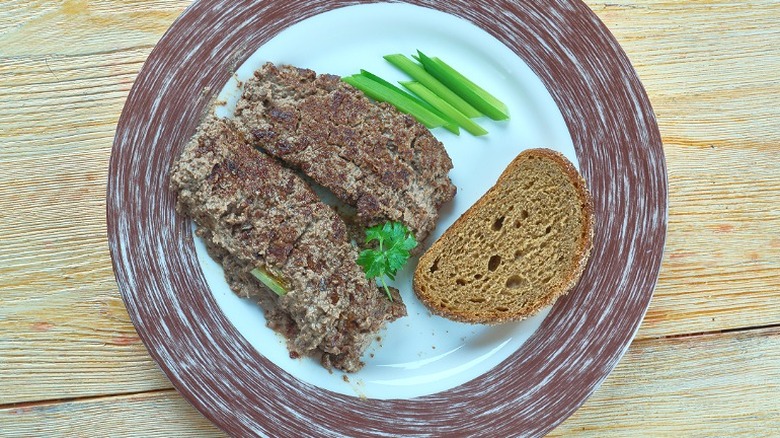
The U.S. is home to many tried-and-true regional food classics. Of these, liver mush tends to fly under the radar — or under the breakfast table, if you will. It's a North Carolina staple made up of pig's liver and other meat scraps, combined with cornmeal and various spices to create a sliceable loaf. It doesn't have to be heated, but it can be browned in a pan and served up with eggs and either bread or biscuits.
Liver mush likely stems from scrapple, a dish popularized by German immigrants. However, while pork liver is central to liver mush, scrapple doesn't always contain it or has less of a quantity. Liver mush is also closer in texture to a pâté, while scrapple is more meatloaf-like. In the 1930s, liver mush was an affordable, filling food that helped families get through the Depression. But despite its unassuming nature, it is treasured by North Carolinians who even hold annual festivals celebrating the dish.