

Great Value Vs Pepperidge Farm: Who Makes Better Stuffing?
We may receive a commission on purchases made from links.
Whether you call it stuffing or dressing, cook it on the stovetop, in the oven, or even inside the bird (the latter of which is not only overrated, but riskier from a food safety perspective), we all know that the holiday table would not be complete without a dish of this carb-heavy recipe that is, let's be honest, mostly an excuse to eat more bread. Okay, fine, there are usually some herbs and vegetables in there too.
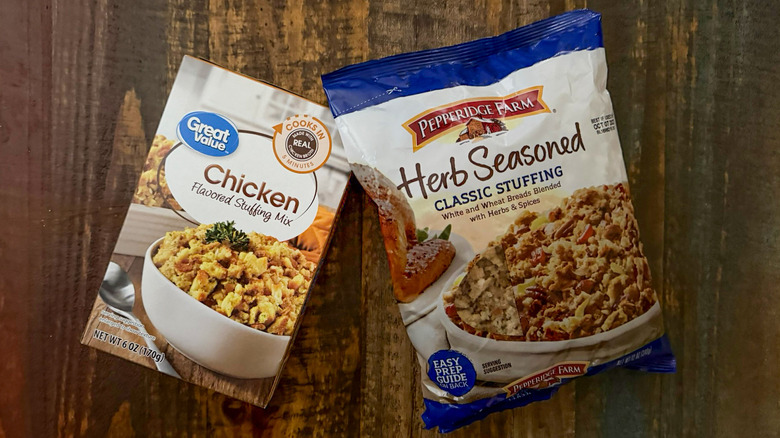
With the 2026 holiday season quickly approaching, we thought we'd take a look at two of the more popular stuffing (or dressing) time-saver products on the market. Or, in other words, those products that provide a shortcut to getting this crucial side dish on the holiday table with a minimal amount of effort. Because while we both know homemade would probably taste better, not everyone has the time, patience, or interest in all that. Without further ado, let's figure out which company makes a better stuffing mix: Walmart's Great Value or Pepperidge Farm.
Taste test: Great Value chicken flavored stuffing mix
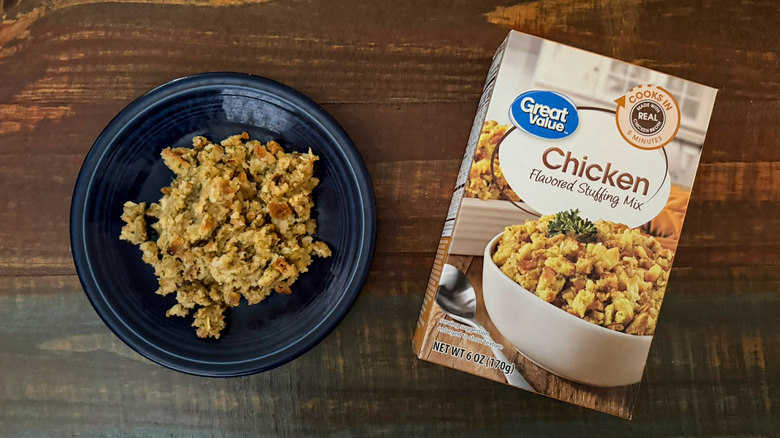
Right off the bat, this stuffing smells and tastes like that classic box stuffing popularized by the Stove Top brand. Its taste is, simply put, dominated by notes of dried onion, dried herbs, and chicken bouillon. While this is probably a comforting flavor profile for many — as it surely carries a hearty dollop of nostalgia — the truth is that it comes across as rather cheap and manufactured. Once one has been introduced to stuffing made with whole ingredients, it is hard not to immediately notice how everything here seems like it is derived from powdered ingredients.
On the plus side, this stuffing is incredibly easy to make. Following the box directions, all I did was add 1 ½ cups of water and 4 tablespoons of butter to a pan, bring it to a boil, and mix in the stuffing contents. Five minutes later — and with no mess and no fuss — this was ready to eat. The box even includes microwave instructions, but unless one doesn't have access to a stovetop, I can't imagine ever needing to use that method.
Taste test: Pepperidge Farm herb seasoned classic stuffing
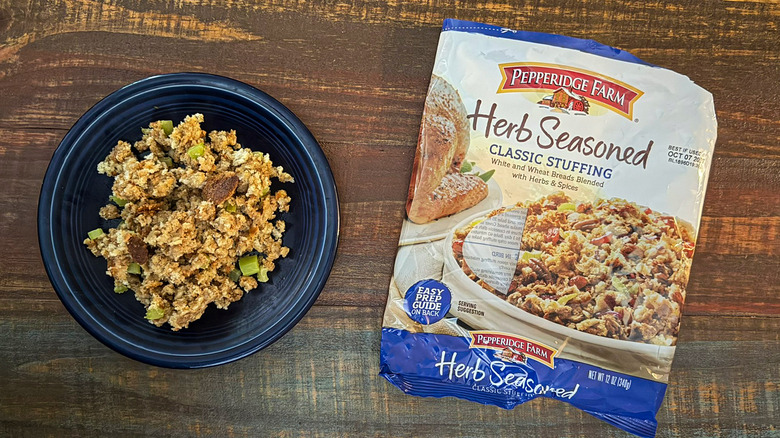
In contrast to the Great Value stuffing, Pepperidge Farm's recipe requires more effort from the cook, with a few additional steps. Namely, it suggests adding 1 cup each of diced onion and celery, plus 2 cups of chicken broth. While certainly not excessive, at the very least this requires a few minutes of vegetable chopping (unless, of course, one sources pre-cut onions and celery).
The positive here, especially as someone with strong cooking opinions, is that this allows for a bit more customization of the recipe. I, for example, prefer a less onion-forward flavor in my stuffing, so while I was stuck with a pre-set amount of dried onions in Great Value's mix, here I could adjust the amount used to better match my own preferences. (Both mixes, to be clear, do include onion powder.)
This Pepperidge Farm mix also includes both white and wheat breads, which gives the stuffing a heartier flavor and makes the taste of bread more prominent. Also, because I chose to use a high-quality chicken broth, there was less of a dusty bouillon flavor and more of a true chicken note. On the downside, this stuffing features a somewhat bitter herbal note on the finish, which isn't all that pleasurable.
Which stuffing is better?
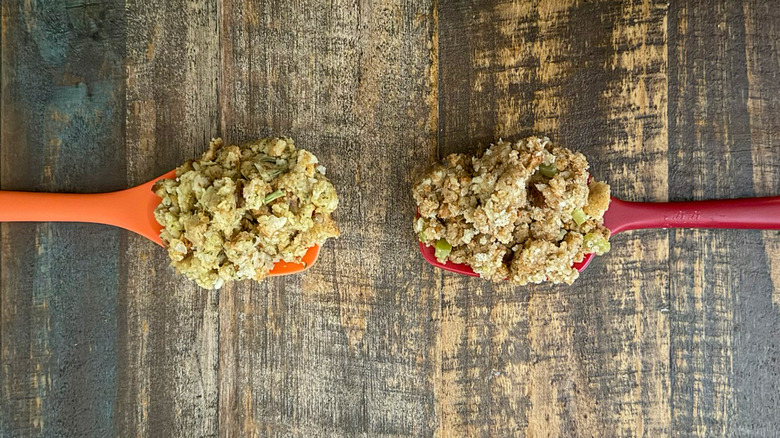
At the end of the day, this verdict really comes down to what one is looking for in a stuffing mix. For those interested in the easiest, simplest, absolute no-brainer option, Great Value's stuffing mix is incredibly easy to make and offers a nostalgic flavor profile that many people will appreciate. All you need is a box of mix, some butter, and about 15 minutes, and this stuff is ready to go.
Pepperidge Farm's stuffing mix, on the other hand, not only offers a cleaner flavor that is arguably closer to homemade but also offers more customization and flexibility for those willing to put in a little effort. (It's still pretty easy.) For me, the heartier bread flavor here, as well as my ability to manage the onion and celery amounts and use fresh broth, makes this one the clear winner. As noted above, however, your mileage may vary.
Comparing prices and nutritional content
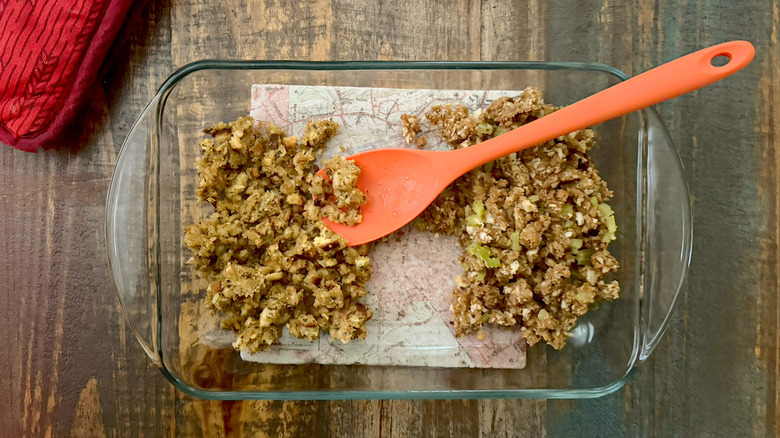
Considering Great Value's stuffing only cost me $0.82 per box (on sale at Walmart from $1.08), versus $2.68 for a bag of Pepperidge Farm's stuffing (also on sale at Walmart from $3.12), it seems at first that the Great Value option offers staggeringly good value. Keep in mind, however, that the Pepperidge Farm bag offers twice the amount of stuffing (12 ounces versus 6). As such, the prices here are closer than they first seem, with Walmart's option coming in around $0.18 per ounce at regular price, versus Pepperidge Farm's $0.26 per ounce.
The other potential consideration here is what else is needed to create the recipe. While both call for a ½-stick of butter, the Great Value stuffing otherwise only requires water. The Pepperidge Farm recipe, on the other hand, calls for 1 cup each of raw onion and celery, and 2 cups of chicken broth. Taking all that into account, the Great Value stuffing mix is significantly cheaper.
Many of the nutrition facts for these two items are similar. Neither is a significant source of fiber, with a serving of both coming in at 4% of the recommended daily value. For sodium, Great Value's includes 390 milligrams per 28-gram serving, while Pepperidge Farm's comes in at an ever-so-slightly higher 410 milligrams per 29-gram serving. Both stuffings contain 2 grams of sugar per serving. As a final note, Walmart's stuffing does contain vegetable shortening and high-fructose corn syrup, whereas Pepperidge Farm's contains vegetable oils and sugar.
Methodology
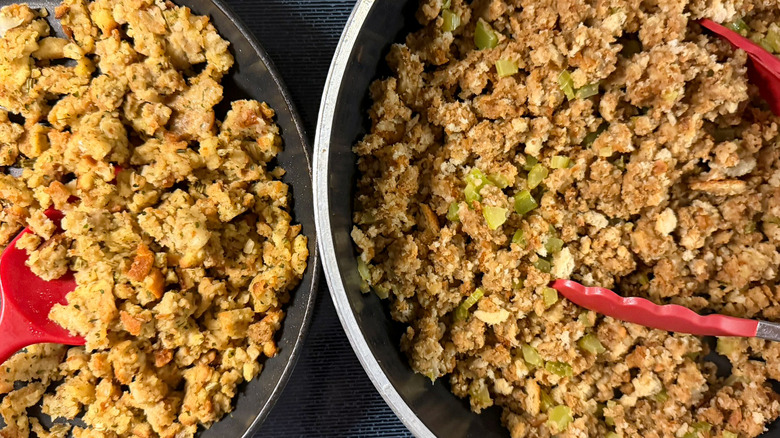
For each of these stuffing mixes, I followed the directions on the packaging to make the stuffing on the stovetop (does that mean it is really dressing?). Though Great Value's box did not include a suggestion on how to heat its stuffing in the oven, I followed the instructions on the Pepperidge Farm bag for both stuffings to compare them both directly from the stovetop as well as after a crisp-up in the oven. After that, I rated each on overall flavor, texture, and balance.
Prices listed are from my local Walmart in the Philadelphia, Pennsylvania, suburbs in November 2026, and are obviously subject to change based on timing and location.