

Burger King Was Owned By This Beloved Bakery Brand From The '60s To The '80s
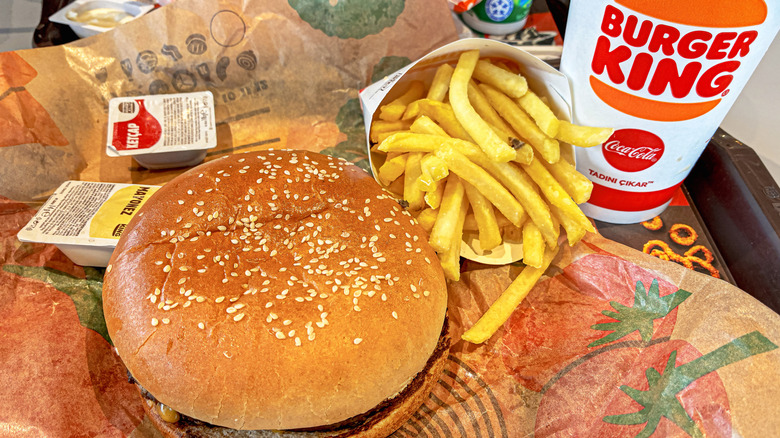
Before Burger King became one of the most popular fast food chains in America, it went through a lot of changes. With Burger King's scandal-ridden history, it's not surprising the chain has had at least six corporate ownership switches. One noteworthy switch was when the Pillsbury Company acquired the company for $18 million in 1967. The beloved bakery brand took over all 274 Burger King locations as part of the deal, officially marking Pillsbury's entry into the restaurant industry. The acquisition came as the then-13-year-old restaurant chain was struggling with sales and profitability.
Under Pillsbury, Burger King saw exponential growth and expansion, giving the restaurant brand the boost it needed to become a national competitor and rival the likes of McDonald's. The chain opened thousands of restaurants during this period. (It had 4,743 locations by 1986, including 402 international stores in 25 countries.) But while Burger King thrived under Pillsbury, the bakery brand found itself in a takeover battle with British conglomerate Grand Met in 1988 which ended with the latter acquiring the former for $5.79 billion. This inadvertently meant that Grand Met (then the world's largest liquor company) became the default owner of Burger King until 2002, when it sold the restaurant chain to private equity.
Burger King's Pillsbury era wasn't as successful as it seemed
Although Pillsbury was instrumental to Burger King's sizable growth, there are still many things to know about the burger chain and its history to better understand the situation. Many good things happened under the bakery brand's tutelage, from the chain's expansion across all 50 states to the introduction of drive-thru service, as well as the debut of the bacon double cheeseburger on its menu. The salad bar, chicken tenders, and the breakfast favorite Croissan'wich were also introduced during this period. Pillsbury strategically brought in former McDonald's executive Donald N. Smith in the late-1970s to revamp the menu and bring unruly franchisees in line.
Despite all of these efforts, Pillsbury received some flak for how it ran the business. "Burger King is a strong restaurant concept that has survived in spite of itself, in spite of bad promotions, poor marketing strategies, inconsistent operations and shoddy management," franchisee Steven M. Lewis was quoted as saying in a New York Times article published in November 1988. Even James McLamore and David Edgerton, who founded the Burger King Corporation, expressed regret over selling the brand to Pillsbury. "We sold out to Pillsbury, and we shouldn't have," Edgerton said (via the Burger King Book).