

11 Things Most People Don't Know About Outback Steakhouse
It was once the biggest steakhouse chain in America. It dominated the sit-down chain restaurant sector throughout the 1990s and well into the 2000s. It was ballsy enough to stereotype a culture with whom it had zero firsthand experience. We're talking, of course, about, Outback Steakhouse. Founded in 1988 in Tampa (side ask: Is Florida the Australia of America?), Outback seemed to be on a non-stop rise for decades before the bottom line, ahem, boomeranged on them and the business took its lumps from competition.
Although parent company Bloomin' Brands has seen a number of recent closings, including 11 outposts in 2026 alone, there are still well over 600 Outback locations in the U.S. With corporate trying to right the wrongs that prompted the decline, things may soon be on an uptick for the faux Aussie shopping-center staple.
While we wait on a comeback, here are 11 things most people don't know about Outback Steakhouse. Some of these may even surprise the most ardent Outback historians. Well, maybe not them, if they are indeed calling themselves historians — but everyone else will certainly raise an eyebrow and rub a chin with intrigue to the sounds of a didgeridoo.
The founders had never been to Australia

Okay, it's no great revelation by now that Outback has no actual, authentic connection to Australia in any way, shape, or form, aside from the superficial, corporate co-opting of the culture. But, did you know that none, not one, of the several founders had ever even stepped foot onto the continent-country of Australia?
It's true, gang. These were people in the restaurant business who wanted to parlay the surprising but substantial popularity of "Crocodile Dundee" — which, in 1986, was the second-highest grossing film in America behind only "Top Gun" — into a sit-down family chain. The thinking must've been: Well, if people will watch it, they'll also eat it?
There was talk amongst them about taking a research trip Down Under, but they'd decided against it so as to not be too influenced by real Australia. Outback was always meant to be an American restaurant with a fun, exaggerated Aussie theme. Sure, they'll sell Australian beer and wine, and they'll have some clichéd decor and employee outfits. But don't expect them to get the approval of a bushmen from the actual Outback — nor do they seek it.
The Bloomin' Onion is a New Orleans thing
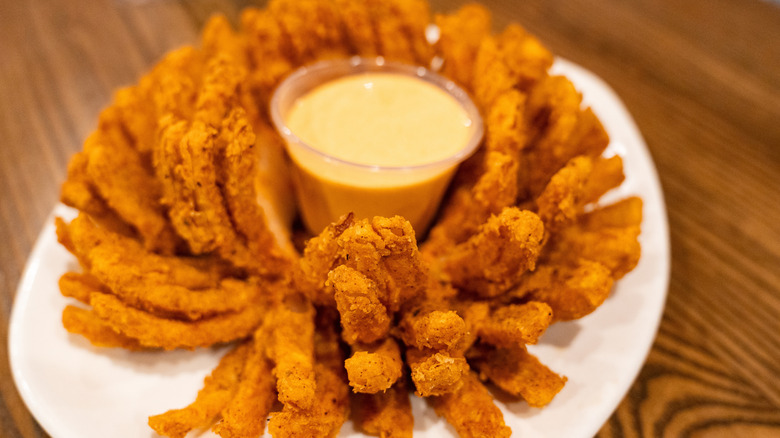
It's the one menu item that even a non-Outback goer would probably know. The Bloomin' Onion is an offering that defines Outback in the same way that a Blizzard defines Dairy Queen, or a Whopper defines Burger King. We know, that's heady company, but it's warranted.
But who really invented the Bloomin' Onion? It's often credited to one of the founders, Tim Gannon, who worked in New Orleans for years before joining the Outback team. But, according MEL, even he admits he got the idea from someone else — a fellow chef and friend of his named Jeff Glowski. Glowski worked at Russell's Marina Grill, and in 1985 he created the dish for a contest. Gannon says that they collaborated together on this entry.
Gannon would carry the dish over to another chain restaurant venture he had called Copeland's, while Glowski also took it — to Australia, incredibly. He worked as a chef at a New Orleans-themed restaurant in New South Wales. On the menu Glowski included the dish he called "Onion Mum." Eventually, Gannon would add the renamed version to the fledgling Outback menu. The rest is bulb vegetable history.
There are actually seven Outback Steakhouses in Australia
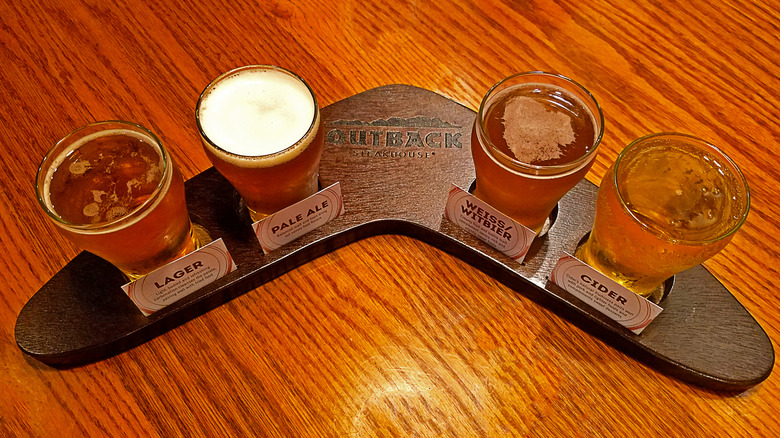
For all the talk about Outback being as Australian as a chihuahua dressed as a dingo, you might assume the chain could never crack the Aussie market, a la Taco Bell in Mexico. Well, you'd be surprised then. Not only is there an Outback Steakhouse within the borders of the Land Down Under, there are, as of writing, seven.
They are split between the states of New South Wales and Queensland: Campbelltown, Parklea, Penrith, Wentworthville, and Wollongang in the former; Aspley and Pacific Fair in the latter. What real-deal Aussies make of this, we're not sure. But you don't keep seven restaurants open because no one is going. Interestingly, it's basically the same menu you'd find stateside.
There really is no reverse comparison to this in the U.S., is there? Try to imagine American-themed restaurants from other countries opening here. For instance, the Beverly Hills Diner in Moscow, Eddie Rockets in Dublin, and Betty's Midwest Kitchen in Malaysia. Would they survive? Actually, Eddie Rockets sounds like it would do well here.
Outback didn't start serving lunch until 2012
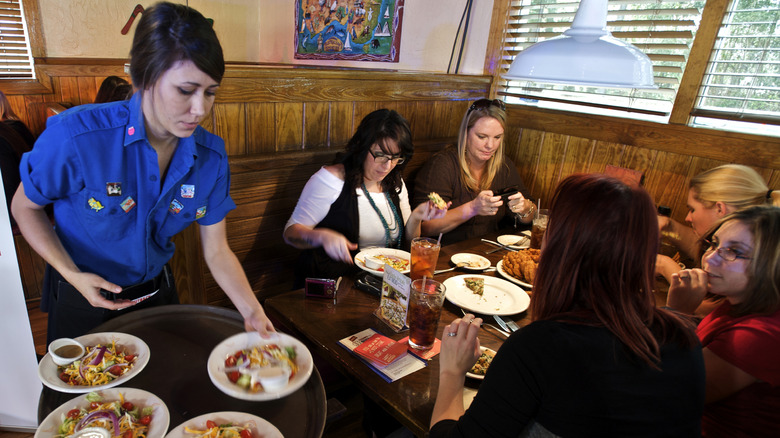
For 24 years after the first restaurant opened in 1988, Outback was a dinnertime-only joint. Any midday hankering for Kookaburra Wings or Chocolate Thunder would have to be kept at bay until the evening rolled around. How did Outback lovers cope with this empty interim? Eating a deli sandwich while riding a coin-operated kangaroo? Having a salad served on top of a boomerang?
This all changed in 2012. Actually, 2011, when Outback first experimented with lunch at just 50 of its 775 locations. Things obviously went well enough to introduce it nationwide the following year, each spot opening at 11 a.m. Some might say that's too early for even a delicious ranch dressing like Outback's, but it's a free country. Indulge as you like.
The inaugural lunch menu featured ten entrées under $10 (including lunch-ified variations like the Alice Springs Chicken Quesadillas), plus a combo option that consisted of a soup, salad, and a main for $7.99. Amazing to catch a glimpse at a long-forgotten time before crippling meal inflation. Kind of adorable, actually.
8 million Bloomin' Onions are ordered every year
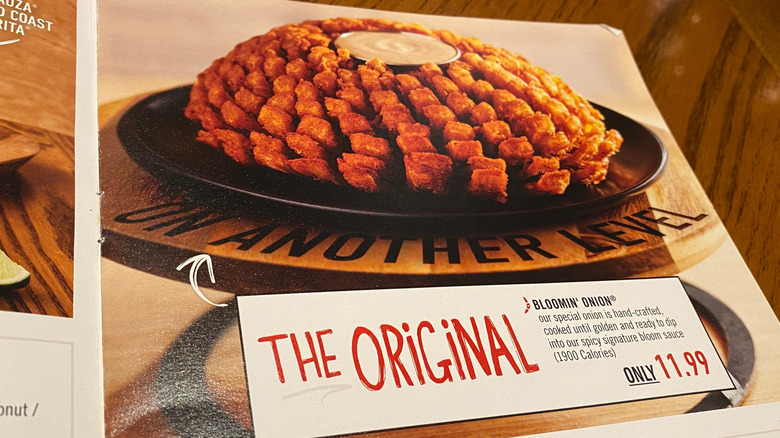
We've talked about the Bloomin' Onion as the signature dish of Outback, along with its deeper origins. But we have to take a step back now and really look at how immensely popular this talismanic menu item is.
Yes, you can technically make your own Bloomin' Onion in an air fryer at home, if you're careful. But there's a good chance it won't be the same as the workhorse version at the restaurant. There's no shame in that, by the way. Outback makes this thing hour upon hour, day in and day out, year after year — to the tune of 8 million sold annually, per its website. That amounts to a quarter of all Outback appetizers sold.
The company sources its onions from 15 different growers across four states: California, Idaho, Texas, and Oregon. And, they are huge — over 4 inches in diameter and weighing more than a pound raw. It has spawned many a copycat attempt. Many. Even The Food Network released its own iteration. People even try to reconstruct just the sauce, which is apparently a balance of ketchup, mayo, sour cream, horseradish and a mix of spices. No matter how you slice it — or pick it — the Bloomin' Onion is smash hit.
Outback once had its own fleet of blimps
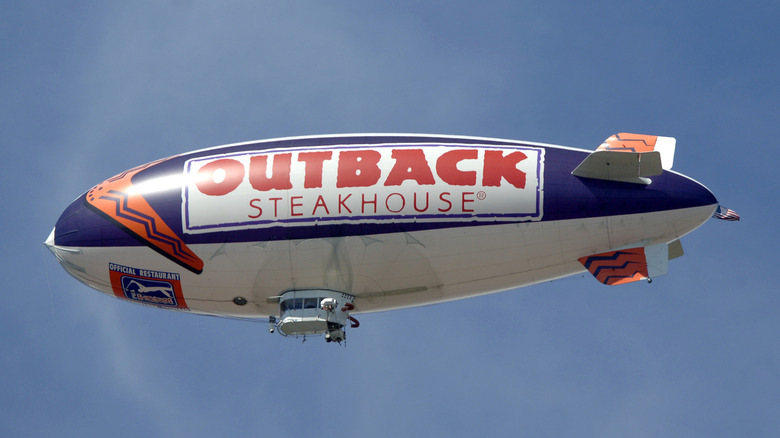
With success comes perks. With success comes liberties. With success comes eccentricity. Each of these concepts can be feasibly rolled into one, totally useless, yet impressive vessel: the blimp. Long made obsolete as a practical method of flight — if it even ever was — a blimp is purely for show at this point. Kind of like decorative buttons or the English monarchy.
Outback has become successful. Therefore, using a logic equation alluded to above, it must have invested in a fleet of branded blimps. Well, only if you count two as a fleet (which nobody probably does). Bloomin' Onion I and Bloomin' Onion II, as the ellipsoid vehicles were so named, were in operation throughout the 2000s.
They were on airborne display at major sporting events, mostly. (When else are blimps used?) Alas, their time as helium-filled, floating Outback billboards was brief, seemingly out of circulation by the 2010s. No doubt the expense as compared to the return was heavily scrutinized by corporate. Especially since we live in an age where getting brands in front of people's faces does not require an actual airship.
Outback keeps its seasoning recipes a secret (though it's been hacked)
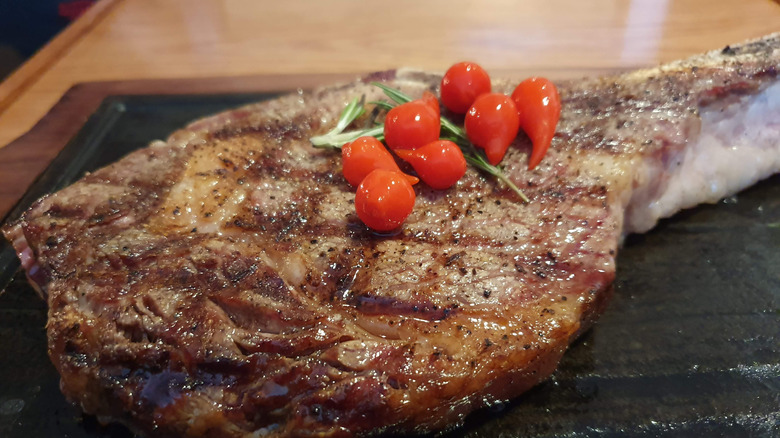
Like many an eatery franchise, Outback has to maintain its proprietary appeal. Otherwise, it can just be carbon-copied and the enterprise's very existence will become irrelevant to the point of redundant. Therefore, like KFC, Krispy Kreme, and Campari before them, Outback keeps one of its recipes a closely guarded secret. Which has only ever baited food-based reverse engineers into trying to crack the code.
The recipe in questions is the signature seasoning blend. According to Outback, it consists of 17 different spices, including "several unique peppers" from "global boutique markets." It was created by co-founder Tim Gannon for the Bloomin' Onion, and is used across several menu items, including the Bloomin' Burger, Bloomin' Fried Chicken, and Bloomin' Fried Shrimp, along with certain steak dishes.
It seems, however, folks have unlocked the flavor cipher. A simple Google search will yield the recipe, or something approximating it. It's hard to tell if this ultimately has a detrimental effect on Outback; or if people copy these things, not to avoid going to the source, but to incorporate more of it into their lives. Might be too psychoanalytical a venture for an article like this.
AARP members get 10% off at Outback (except on booze)
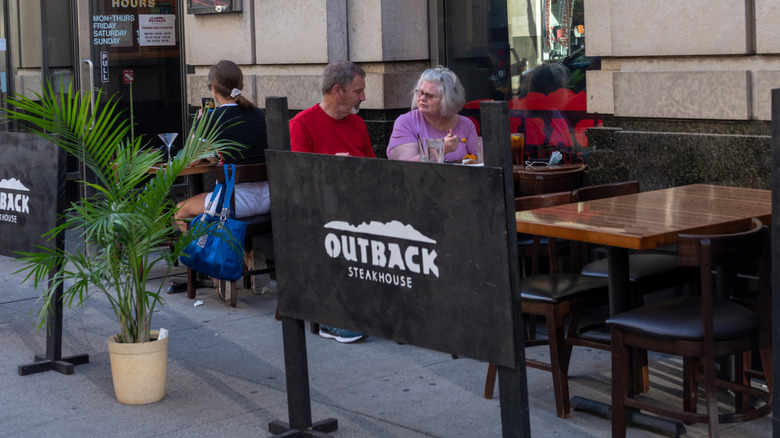
Never say Outback doesn't look out for people. Well, people over 50 years old, at least. Well, people over 50 years old with a valid AARP membership. That's because they get a 10% discount on food and drinks. It may not be as good as the secret Outback to-go deal that no one tells you about, but it is certainly nothing to sneeze at.
In all fairness, an AARP membership is only around $15 per year. So, at $1.25 per month, if the only reason you become a member is purely to get 10% off your Outback meals, it'll still be worth it. It's also worth remembering, if this has indeed pricked up your senior citizen ears, that the discount only applies to dine-in (not delivery or catering, although curbside is okay) and is not valid for alcoholic beverages (because that would just be too awesome, apparently).
It should be noted, even though AARP focuses its mission on the 50-plus age set, you only have to technically be 18 years or older to join. We're not so sure if Outback wants that particular information to get out, but it is easily found and Google-able. AARP sure isn't trying to hide the fact. Despite being called the American Association of Retired Persons, you don't have to be retired at all. Just a big Outback fan?
Outbacks on the West Coast are run by different companies
If you go to an Outback on the West Coast, and you're a regular from wherever else you came from, you might notice some difference — subtle and otherwise. That's because Bloomin' Brands — the parent company of Outback Steakhouse – re-franchised and sold off dozens of locations across five states out west (along with sister chain Carraba's Italian Grill, albeit in different states).
Cerca Trova Restaurant Concepts bought 45 Outbacks in 2017. It had already been running all the California Outbacks dating back to 1994, under the name T-Bird Restaurant Group. Cerca Trova itself is a subsidiary of Out West Restaurant Group. You know how these corporate Russian doll boxes work.
What does this mean practically? Well, the menu items and style of cooking is the same as all the other locations — so they are still using butter to cook the Outback steaks, no worries there. It's in the aesthetic and layouts, as well as the real estate approach, where the differences may be seen. Many of the locations in that part of the country avoid the cookie-cutter look of most other Outbacks — making it feel like a bootleg Outback when you first see one. They're not. They're legit. Just ... West Coast-ified.
The last Outbacks in the United Kingdom closed over a decade ago
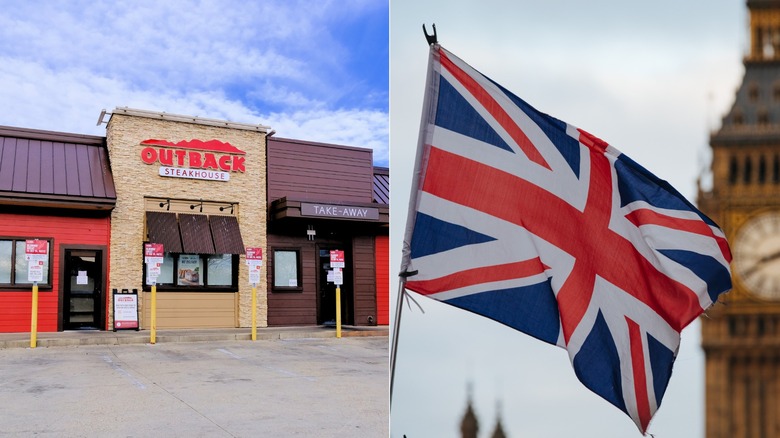
Although Australia has seemingly accepted Outback into its bosom, the same can't be said for another Anglophone country. In fact, the Anglophone country: England. Or for that matter, any of the British Isles. Sure, Outback did make incursions into the U.K., and for a time a lasted. Alas, it ultimately was not to be. And, it's fair to wonder if the Brits even noticed it there at all — although some online commenters do still express nostalgia for the chain.
It was the Outback Steakhouse U.K. Facebook page that released the post heard around the world in 2011. "It is with a heavy heart that i have to tell you all that Outback Steakhouse in the UK has closed down. We have loved working with you all and served some great and loyal customers over the many years we were here."
By the way, who sent this post out? One of the founder's nieces? This is an official page, we might add, not a fan-run page. Outback has closed a lot of restaurants in recent years, but did any get the half-assed yet we're-trying sendoff that this received? So weird.
Outback has a concession stand inside a hockey arena
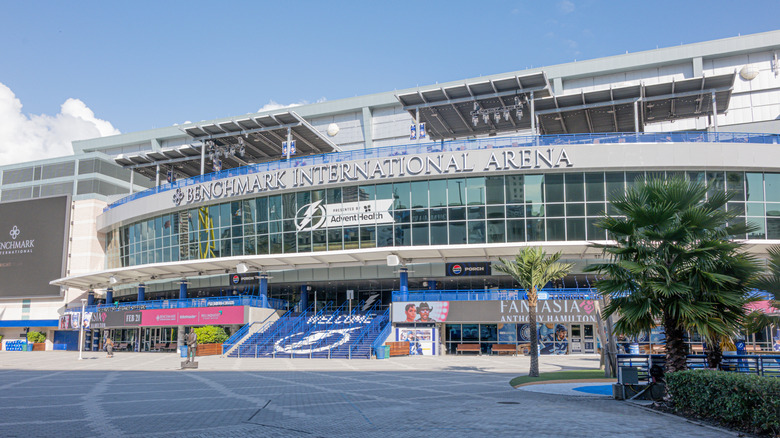
When you think of an Outback setting, you often think strip mall, its own lot off a main thoroughfare, something to that effect. You probably don't think of it as concession stand fare. This is where Outback has thrown a curveball, and it's done in the name of a hometown sports team. Not only was Outback founded in Tampa, so was the Stanley Cup-winning hockey franchise the Tampa Bay Lightning.
In Section 117 of Benchmark International Arena, you can take a break from the on-ice action and get yourself the full Outback experience. Sports venues have become showcases, not only for athletics, but food. Go to any modernized stadium and you're bound to see the cutting edge of cuisine (at a premium price).
But the uniqueness of Outback at this one and only stadium gives it an extra draw. It's fair to wonder how many Outback-heads visiting Florida will go to a hockey game for the sheer reason of checking off this box. They could create a variation on the classic Rodney Dangerfield joke: "I went to a hockey game and a Bloomin' Onion broke out." Actually, that's way less funny than the original.